Pasta with Lobster, Chilis and Mint

This dish is admittedly a splurge which I allow myself once or twice in the summertime.  Although lobsters are available yearound, it only feels right to enjoy this dish outdoors in the summer.  It’s an impressive and festive dish and, if you have the right fishmonger, can be a very simple dish to make.

It’s nice to cook the lobsters yourself but of course, this adds greatly to the preparation time, not to mention the mess.  If you have a seafood market that will cook the lobsters and remove the meat from the shells, that makes the dish infinintely easier to undertake–in fact, it makes the dish ridiculously easy.
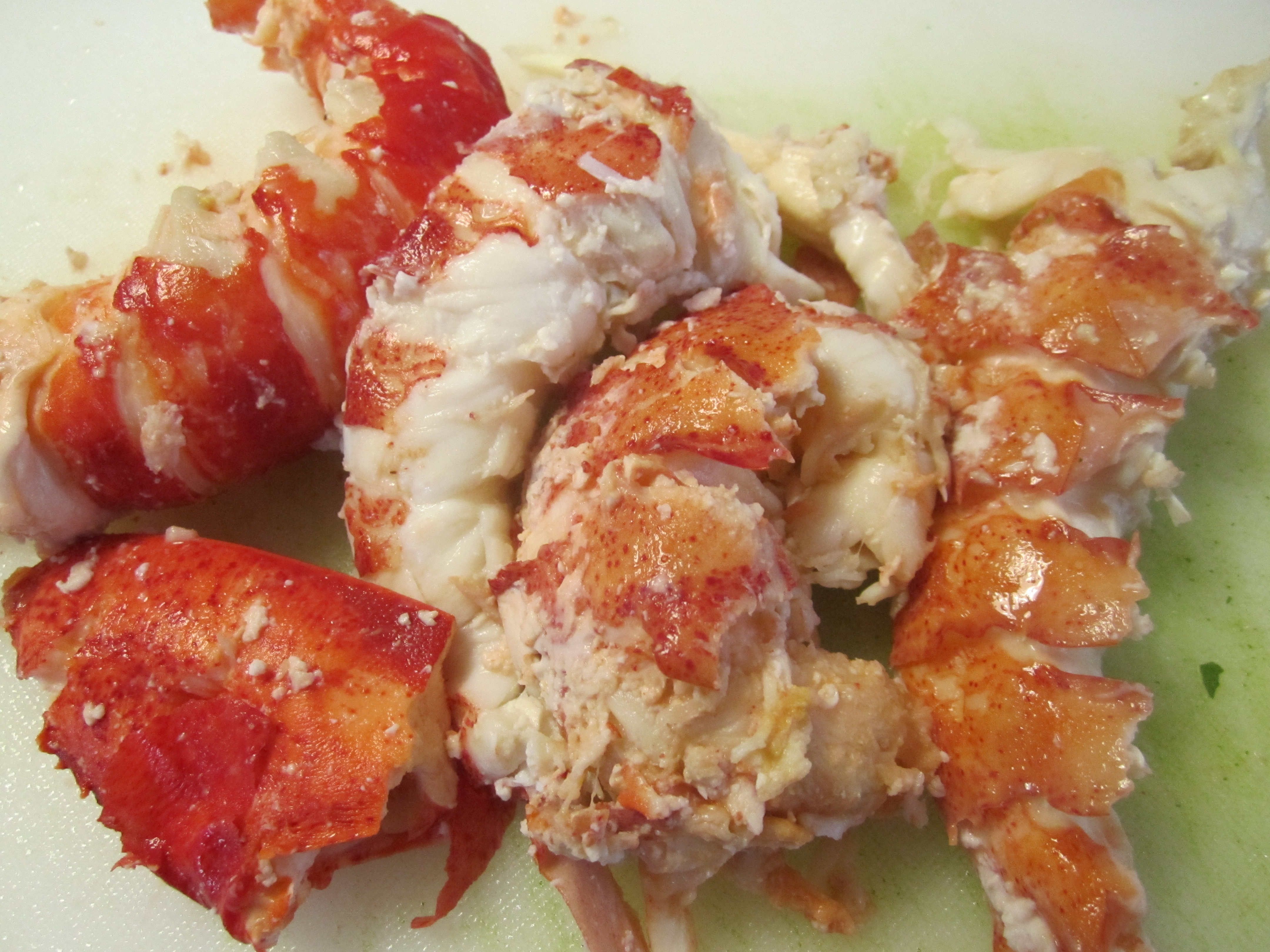
The remaining ingredients take no time at all to prepare.   Peel and chop some ripe tomatoes (or you can use grape tomatoes, halved), slice some garlic, chop some parsley, and you’re ready to assemble the dish.

Whether to use fresh pasta or dried is always a question.  I’ve tried both fresh and dried, and I think that dried is more appropriate for this dish.  It’s essentially an oil-based sauce with a touch of tomato–fresh pasta ends up being too delicate for this sauce.

Pasta with Lobster, Chilis and Mint

serves 4

1 lb spaghetti

1 lb lobster meat, cooked, shelled and diced into 1″ chunks

3 plum tomatoes, peeled, seeded and chopped into 1/2″ dice

3 cloves of garlic, sliced thinly

4 tbls extra-virgin olive oil

1/2 c white wine

12 mint leaves

3 tbls parsley, chopped finely

salt and pepper to taste

1 tsp chili flakes (optional)

While the pasta is cooking, in a broad skillet, saute the garlic on low heat in 2 tbls oil until just beginning to color.  Turn up the heat and add the tomatoes and white wine.
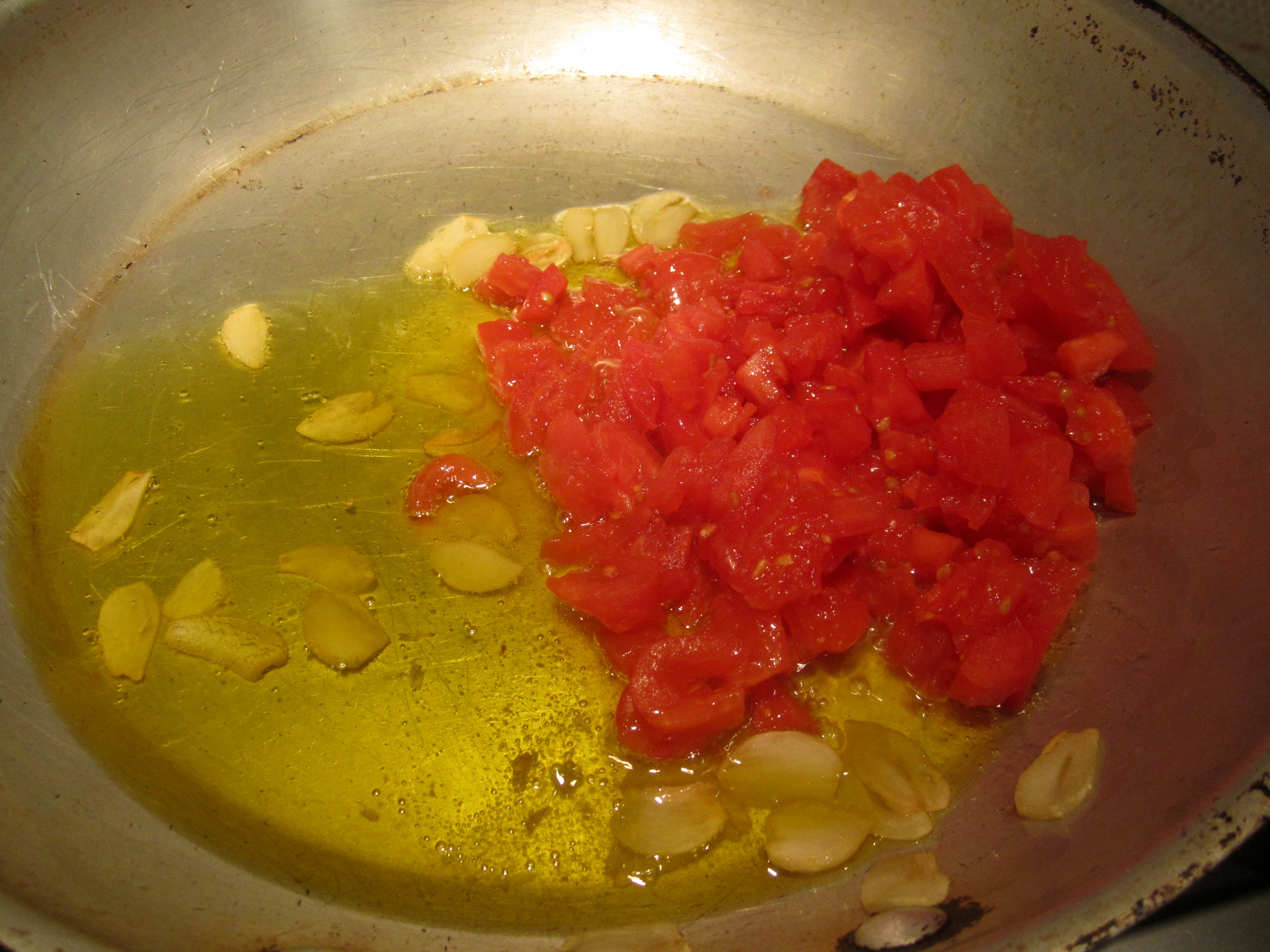
Reduce for a minute, then add the lobster meat.  Add the mint leaves, chili flakes, and heat very gently until the pasta is done (you don’t want to toughen the lobster meat–just heat it through).

Toss in hot pasta, parsley and remaining tbl olive oil.  Add 1/2 cup pasta cooking liquid.   Add salt, if necessary.

Serve with or without grated parmiggiano  (although this would be forbidden in Italy, I sometimes like it).
Posted in Pasta | 1 Comment

Deconstructed Duck

I rarely order duck in restaurants because it’s usually tough and the skin is never crispy enough for me.  Admittedly, I’ve tried many methods of cooking duck, but there is no easy way to get all the parts right.  The method I’ll describe for you today offers the best of all duck worlds–but it doesn’t come easy.

I should begin by stating that I make duck only on rare occasions, but when I do make it, I am always deeply gratified.  The reason for this is that duck is one of those animals (like pig) that provides so much useful raw material that it’s a shame to throw away any part of it.

Maximum use of a duck entails removing the legs and slow-cooking them; removing the breast and quick-cooking it (on the grill).  You are then left with a carcass (for irrestistible stock), and a couple of pounds of skin and glorious fat.

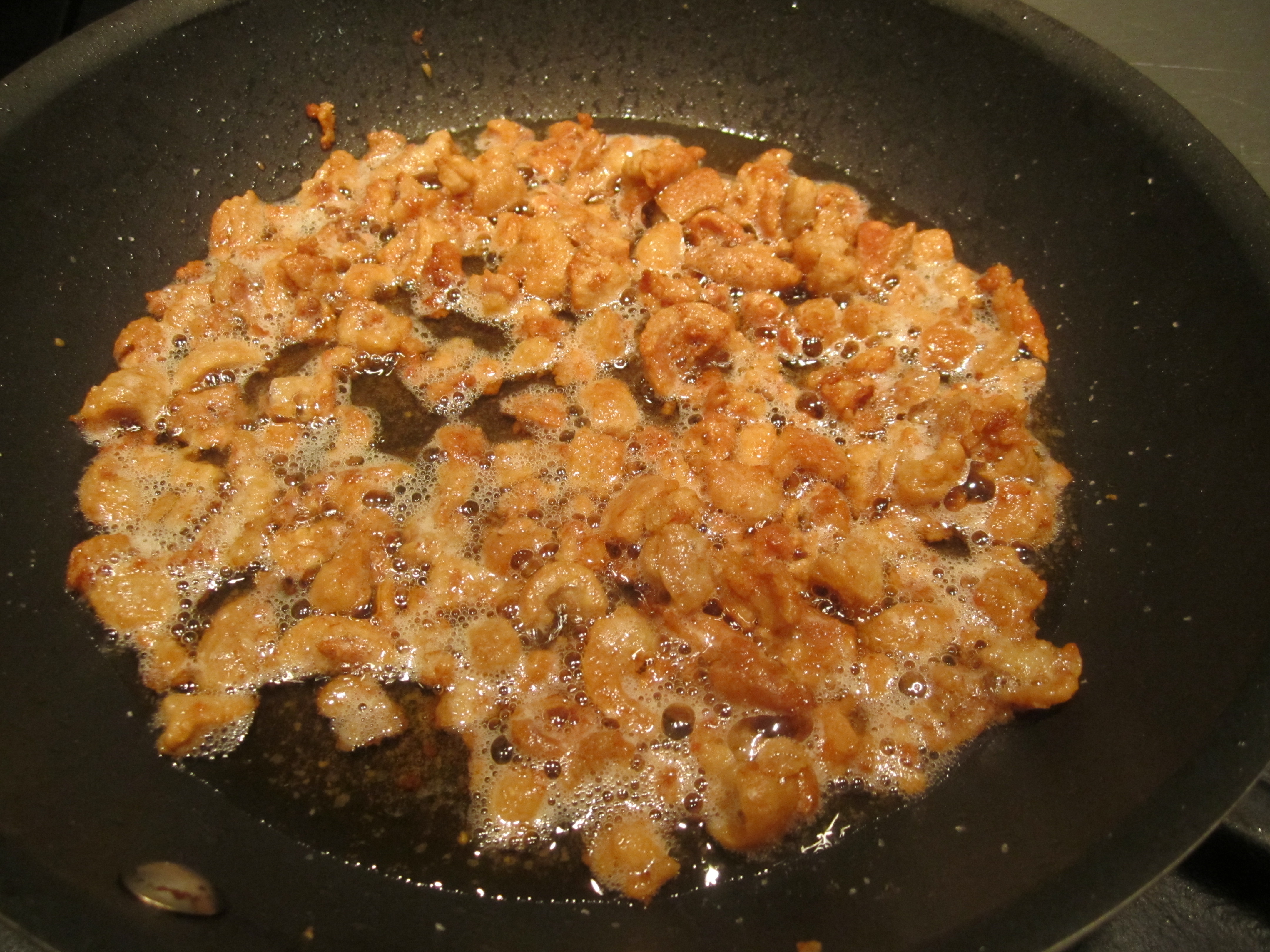
I like to dice the skin and fat (time-consuming but cathartic), place it in a pan covered with water, and slowly render it.  What you are left with is a pot of golden duck fat– perfect in which to fry potatoes (or just about anything else). Additionally, you’re left with a pile of sublimely delicious cracklings–perfect to shower with salt and put on a salad of bitter greens.

Because I can’t seem to cook a duck without doing all of the above, I save it for a day when I have the entire afternoon to devote to my duck–like today.   I’m having a group of friends for dinner, one of whom maintains that she has never eaten any duck other than mine–so I decided to surprise her.

Be prepared for a mess in your kitchen, and have a bottle of sprayable bleach at the ready to wipe down everything in the kitchen after you’re done with the handling of all the raw parts.

Begin by butchering the duck:

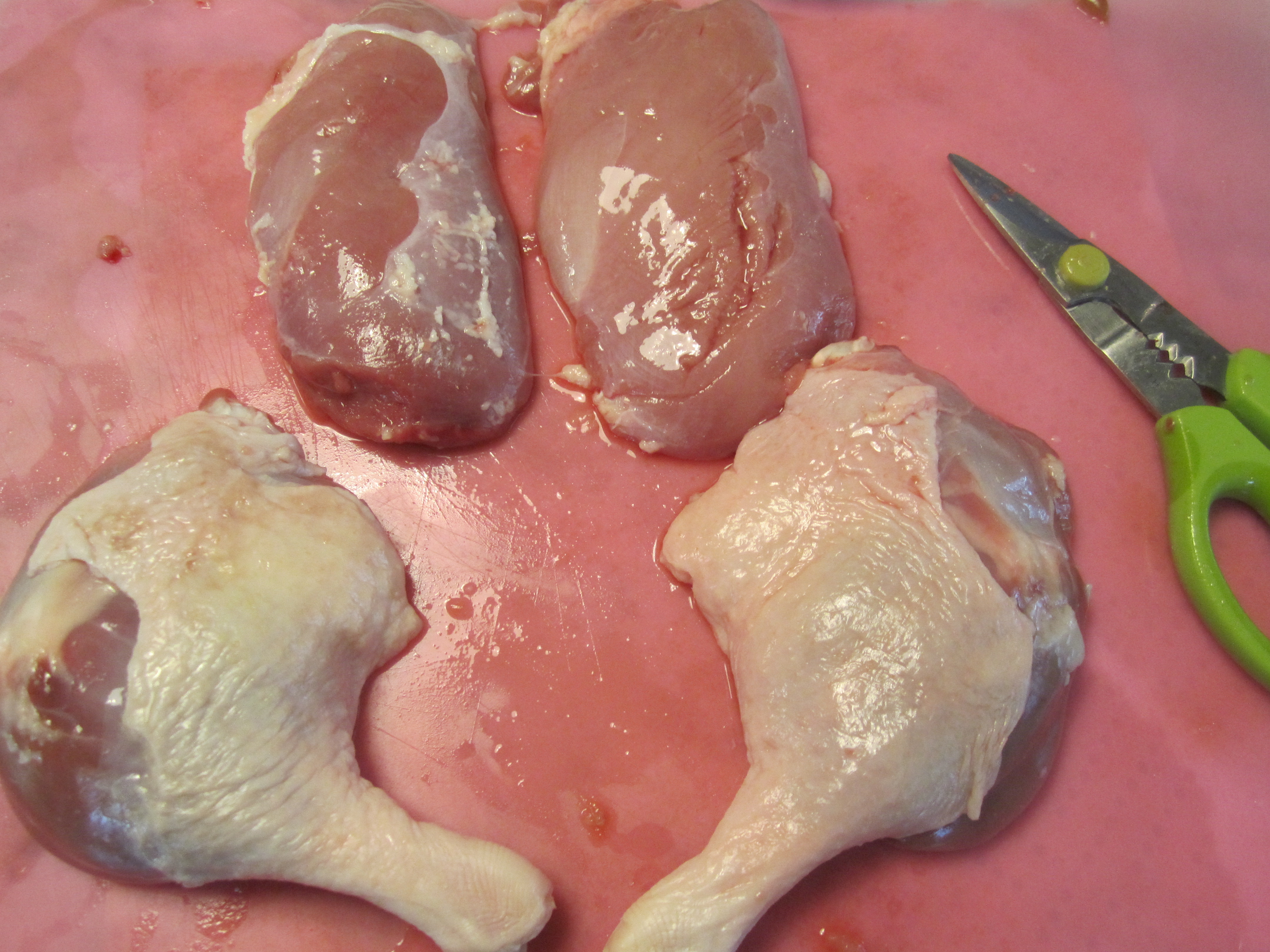
Remove the legs with a combination of scissors and knife.

Pull off any thick fat from around the thighs and reserve for the rendering process. Next, remove the breasts by slicing along the breastbone on both sides of each breast.  Then gently pull off the skin and reserve.

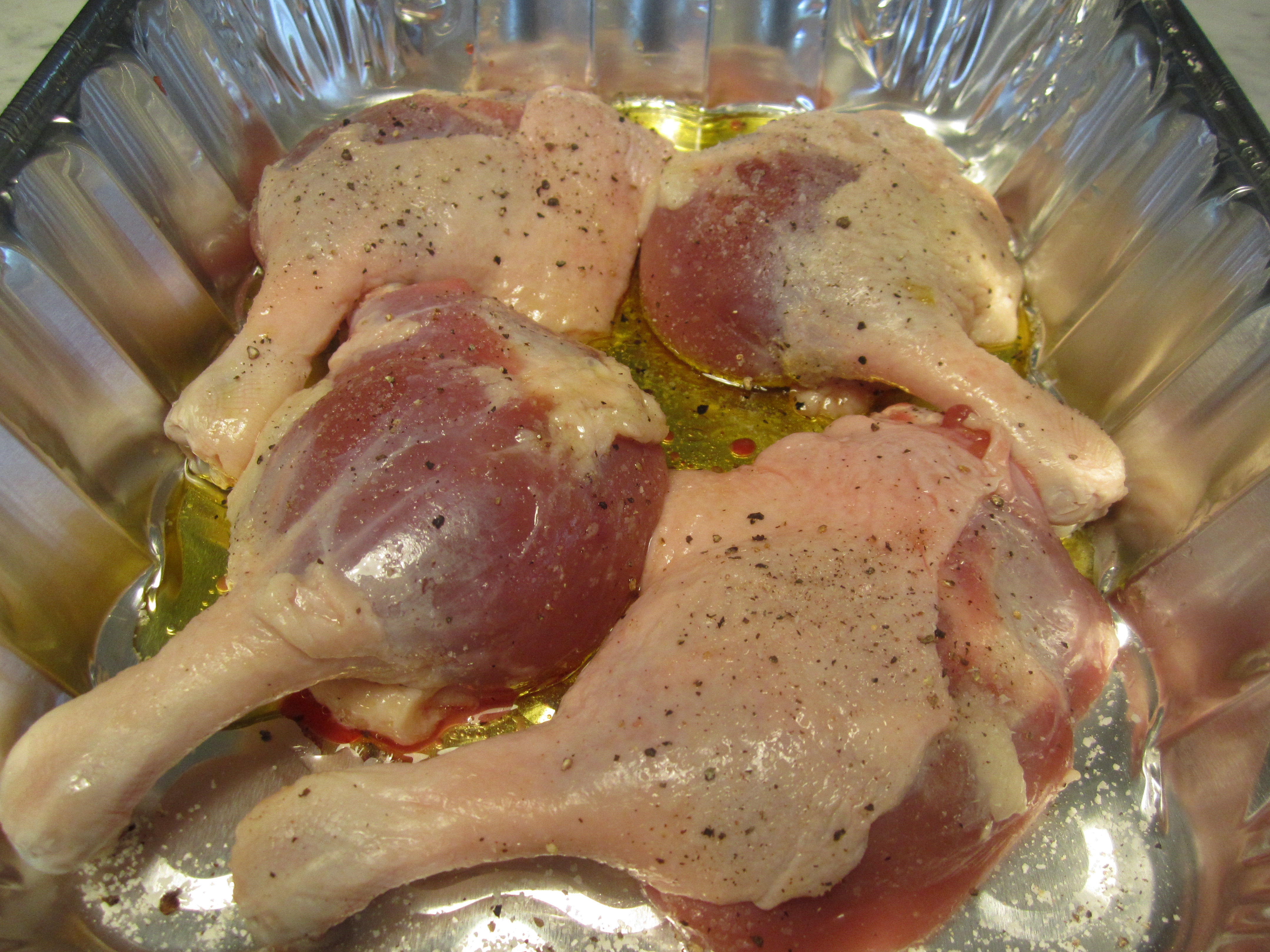
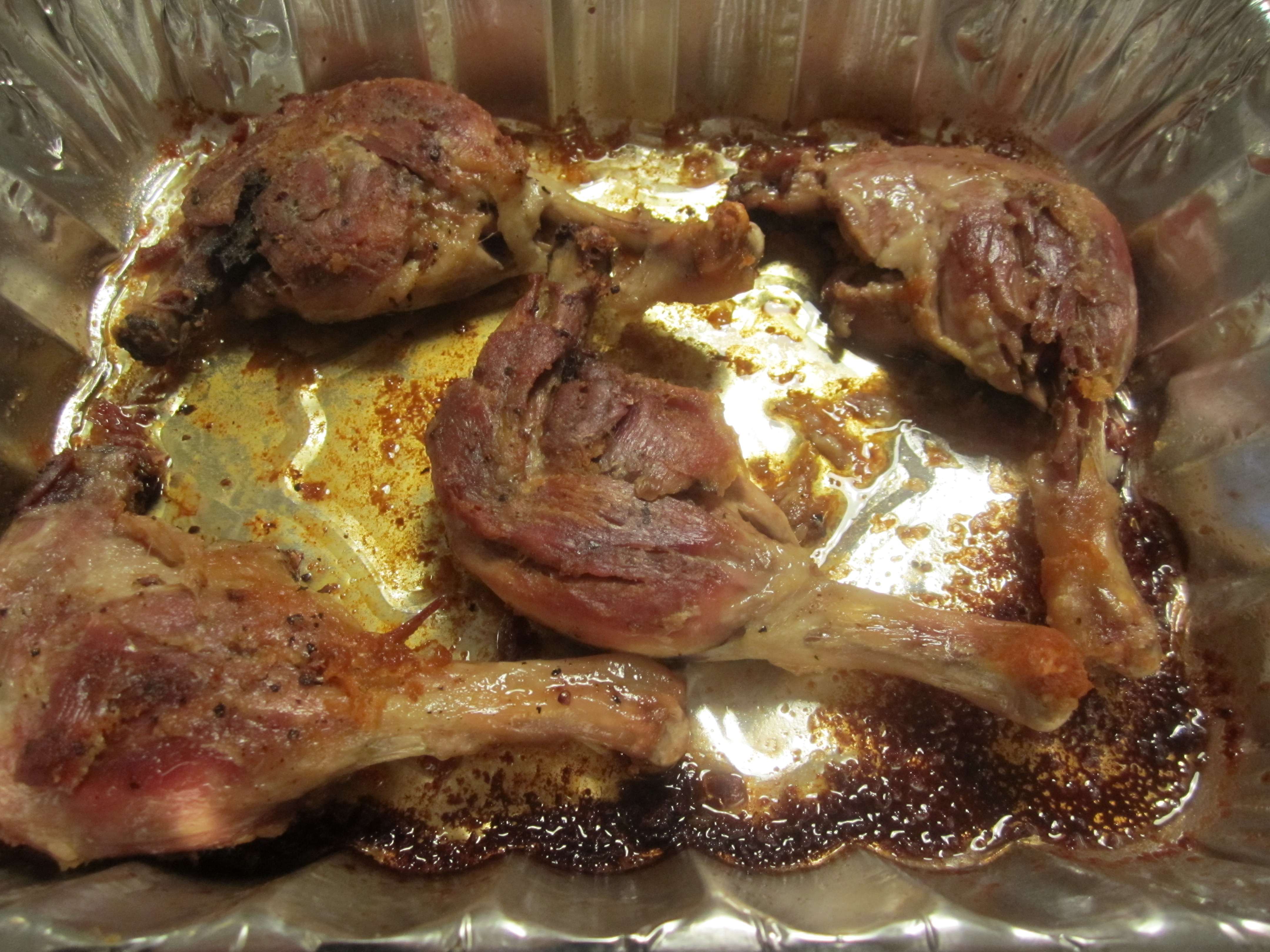
Pull off any thick excess fat from around thighs and arrange thighs in a roasting pan.  Season liberally with salt and pepper and cover with foil.

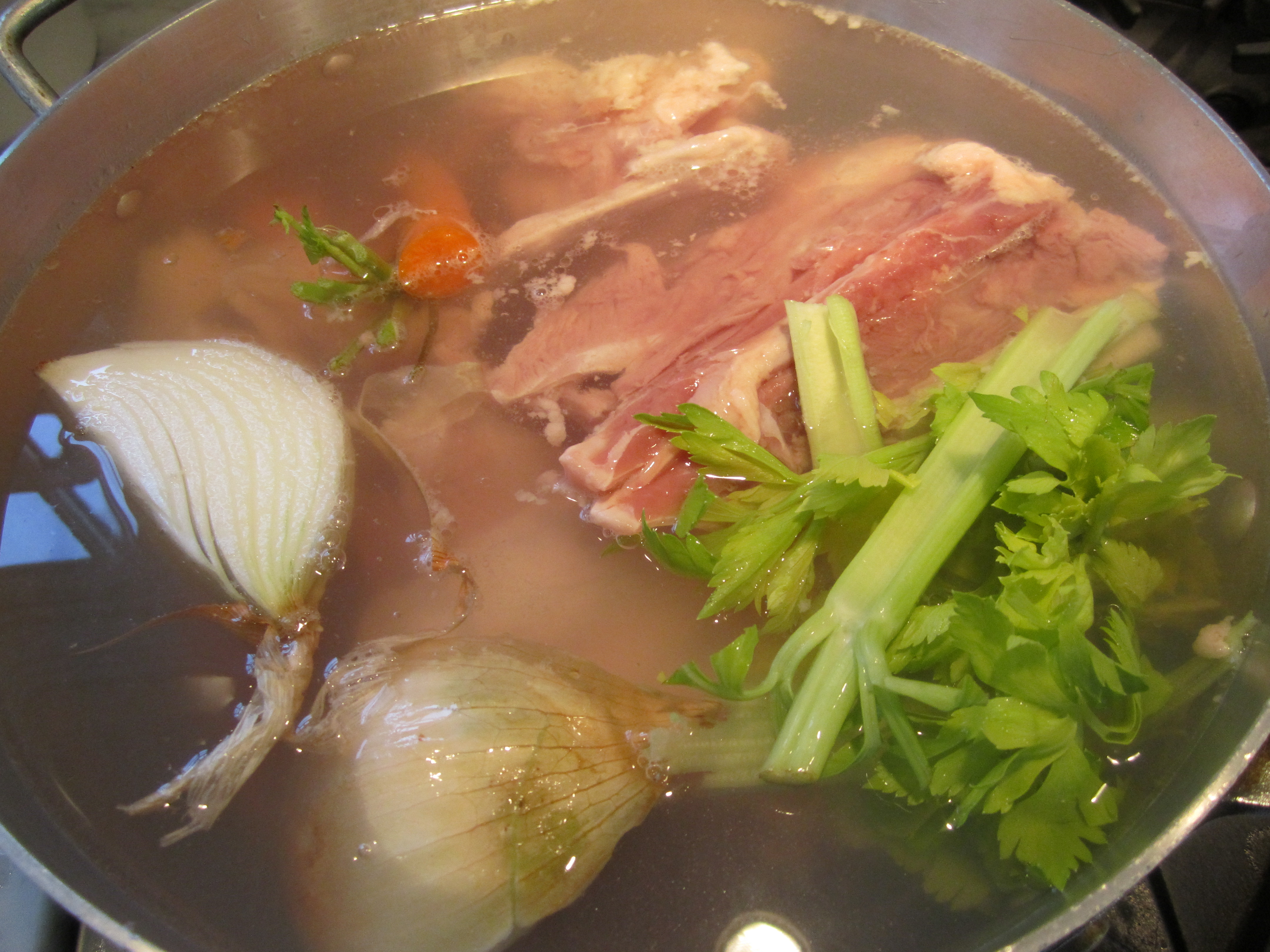
To make the stock, simply place carcasses and necks (if you have them) in a large stockpot and fill with water, a large onion, a carrot, and some celery.  Simmer for an hour-and-a-half, removing scum and fat from the surface of the water.  Add salt or a couple of bouillon cubes, then cool and refrigerate or freeze for later use.

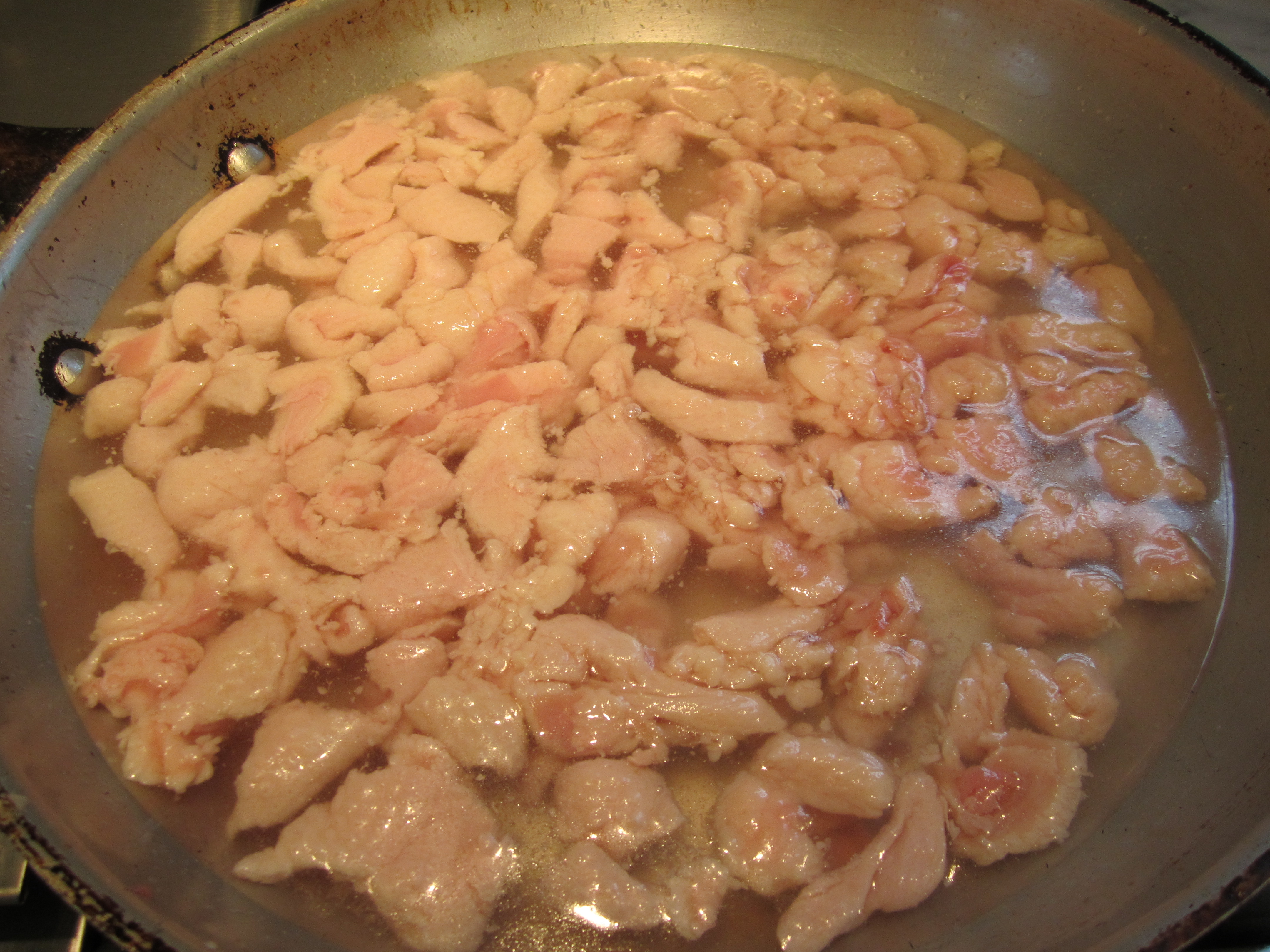
Next, to render the fat from the skin, take all of the skin and fat, and cut into 1″ or 2″ pieces.  This requires slow movement with a very sharp knife, slicing back and forth.  Place all skin in a skillet and cover with water.  On low heat, slowly simmer uncovered until there is no more water remaining–only shrunken pieces of skin and golden duck fat.  This can take about a half-hour or so.  Pour off the golden liquid through a cheesecloth-lined strainer and reserve the fat for frying potatoes.

Place the bits of skin in a smaller nonstick skillet and continue rendering them until golden and crispy.  Shower with salt and scatter over a salad (or anything else you want).

About an hour-and-a-half before dinner, place the covered tray of leg/thighs on a covered grill (or in a 350-degree oven) and roast until golden and crispy.  Turn halfway through.

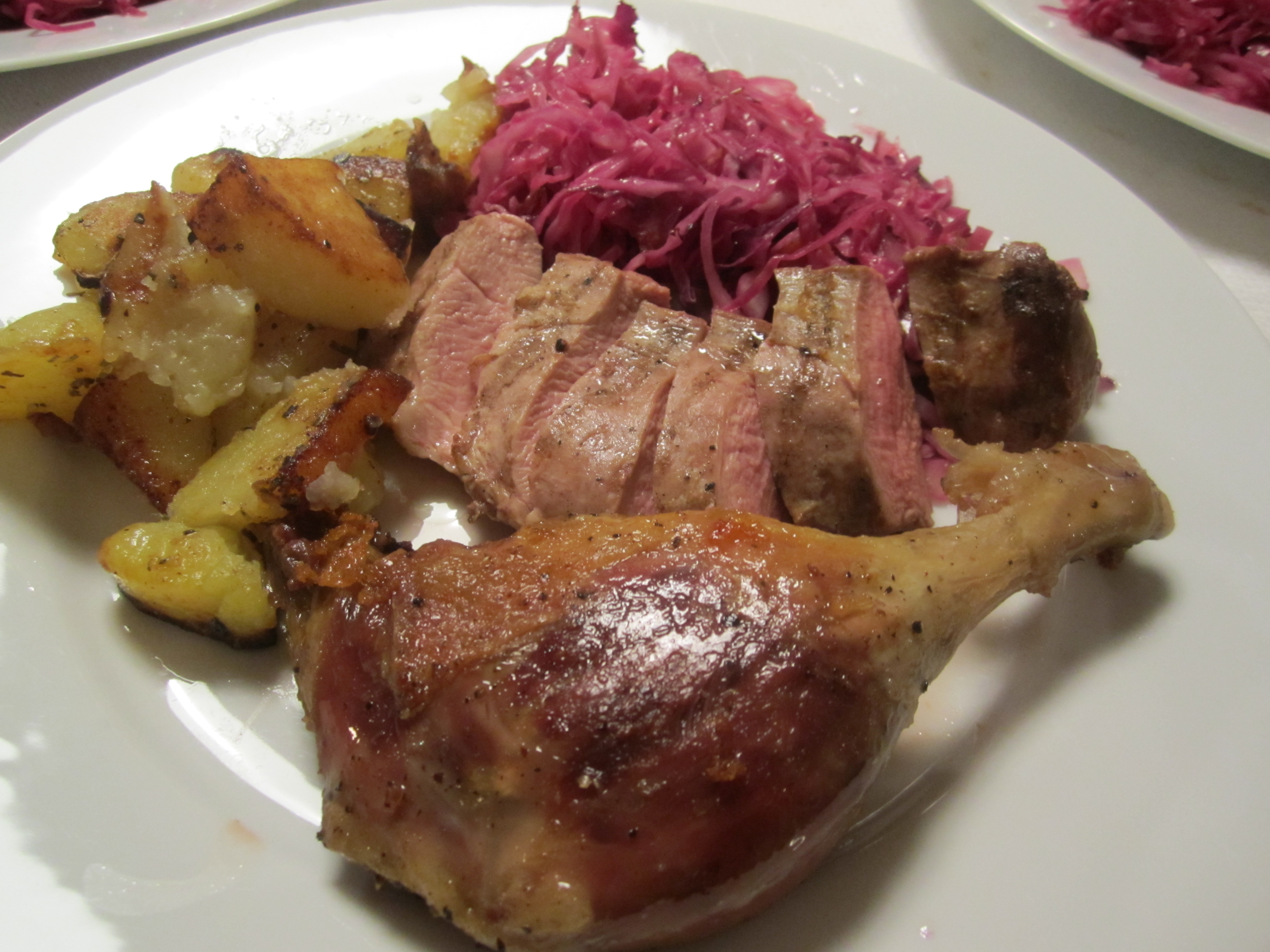
To make the breasts, simply season with salt and pepper and grill on high heat for about 4 minutes per side.  Let rest for about 5 minutes, then slice and serve alongside the legs.  Incidentally,  a great sauce (served on the side) for this dish is the barbecue sauce from my Barbecued Spareribs  post. 

Serve with skillet potatoes, substituting duck fat for olive oil.   Also, a nice warm red cabbage and bacon salad.  As a separate course, serve a salad with crispy cracklings.

Posted in Poultry | Leave a comment

Warm Red Cabbage and Bacon Salad

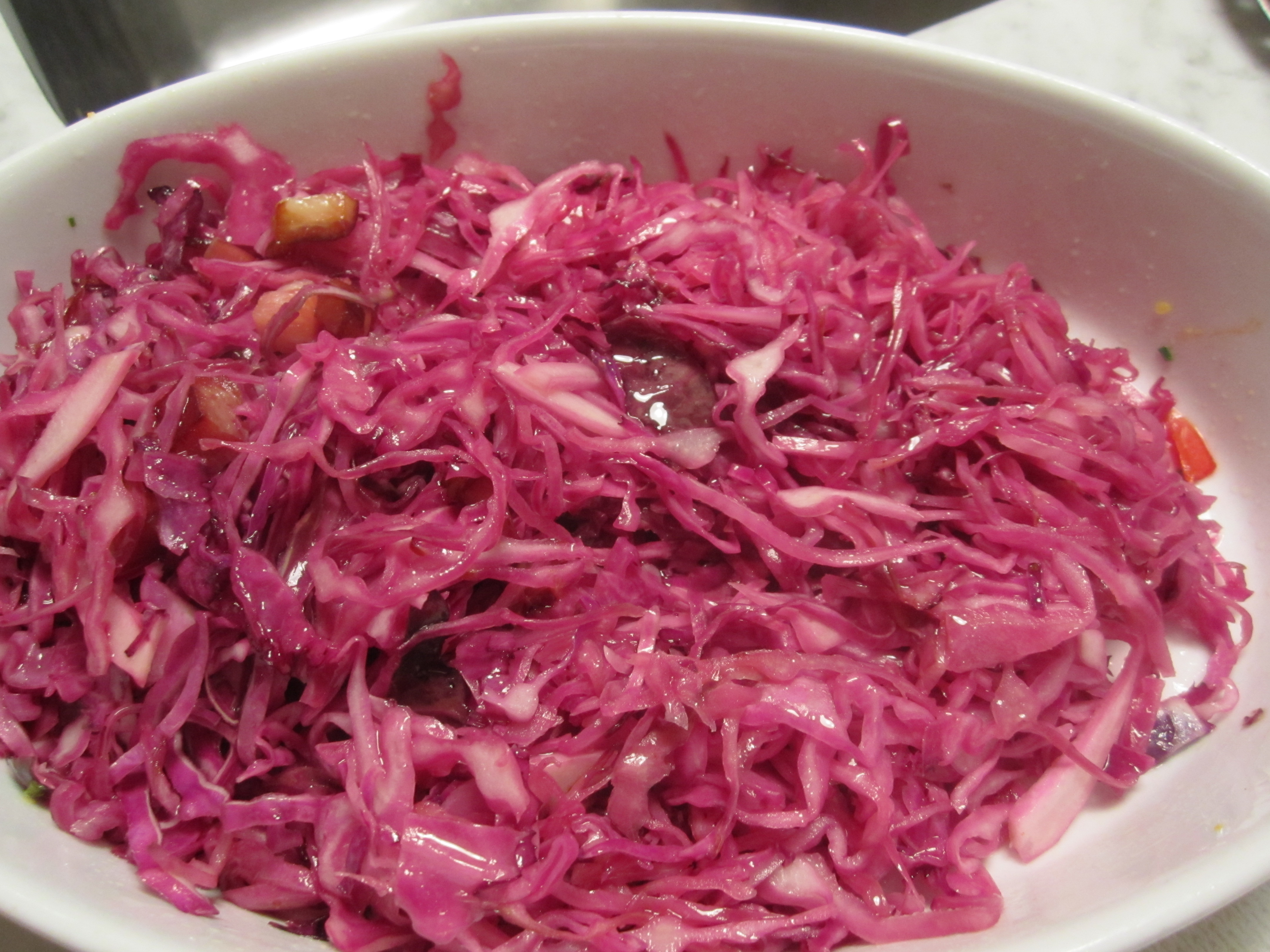
This salad is great with game birds or pork–it has that agrodolce quality that makes it well-suited to cut through fatty flavors.  Simple to make and toss together at the last moment.  Different, however, from my red cabbage and green apple slaw.  Here, the cabbage is sliced thinner and heated briefly with bacon and a few other ingredients.

Simply remove the core from the cabbage and slice with a mandoline slicer, for even, thinly shredded cabbage.  Have some slab bacon cut into 1/2″ lardons and you’re ready to assemble.

Warm Red Cabbage and Bacon Salad

serves 4

1 head of red cabbage, cored and  shredded on a mandoline slicer

2 tbls olive oil

1/2 cup slab bacon cubes

3 tbls cider vinegar

1 tsp agave

salt and pepper to taste

In a broad skillet, heat the bacon cubes and olive oil on low heat to render the fat from the bacon (about 5 minutes).  When ready to serve, turn heat to high and add vinegar and agave.  Toss in cabbage and saute for a minute or so, just to slightly wilt.  Taste and add salt and pepper.


Posted in Salads | Leave a comment

Salad with Crispy Cracklings

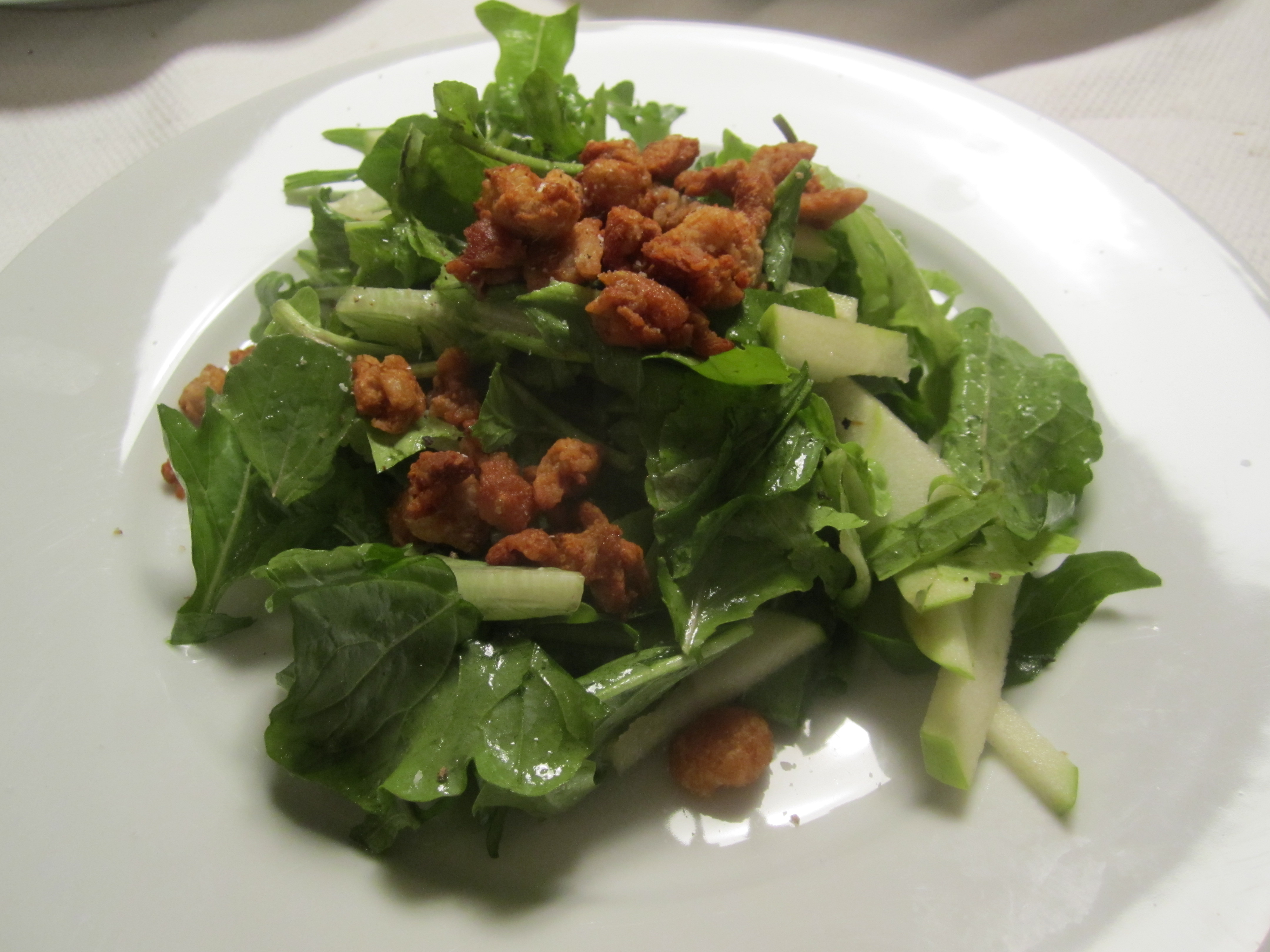
This is a salad that I always serve when there’s a duck in the house.  I can never bring  myself to discard all that skin that takes so long to cut finely and render slowly–but I’m always happy I did it when salad is served.

To make the duck cracklings, follow the directions in my Deconstructed Duck post.  These cracklings are great on bitter greens, like chickory or frisee.  Tonight, however, I have something better–bitter arugula and lettuce from Beppi’s garden. 

The cracklings should be served hot or warm, but lose their appeal when they’re at room temperature or cold.  Therefore, you can render them to a certain point ahead of time, then give them their finale crisping in a nontsick skillet right before you serve the salad.

They’re also great on mashed potatoes!

Salad with Crispy Duck Cracklings

serves 4

1 lb of bitter greens, such as frisee or arugula

cracklings from 1 or 2 ducks (depending on how much you have around)

1 granny smith apple, cut into thin julienne

1 – 1/2 tbls cider vinegar

1 tbl extra-virgin olive oil

salt and pepper to taste

Sprinkle greens and apples with vinegar, salt, agave and oil. 

Top with cracklings.


Posted in Salads | 4 Comments

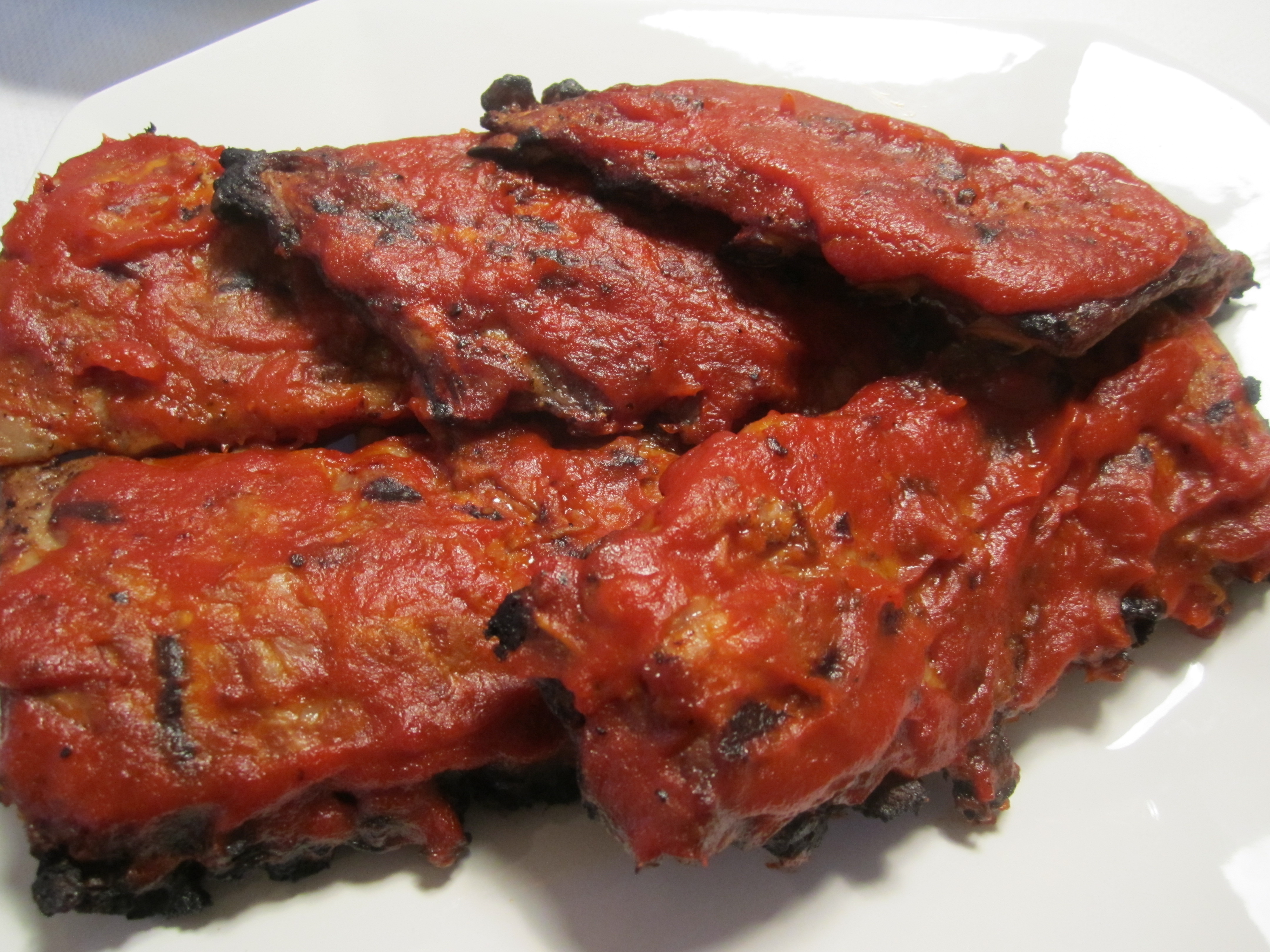
Barbecued Spareribs

I am constantly experimenting with barbecue sauces, since I like that sweet-sour finish–what Italians would call “agrodolce” –on a variety of meats and poultry.  I strived to formulate a barbecue sauce that was cleaner and tangier than most commercial sauces and with as few ingredients as possible (there are 12 ingredients, but you  may already have all of them in your pantry/fridge).  This version is absolutely sparkling, tangy, yet comfortingly sweet, and is very simple to prepare.

The predominant ingredient is ketchup.  I resisted this notion for a while and tried to use tomato paste as the main ingredient.  The predominance of tomato paste made the sauce taste more like  a thick tomato sauce, rather than a sweet-sour barbecue sauce.  Therefore, although tomato paste is an ingredient in this sauce, it is not the predominant ingredient.  

The sauce  begins with a saute of chopped onions and smashed garlic (I like to smash it and remove the big pieces after the sauce is cooked).  The onions basically melt into the sauce.  The remaining ingredients are pretty standard–a combination of vinegars, citrus juices and sweeteners.  I’ve done a lot of trial and error and I’m giving you exact quantities, although the sweetness can vary depending on the ketchup you use (I used Annie’s Natural, which is quite sweet).

The ribs get baked in foil for an hour-and-a-half, then they go over the coals.  The barbecue sauce gets slathered on and they finish on the grill, leaving a sticky mess for you to burn off of your grill grates–but it’s worth it!

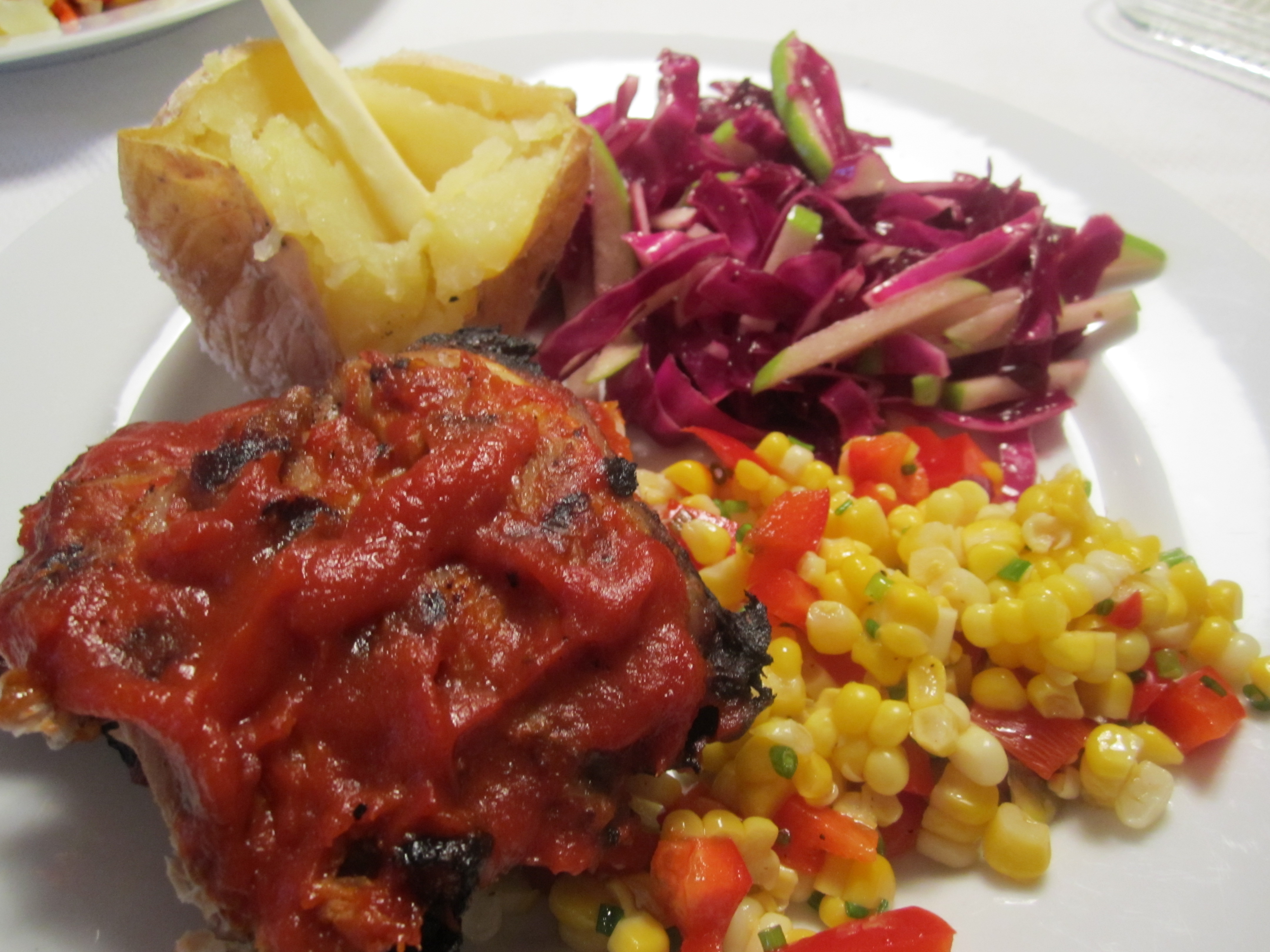
I’m serving these ribs with a red cabbage and green apple slaw, corn salad and baked potatoes.

Barbecued Spareribs

serves 4

3 racks of pork baby back ribs

1 onion, cut in large chunks

2 tbls olive oil

2 tsp salt

1 tsp black pepper

barbecue sauce (see below)

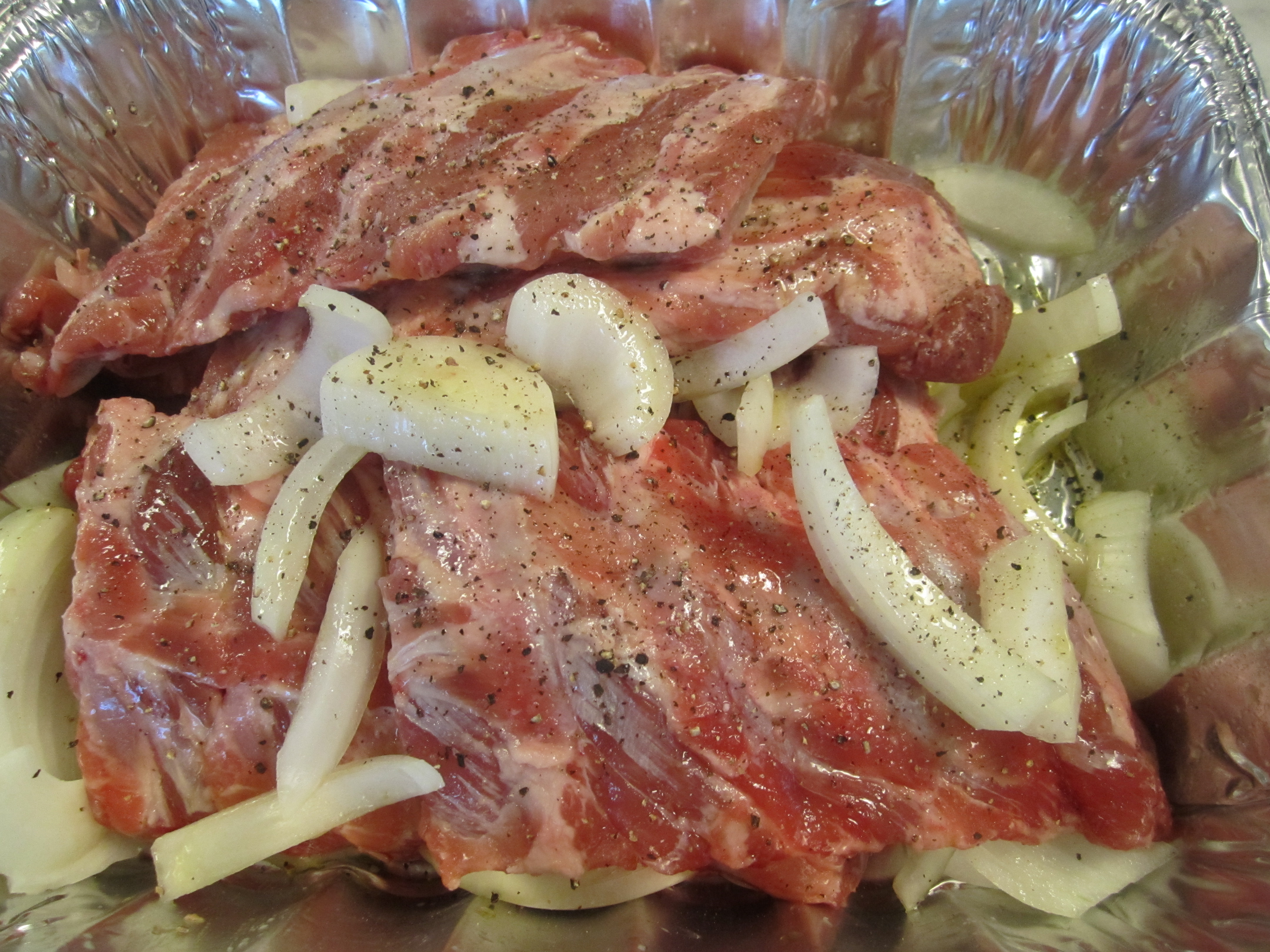
Preheat oven to 325 degrees (or preheat grill, leaving one side of the grill turned off).  Season racks of ribs with salt and pepper, then add oil and scatter onions about.  Cover with foil and bake for approximately 1 1/2 hours. 

Remove ribs from foil, place on the grates of pre-heated grill (meat side up) and slather on barbecue sauce.  Grill on low heat, turning once, for about 10 minutes.  Serve with additional sauce on the side. 

Barbecue Sauce

1/2 small onion, diced finely

2 cloves garlic, chopped

2 tbls olive oil

1 cup ketchup

1/4 c orange juice

juice of half a lemon

1 tbl agave

1 tbl brown sugar

1/4 c red wine vinegar

1/4 c cider vinegar

1 tbl dijon mustard

1 tbl tomato paste

Saute onions and garlic on low heat in oil for about 10 minutes, or until tender and just beginning to turn golden.  Add in remaining ingredients and simmer on low heat, uncovered for about 15 minutes.  Remove garlic pieces and use.  Will keep for several weeks in the fridge.

Posted in Meat | Leave a comment

Red Cabbage and Green Apple Slaw

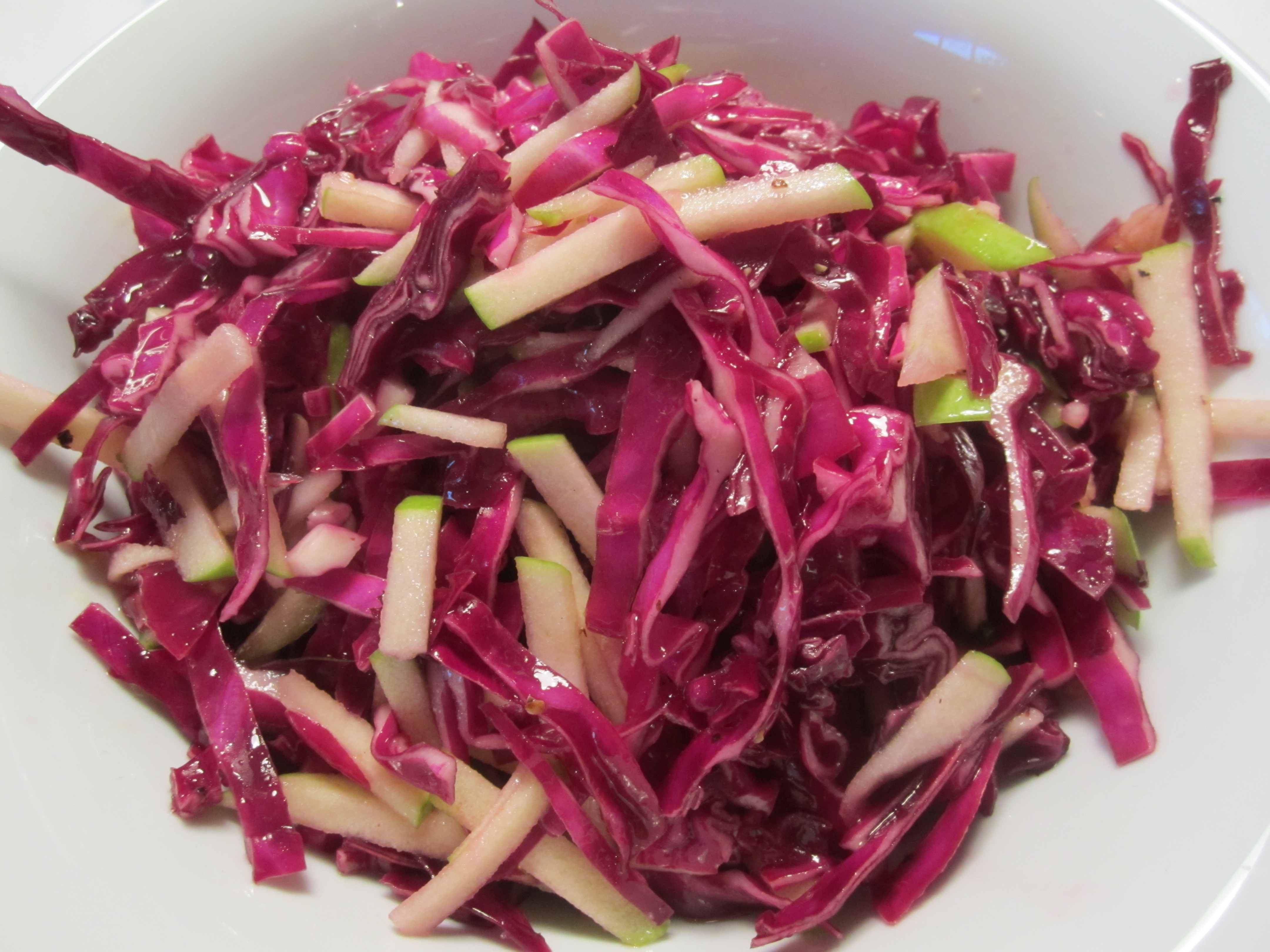
Since I had red cabbage leftover from making my “kale slaw” the other day, I’ve used it to make a variation with granny smith apples.  This is as quick and simple to make as any salad.

The cabbage gets sliced thinly (I did it by hand with a large knife), the apples, get sliced, then slivered into little batons (no need to peel), then the whole thing gets dressed with a combination of cider vinegar, agave, olive oil and salt.  It’s best served after a couple of hours, since the cabbage softens a bit.  It keeps for several days without losing crispness.

Red Cabbage and Green Apple Slaw

serves 4

1/2 head of red cabbage, cored and sliced thinly

1 granny smith apple, sliced, then julienned into 1/4″ batons

2 tbls extra-virgin olive oil

3 tbls cider vinegar

1 tbl agave

1 tsp salt or to taste

1/2 tsp black pepper

Combine dressing ingredients and pour over cabbage.  Toss well.   Let rest in the fridge for a couple of hours before serving.  Toss again prior to serving.

Posted in Salads, Vegetables | Leave a comment

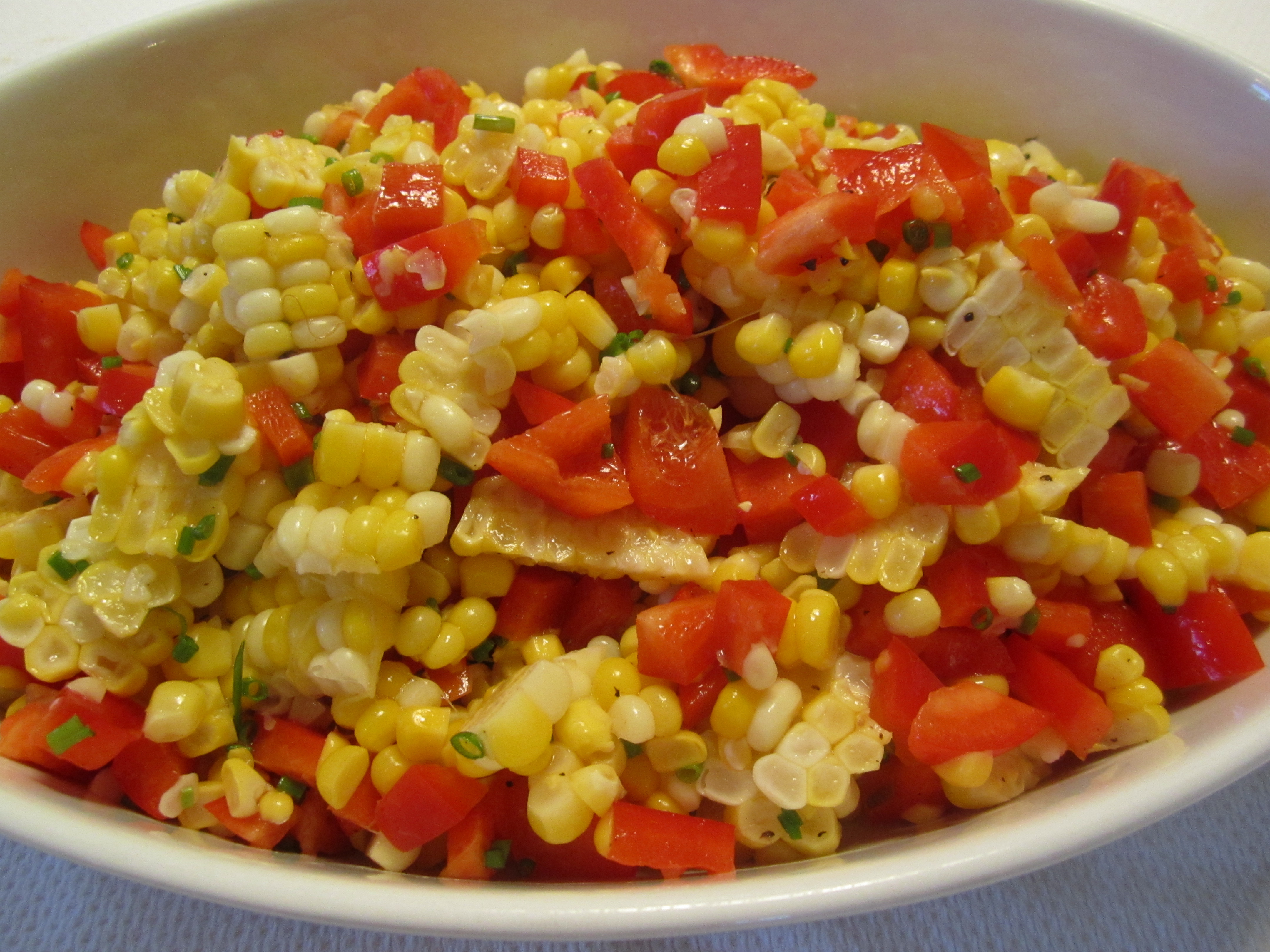
Corn Salad

This time of year, I love to serve side dishes that can be made ahead and served at room temperature.  Although the corn I’m using is from Florida, it’s beautifully sweet and it will stand in nicely until we have local corn in Eastern Long Island.

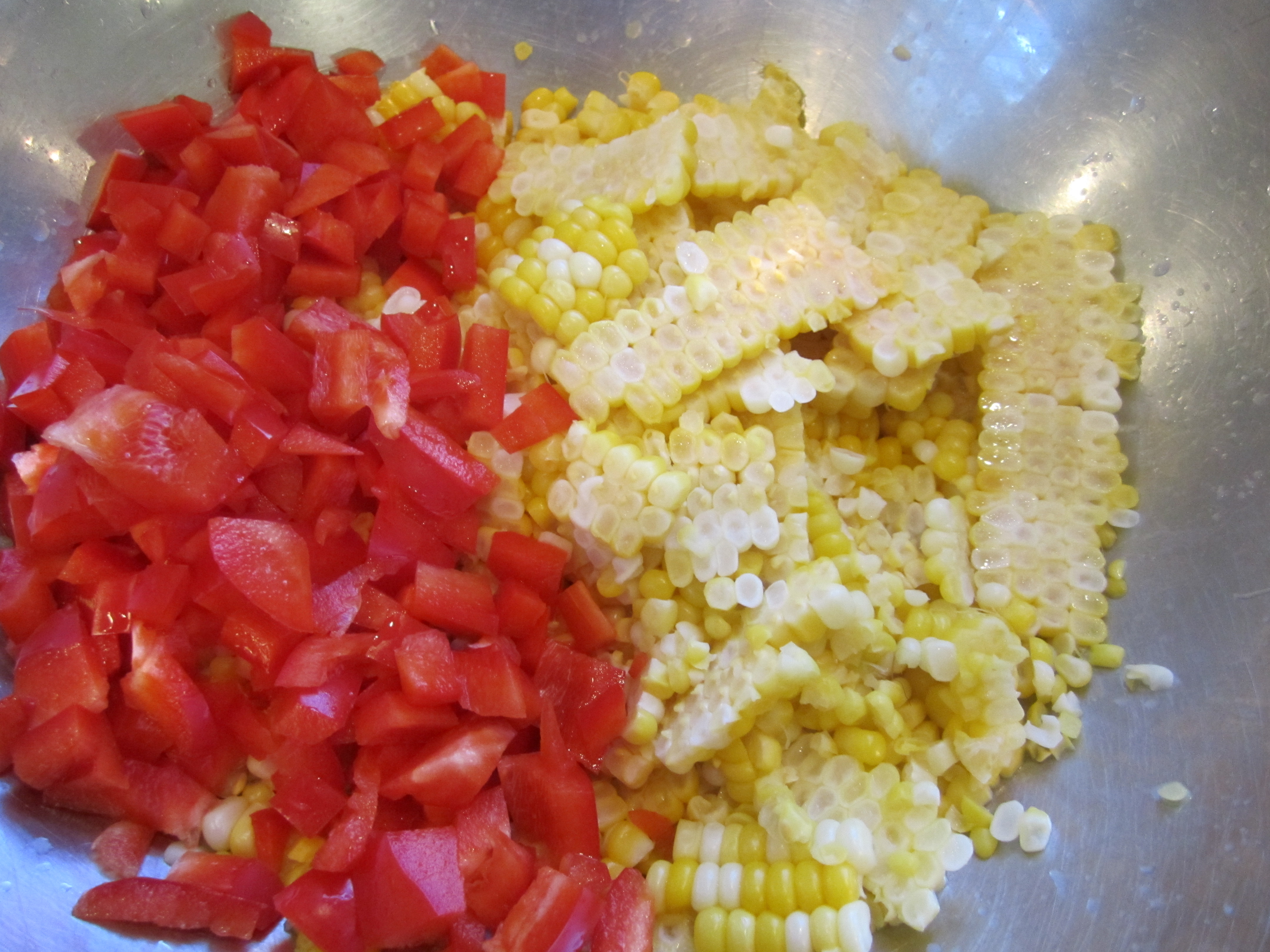
My method of cooking corn is foolfproof for having tender-crisp corn for any use.  I shuck the corn, place the ears in cold salted water and cover.  I bring the water to a boil as quickly as possible.  Shut off the heat and let the corn rest in the water for 5 or 10 minutes.  Then remove, refresh under cold water (so you can handle it), then slice the kernels off the cob with a newly sharpened knife.

The dressing makes use of that bottle of cider vinegar I recently bought, as well as extra-virgin olive oil and chives from Beppi’s garden. 

Corn Salad

serves 4

6 ears of corn,  shucked and boiled as described above, and sliced off the cob

1 large red pepper, coarsely diced

2 tbls extra-virgin olive oil

1 tbl cider vinegar

1 tsp agave

2 tbls chopped chives

1 tsp salt or to taste

1/2 tsp black pepper

Combine corn and peppers, then sprinkle on the remaining ingredients separately, and toss in large mixing bowl.  May be served immediately or can rest at room temperature for a couple of hours.

Posted in Salads, Vegetables | 2 Comments

Grilled Tuna with Black Olive Salsa

My fish market offers sushi grade tuna and today it was ruby red and irrestistible.  All I wanted to do was sear it on the outside and keep it rare on the inside.  The rare tuna is pretty much a blank canvas on which I could go a variety of directions. 

I like to rub tuna with some Meditteranean herbs an hour or so ahead of cooking (no salt or acid of any kind–just some herbs).  I use thyme, chili flakes, black pepper, lemon zest, and olive oil.  The thyme and chili flakes give the tuna a nice earthiness with a spicy kick, and the lemon zest, brightens it up. 

For moisture, a raw salsa is always nice with rare tuna.  Although it’s  not tomato season, I bought some nice looking plum tomatoes the other day that have been ripening on my window sill.  They get chopped, salted and placed in a strainer to drain for an hour.  This removes water and intensifies flavor–I even do it with summer tomatoes at their peak. 

In addition, I wanted some olives but found only olive paste in my pantry–so  a dollop of black olive paste is perfect stirred into the tomatoes.  To reinforce the lemon flavor of the tuna, I’ve added some lemon zest to the tomato and olive salsa.  Lots of chives (from my neighbor Beppi’s garden) give the salsa a nice raw but mild onion-y bite. 

I served this with Israeli couscous with zucchini and onion (see post below).

 Grilled Tuna with Black Olive Salsa

serves 4

Rub for tuna:

2 lbs sushi-grade tuna

2 tsp fresh or 1 tsp dried thyme

1 tsp chili flakes

zest of 1 lemon

1 tbls olive oil

1 tsp black pepper

Salsa:

1 lb plum tomatoes, diced into 1/2″ chunks

1 tbl black olive paste

3 tbls extra-virgin olive oil

zest of 1 lemon

2 tbls fresh chives

salt and pepper to taste

An hour ahead, sprinkle rub ingredients over fish and let marinate in fridge for an hour or so. 

Place tomatoes in strainer over a bowl and allow to drain while fish is marinating.


 After an hour, combine the remaining salsa ingredients and let stand at room temperature until ready to grill.

 Grill tuna on high flame for 1 – 1/2 minutes per side.  Sprinkle liberally with salt and drizzle with extra-virgin olive oil and serve.  Let rest for 5 minutes before serving.

Posted in Seafood | Leave a comment

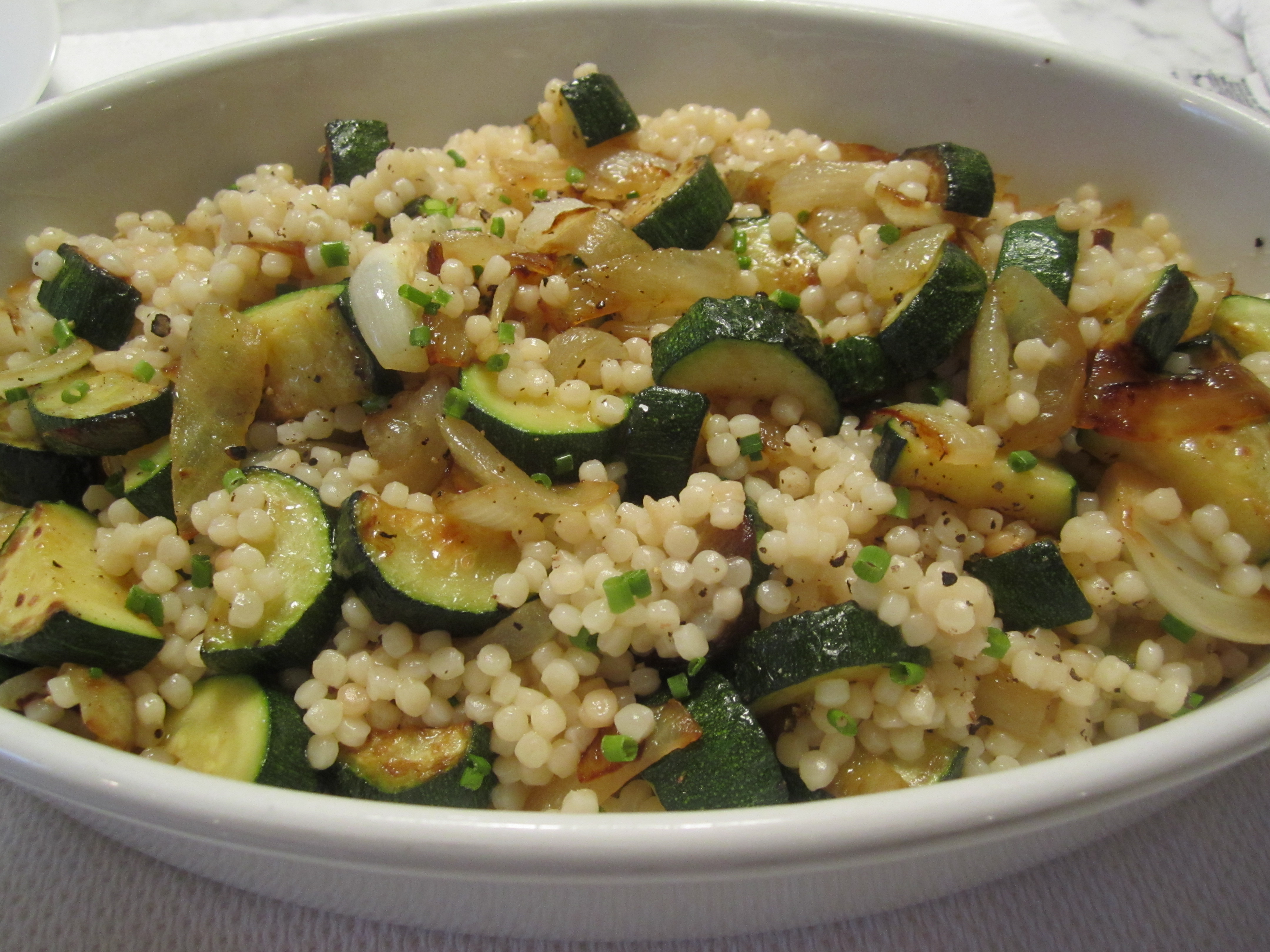
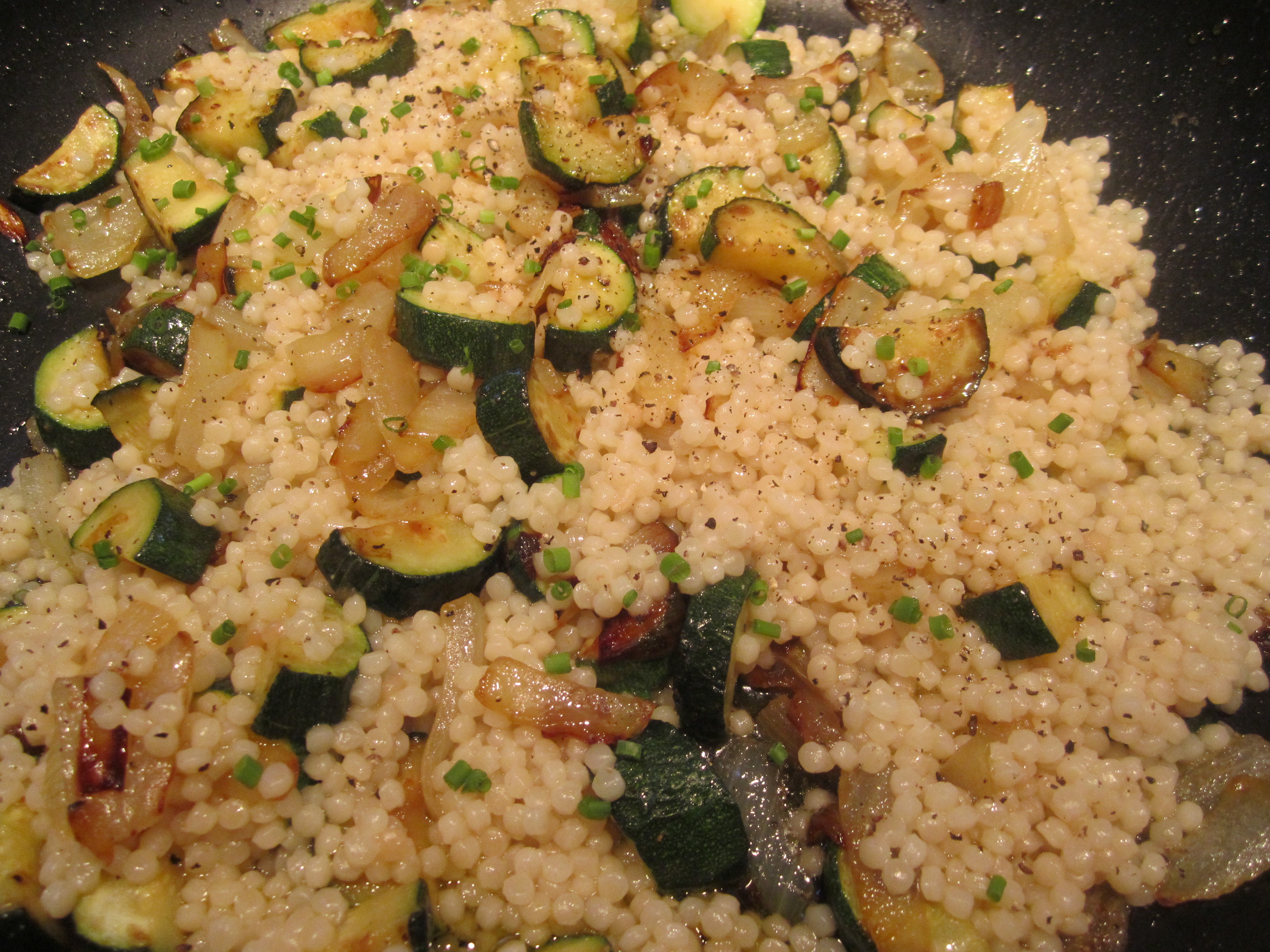
Israeli Couscous with Zucchini

This dish is as simple as any pasta dish gets.  The Israeli couscous are a larger, fatter version of regular couscous.  They cook like any other grain–in water or broth (bouillon, in my version). 

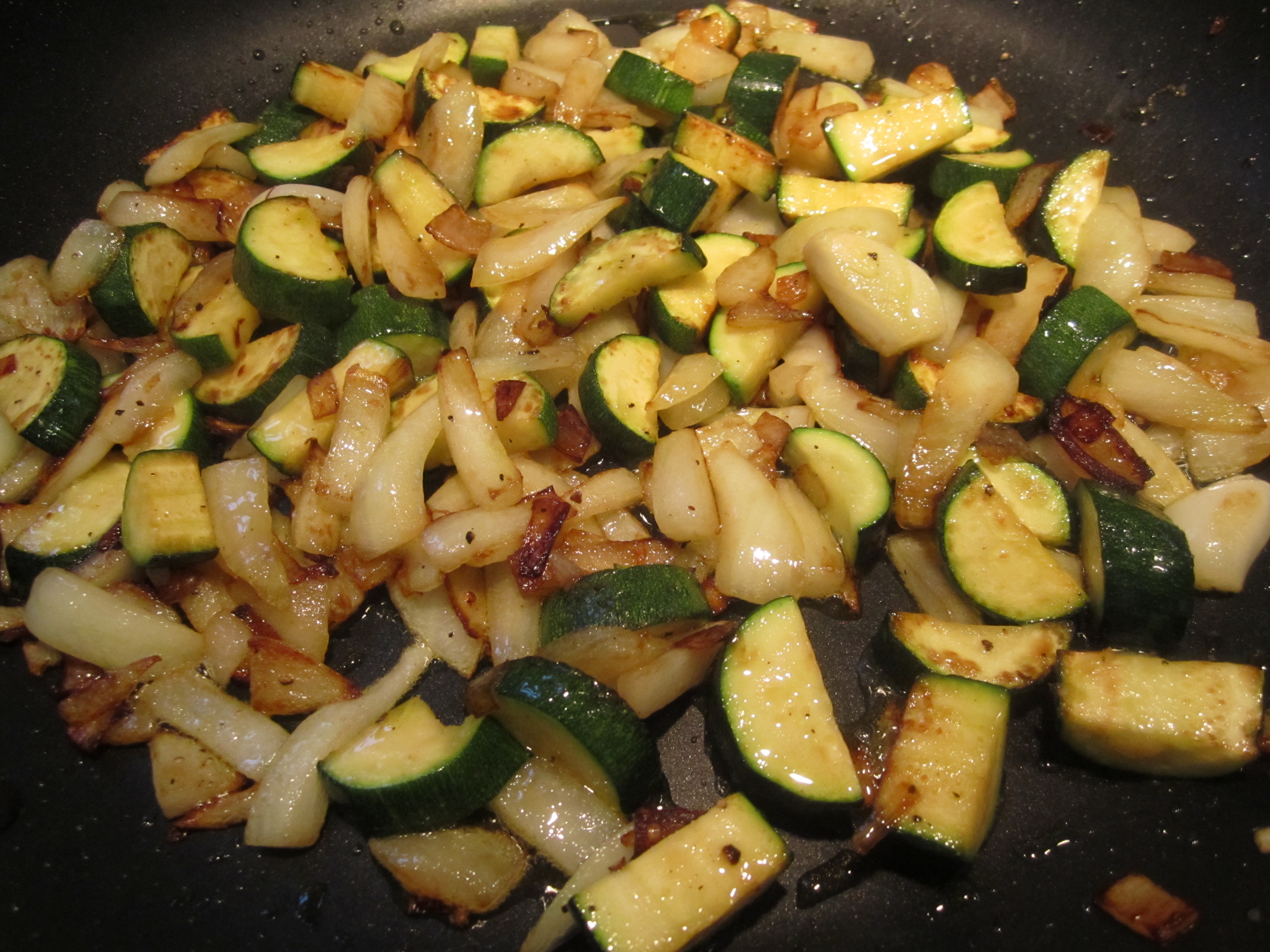
The vegetables are sauteed in a skillet on the side and combined with the couscous once it’s cooked.  the whole dish is drizzled with olive oil and sprinkled with more of those fresh chives from Beppi’s garden. 

Israeil Couscous with Zucchini

serves 4

1 – 1/2 cups Israeli couscous

2 cups water with bouillon cube added

4 medium (around 8″L) zucchini

1 large onion, coarsely chopped

4 tbls olive oil

1/4 c fresh chives, chopped

salt and pepper to taste

In a pot, bring water to boil and add bouillon.  Add couscous and cover.  Simmer on low heat for about 10 minutes, stirring from time-to-time.

In a broad skillet on high heat, begin sauteing the onion in 3 tbls olive oil, until they begin to color.  Add zucchini slices and continue sauteing until lightly golden.  Add salt and pepper to taste.

When couscous are done, toss into skillet with zucchini, sprinkle with chives and drizzle with remaining tablespoon of olive oil. 

Perfect with fish or seafood; perfect cold the next day.

Posted in Pasta, Vegetables | Leave a comment

Italian-Ate Burgers

This burger is one that was inspired by my mother’s braccioleBracciole are little rolls of thinly pounded meat around some sort of stuffing–I’ll make them for you sometime.  My mothers’ consisted of beef, wrapped around a filling of minced bacon, garlic and parsley.  It was such a brilliant combination, that I decided to re-package it into a burger (what’s better than a burger?)

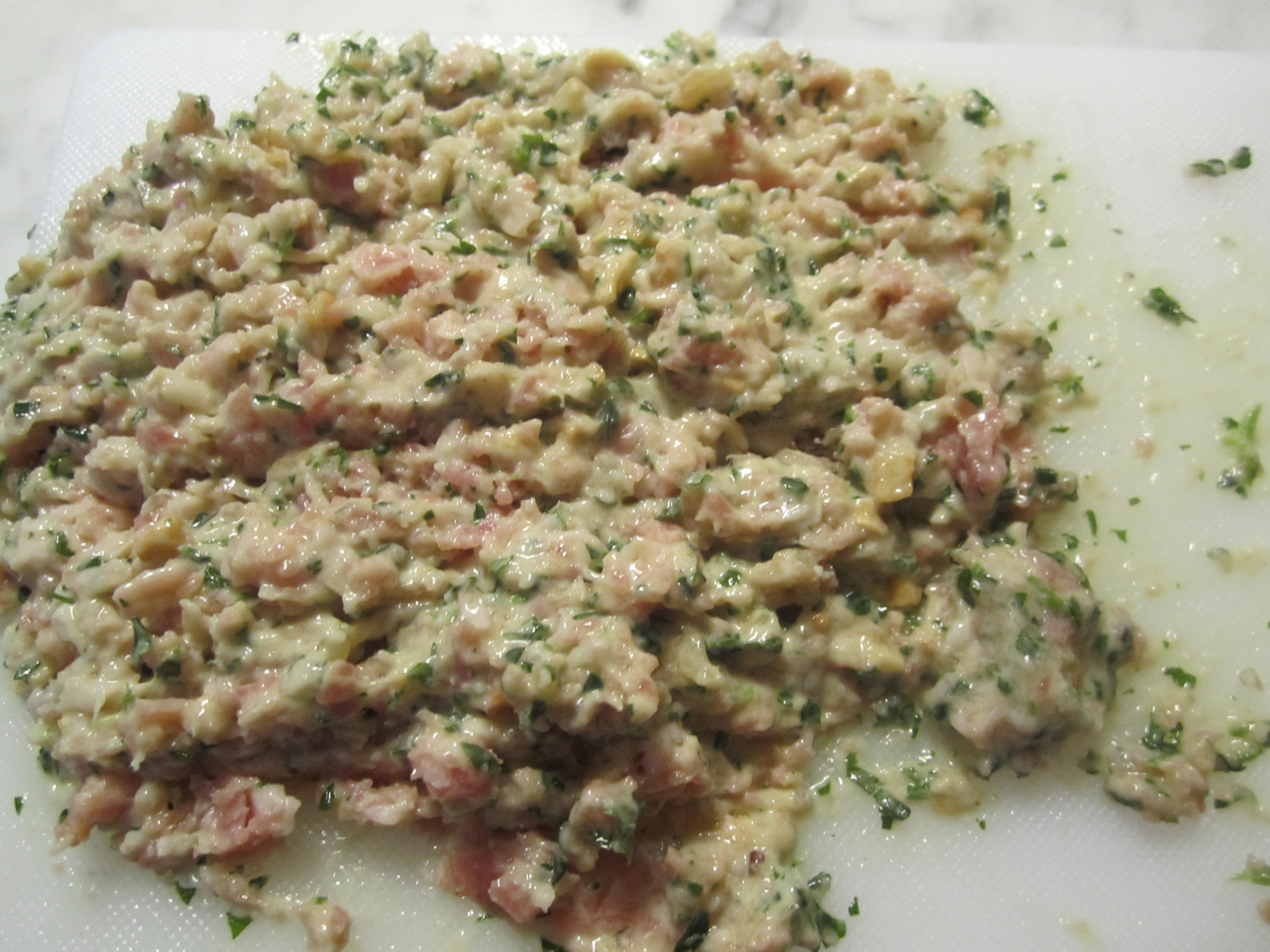
Instead of bacon, I’m using pancetta.  Instead of the raw garlic my mother used, I’m sauteing the garlic to a light golden color, to remove that acrid rawness.  With plenty of chopped parsley, salt and pepper, this is the perfect addition to ground sirloin.

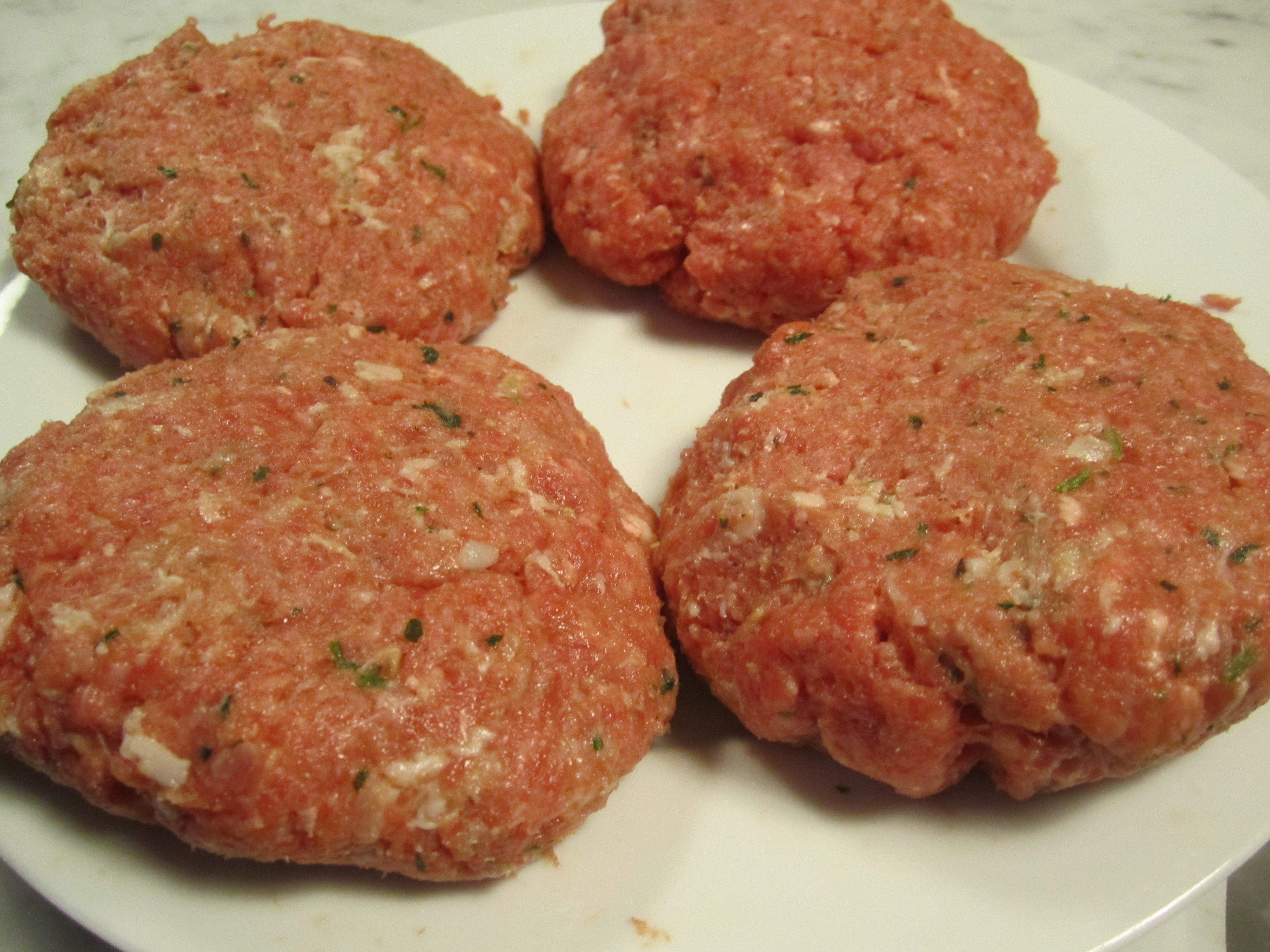
These burgers are so full of flavor and juiciness, they require nothing other than a great bun and maybe some lettuce and tomato.  The grilling time depends on the size you make them.  I like to start with  6 to 8-ounce burgers and grill them on high heat on my gas grill.  They are instantly engulfed in flames when they hit the grill, but as long as you don’t mind charred on the outside/pink on the inside–you’ll love the char-broiled flavor of the beef, combined with the porkiness of the pancetta. 

Italian-Ate Burgers

makes 4 burgers

2 lbs ground sirloin

1/4 lb pancetta, thinly sliced

4 cloves garlic, sliced thinly

1 tbl olive oil

1/4 c chopped parsley

1 1/2 tsp salt

1/2 tsp black pepper

4 egg yolks

In a small skillet on low heat, saute garlic in oil until it turns golden–about 5 minutes.  Let cool.  Combine garlic, pancetta and parsley in a chopper/grinder and process until a smooth paste forms.


Preheat gas or charcoal grill on high. 

In a mixing bowl, combine the beef, egg yolks, garlic paste, salt and pepper, and form into 4 large patties. Set aside until grill is heated.

Grill patties for approximately 3 – 4 minutes per side (depending on the strength of your grill.  Let rest on plate covered with aluminum foil for about  5 minutes. 

Posted in Meat | Leave a comment