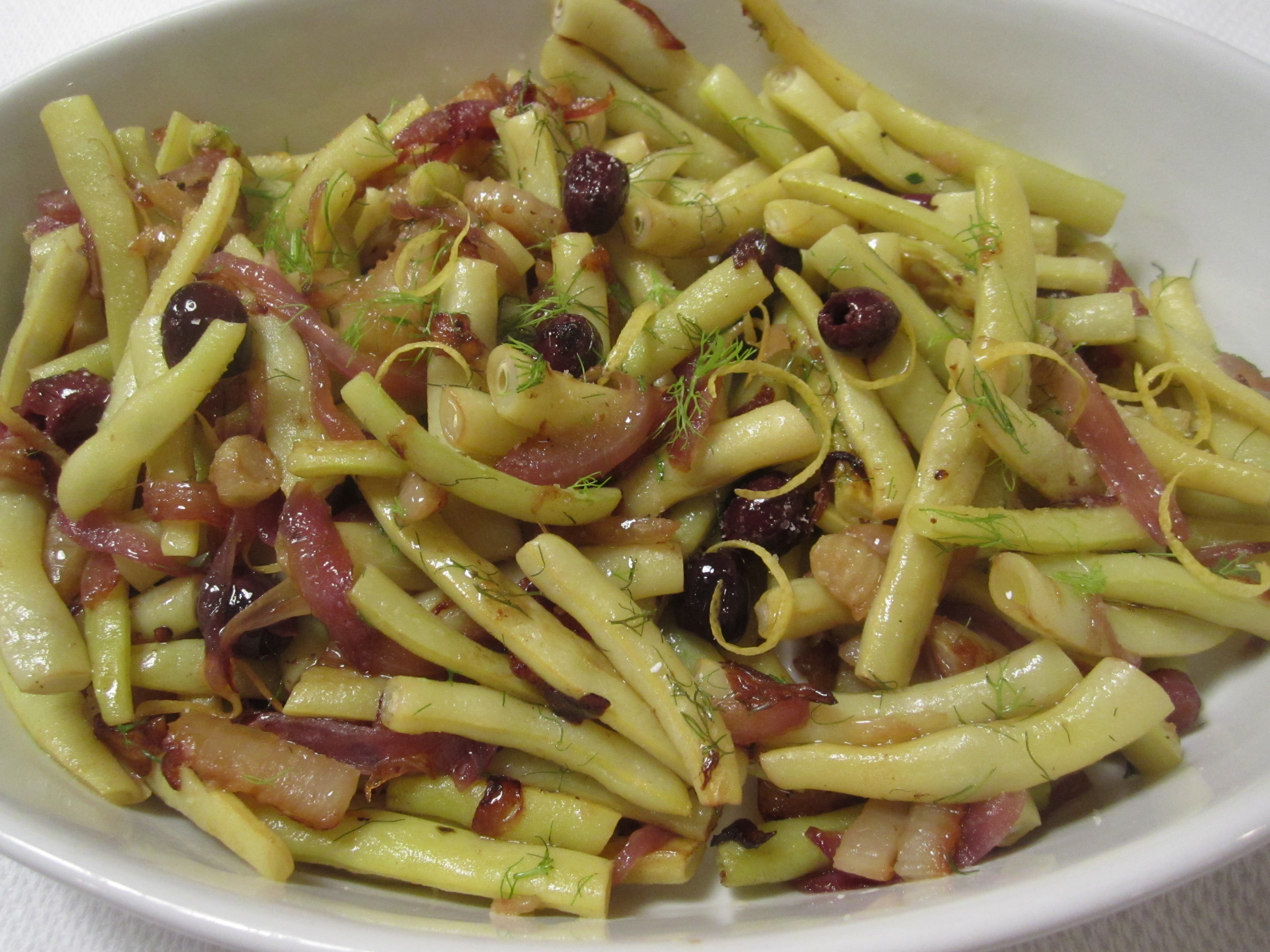
Wax Beans with Caramelized Fennel and Black Olives

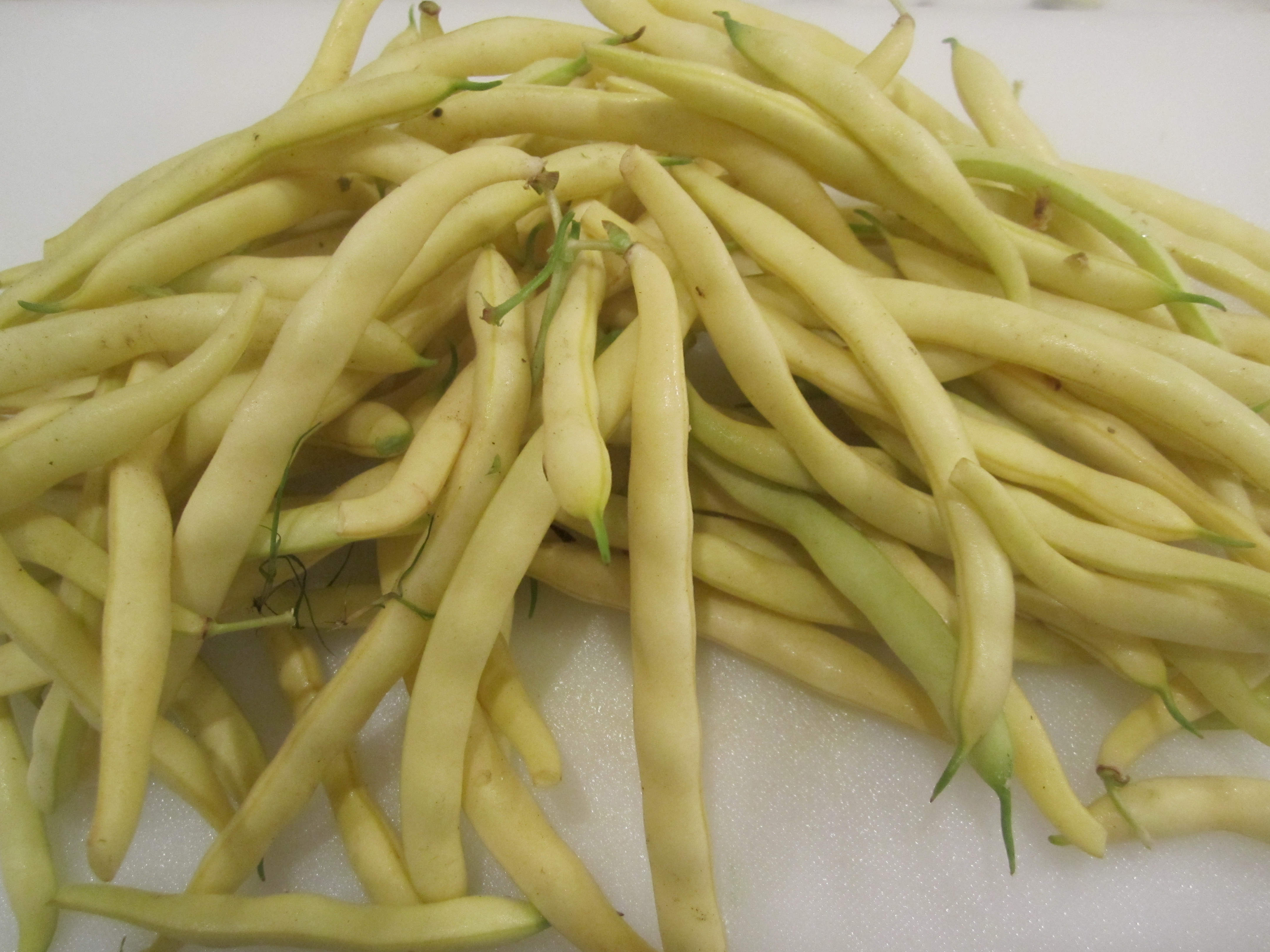
I’ve just received the first of this summers’ stringbean crop from my neighbor Beppi’s garden.  He raises three varieties–long beans, wax beans, and regular stringbeans.  I love the yellow wax beans–they’re sturdy in texture but mild and sweet in flavor.
Their mildness lends itself to some strong accompanying flavors.  Tonight, I’ve decided to use fennel, red onions, nicoise olives and some lemon zest to brighten everything.  The fennel and onions are caramelized in olive oil for a good 20 minutes.  The olives are then added and sauteed for a minute or so.  The wax beans are boiled separately, then added for the last few minutes of sauteing.

This is a sweet, salty, earthy preparation that you can use for any variety of stringbeans.  They pair well with almost any main course.  Tonight, we’re having plain, pan-roasted salmon (for the technique, see salsa verde with pan-roasted salmon).  In addition, some boiled yukon gold potatoes, tossed with parsley and olive oil, and swiss chard sauteed with bacon.
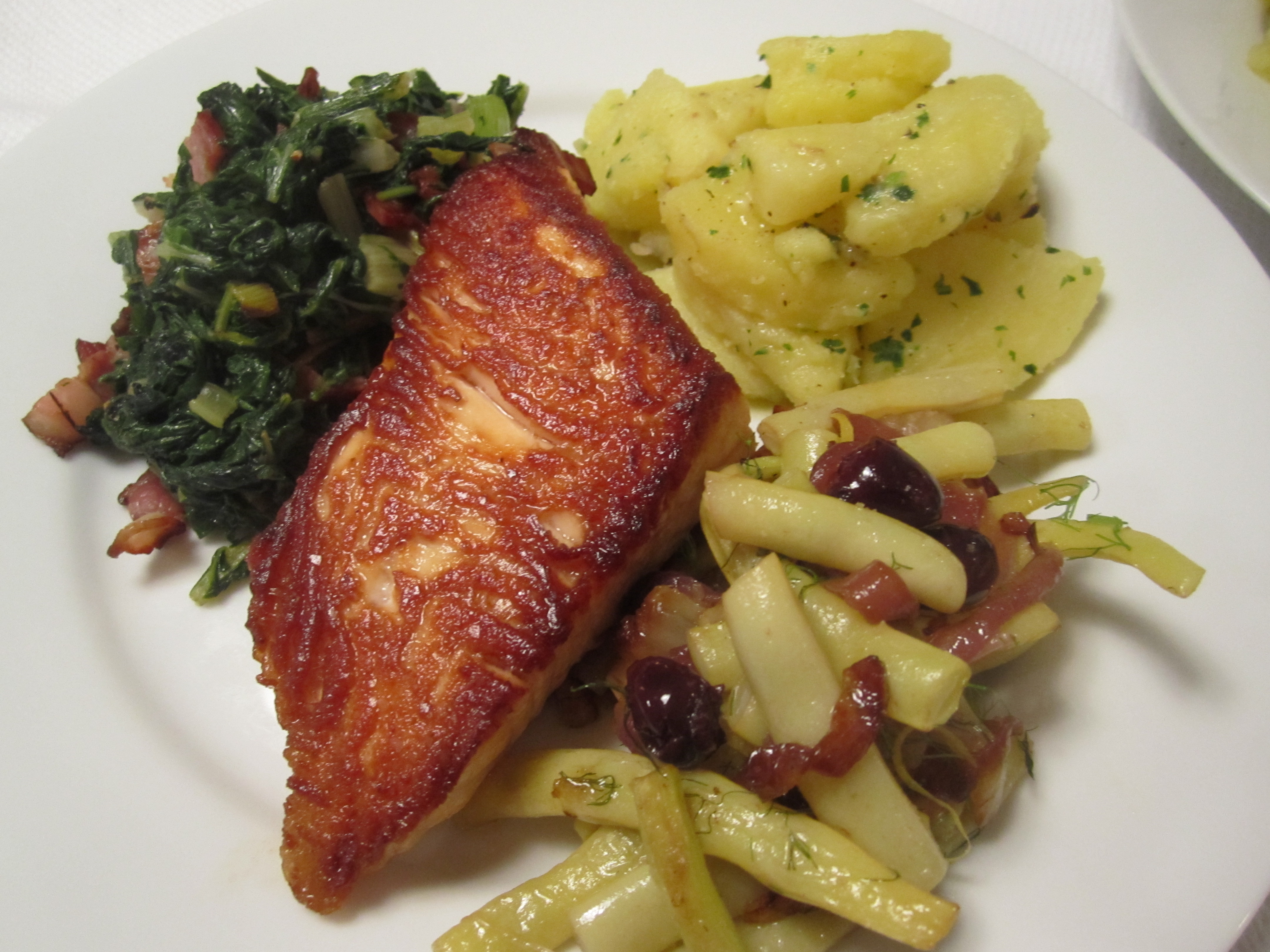
This is a great dish to serve at (or bring to) a party, as it serves well at room temperature.

Wax Beans with Caramelized Fennel and Black Olives

serves 4

1 1/2 lbs. wax beans, trimmed of ends and cut into bite-size pieces

4 tbls extra-virgin olive oil

1 bulb fennel, outer layers removed, halved, cored and sliced into 1/4″ half-moon slices

1 red onion, sliced thinly

1/4 c pitted nicoise olives

2 tsps fennel fronds, washed and chopped

zest of one lemon

salt and pepper to taste

Drop beans into boiling salted water.  Cook until crisp-tender (about 10 minutes).

In a broad skillet, place onion, fennel, olive oil and a sprinkle of salt and pepper.

On low heat, begin simmering, covered.  Remove cover and stir every 3  minutes or so, until they have softened and begun to turn golden brown (about 15 minutes).  Uncover and add lemon zest and olives.  Saute for another minute to release flavor and brown the olives slightly.

May be made up to this point and held, off heat, for about a half-hour.

Add green beans and continue sauteing on high heat.  Top with fennel fronds and additional zest, if desired.
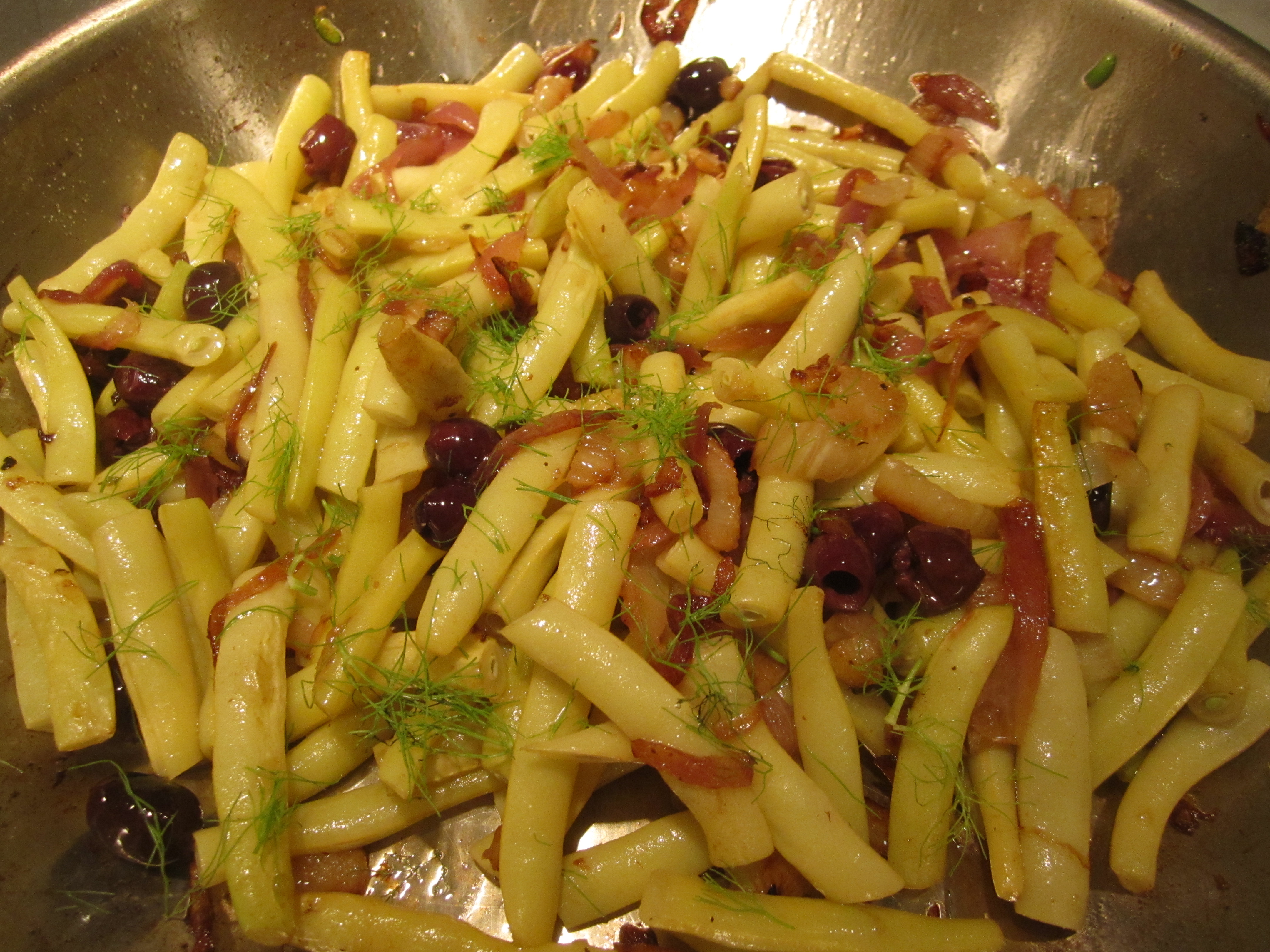
Add salt and pepper to taste.  May be served hot, warm, or room temperature.
Posted in Vegetables | Leave a comment

Golden Beet Risotto

The golden beets have been so sweet and irresistable, I’ve been serving them nonstop in one form or other for the last couple of weeks.

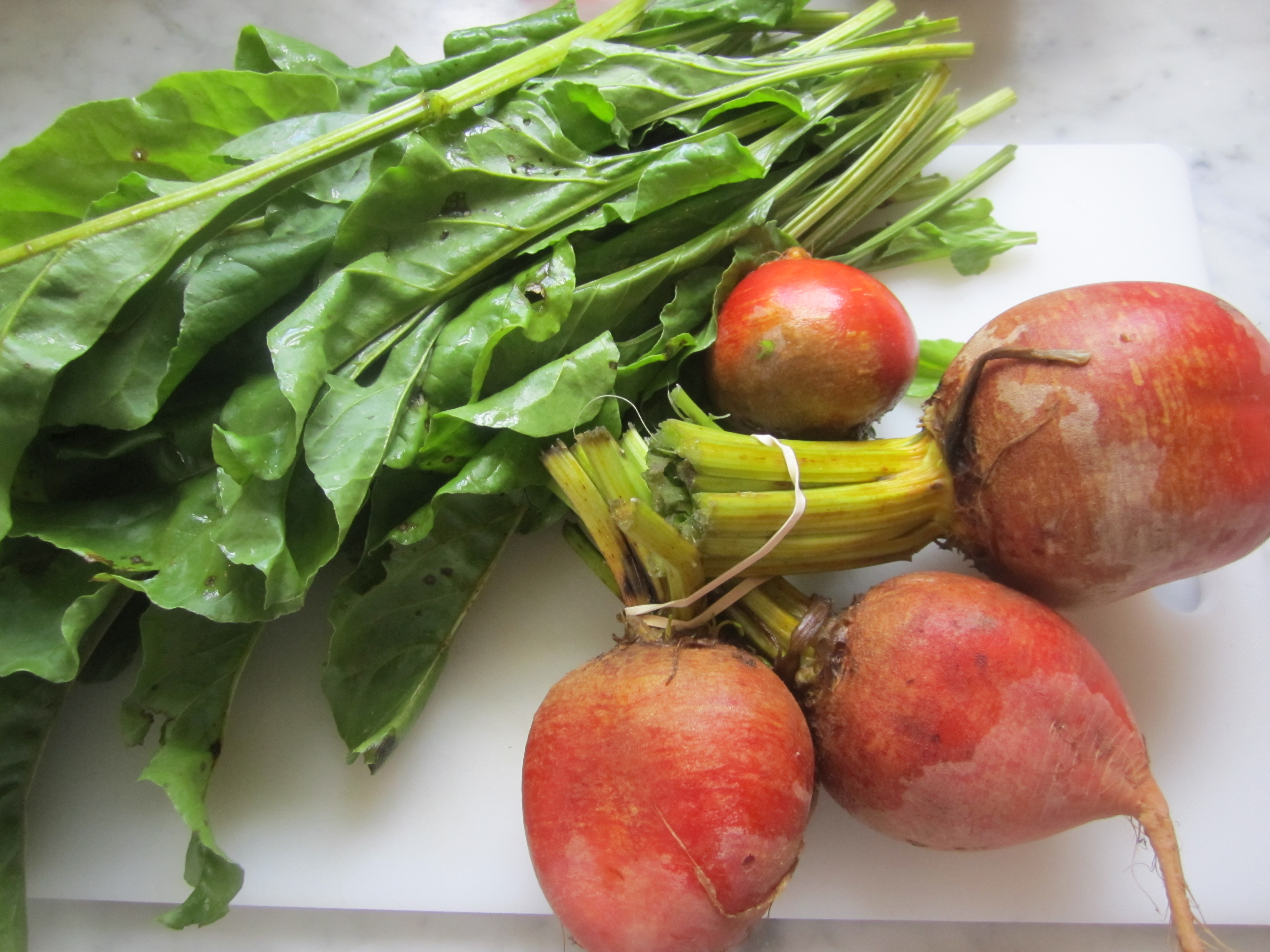
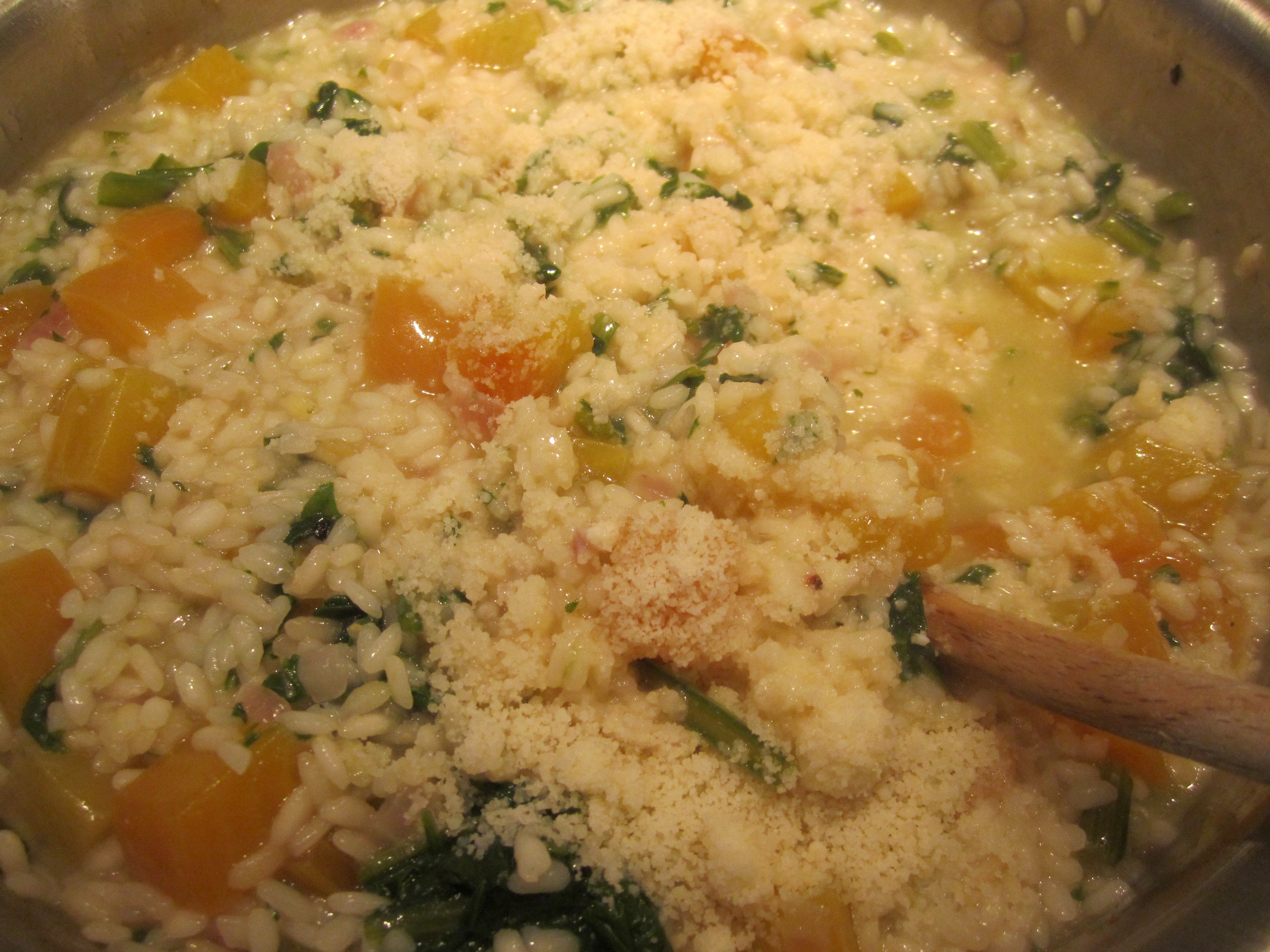
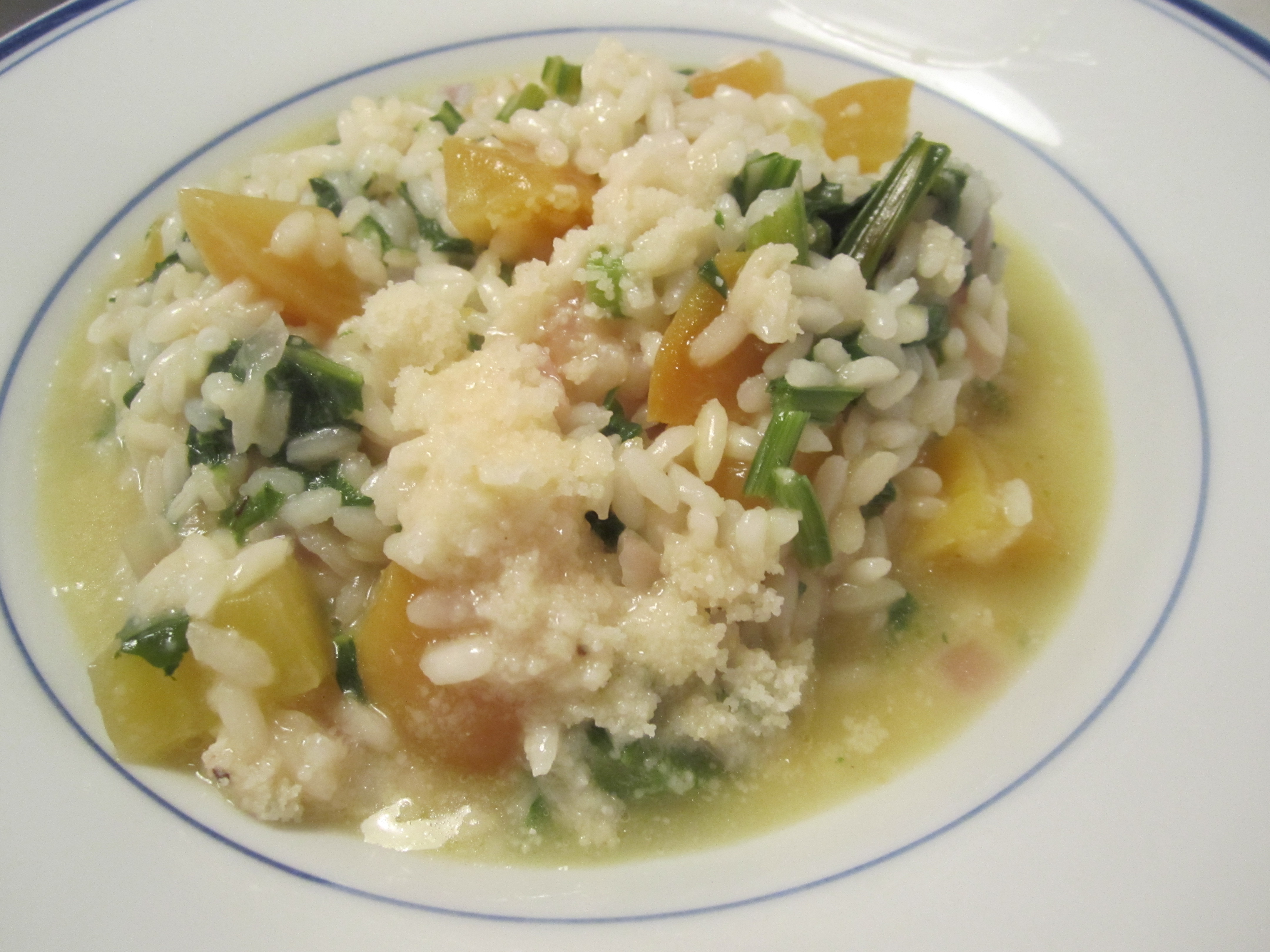
Risotto is the perfect way to showcase them.  Their sweet earthiness is the perfect complement to the combination of rice, white wine and parmigiano cheese.  The added bonus is that I can use their beautiful green leaves as part of the risotto.  If you’re fortunate enough to find beets with beautiful, healthy green  tops, don’t ever throw them away.

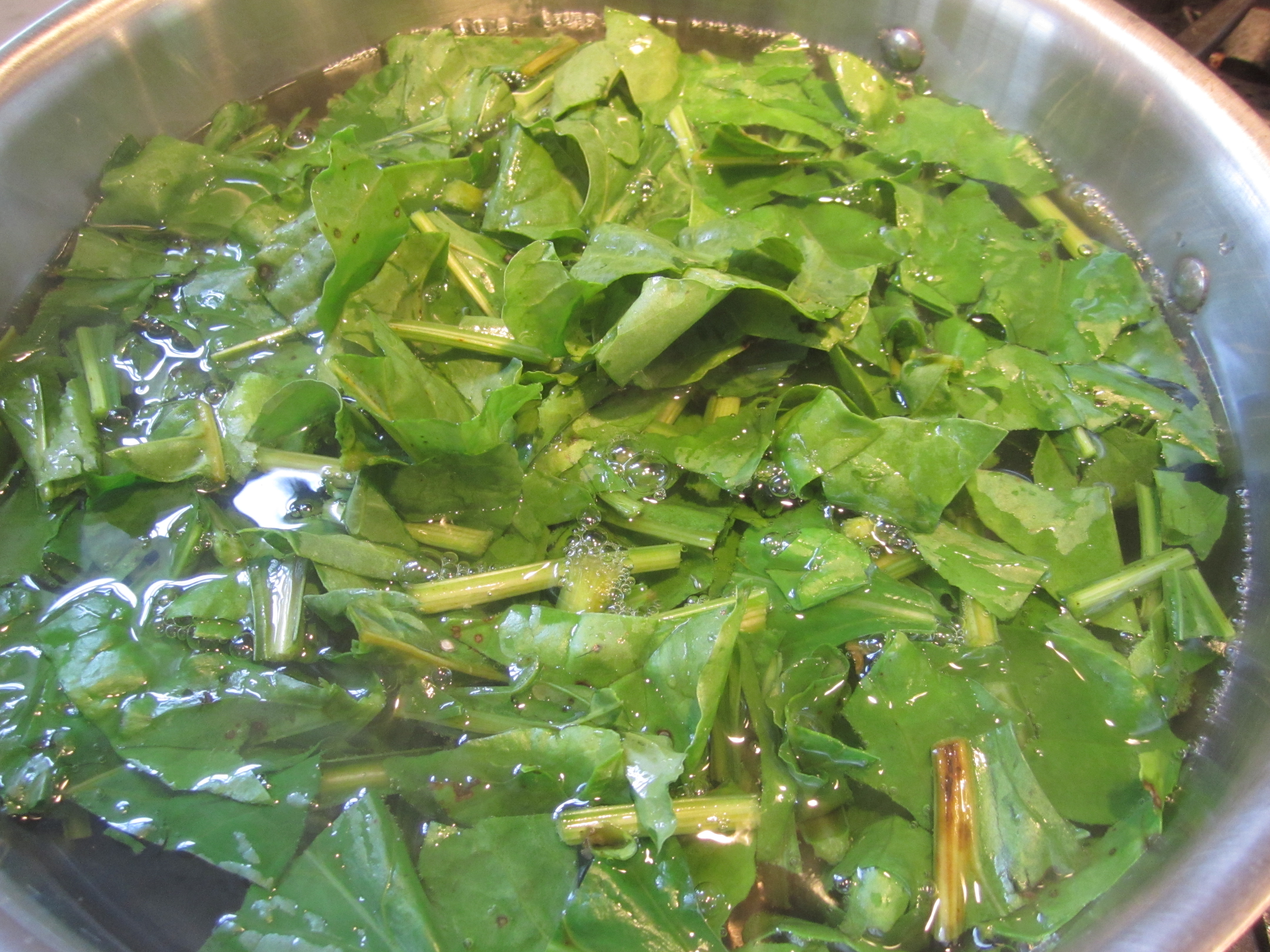
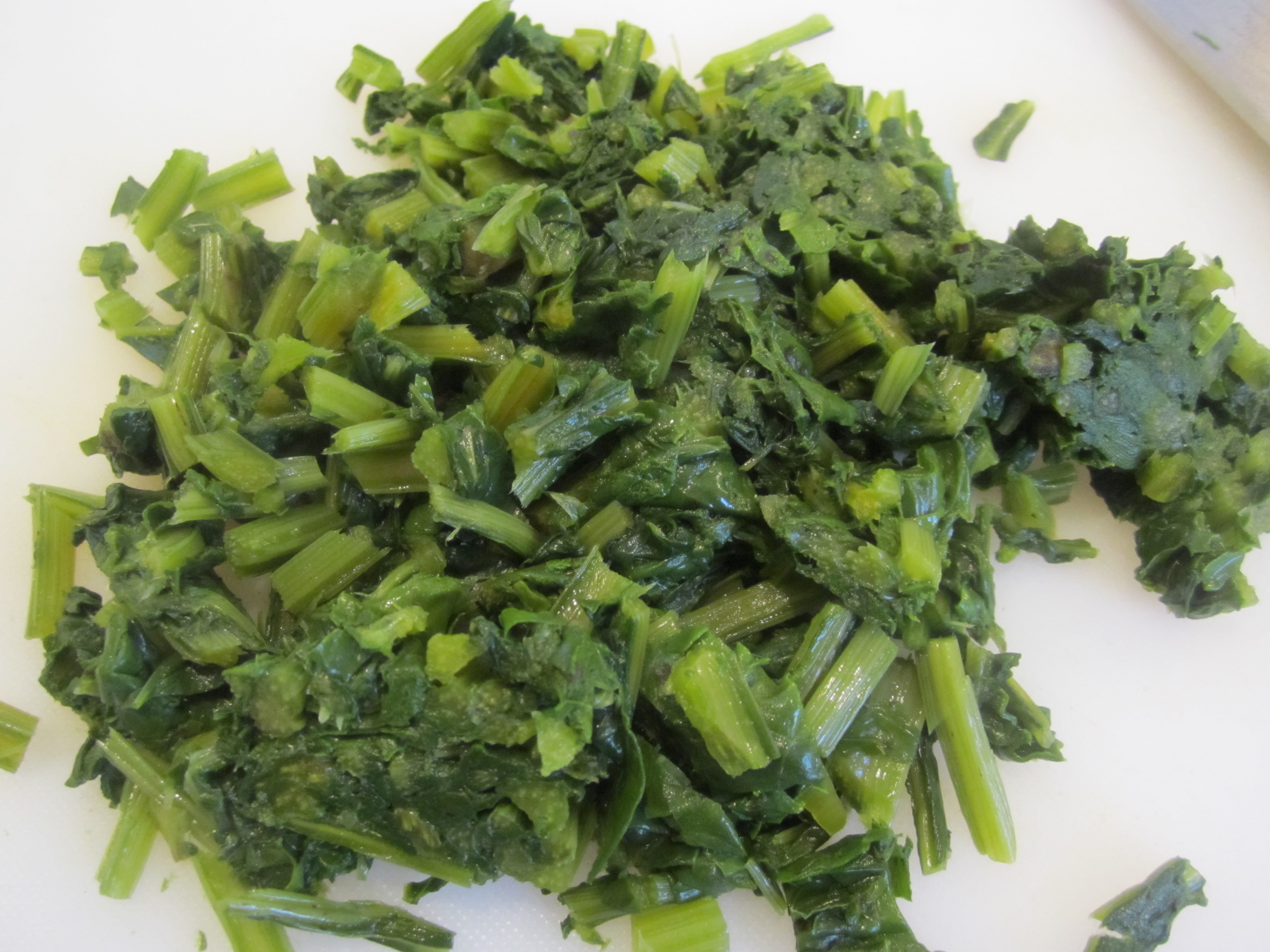
Beet greens take a little work to prepare, but are well worth the effort.  Simply wash them in several changes of water, until no soil remains at the bottom of the bowl.  Drop into salted boiling water.  They need to boil longer than most greens because their stems are very sturdy.  You want to cook them until the stems are tender.  Drain, rinse with cold water, and squeeze in small bunches until no more water remains.

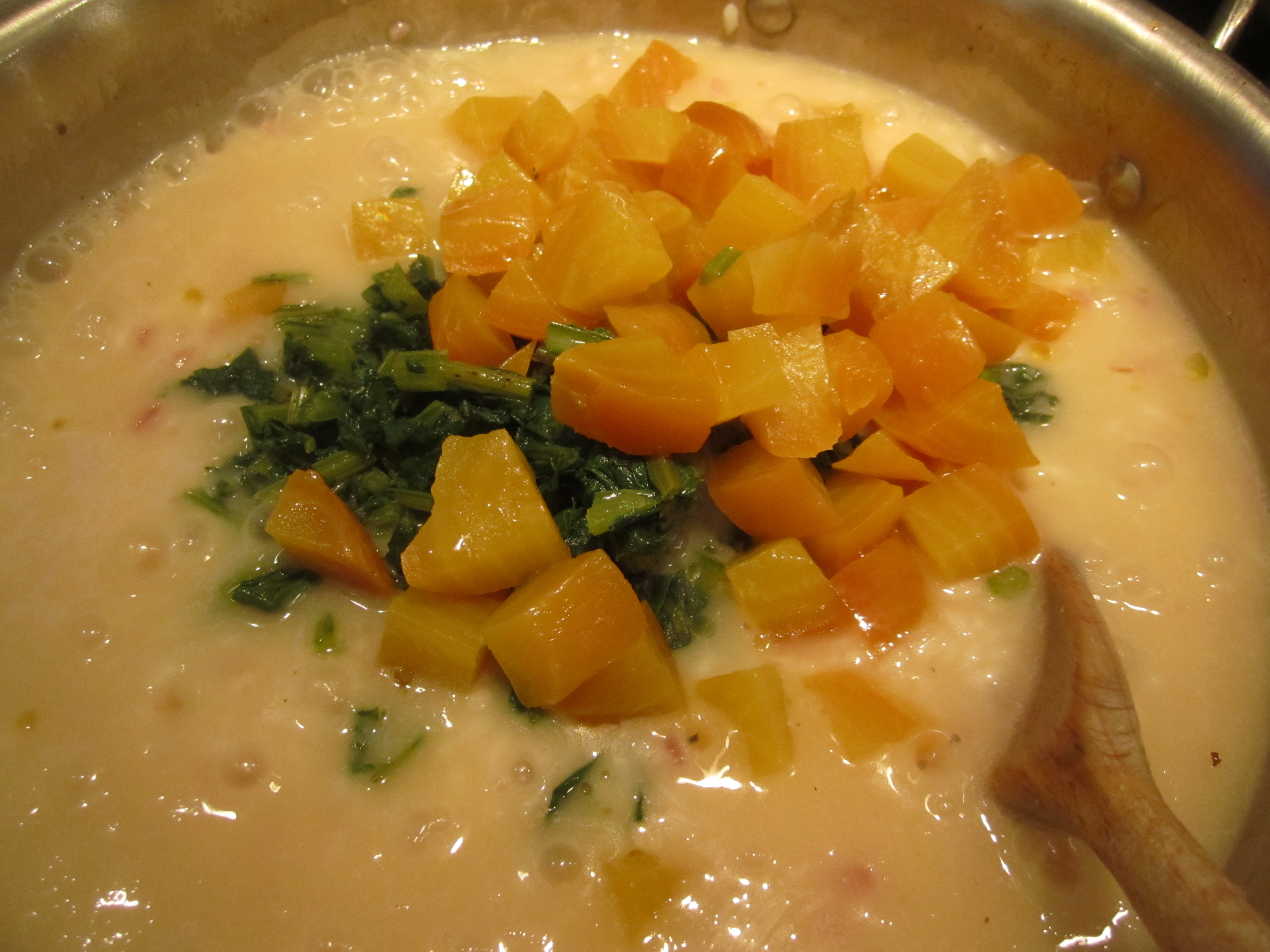
The risotto technique is the same one I’ve shown you in prior posts, but I’ll go through it here from start to finish.  The beets and greens simply get folded in during the last minutes of cooking.

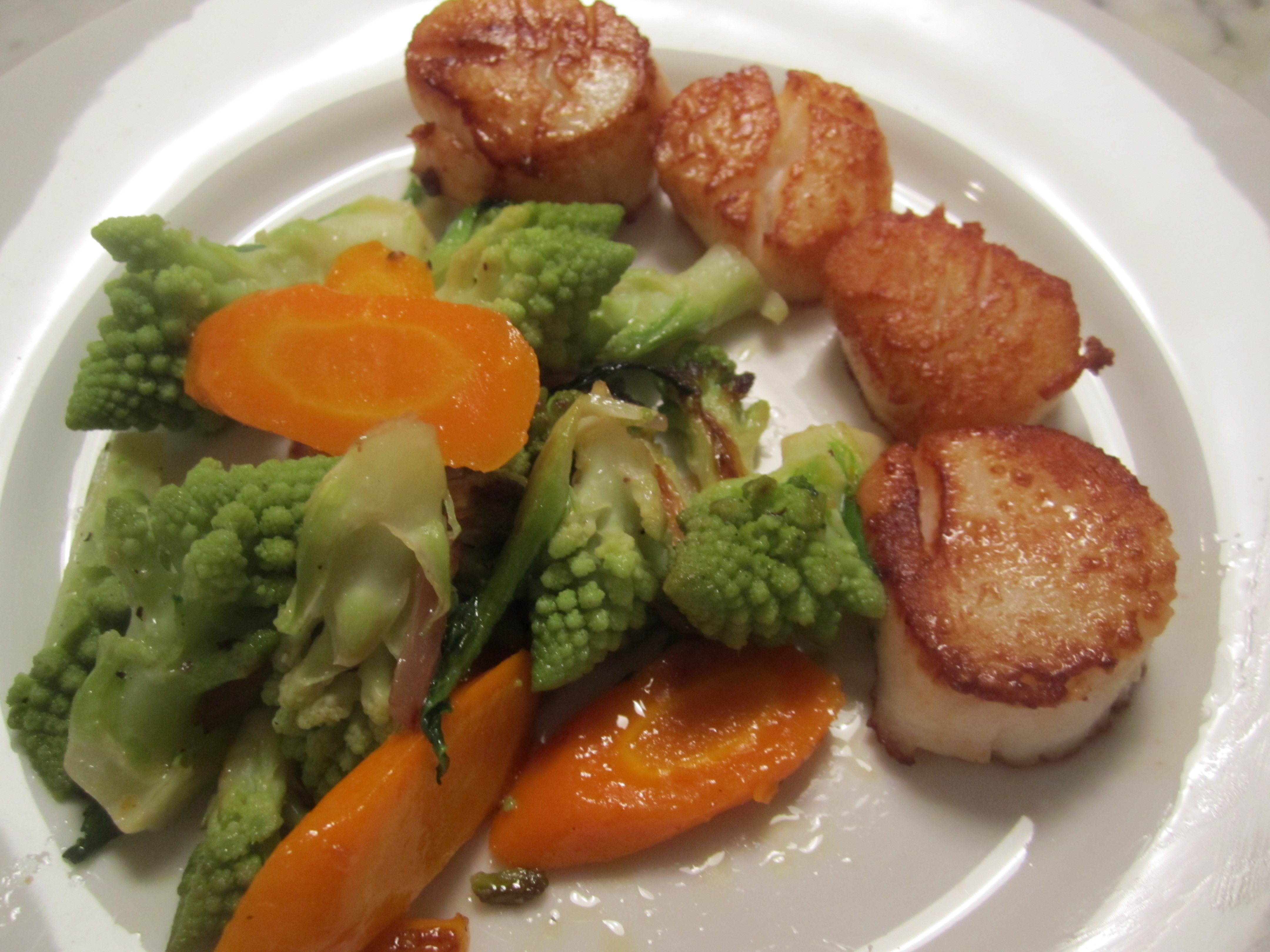
As a main course tonight, I served simple seared Montauk Sea Scallops with sauteed Romanesco Broccoli and carrots.

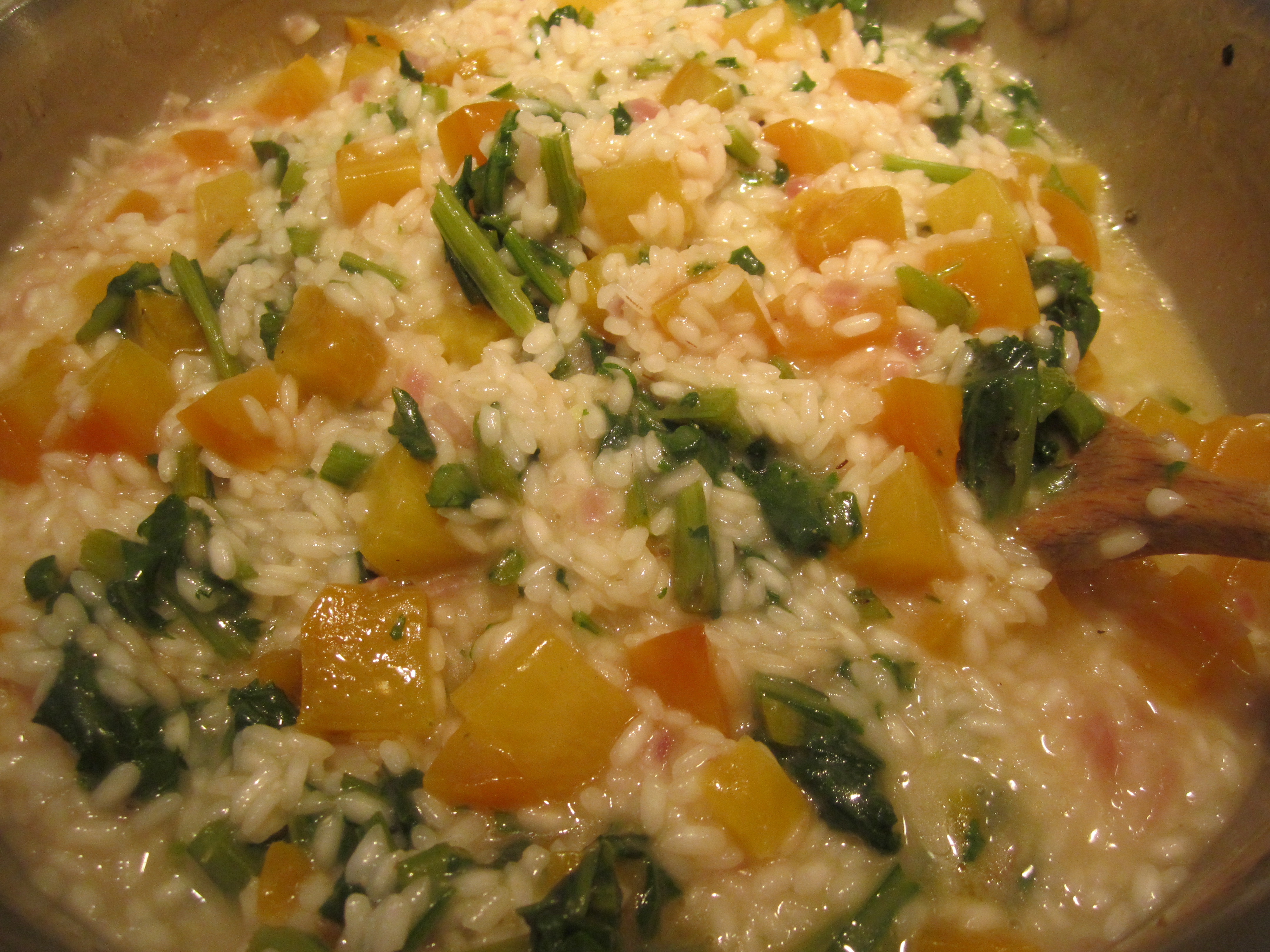
As for the risotto, one of my more discriminating guests proclaimed this the best risotto she’d ever had–I had to agree!

Golden Beet Risotto

serves 6

4 medium golden beets with greens removed and set aside

2 tsps olive oil

2 1/2 c arborio rice

1/2 red onion, finely diced

6 tbls butter

1 c white wine

8  cups chicken broth

1 c grated parmigiano for sprinkling

salt and pepper to taste

Preheat oven to 350 degrees.

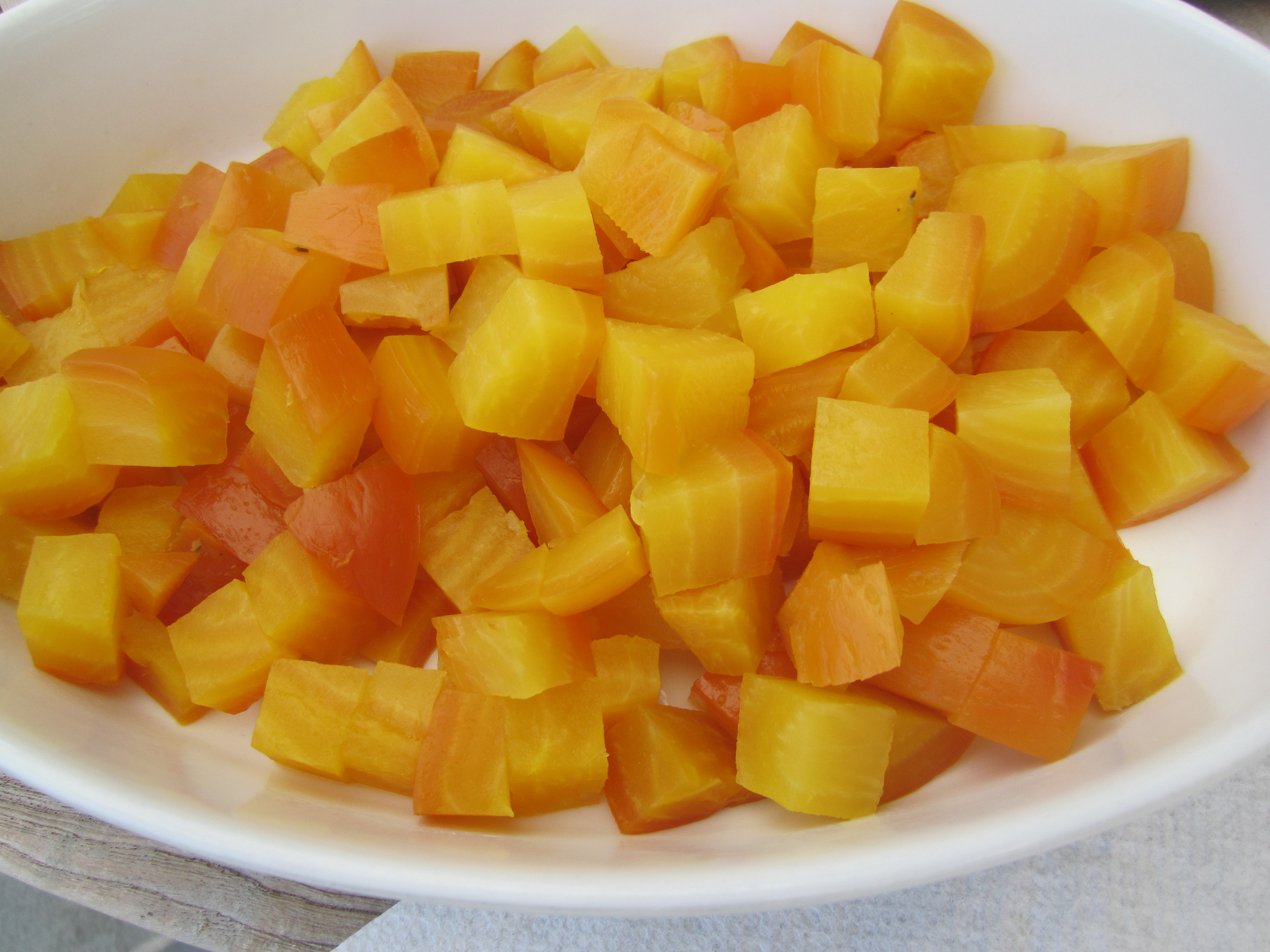
Wash beets, then place on aluminum foil, 2 to a packet, and drizzle with olive oil.  Seal the packet tightly and roast on a sheet pan (in case they leak) for 1 to 1/2 hours, or until beets are springy and tender when squeezed (alternatively, open one of the packets and pierce the largest beet with a paring knife–if it goes through the beet without any resistance, they’re all cooked).

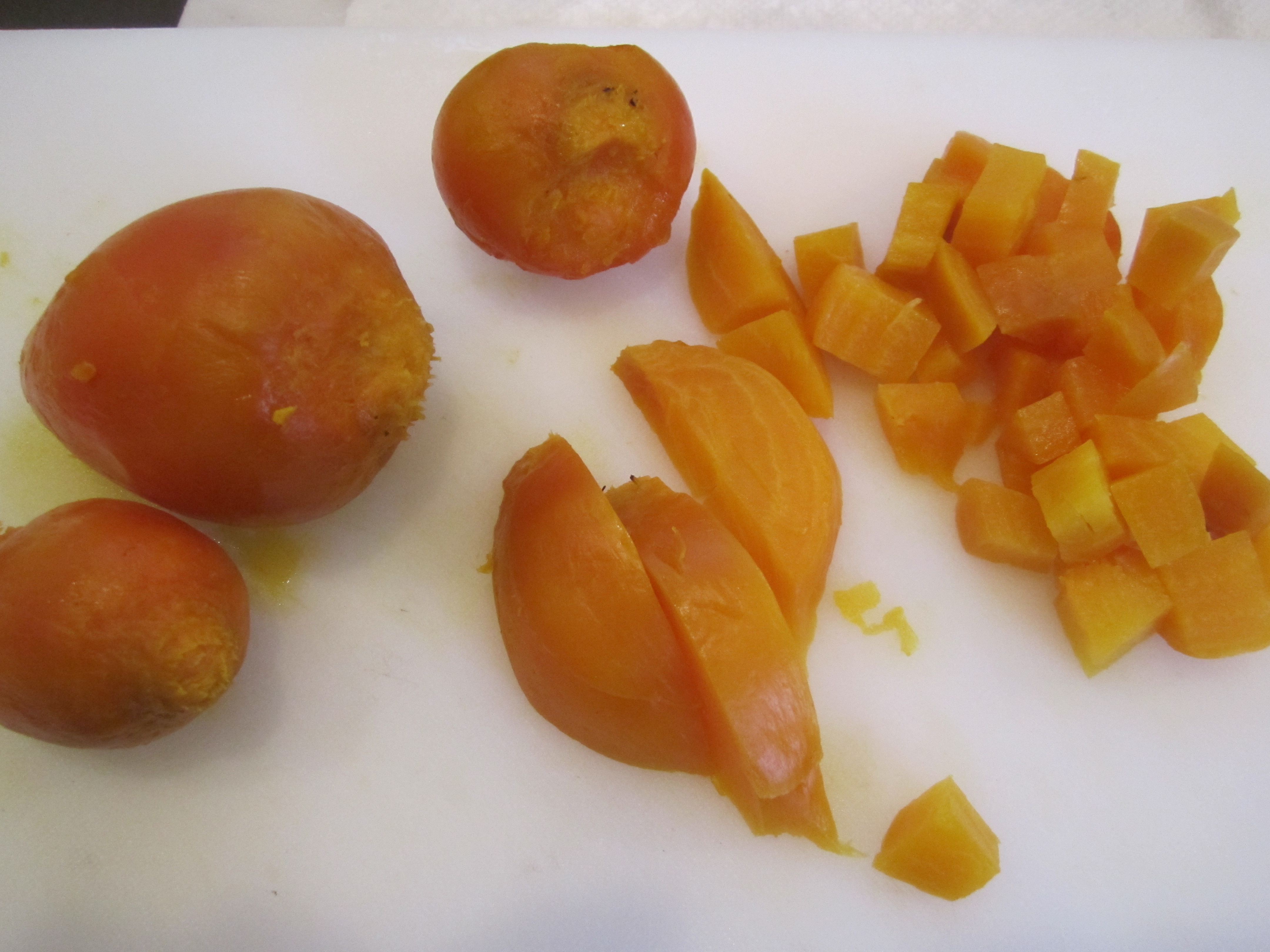
Set aside the sealed packets and allow to cool for about 15 to 20 minutes.  Rub with paper towels to remove skins.  cut into 1/2″ dice and season with salt and pepper.  Set aside until ready to assemble the risotto.

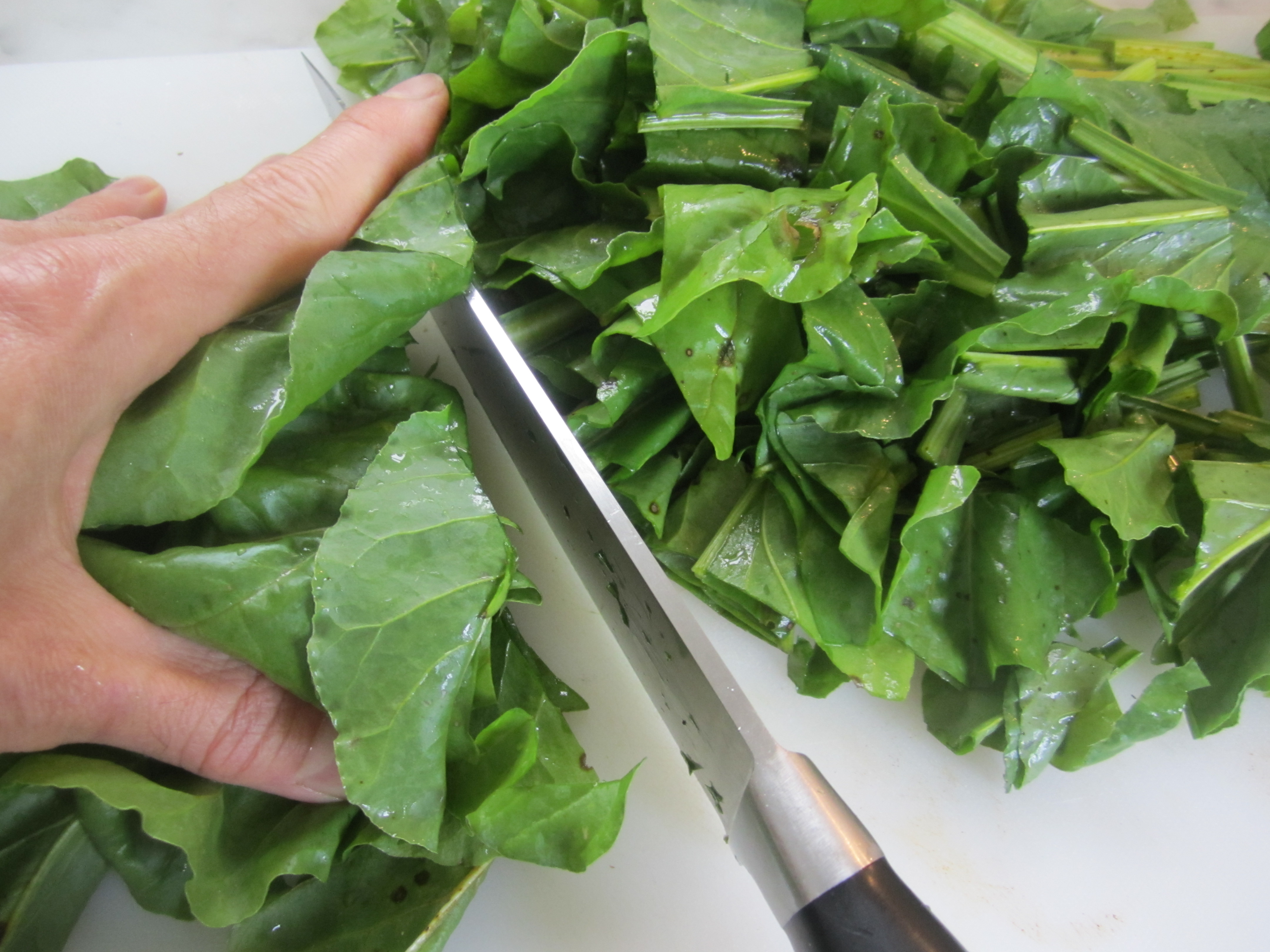
To clean the greens, chop into large segments about 1 1/2″ long.

Wash in a mixing bowl in several changes of water until no soil remains.  Drop into boiling salted water and cook for about 15 minutes, or until stems are soft.

Rinse with cold water and squeeze in small bunches to remove excess water.  Chop into 1/2″ dice and set aside until ready to prepare risotto.

To prepare risotto, bring chicken broth to a simmer.

In a high sided saute pan, on medium heat, bring onions and butter to a sizzle and saute for about 5 minutes or until onions turn translucent and begin to wilt.

 Turn heat to medium high and add the rice.  Saute for 4 – 5 minutes or until the rice begins to pop and appears translucent.

Add wine and reduce for a minute or so until wine is evaporated.  Add  1 cup of broth and stir.

As soon as the first installment of broth is added, set your kitchen timer to 10 minutes.  Continue adding broth and stirring during that time.

When 10 minutes have elapsed, add beets and greens.

Stir to combine.

Turn off heat and cover for 5 minutes.  At the end of 5 minutes, add a bit more simmering broth to loosen the mixture, as well as a good handful of the grated cheese.

Ladle into warm bowls and sprinkle generously with additional grated parmigiano.

Posted in Risotti | Leave a comment

Italian Flat Stringbeans with Zucchini and Tomato

As I indicated in my last post, my favorite meals for entertaining this time of year are those which consist of something from the grill, plus a variety of make-ahead side dishes.

My mother is visiting again this weekend, and has brought me a variety of stringbean that I can’t seem to find at my local farm stands–the flat stringbean, or Italian pole bean.  Someone has given these to her from their garden in New Jersey.  These beans require a longer cooking time than a conventional stringbeans, but are meatier, denser and more flavorful as well.

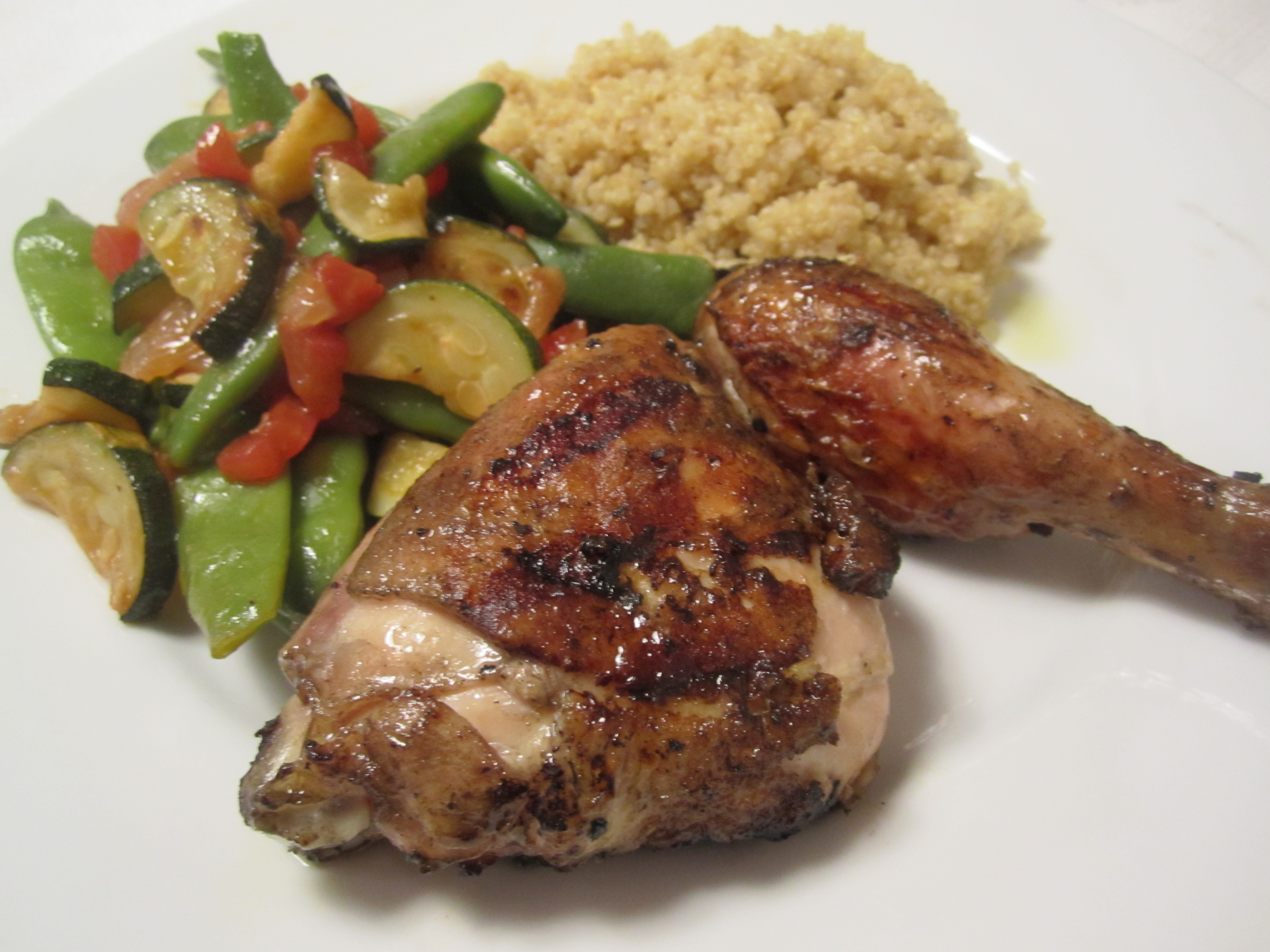
My mother usually dresses them with olive oil and red wine vinegar, but tonight, we’re sauteing them with zucchini and chopped fresh tomato.  A little bacon wouldn’t hurt, but tonight, I’m keeping the flavors clean and uncluttered.

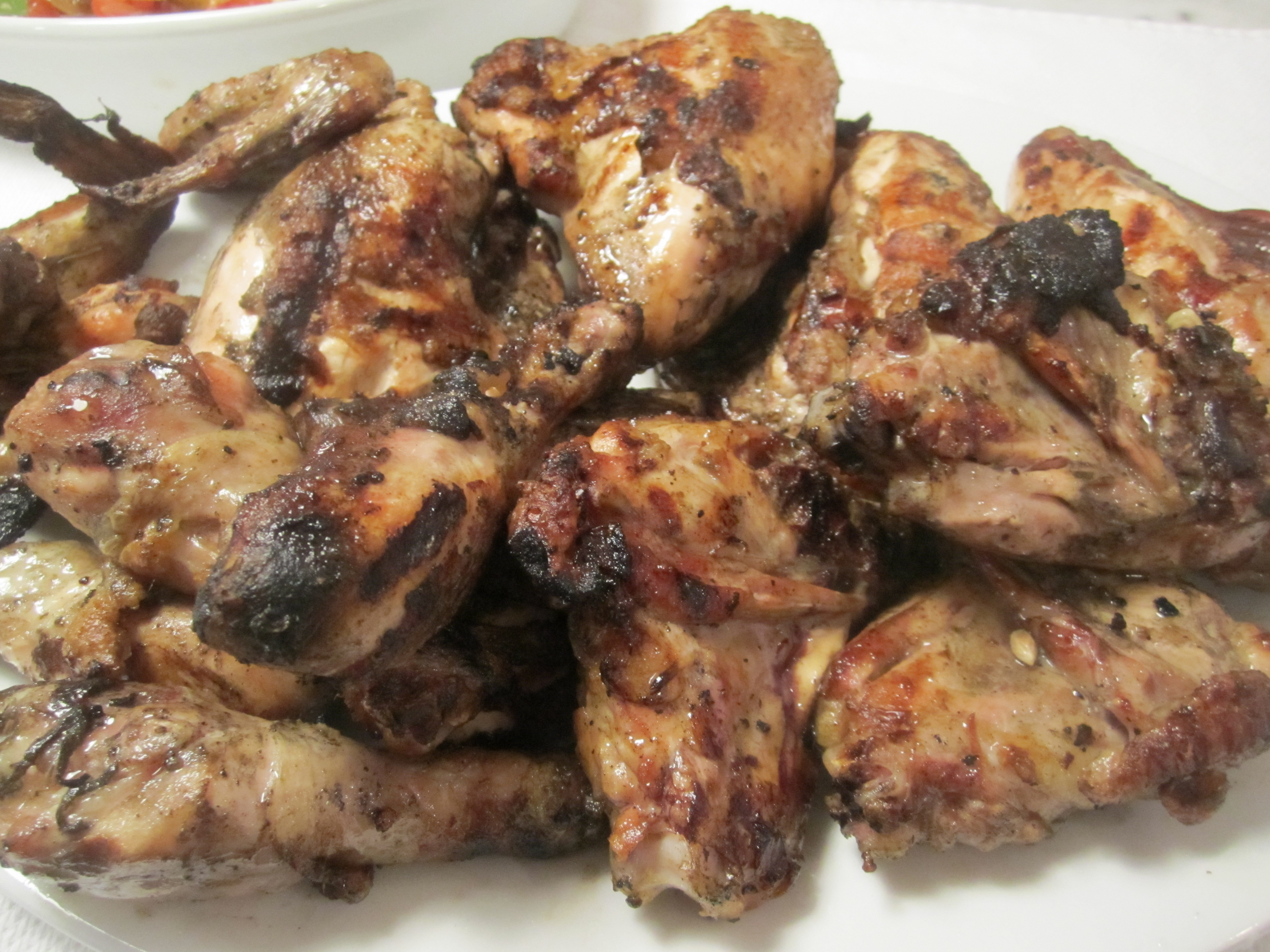
Tonight, for our grilled dish, we’re having chickens (cut into pieces) freshly killed from our local chicken farm, North Sea Farms.   These chickens are a special treat and I make them for guests as often as I can.  The recipe for tonight’s chicken is exactly the same as last week’s chicken thighs–marinated with sage and lemon.

They are first seared over high flames, then moved to the cool side of the grill on indirect heat to roast, covered, for about an hour.  At the last minute, they’re moved back to the flame until the skin is crispy and slighty charred.

As a simple side dish, we’re having plain boiled quinoa with lots of pecorino, black pepper and olive oil.  The nuttiness of the grain is terrific with the salty flavor of the pecorino.  It’s a great side dish for grilled meats or poultry, and easier than potatoes!

Italian Flat Stringbeans with Zucchini and Tomato

serves 4

1 lb Italian stringbeans

1 medium red onion, cut in half and sliced lengthwise into 1/4″ slices

2 medium zucchini

2 plum tomatoes

4 tbls extra-virgin olive oil

salt and pepper to taste

Remove both ends of the beans and, in the process, pull off any stringy connectors.  Boil in salted water for about 10 minutes or until crisp-tender.

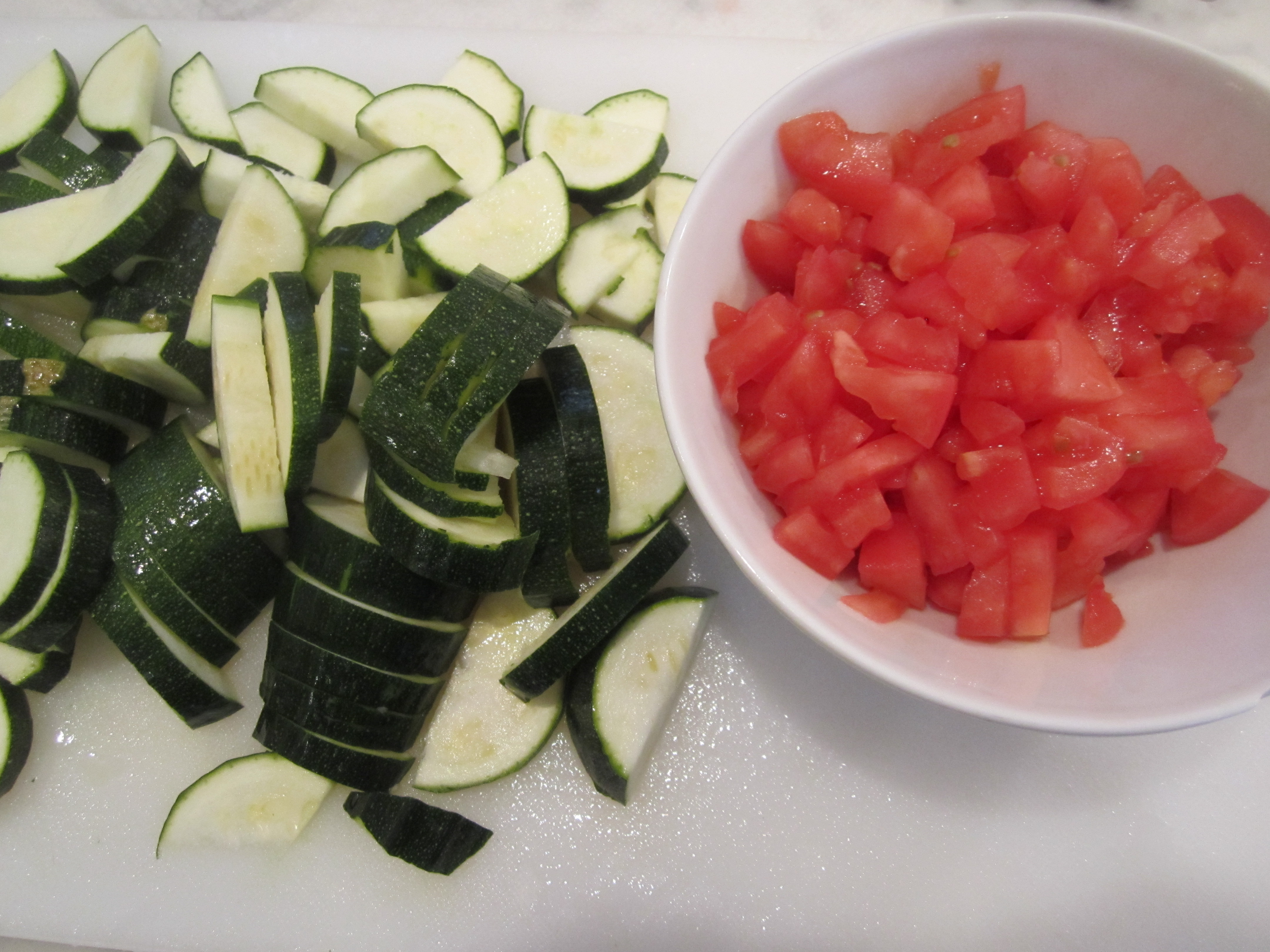
In the same boiling water, blanch tomatoes for about 30 seconds.  Peel and dice.  Slice zucchini in half lengthwise, then into half-moon slices about 1/4″ thick.

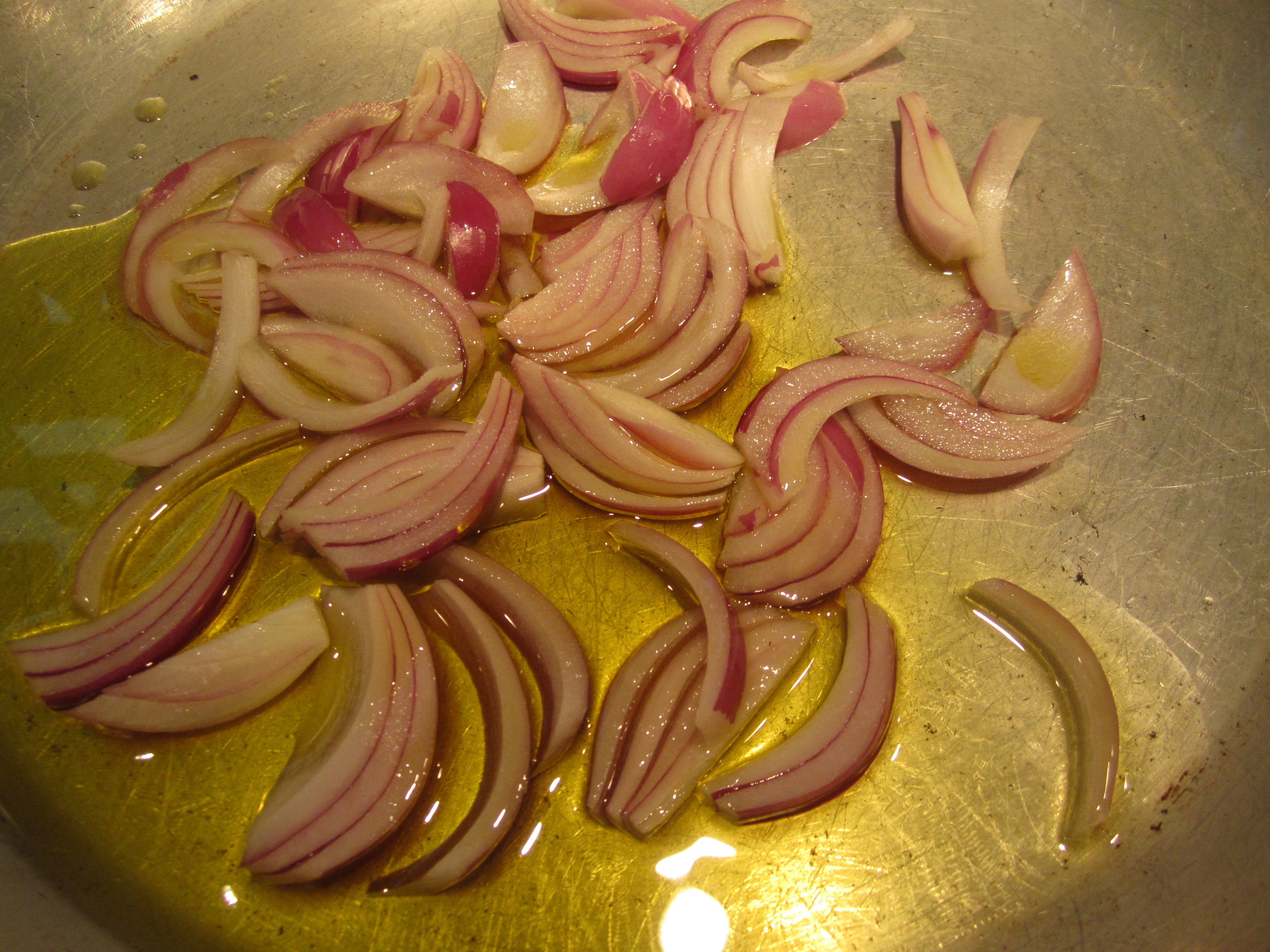
In a broad skillet, heat oil and onions.  Saute onions for about 2 minutes on high heat.

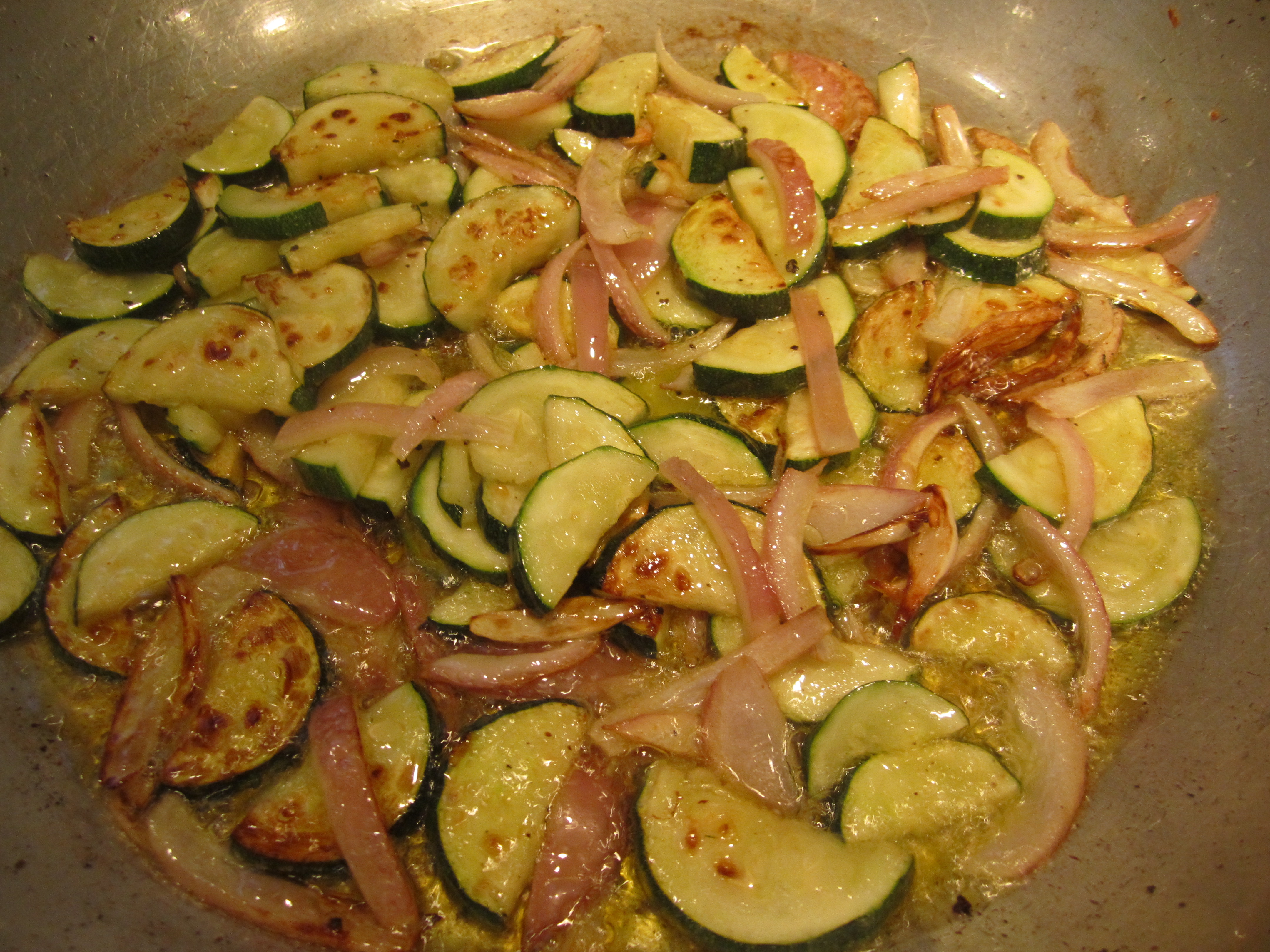
Add zucchini and saute until golden.   Saute for another 3 or 4 minutes.

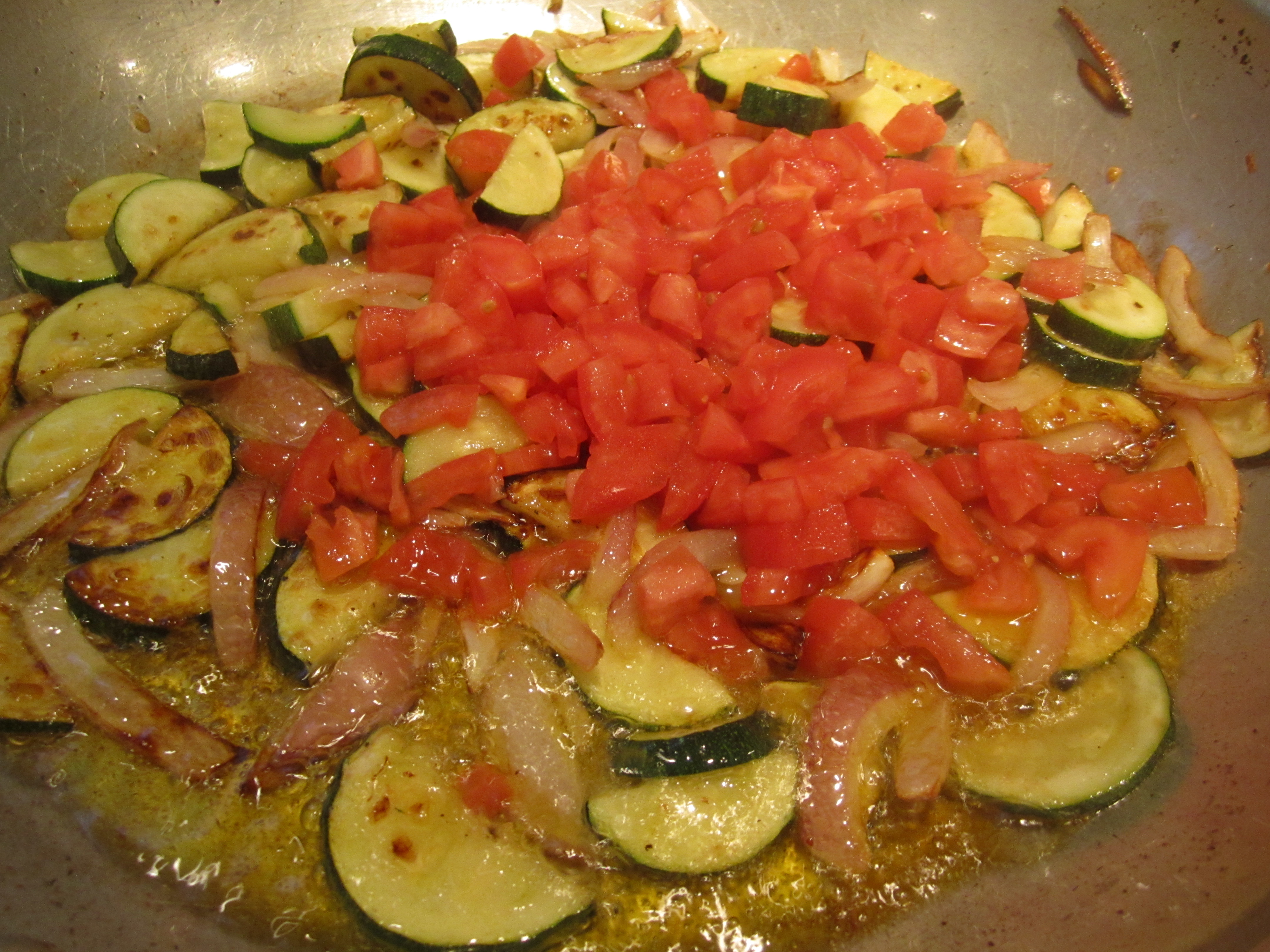
Add tomatoes and saute for another minute or two.

Add beans and toss to incorporate and reheat beans.

Can be served at room temperature.

Posted in Poultry, Vegetables | Leave a comment

Quinoa with Golden Beets, Cucumber and Dill

This is the perfect summer dish–a cross between a grain and a salad.   In the summer,  I’m always looking for dishes that can be served at room temperature.  My summer meals are often a combination of room-temperature salads with a main course from the grill.

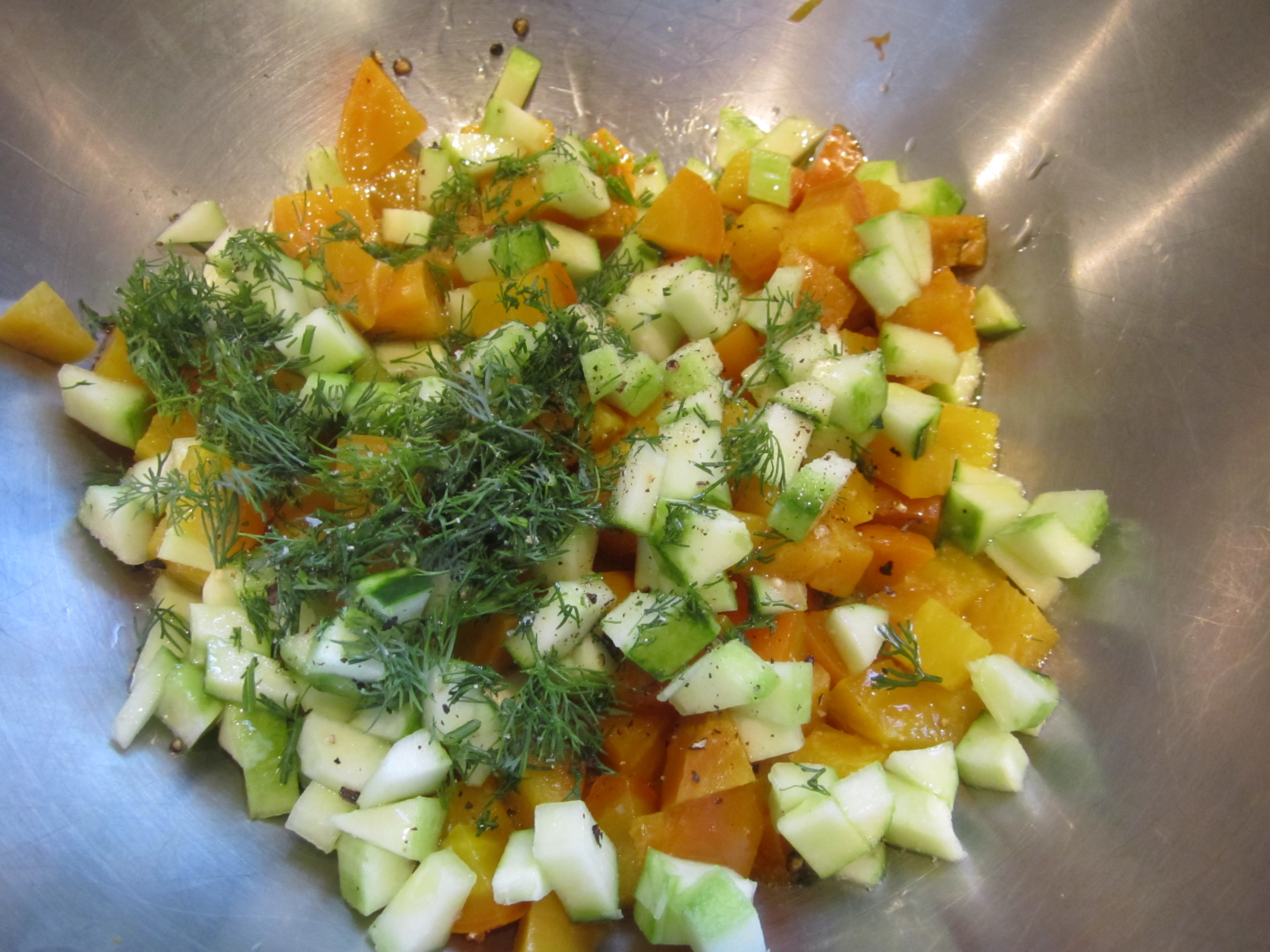
Today, one of my favorite farm stands, Halsey Farm, re-opened for the summer.  Their golden beets are the sweetest I’ve ever had.  Beets go well with nutty whole grains like farro, bulgur and quinoa. Cucumbers and dill are the perfect bright, green counterpart to the earthy sweet beets.

The dressing for this dish is olive oil and rice wine vinegar.  The rice wine vinegar provides a light, sweet acidity which balances all of the earthy flavors.  You could also substitute lemon juice for the vinegar, although I think the rice vinegar provides just the right sweet/sour note.

Needless to say, the dish can be made an hour or two ahead of dining and allowed to rest at room temperature.  It also keeps and serves well the next day straight from the fridge.  Preparation time is minimal, once the beets have been roasted.
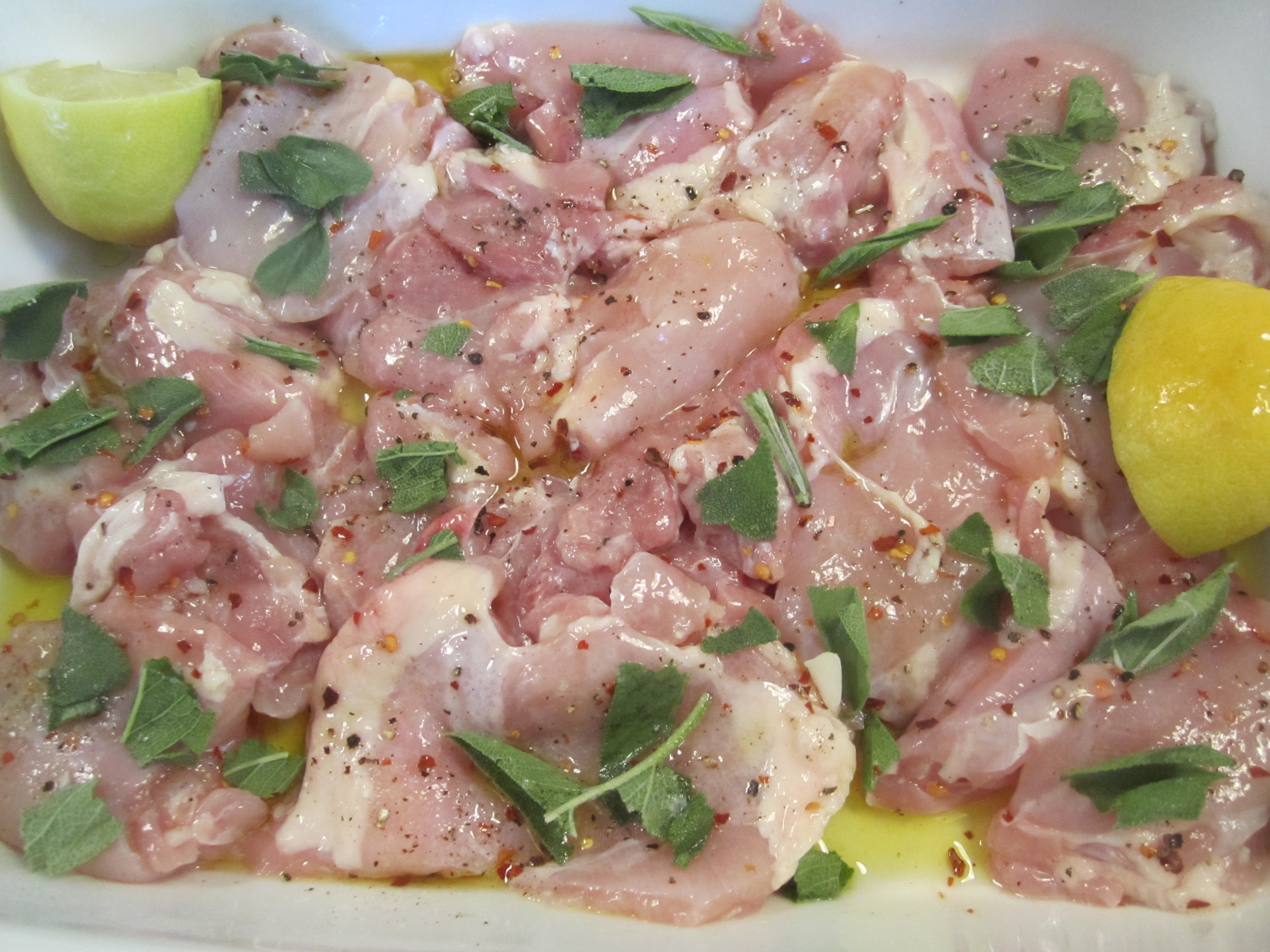
Tonight, as a main course, we’re having grilled chicken thighs.  Today, I’ve marinated them with sage, lemon, salt and chili flakes for five hours in the fridge.

Along with a fresh salad of oak leaf lettuce from my neighbor Beppi’s garden, this is the perfect summer meal.

Quinoa with Golden Beets, Cucumber and Dill

serves 4

1 c quinoa

1 1/2 c water

1/2 tsp salt

1 medium cucumber

4 medium golden beets

3 tbls extra-virgin olive oil

2 tbls rice wine vinegar

2 tbls chopped fresh dill

salt and pepper to taste

Wash and roast beets in foil packets in a 375-degree oven for about an hour, or until slightly soft.  You should be able to run a knife through the entire beet without any resistance.  Allow to cool about 20 minutes.  Peel by rubbing off skin with a paper towel.

Cut beets into 1/2″ dice and set aside.

In a pot of cold water, bring quinoa and salt to a boil.  Cover and simmer on low heat for 15 minutes.  Allow to rest until other ingredients are prepped.

Peel and remove the seeds from cucumber.  Dice into 1/2′ cubes.

Place beets, cucumber and dill in mixing bowl.  Dress with the oil, vinegar and some salt and pepper.

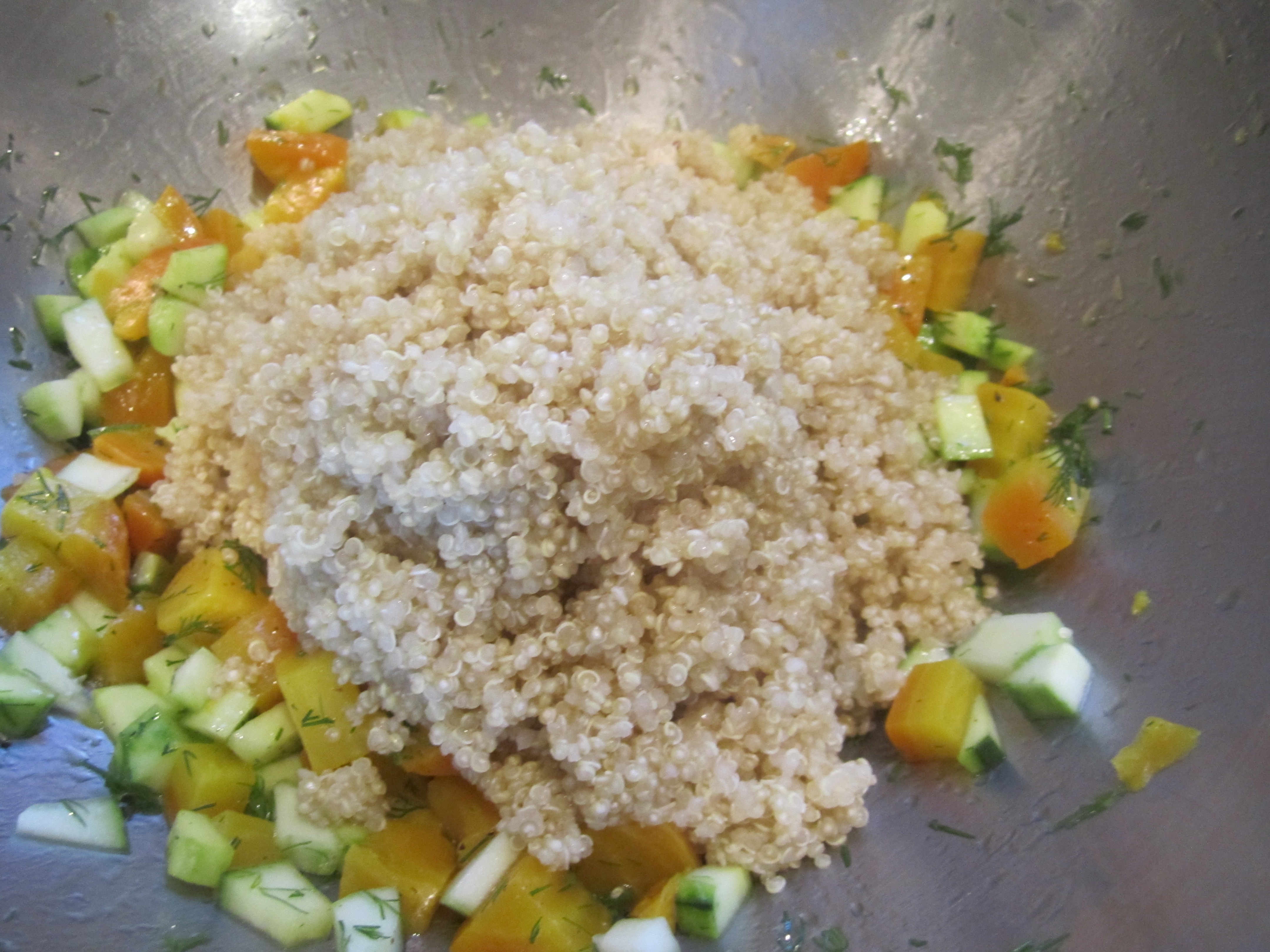
Add quinoa and stir to combine.

Taste again for salt and pepper.  Serve at room temperature within an hour or two.

Posted in Vegetables | 1 Comment

Pasta with Fava Beans and Speck

This past weekend, I had my 90 year-old neighbor Beppi and his family over for dinner.  Cooking for Beppi is always a challenge, since he was the owner of the former San Marco Restaurant, one of New York City’s only 3-star Italian restaurants (bestowed by Craig Claiborne of the New York Times).  His cuisine was refined and elegant, reminiscent of the Veneto region of Italy, where he was born and raised.

I decided to make my own version of a Southern Italian dish, with a bit of a northern Italian flare.  Since my mother was visiting, I decided to make one of her childhood dishes–pasta with fava beans. In my mother’s region (Calabria), this dish was typically made with pig skin, dried fava beans and water–not much else.  The finished dish was poured over dried bread, like a thick porridge.

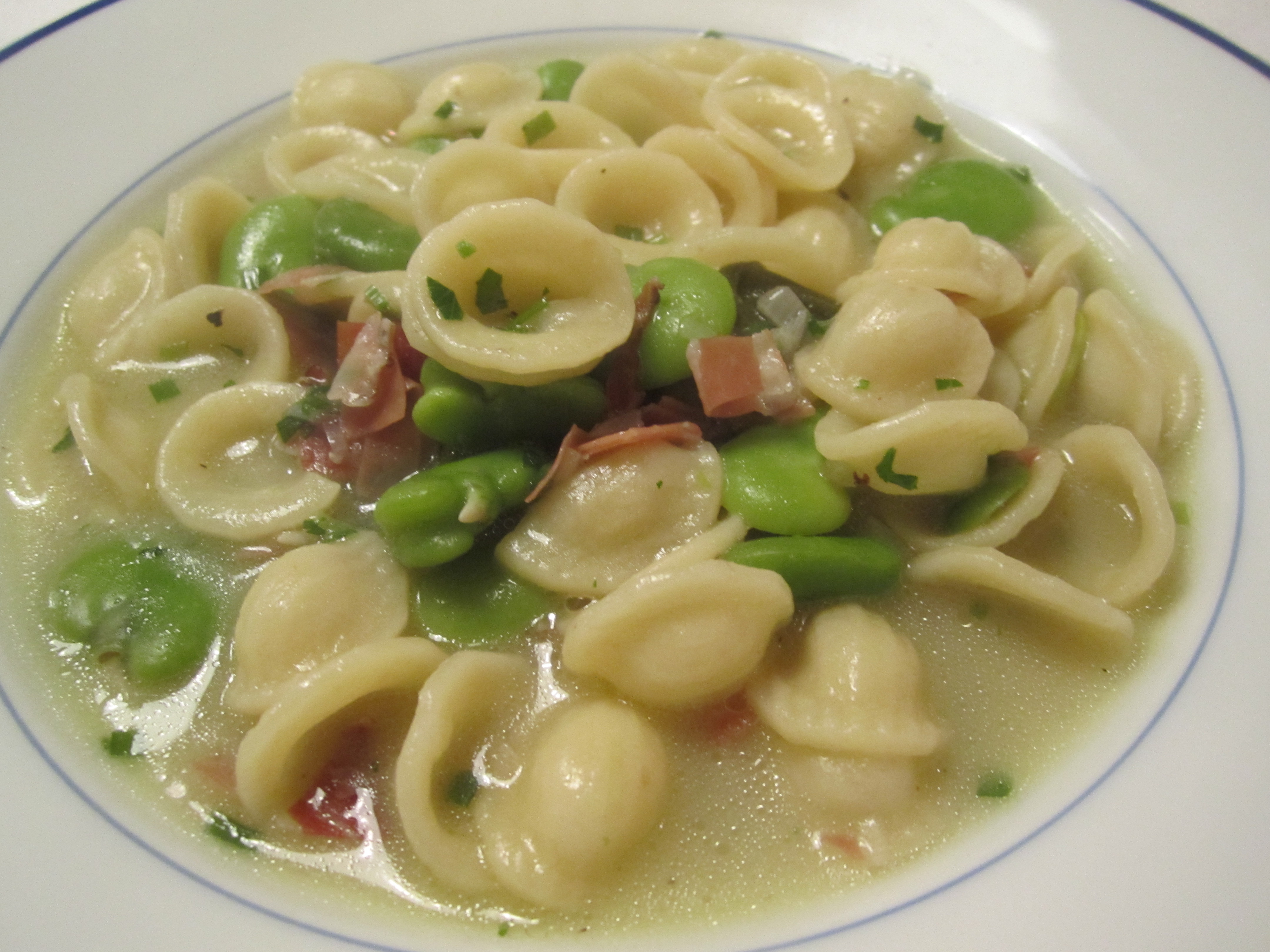
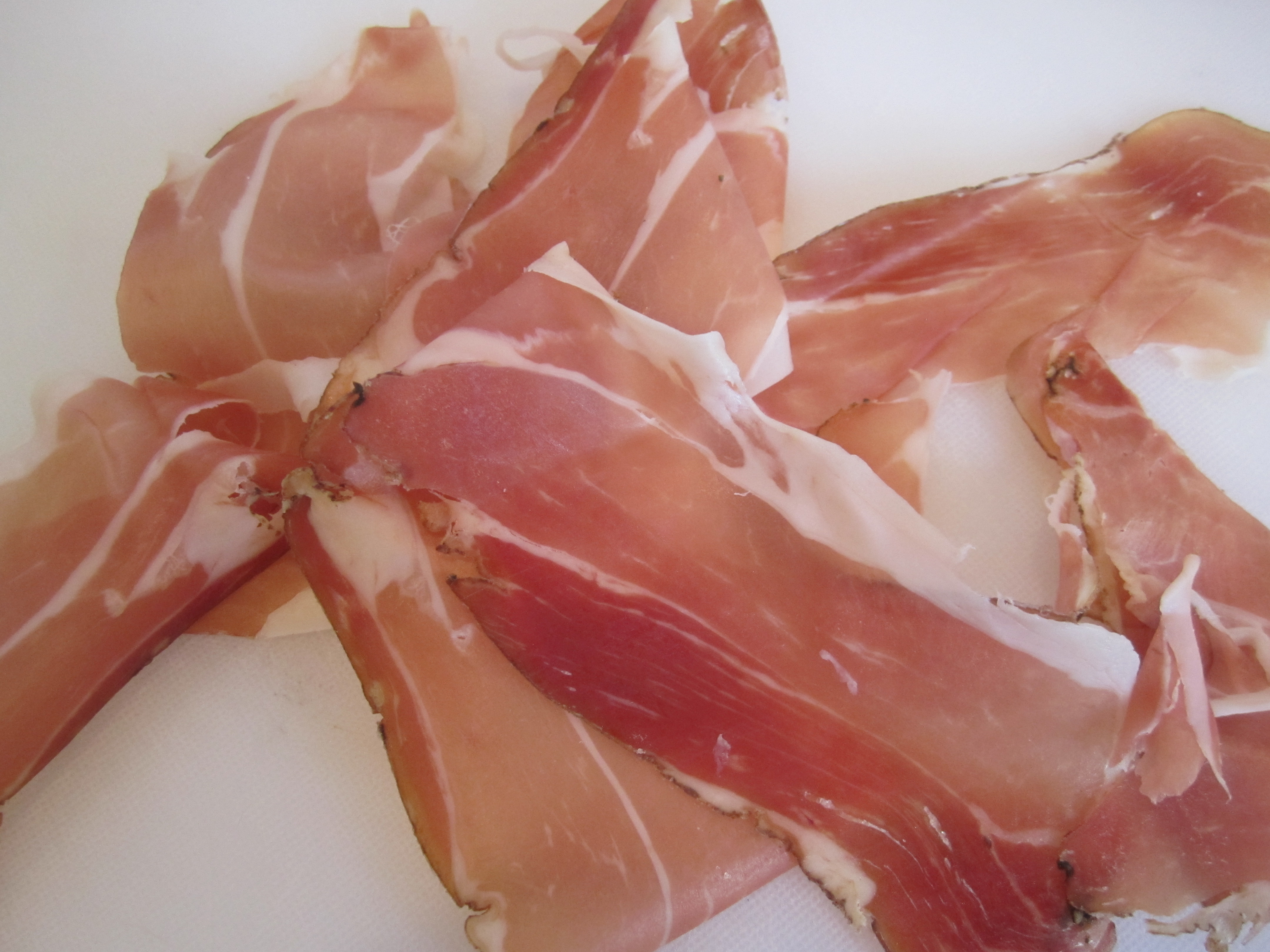
Tonight, I’m using speck, a german style cured pork, very similar to prosciutto, but a bit drier and with its own distinctive flavor.

In addition, I’ve added butter, sage and chicken broth.  This combination adds an earthy richness to many pasta dishes and soups.  The finished dish is heavily dusted with grated parmigiano.

The dish can either be made soupy or tighter, without so much liquid.  Since our weather took a turn for the cooler this past weekend, I made it on the soupy side.

I can tell when Beppi likes a dish and when he doesn’t (although he’s gracious to a fault, either way).  This dish met with his approval and some guests opted for seconds–which any cook appreciates.  It even met with my mother’s approval, despite her thinly veiled skepticism while I prepared the dish (“we never used grated cheese or butter with beans . . . we never cooked much with sage . . . “)

Enjoy this dish while fava beans are in season–the fresher the beans, the brighter the flavor.

Pasta with Fava Beans and Speck

serves 6

1 lb orrechiette

2 lbs fresh fava beans, shucked, blanched and peeled

1/4 lb speck (or prosciutto), thinly sliced, cut crosswise into 1/2″ ribbons

2 medium shallots, chopped finely

12 sage leaves torn in half

1 stick butter

1 c chicken broth

2 tbls freshly chopped parsley

1 tbl freshly chopped chives

grated parmigiano for sprinkling

salt and black pepper to taste

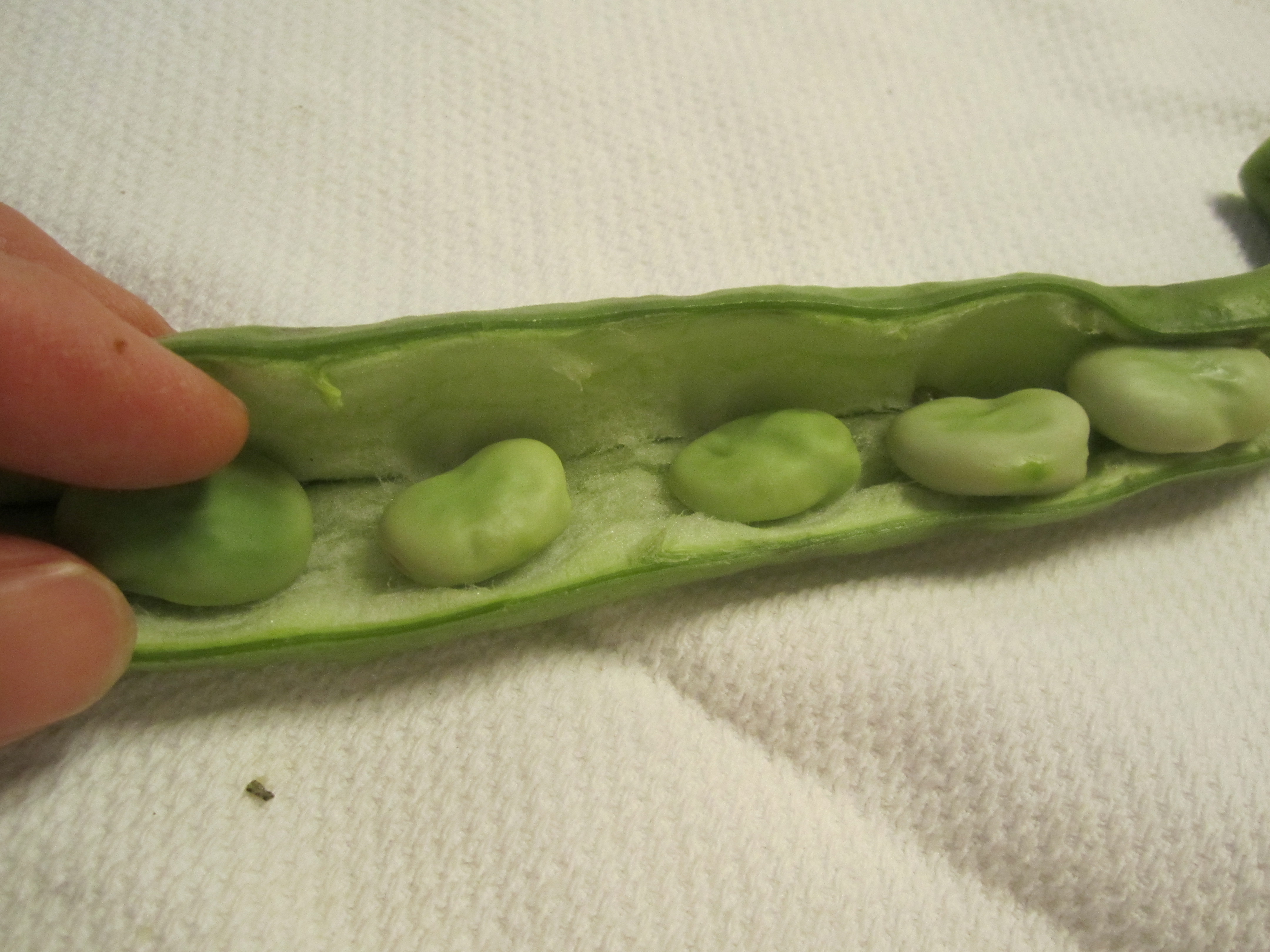
To begin, clean and peel the fava beans:  each fava bean pod must be split by hand (not with a knife or you’ll bruise the beans inside) and the beans inside removed (scrape them out with your fingers–they pry out easily enough).

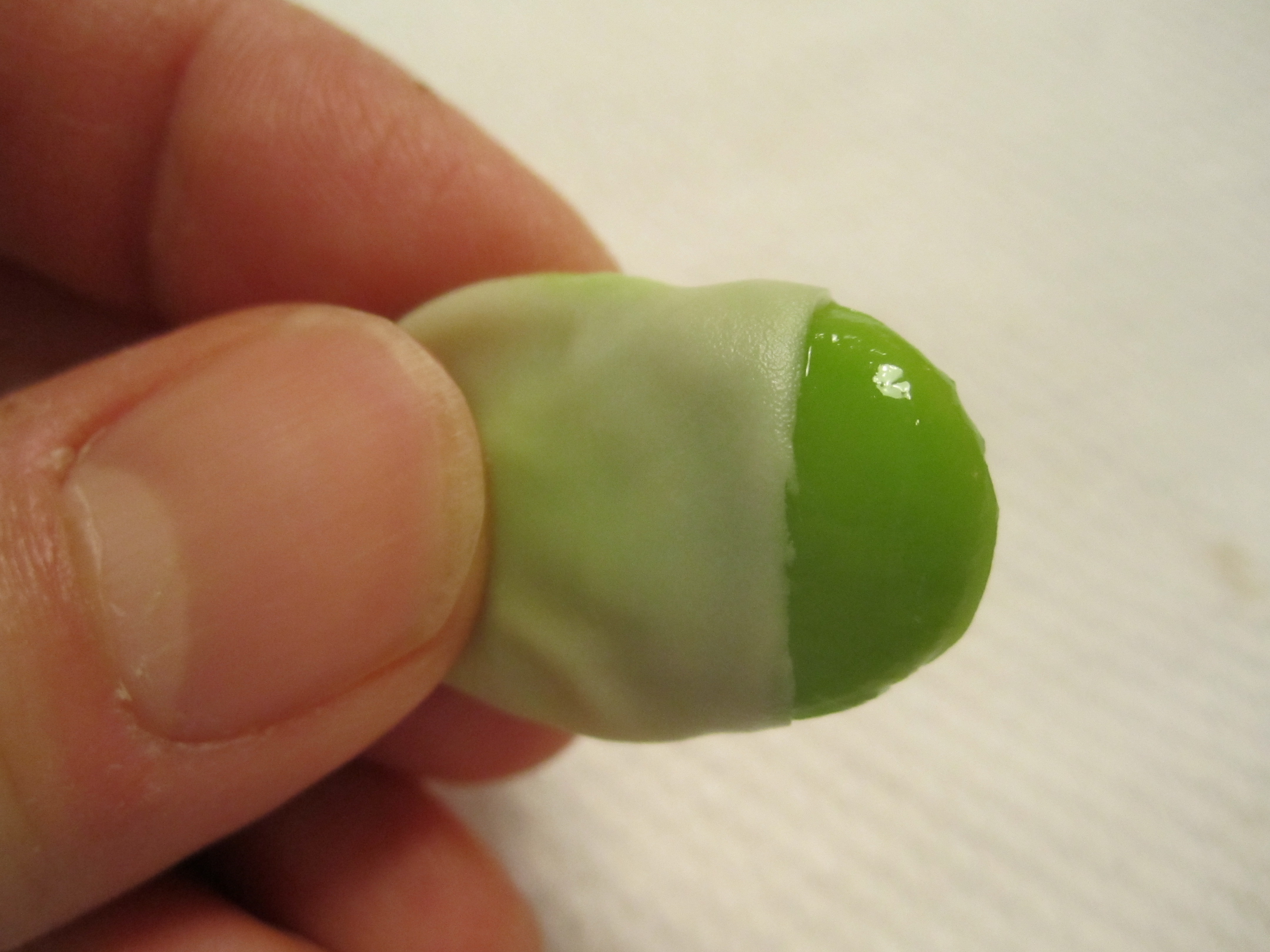
Then blanch the shucked beans in boiling water for about a minute.  Then shock in cold water for a few seconds, so the beans are cool enough to handle.  Next, take each bean and pinch a slit on one side.  Note:  there is already an apparent “opening” in the bean from which it appears the bean is beginning to burst.  Although it seems counterintuitive–that is NOT the place to try to pinch and extract the bean. It’s easier to pinch the opposite end of the bean, then the bright green bean will slip right out.

After peeling all the beans, proceed with the recipe below.

Boil water for pasta, add a couple of tablespoons of salt, then cook pasta.

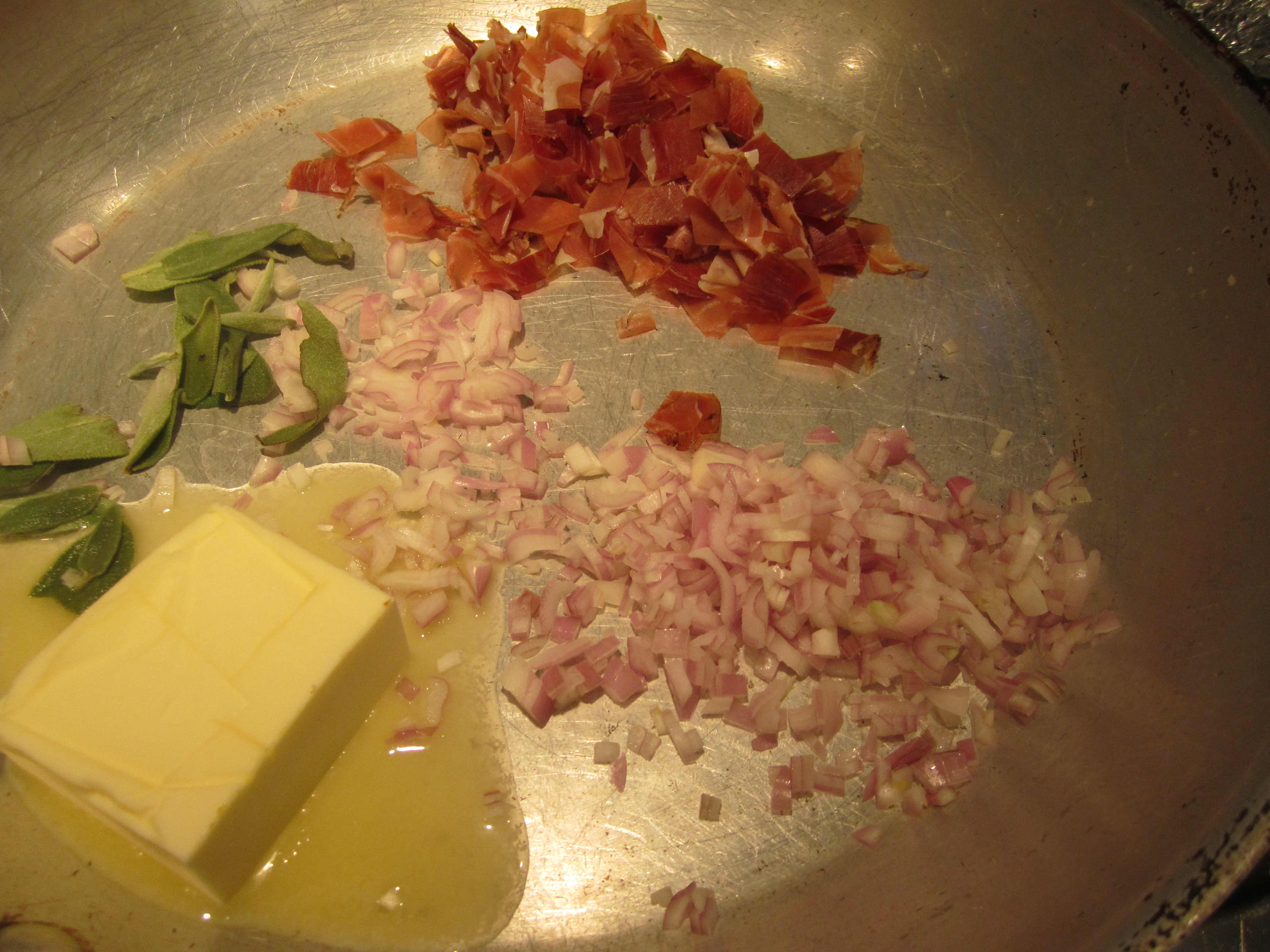
While the pasta boils, in a large skillet, combine the shallots, speck, butter and sage.  Bring to a simmer on low heat to soften shallots and render speck.

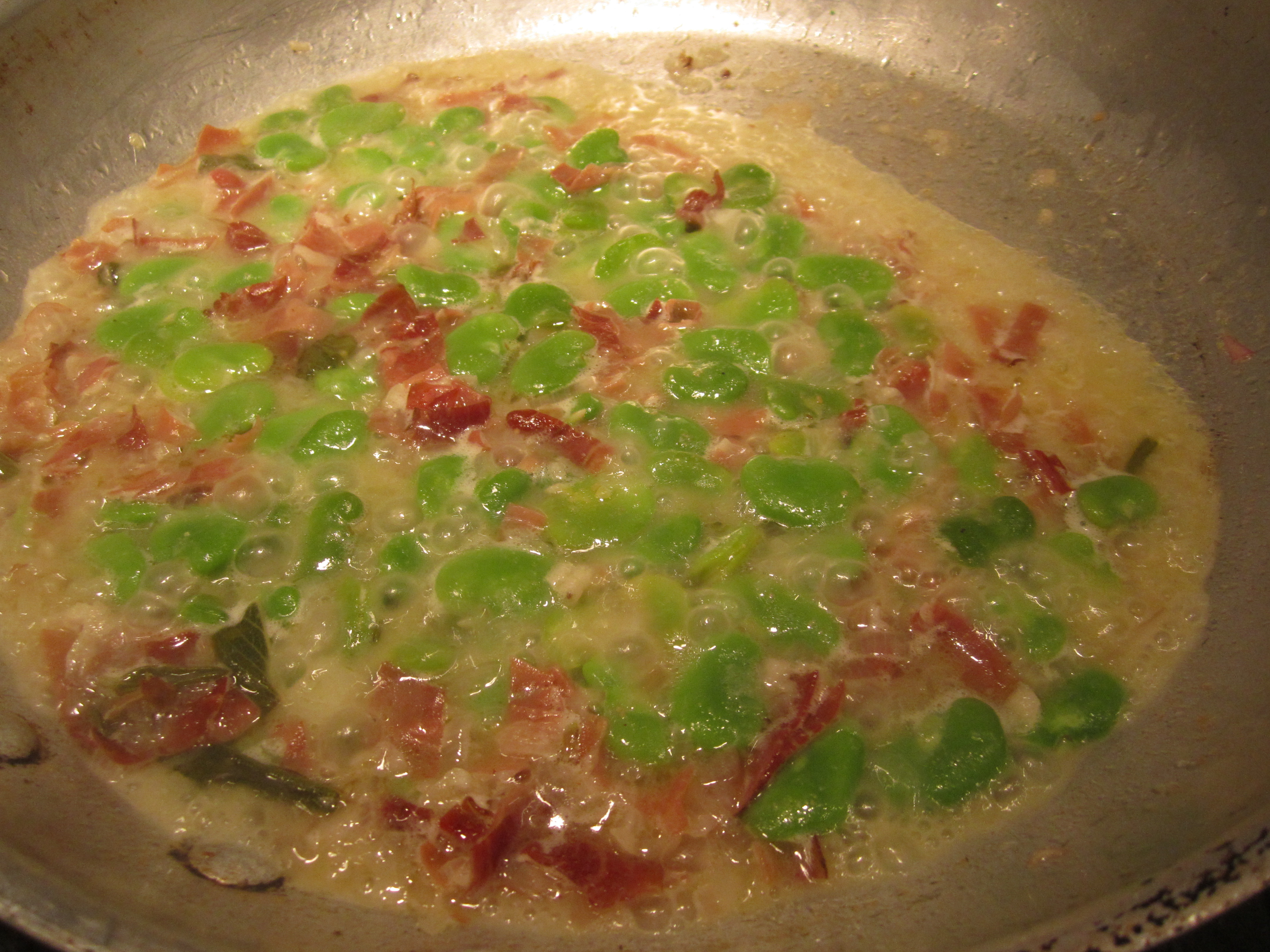
After about 4 minutes, add chicken broth and cleaned, peeled fave.  Simmer, uncovered until pasta is cooked.

Add chives, parsley and pasta.  Stir and add another cup (or more) of salty pasta cooking water.

Serve in heated bowls with immediately.

Top with plenty of grated parmigiano.

Posted in Pasta | Leave a comment

Mom’s Squash Flower Fritters

Squash flowers are a fleeting delicacy that emerge with the new summer crops of all the winter squash (acorn, butternut, etc.).  They must be picked and cooked on the same day, or at most, the next day–they wither and die very quickly.  For this reason, they’re difficult to find at markets, even farm stands.

My mother is visiting from New Jersey and one of her friends who knows how much I love the flowers, has sent me a magnificent bounty of them from her garden.

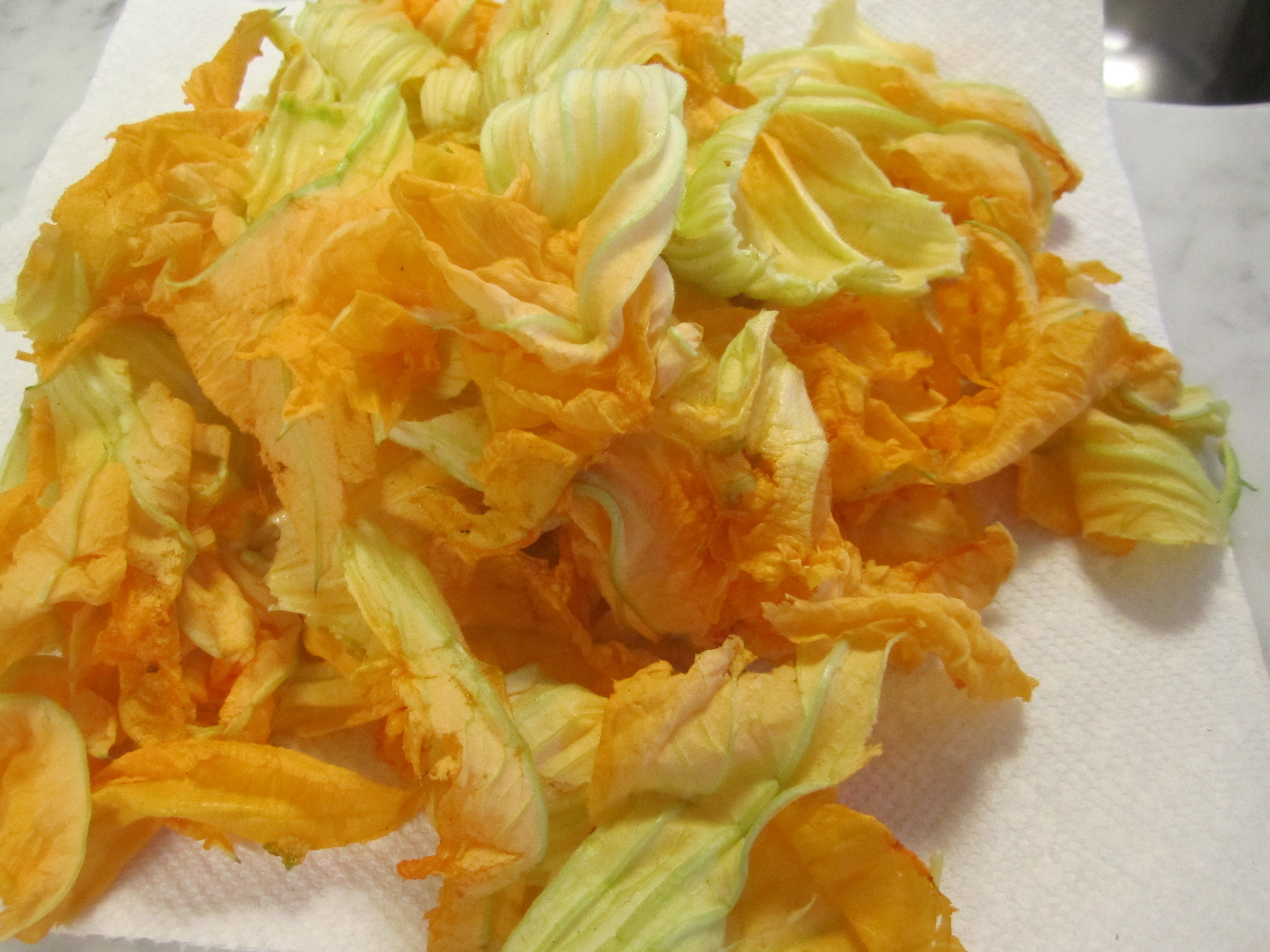
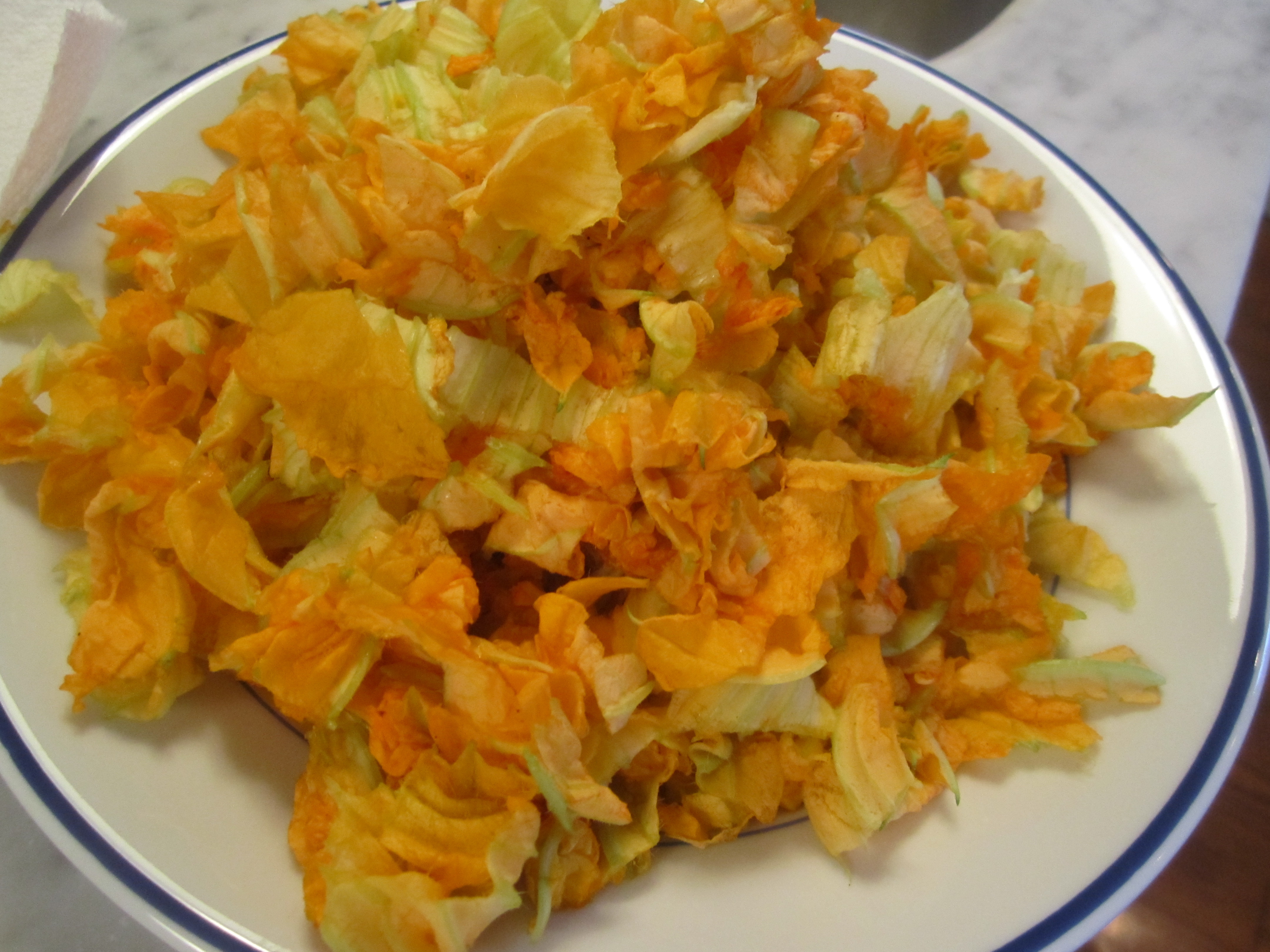
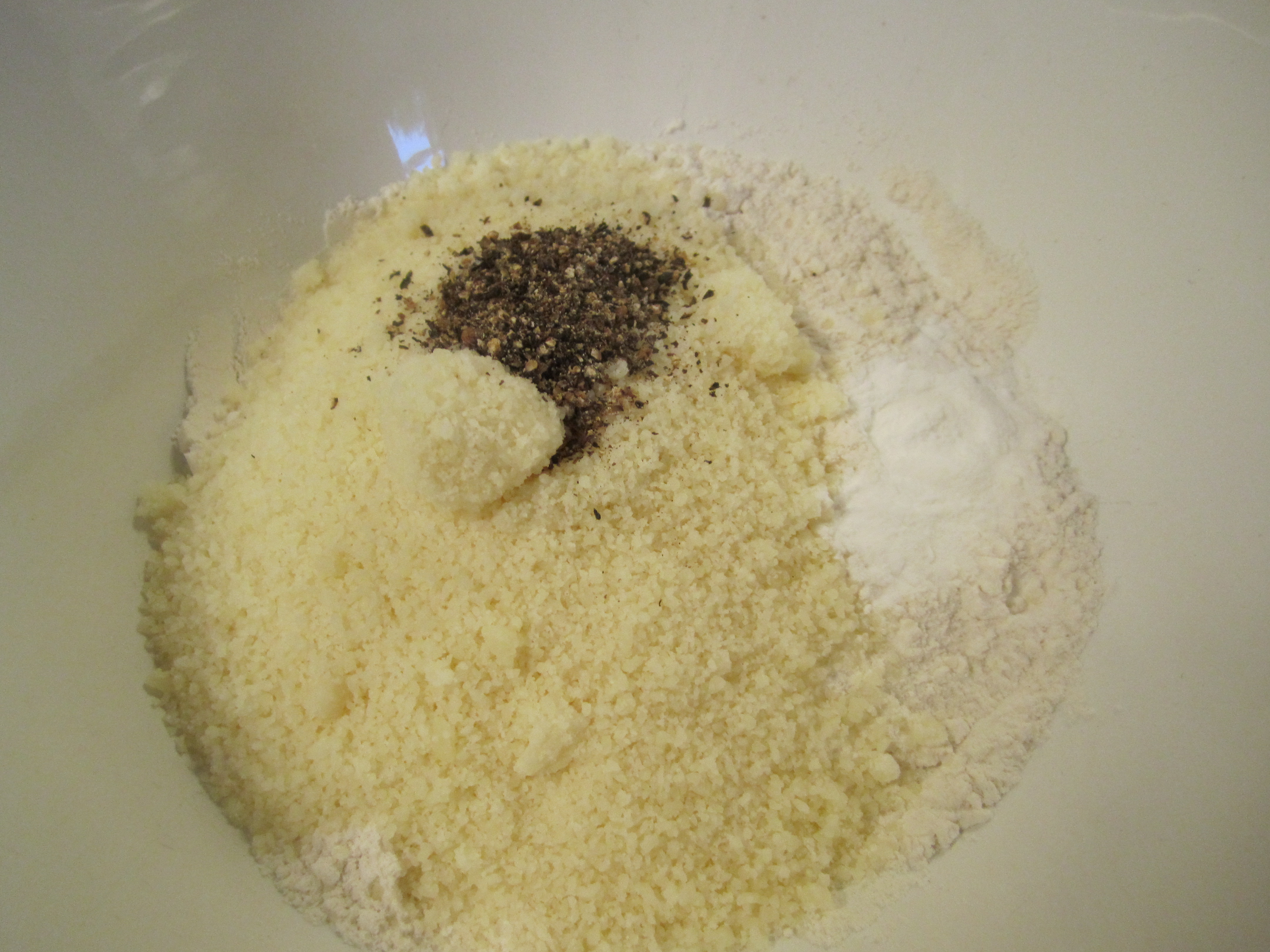
She begins by making a simple pancake-type batter of flour, eggs, baking soda and grated pecorino romano cheese.  The flowers are clipped into small pieces with scissors (my mom maintains that they’re too delicate to chop with a knife) and added to the batter.  The orange-flecked batter is dropped by the heaping tablespoon into hot extra-virgin olive oil and fried until golden and puffy.   Like pancakes, they’re best eaten hot.

Mom’s Squash Flower Fritters

makes about 20 fritters

3 c tightly packed squash flower petals (the yield from about 5 cups of whole flowers)

1 1/2 c flour

3 large eggs, beaten

3/4 c grated pecorino romano 

1 tsp baking soda

2 tsps salt

1 tsp black pepper

Open the flowers to reveal the base and heart.  Peel away and remove the petals.  Discard the base and heart.

Snip the petals into small pieces (approximately 1″)

In a separate bowl, blend dry ingredients, then add beaten eggs.

Drop by the heaping tablespoon into hot oil.

Begin frying on high heat and lower slightly if they become golden too quickly–they should take about 3 – 4 minutes per side to become golden and puffy.

Posted in Vegetables | 1 Comment

Beppi’s Luganiga Sausage with Mushrooms and Polenta

This dish came by way of my 90 year-old neighbor, Beppi.  In the Veneto, Beppi’s region of Italy, polenta is eaten quite often, if not daily.

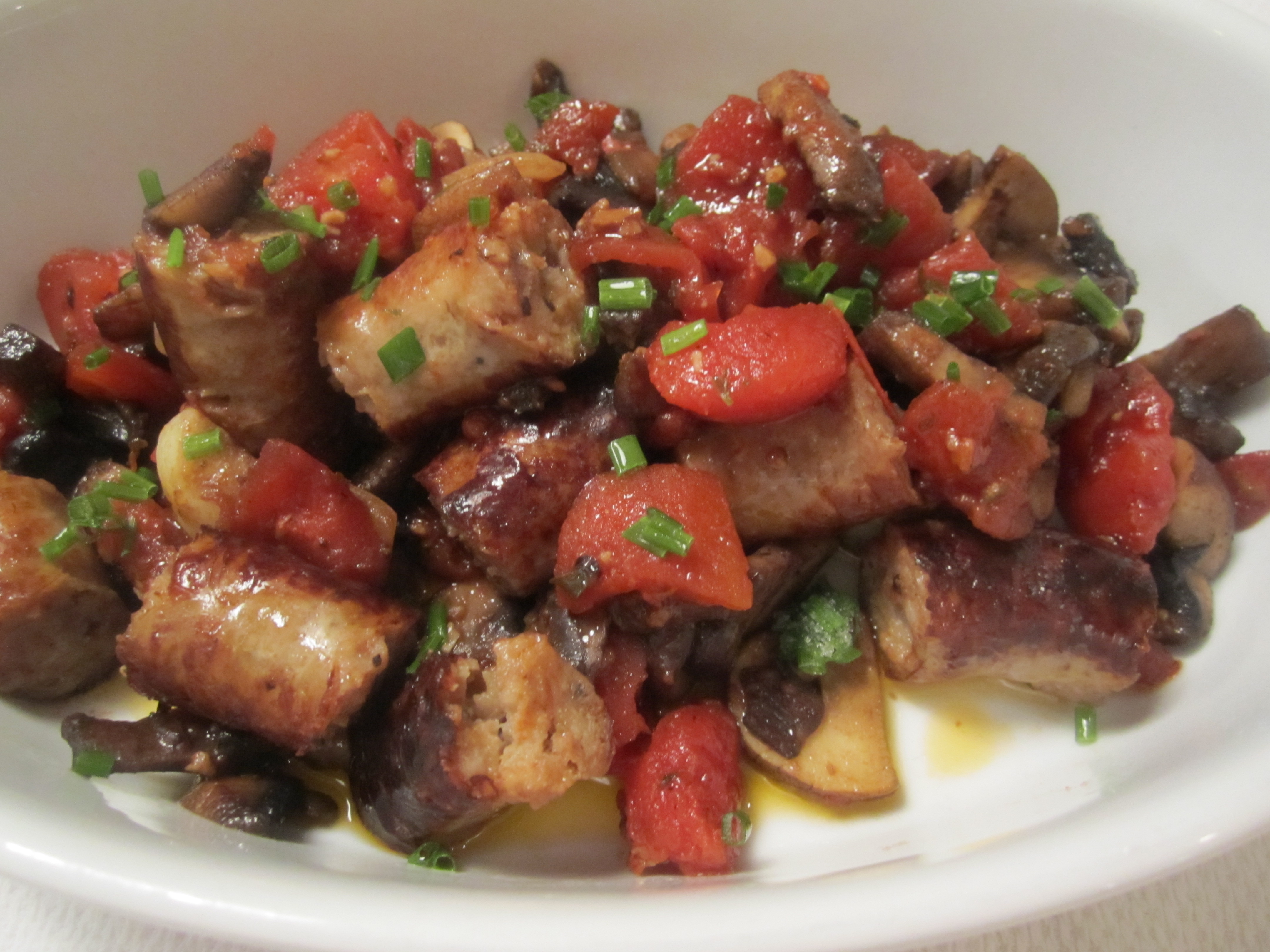
When Beppi makes polenta, I’m usually the recipient of a nice portion of it.  This week, along with the polenta, he gave me a sample of his luganiga sausages, sauteed with mushrooms and a touch of tomato–they were absolutely delicious!   I asked him his recipe, which he graciously (as ever) gave me.  This is my approximation of Beppi’s recipe from his description.

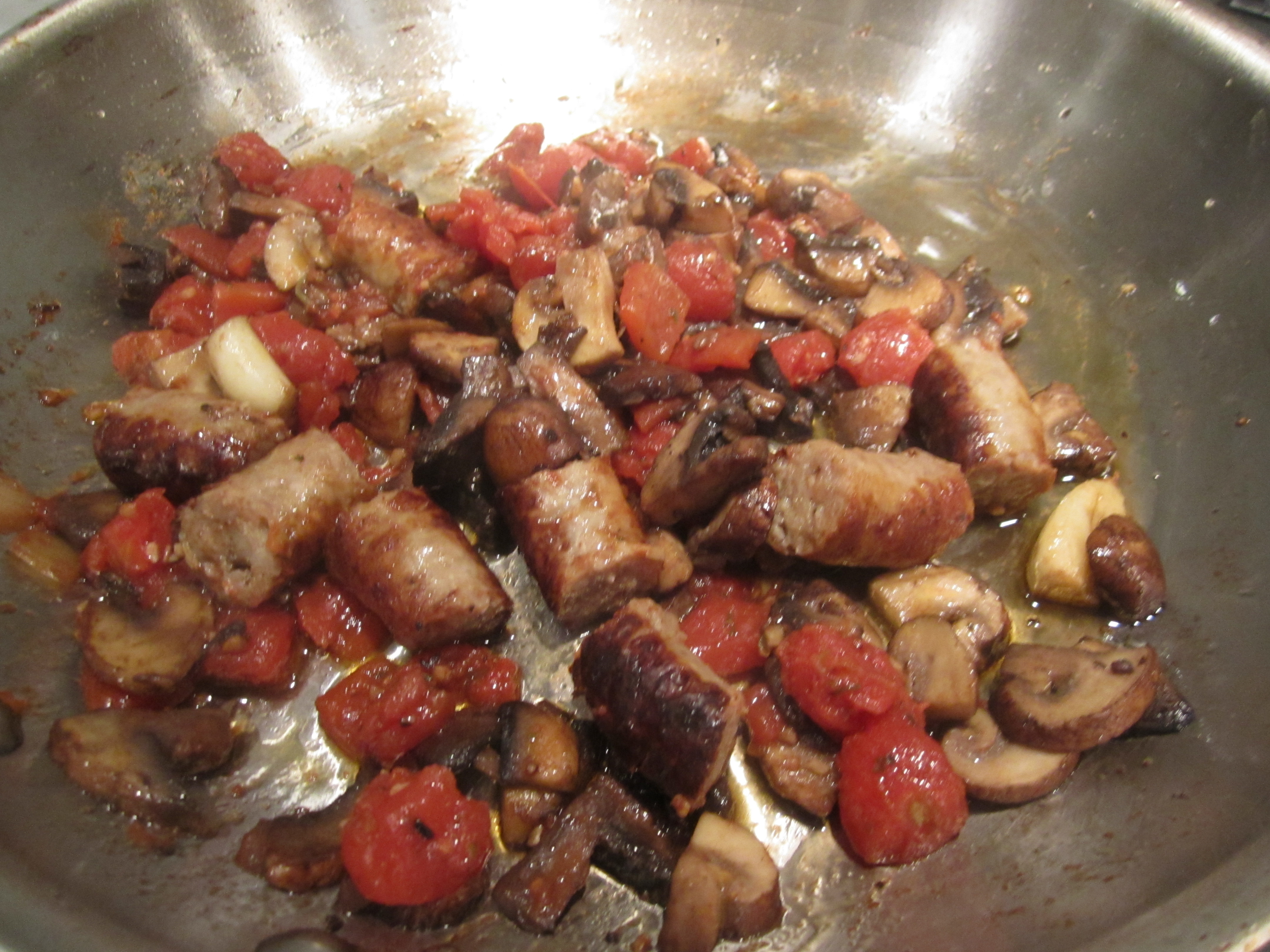
Luganiga sausage, you may recall from my prior posts, is a thin, delicate pork sausage, sold in a ring.  Beppi takes the entire ring and lightly browns it in a skillet on low heat for about a half-hour.  Then he sautes mushrooms and diced tomatoes, then stirs in a spoonful of his homemade pesto at the end.

Since I don’t currently have pesto in my freezer (although, by the looks of Beppi’s basil plants, that will soon be remedied), I chose to add a handful of chives to give my sausages a nice green color and flavor.  In addition, I sauteed some sliced garlic, along with the mushrooms.  Beppi is allergic to garlic, otherwise, I’m sure he’d approve of garlic with mushrooms.

I was lucky enough to have Beppi’s polenta as a base for my dish.  Beppi uses instant polenta, but cooks it for 20 minutes, rather than the 5 minutes recommended on the package.

I happened to have some cooked luganiga sausage in my freezer, so I was able to make this dish in about 15 minutes.  Otherwise, the total prep time would be a half-hour–the mushroom mixture would be made while the sausage browns.  This evening, I was cooking for two, but I’ve given you the proportions for four, based on one ring of sausage.

Beppi’s Luganiga Sausage with Mushrooms and Polenta

serves 4

1 ring of luganiga sausage, lightly browned on both sides, cut into 2″ links

3/4 lb fresh cremini mushrooms, wiped with a damp cloth to remove any loose soil, cut in half, then sliced crosswise into 1/4″ slices

2 cloves garlic, sliced

3 tbls olive oil

1 15-oz. can of diced tomatoes, drained in a strainer

1 tbl fresh chopped chives

salt and pepper to taste

polenta

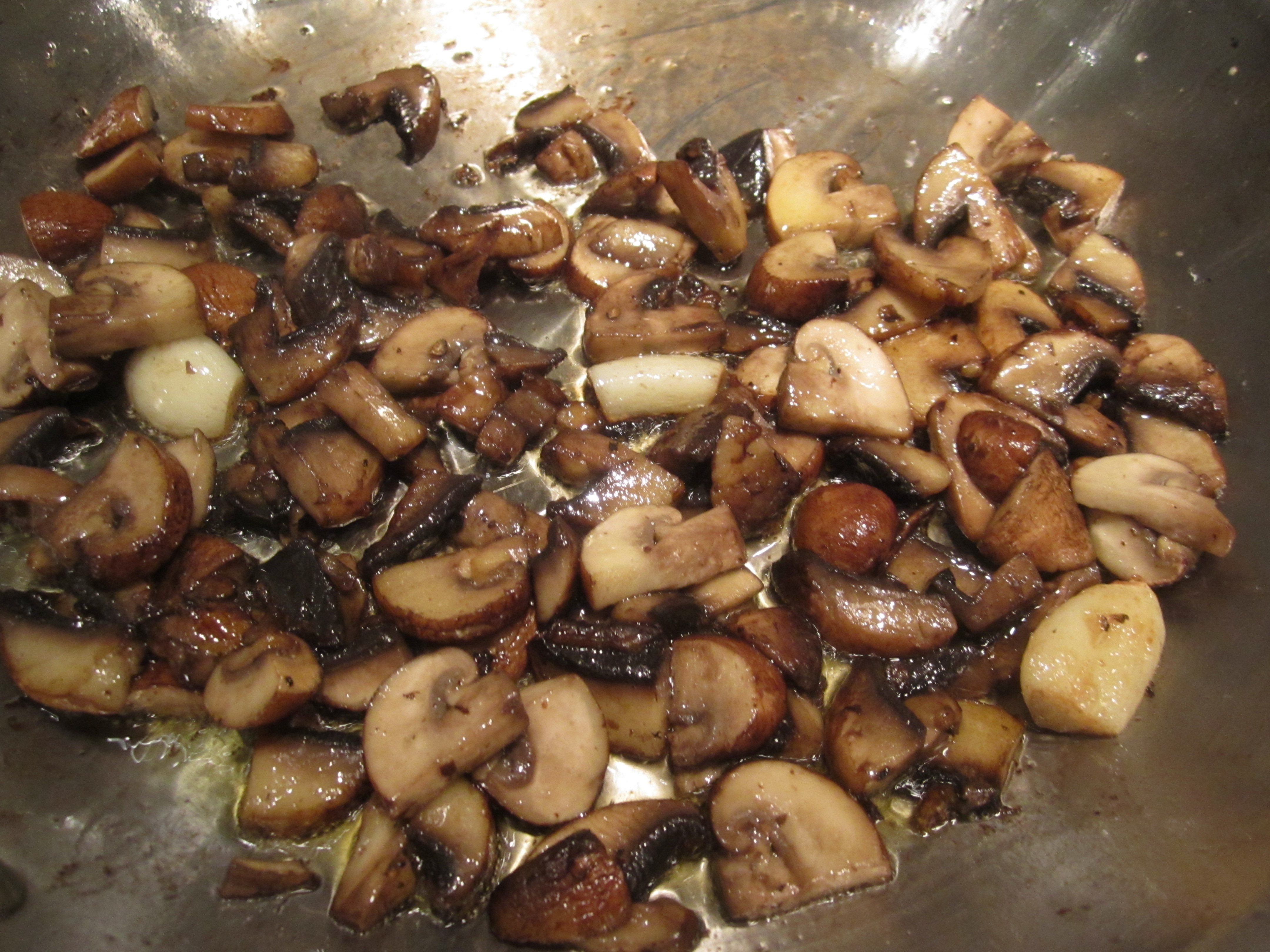
In a skillet on low heat, lightly brown the garlic in the olive oil for about a minute.  Turn heat to high and add mushrooms.  Toss and saute for about 4 – 5 minutes on high heat.  Add salt and pepper to taste.

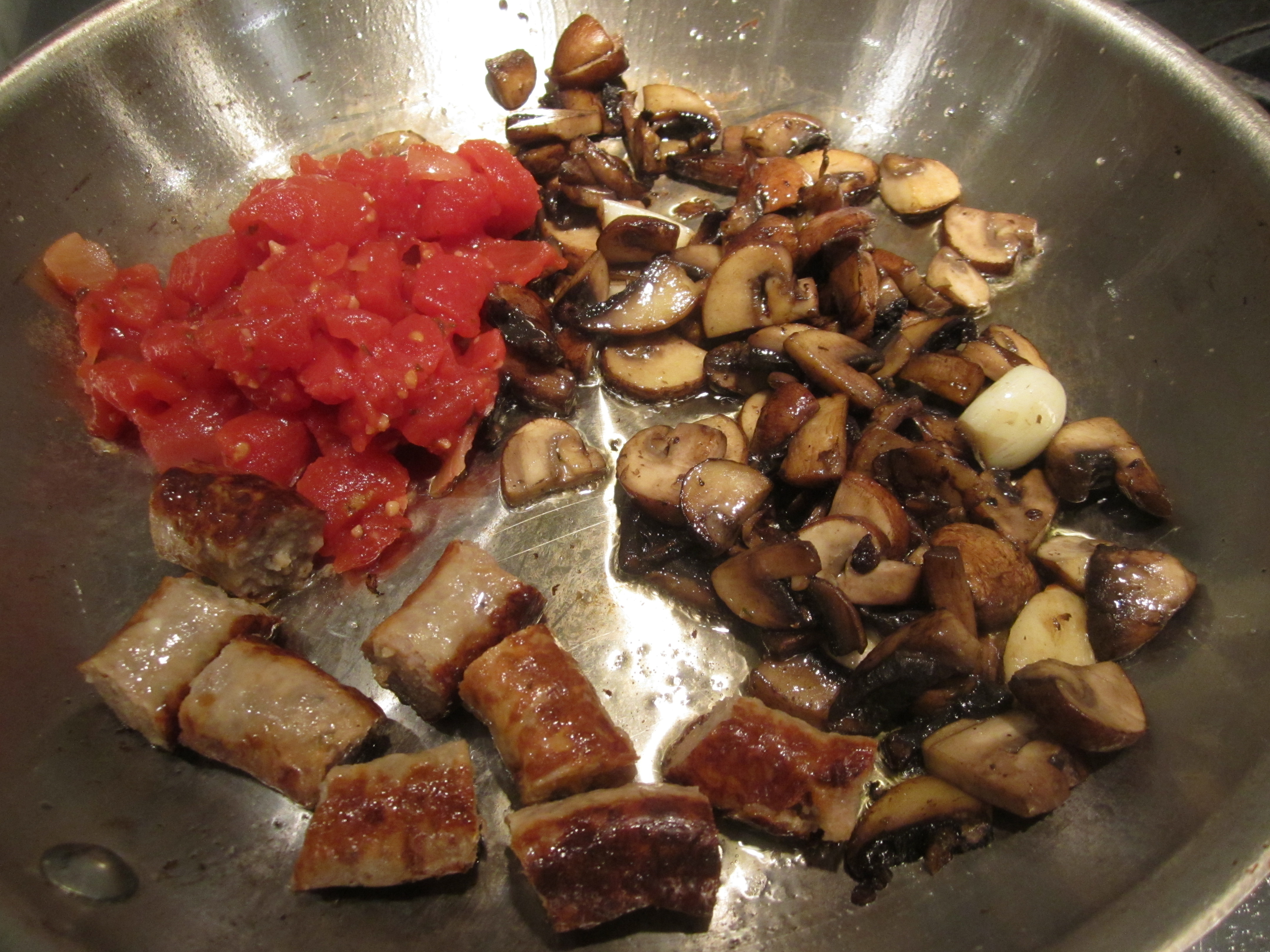
Add cooked sausage and tomato pulp (save the liquid for another use).

Cover and simmer on low heat for about 10 minutes.

Sprinkle on chives and serve over polenta.

Posted in Meat, Sauces, Uncategorized | 3 Comments

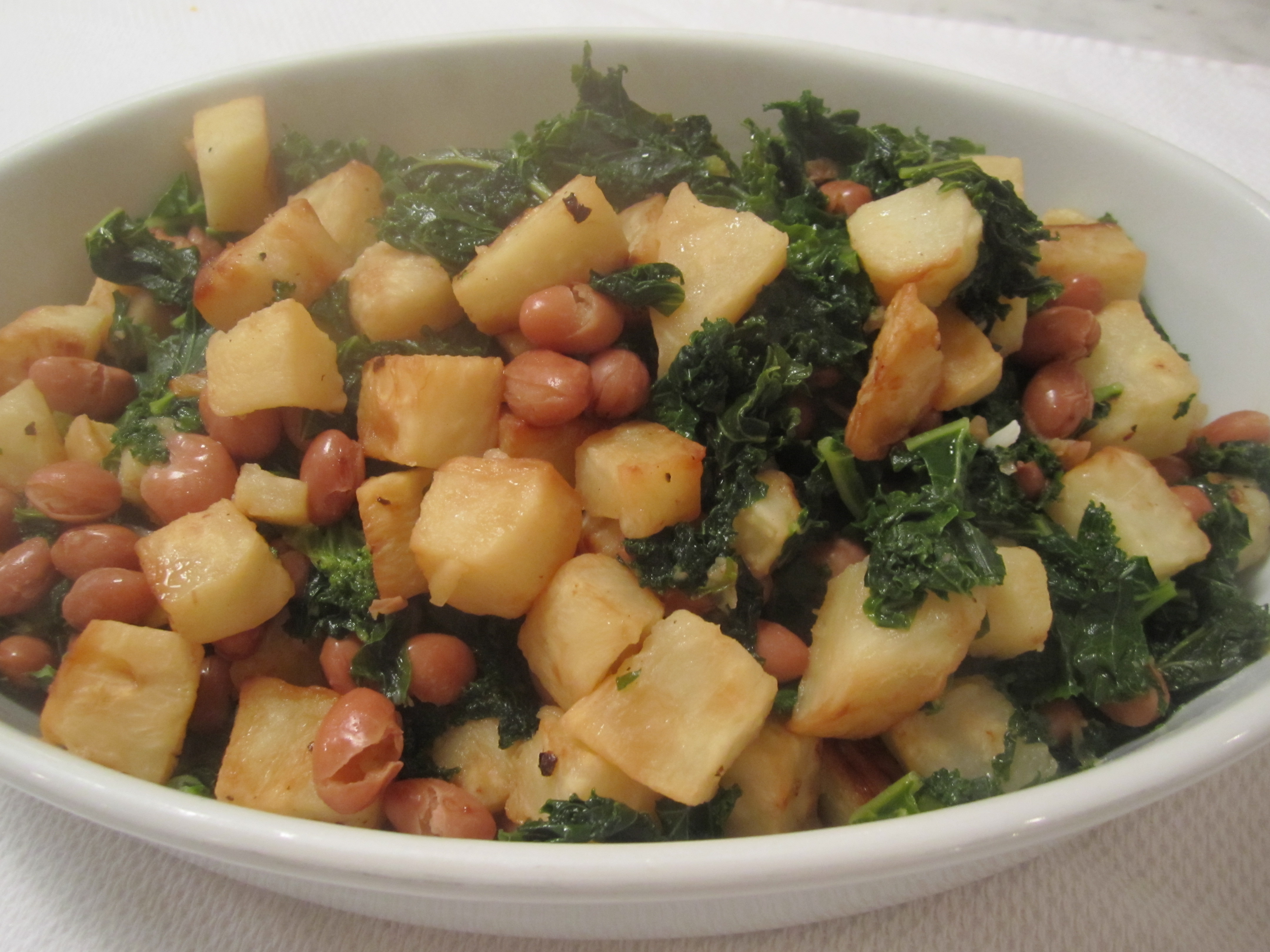
Caramelized Celery Root with Kale and Cranberry Beans

This is a great, nutritious combination that goes well with simple grilled meats or fish.  Celery root is available year round and, like most root vegetables, despite its dirty, craggy exterior, what’s inside is sweet and complex.

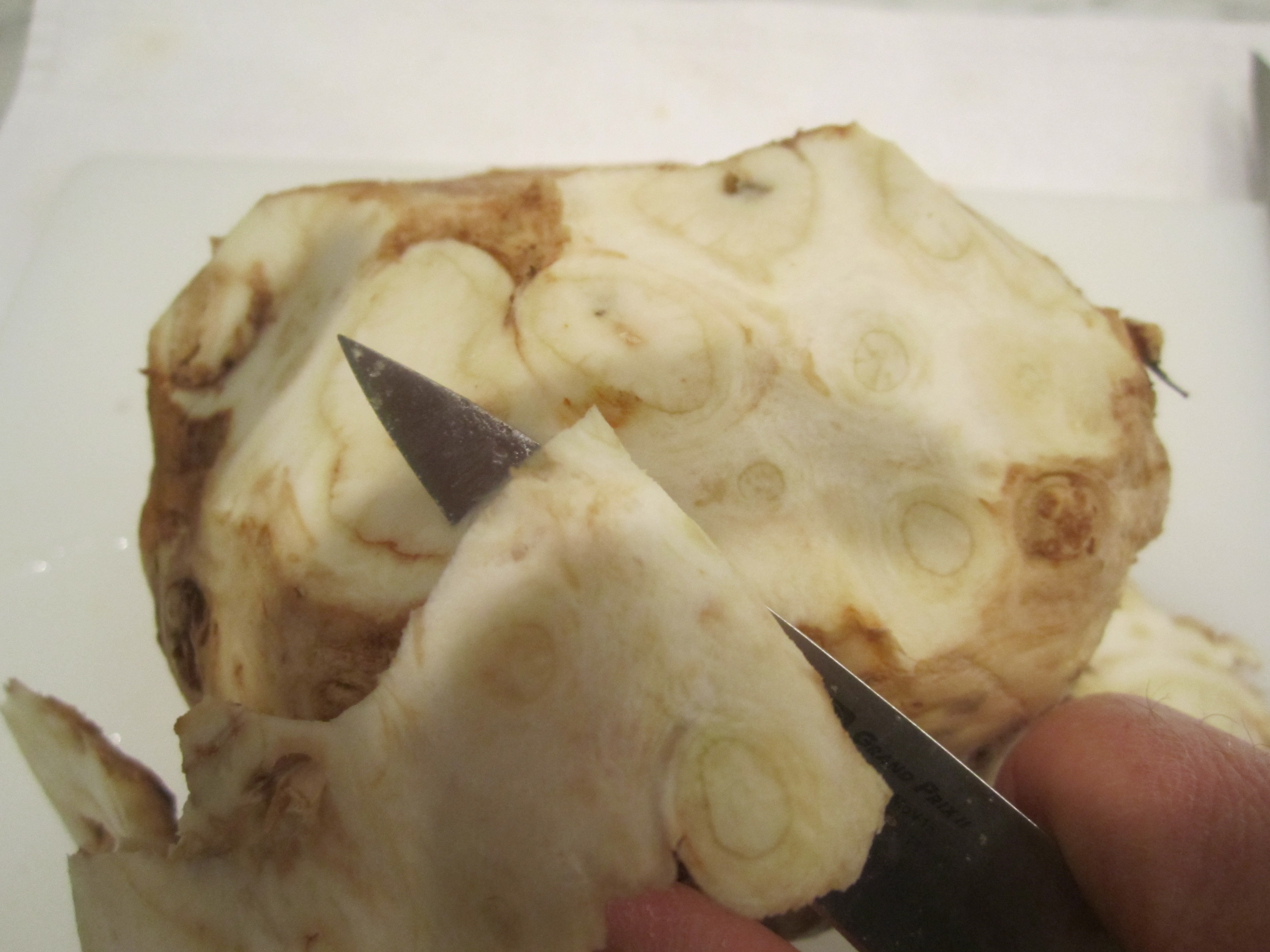
The dish begins with peeling the celery root, so that all the rough, irregular exterior is removed, to expose the white flesh underneath.

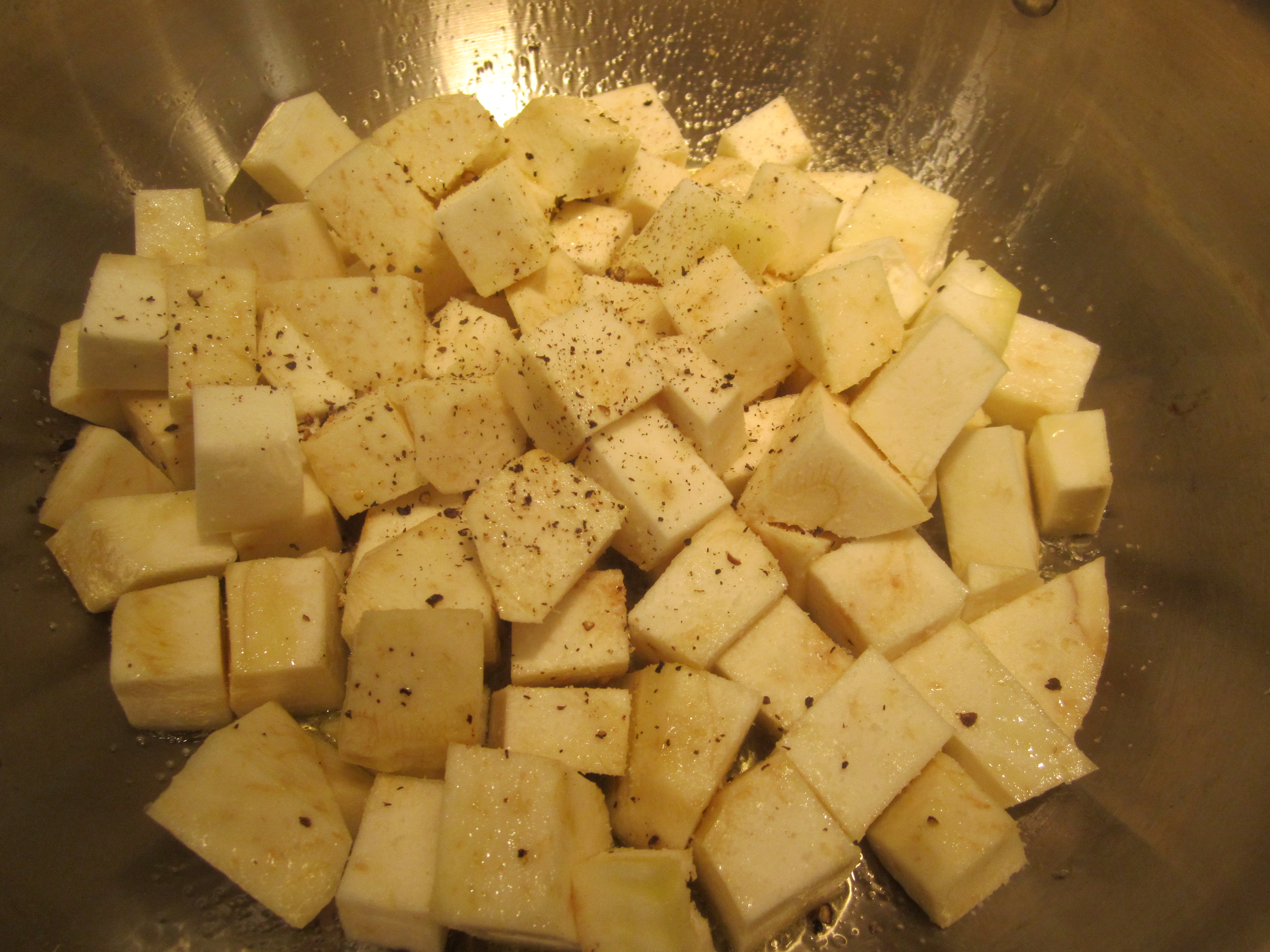
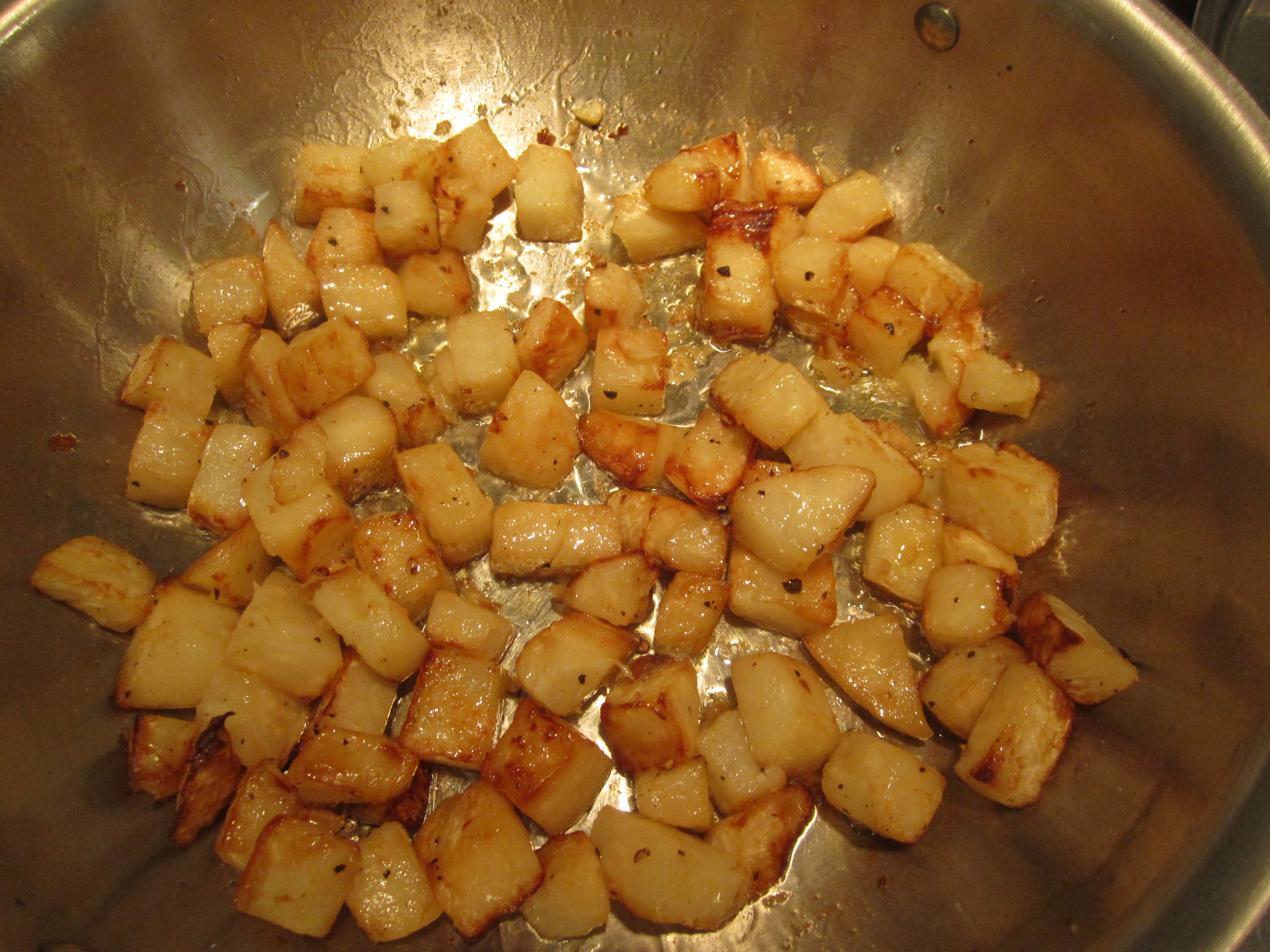
Like potatoes, it must be peeled at the last minute, or else it will blacken quickly at room temperature.  The root is sliced and diced into 3/4″ cubes which are immediately placed in a skillet of heated olive oil.   The skillet is covered to allow the cubes to steam and soften while they become caramelized.  Toss every couple of minutes–you’ll smell the wonderful aroma of caramelization very quickly.

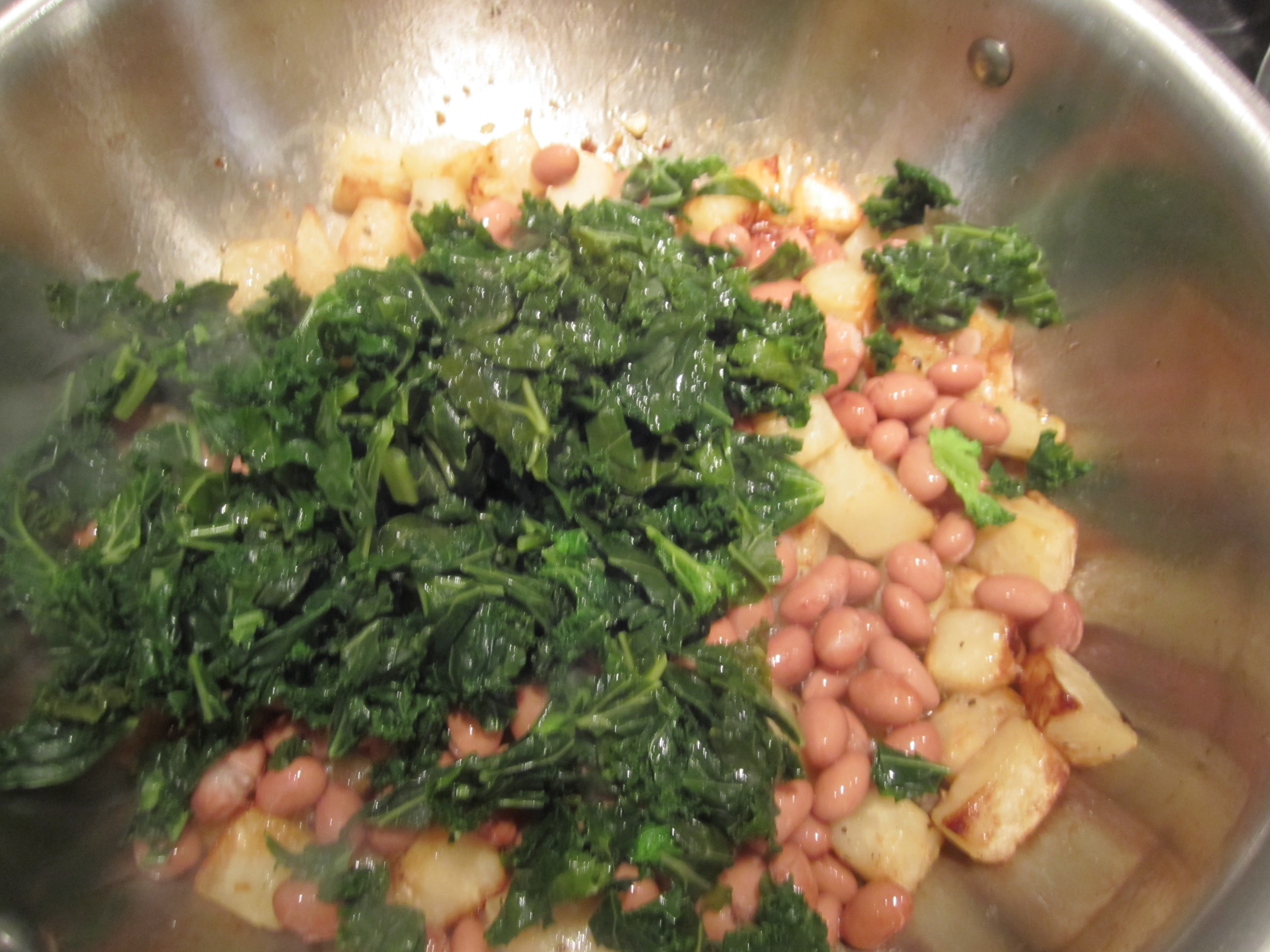
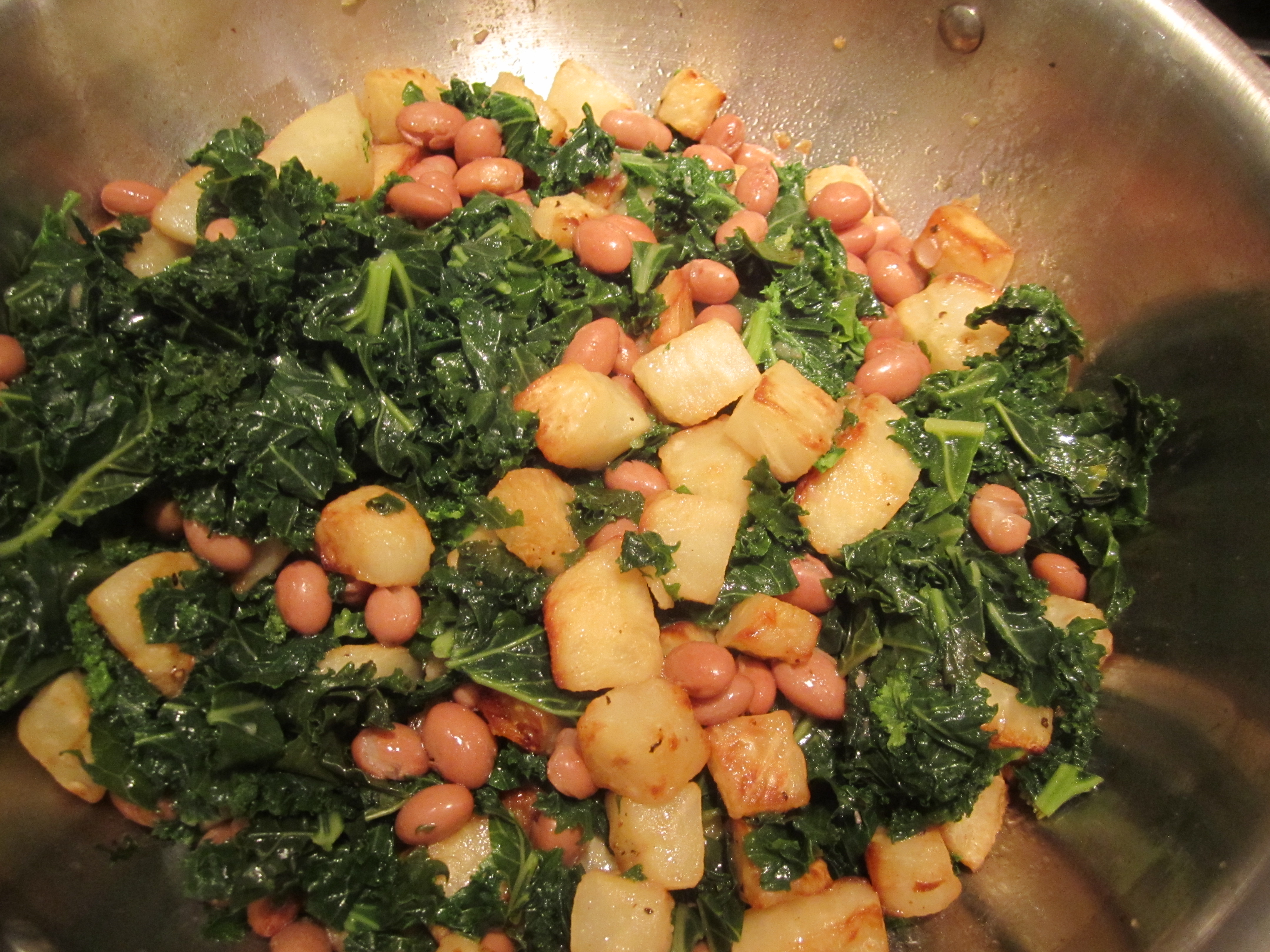
Once the root is golden and mostly soft, add a can of cranberry beans (or fresh beans that have been boiled to al-dente firmness), and a bunch of cooked kale.  A bit of chicken broth brings all the flavors together and helps the kale and beans heat through.

Tonight, we had this dish with pan roasted salmon (for salmon cooking technique, see salsa verde with pan roasted salmon) and some plain boiled arborio rice.

This is a good side dish for company because it’s ingredients are all very sturdy–the celery root can be caramelized ahead of time, then the kale and beans heaped on top until ready to heat and serve.

Caramelized Celery Root with Kale and Cranberry Beans

serves 4 as a side dish

1 celery root, approximately 5″ – 6″ in diameter

3 tbls extra-virgin olive oil

1 15-oz. can of cranberry beans

1 bunch cooked kale leaves (stripped from tough stems, sliced into 1/2″ ribbons, dropped into salted, boiling water for 5 minutes, then drained in a strainer)

1/2 c chicken broth

salt and pepper to taste

Peel celery root and dice into 3/4″ cubes.   Heat oil on high in a skillet large enough to hold all ingredients.  Add celery root and lower heat to medium.  Sprinkle with salt and pepper and cover.

Stir and shake every couple of minutes until golden and tender–about 15 – 20 minutes.

Add beans, kale and broth and cover for another 5 minutes.

Cook, uncovered until most of the broth has evaporated and everything is nicely combined.  Add salt and pepper, if necessary–lots of black pepper is good here.
Posted in Vegetables | Leave a comment

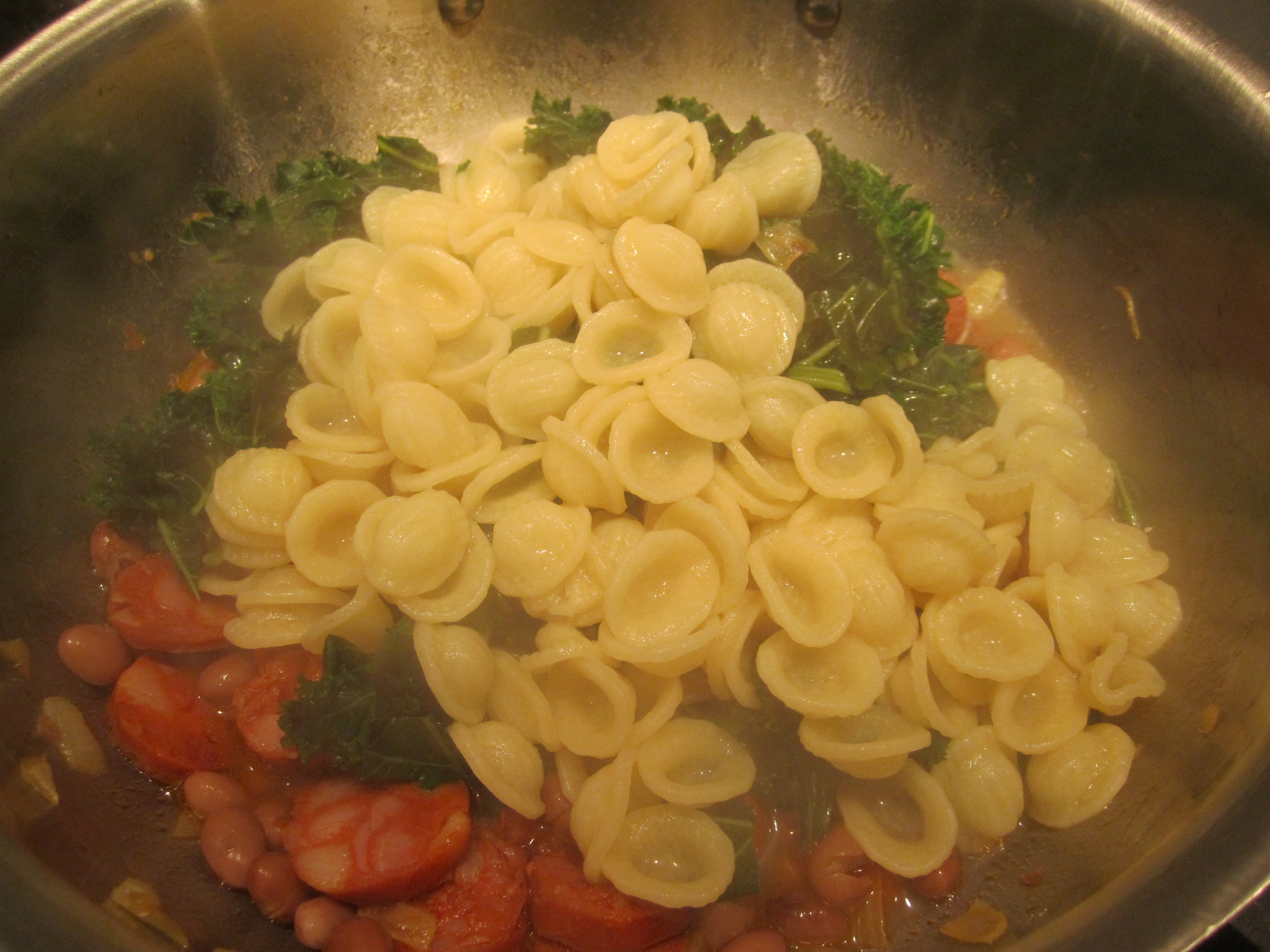
Orrechiette with Chorizo, Kale and Cranberry Beans

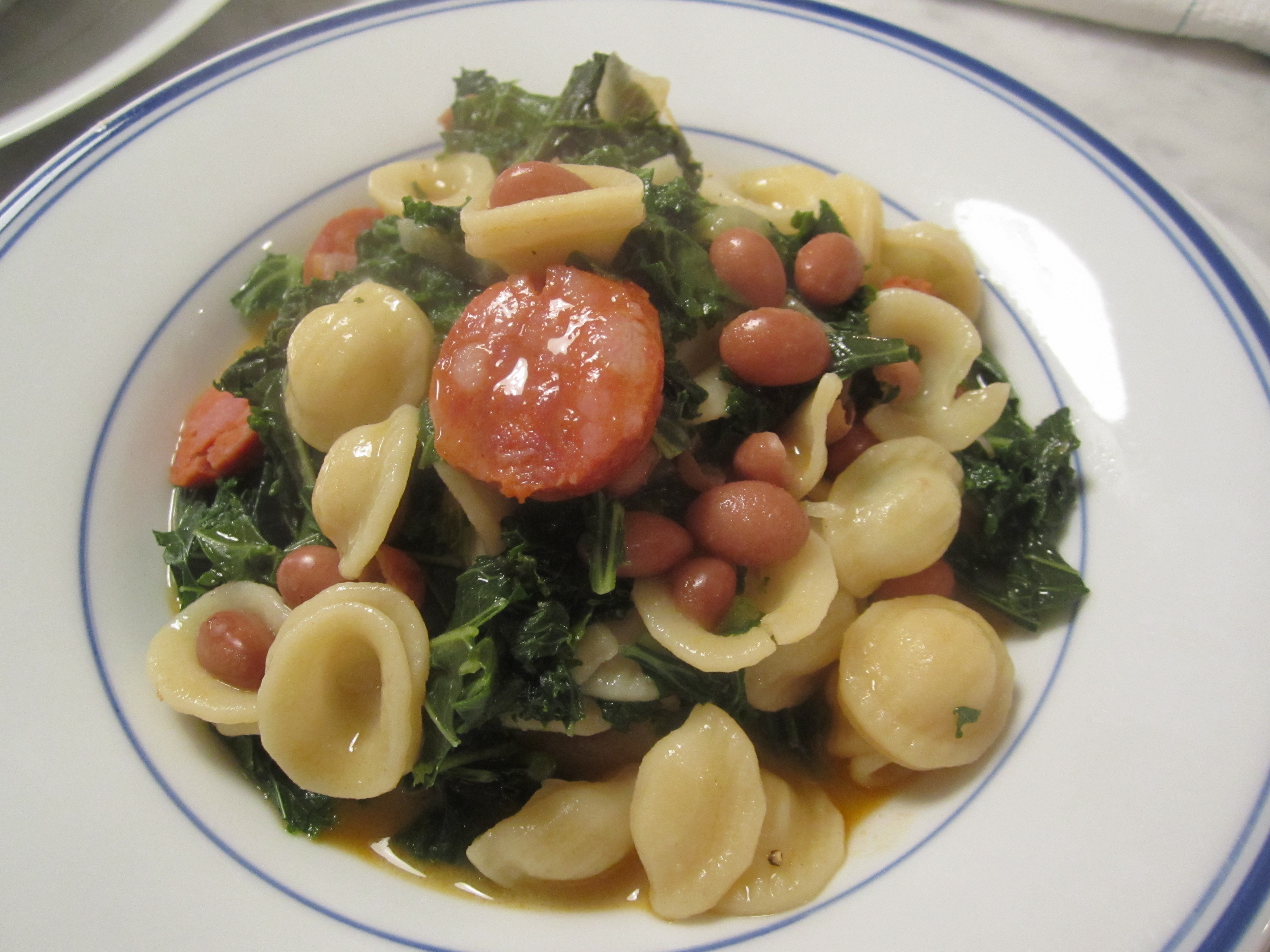
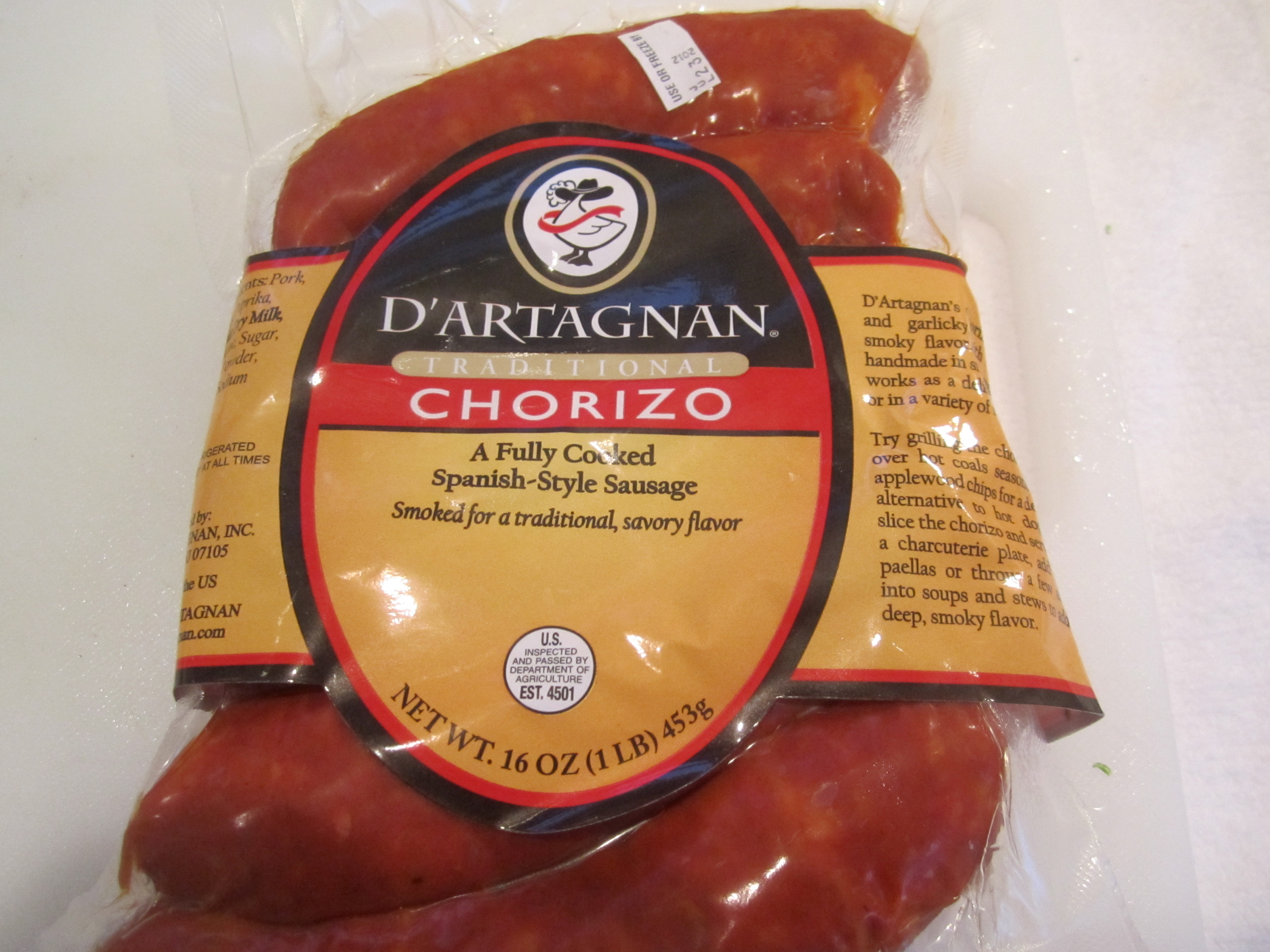
The combination of smoked sausage, beans and greens is one that I never tire of.  Chorizo is a particular favorite of mine, with its extra-smokey bite of Spanish paprika that turns everything it touches a deep scarlet color.

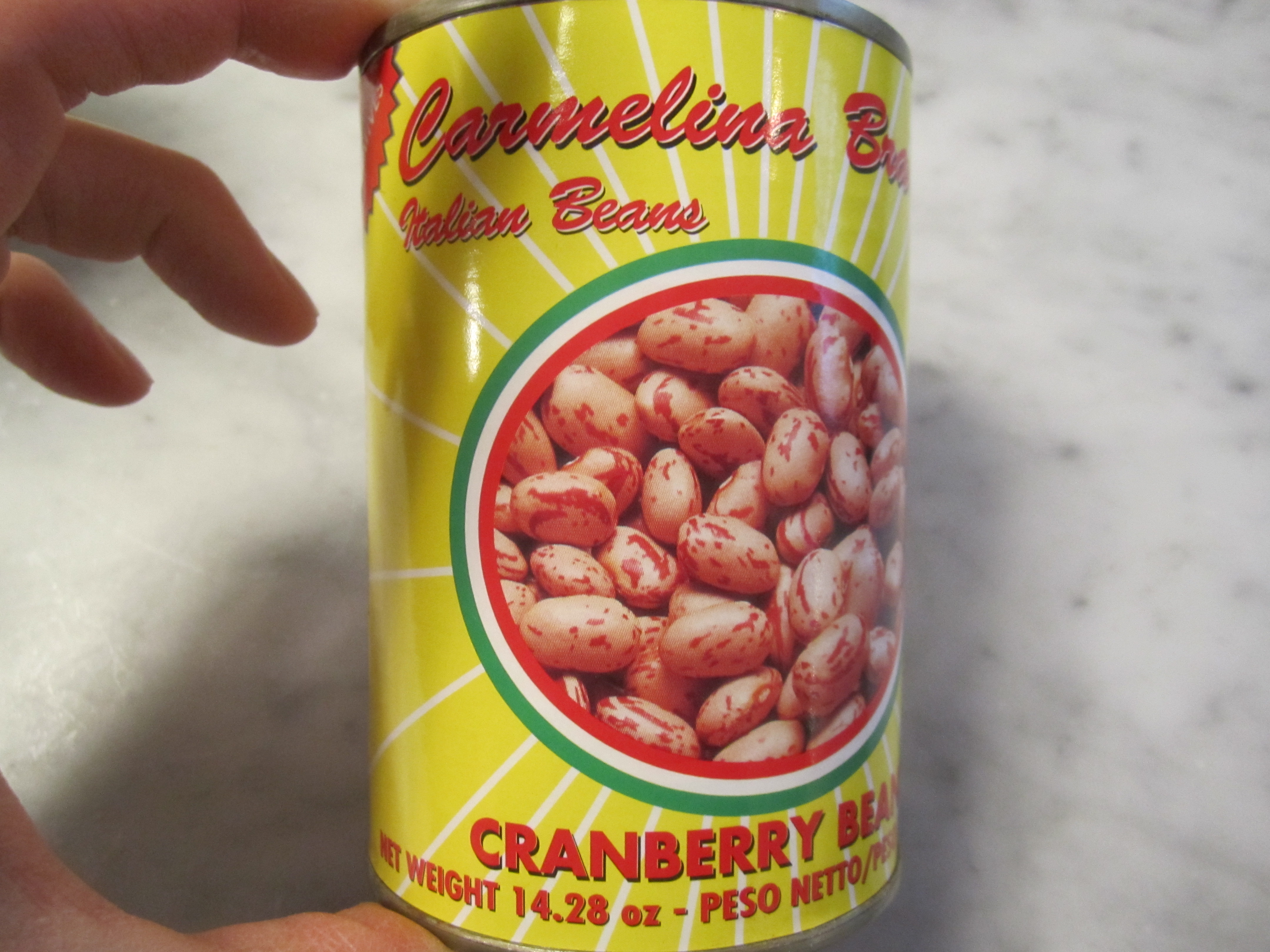
Generally I try not to use canned beans (except for chick peas, which I only use canned).  Recently, however, I’ve found an imported brand of cranberry beans which retain their body and firmness, and I love using these in all kinds of soups and stews.

The kale gets stripped off its stems, cut into ribbons and boiled in salted water for about 5 minutes.  In the same water, the pasta gets boiled.  In a separate pan, the sauce is made in the time it takes to boil orrechiette.  
This is a cross between a pasta and a soup, and in fact, you can make it as soupy as you choose.  On this rainy and chilly spring evening, I’ve chosen to make it fairly soupy and savor its warming goodness.

Orrechiette with Chorizo, Kale and Cranberry Beans

serves 4

1 bunch kale, stripped off its stems, sliced crosswise into 1/2″ ribbons and boiled for 5 minutes

3/4  lb orrechiette

4 links of smoked chorizo, peeled and sliced into 1/4″ rounds

1/2 of a medium yellow onion

2  c chicken broth

2 15-oz cans cranberry beans, drained

1/4 c + 2 tbls extra-virgin olive oil

grated pecorino romano for sprinkling 

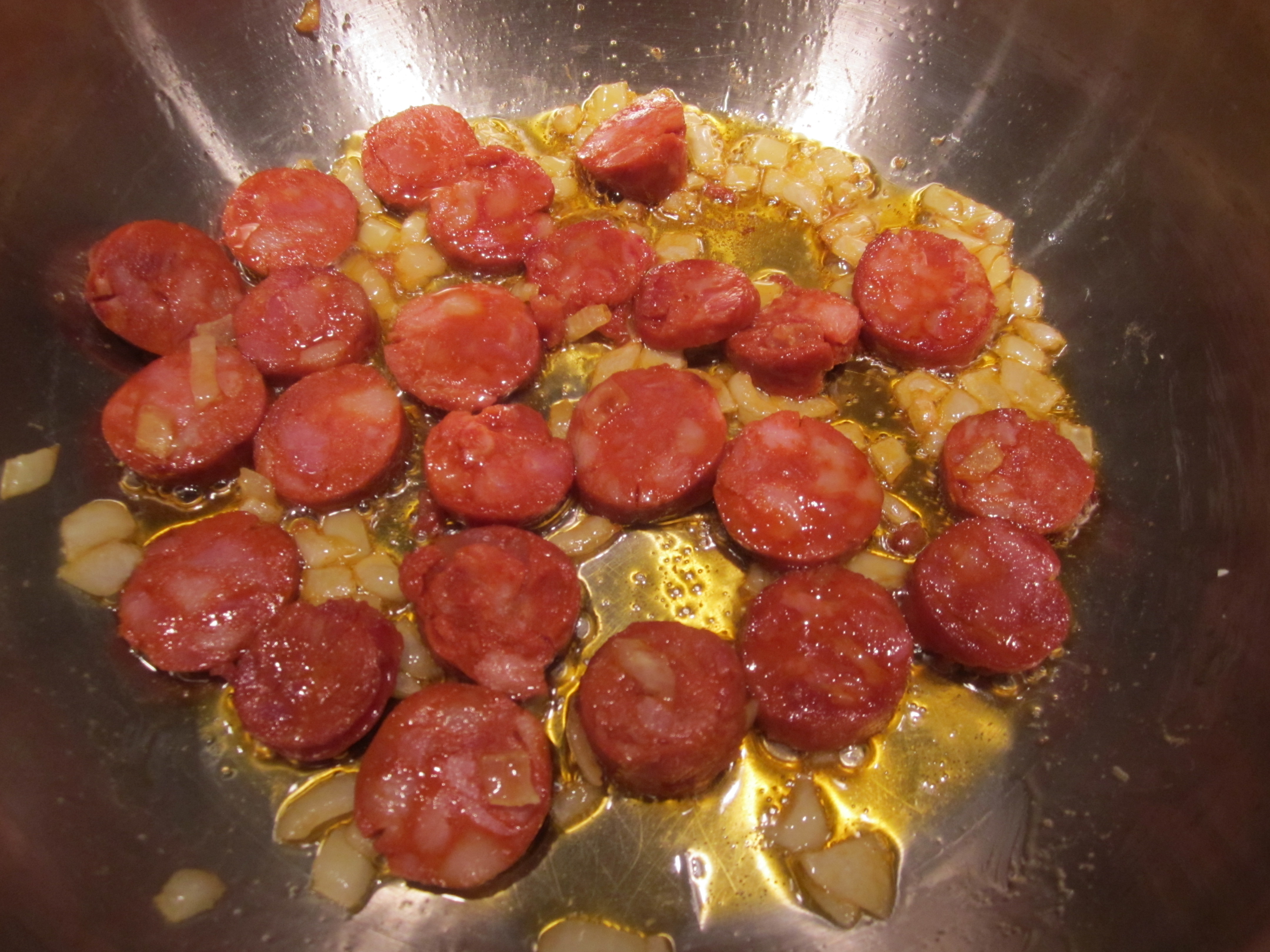
While pasta is boiling, in a large skillet, saute onion on medium heat until translucent–about 5 minutes.  Add chorizo and increase heat to high.  Saute for a minute to slightly brown the edges of the chorizo.

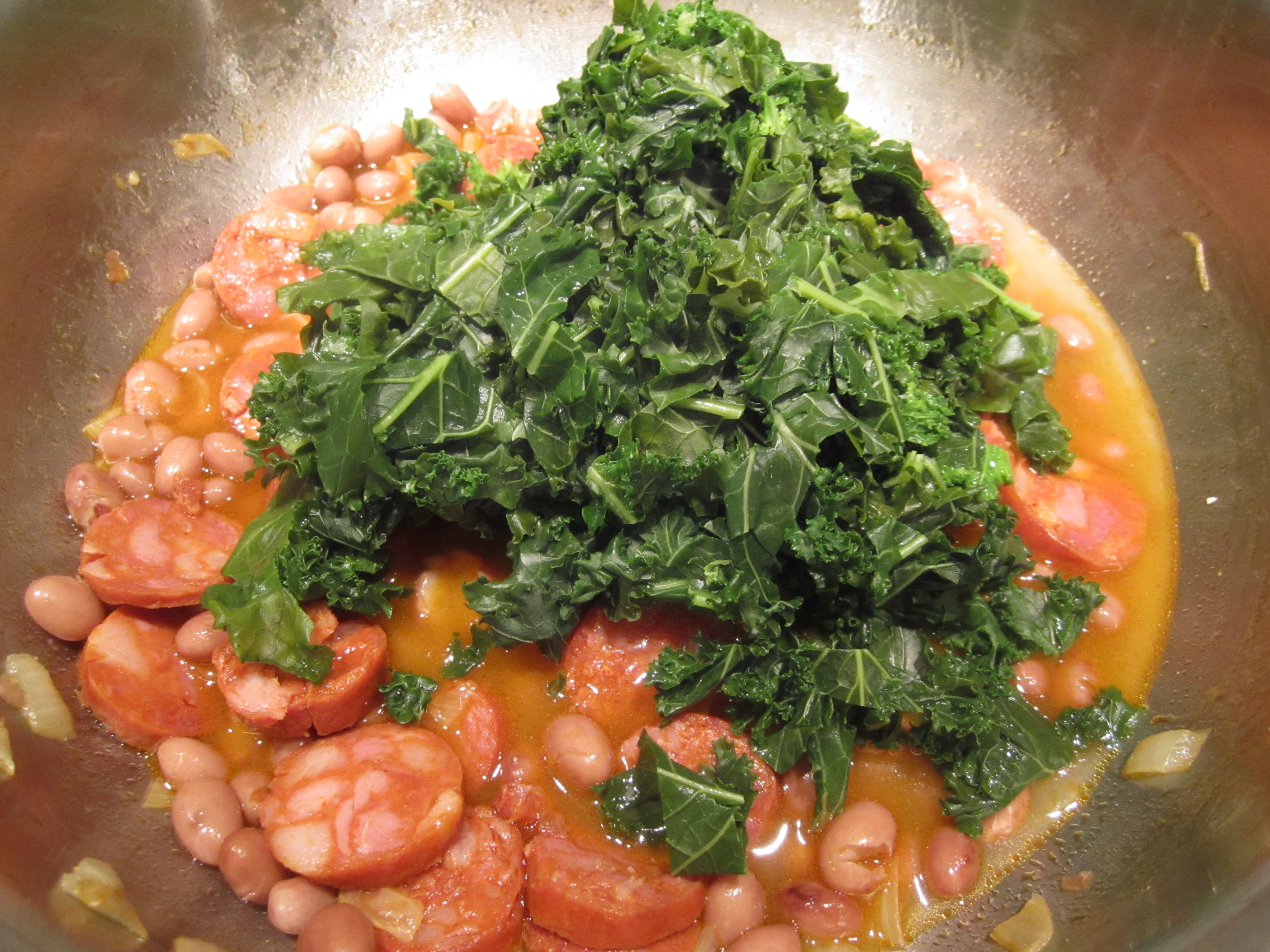
 Add the beans, broth and kale, and simmer, uncovered, until pasta is a minute shy of done.

Add pasta to the skillet mixture, along with the desired amount of pasta cooking water.  Taste and add salt and pepper.  Simmer for a minute.

Serve with remaining oil drizzled on top, along with the grated cheese.

Posted in Pasta | Leave a comment

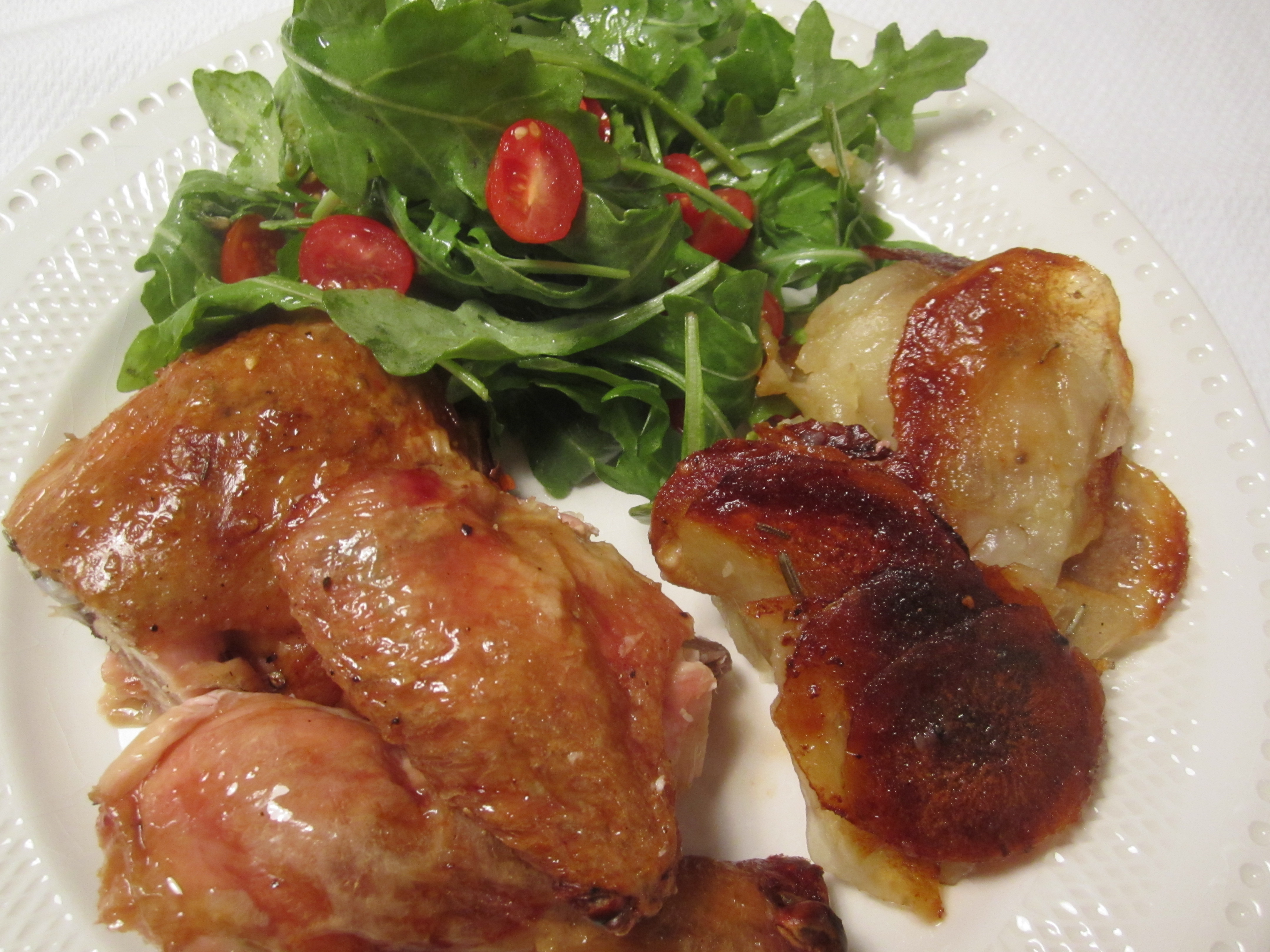
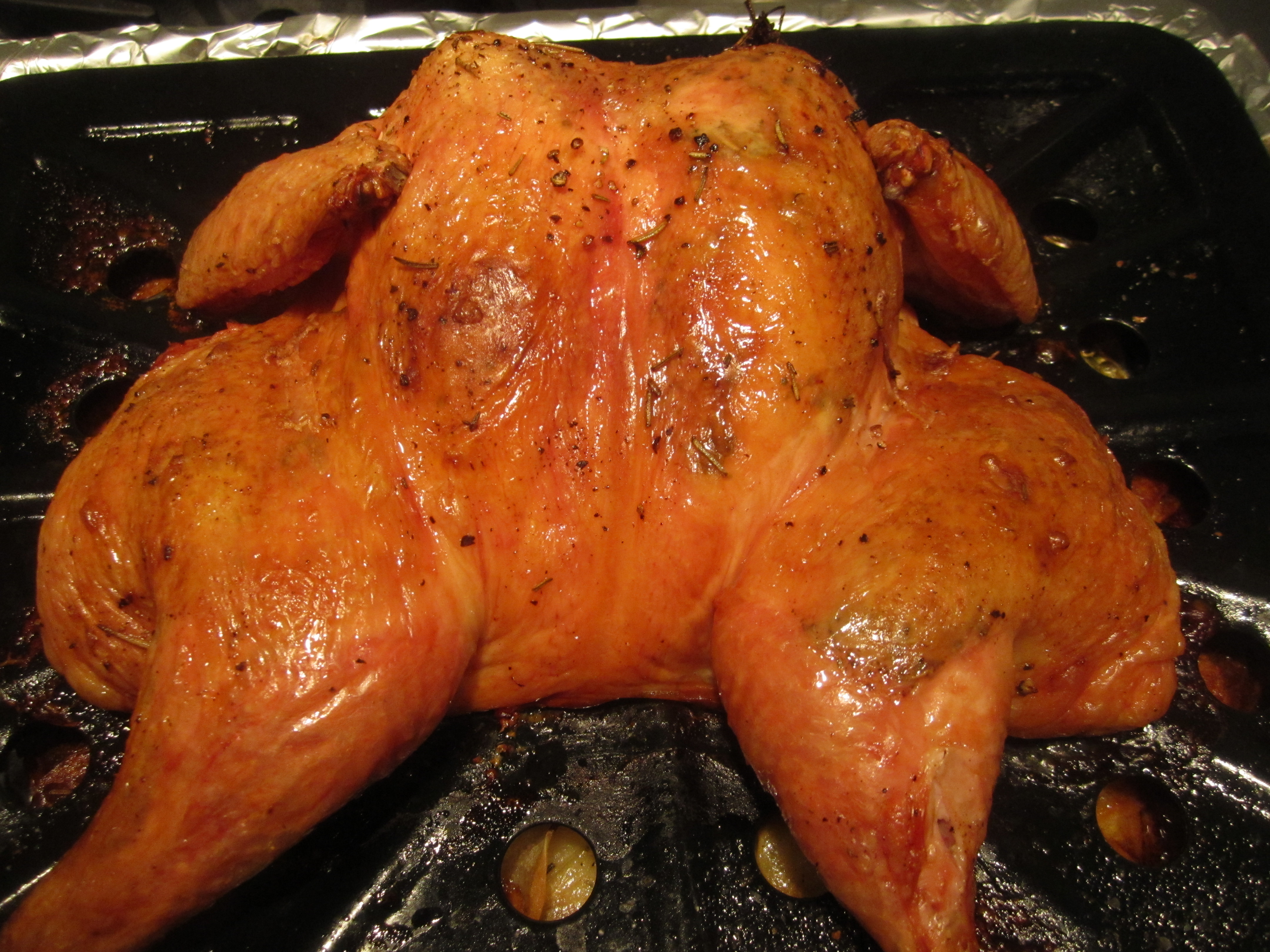
Dry-Brined Roast Chicken with Crispy Potatoes

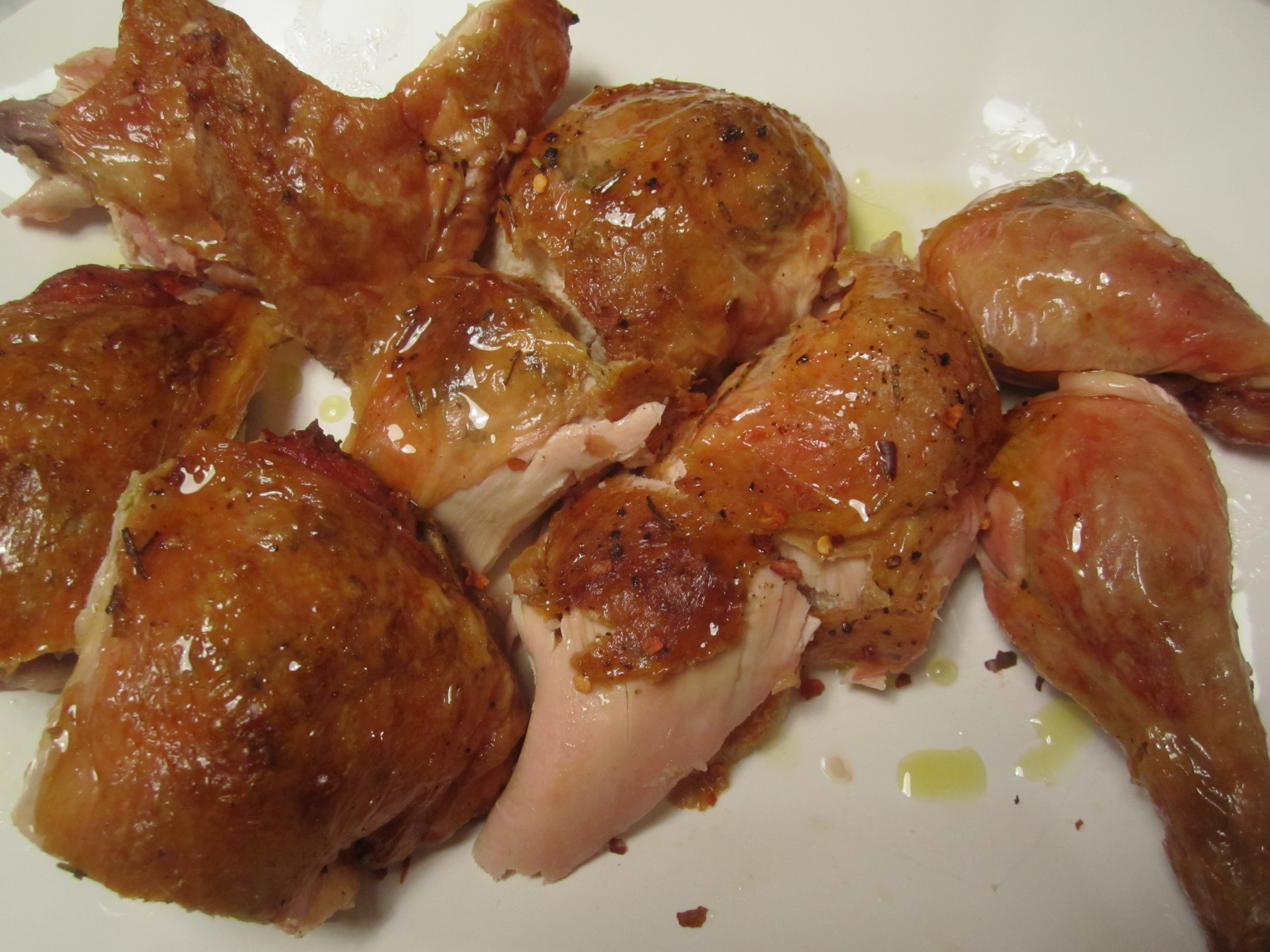
This is a very similar technique to my butterflied roast chicken, with one key difference.  Here, I’ve used a dry-brine, as opposed to the wet brine in the prior recipe.  They are both wonderful methods of cooking a chicken.  This method, however, produces a slightly crispier skin, and for that alone, it was worth sharing with you.

Dry brining is essentially a heavy salting.  For a 4 to 5-lb chicken, 7 or 8 hours is sufficient to season the chicken beautifully.  Part of the salting process is designed to extract a bit of moisture from the bird, thereby making the flesh a bit denser and more flavorful.  Ironically, although the salt leeches some moisture from the bird, it actually ends up producing a moister, juicier finished product.

By not submerging the bird in water, you’re actually allowing the skin to air-dry, while the salt seasons the flesh from the inside-out.  Theres no need to baste, and the bird requires almost no attention at all.

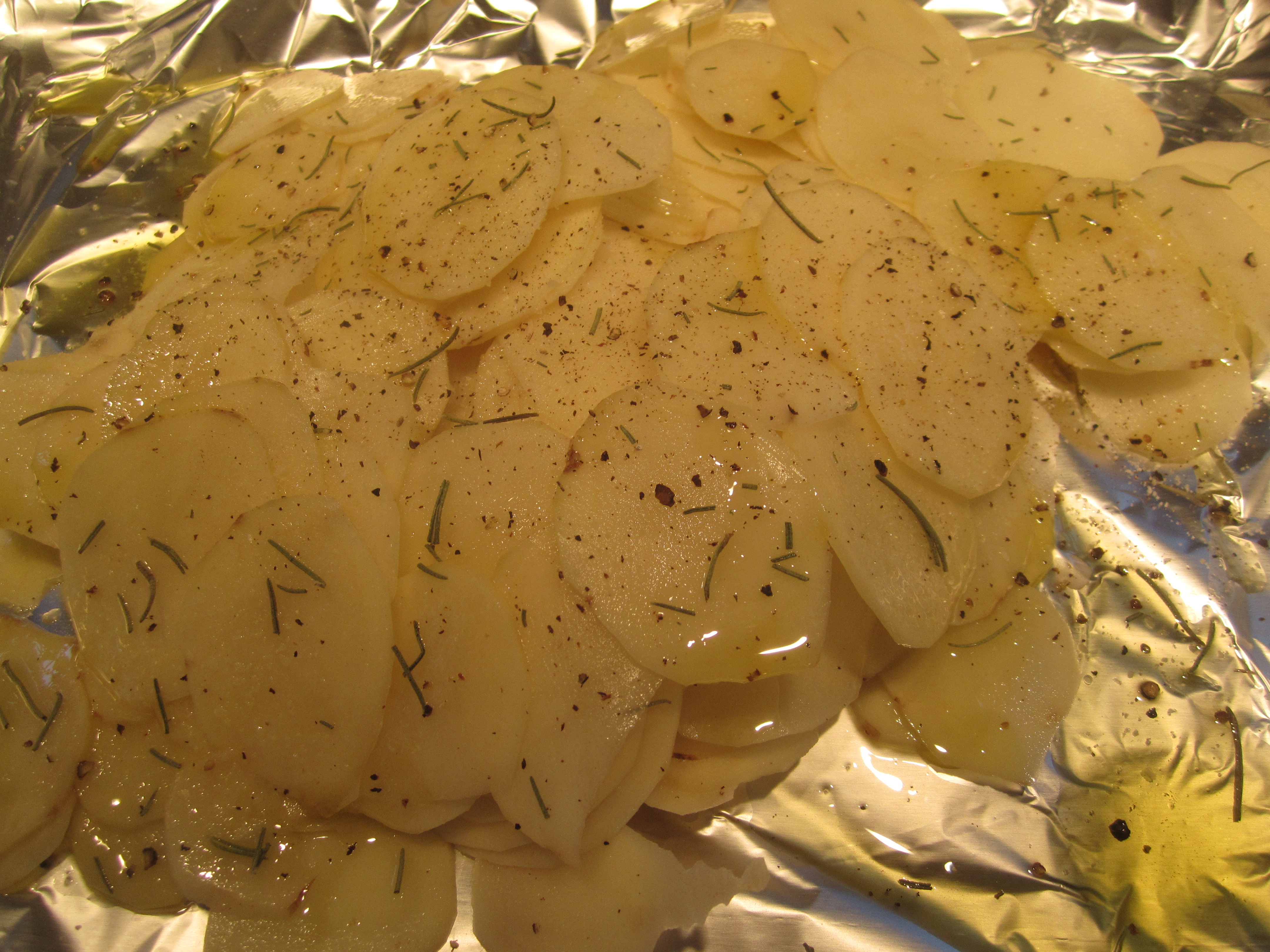
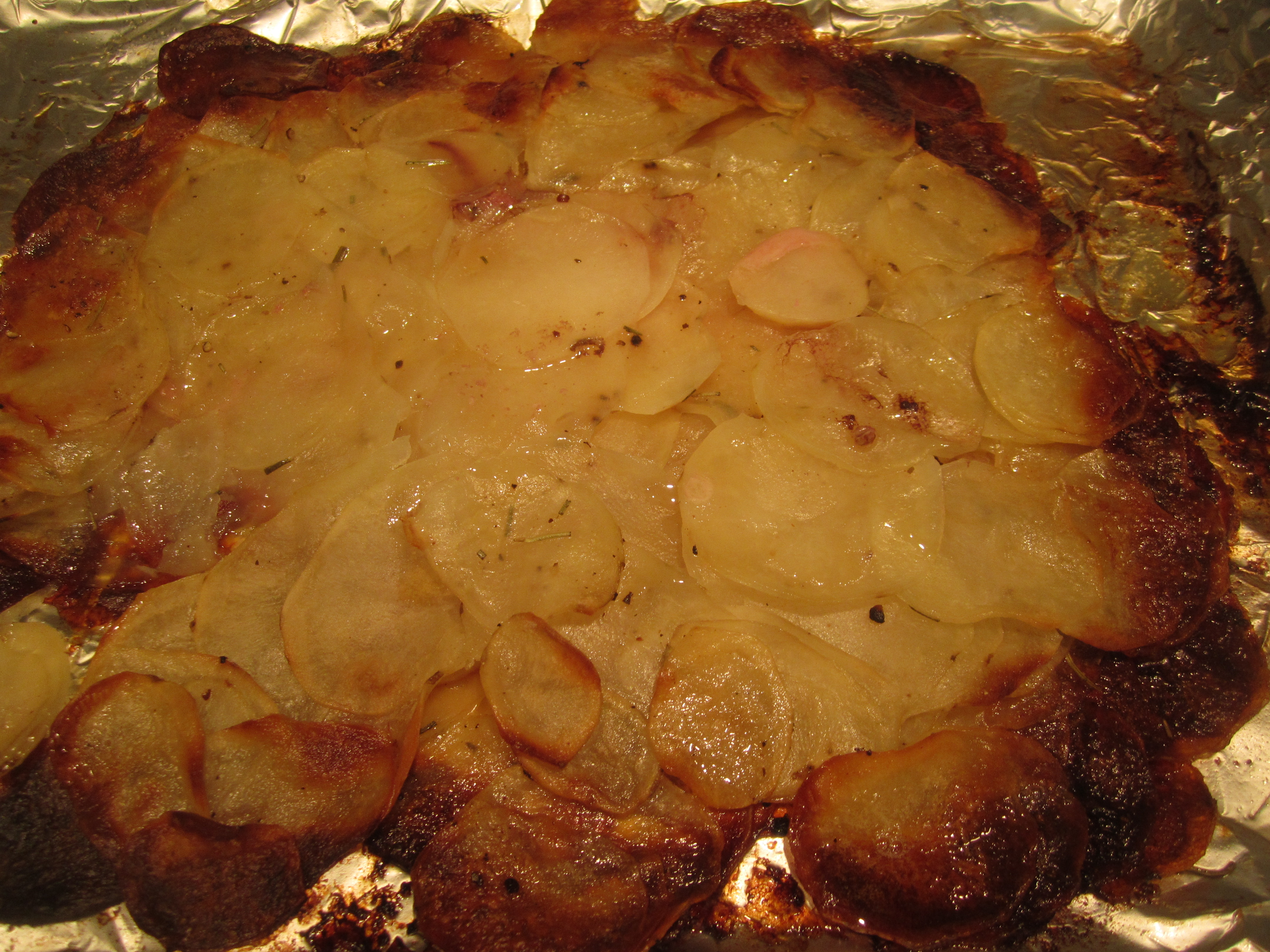
The bird roasts on high heat (475 degrees) for approximately an hour.  Underneath the bird, rests a layer of thinly sliced potatoes, which become crispy around the outside of the mound, soft and tender on the inside.  The chicken juices flavor the potatoes as they drip from the bird.

I may have said this before, but this is truly one of the best roast chickens you’ll ever make!

Dry-Brined Roast Chicken with Crispy Potatoes

serves 2, with leftovers for lunch

1  4 – 5 lb. chicken, backbone removed

1 tbl kosher salt

1 tsp black pepper

1 1/2  tsps dried rosemary

juice of half a lemon

3 russet potatoes, peeled

2 tbls olive oil

About 7 hours in advance, combine 2 tsps salt with 1 tsp of rosemary and black pepper.  Rub the mixture liberally under the skin of the breasts and thighs, reaching into the legs as well.

Place on a broiling rack and sprinkle with the lemon juice.

Allow to rest, uncovered, in the fridge until an hour before roasting.  Remove from the fridge and allow to come to room temperature for an hour.

Preheat oven to 450 degrees.

Line the bottom part of the broiling pan with heavy-duty aluminum foil. Peel the potatoes and slice on the mandoline, letting them fall right onto the foil.  Sprinkle remaining teaspoon salt, 1/2 teaspoon of rosemary, along with 1 tablespoon olive oil over the potatoes.  Toss to coat evenly with salt and oil.  Spread out into a mound.

Top with perforated top of broiling pan containing chicken, and roast uncovered for approximately an hour, turning the tray once.

Remove from oven and while chicken is resting, remove the potatoes from the pan, scraping foil with a spatula, tasting and adding salt, if necessary.

The potatoes around the edge will be crispy, those in the center, soft and melting–both together a wonderful combination.

Carve chicken, drizzle with a bit of oil and lemon juice and serve with potatoes.

Posted in Poultry | Leave a comment