Green Sauce

I won’t go so far as to call this sauce by the Italian “salsa verde” because genuine salsa verde in Italy is something different and more complex than this sauce–it is a concoction of parsley, pickles, boiled eggs, capers and shallots.  It is a northern Italian specialty served with boiled meats (bollito misto) and vegetables.   My neighbor Beppi is an expert at making salsa verde and one day, I will publish his recipe.

This sauce, however, is a variation on a condiment we used to make at Po Restaurant–green oil.  Green oil was more of a garnish on the plate, rather than an actual sauce.  It was made by processing parsley and a few spinach leaves with lots of oil, then straining.  It made the brightest greenest streaks on almost every plate that was served at Po.

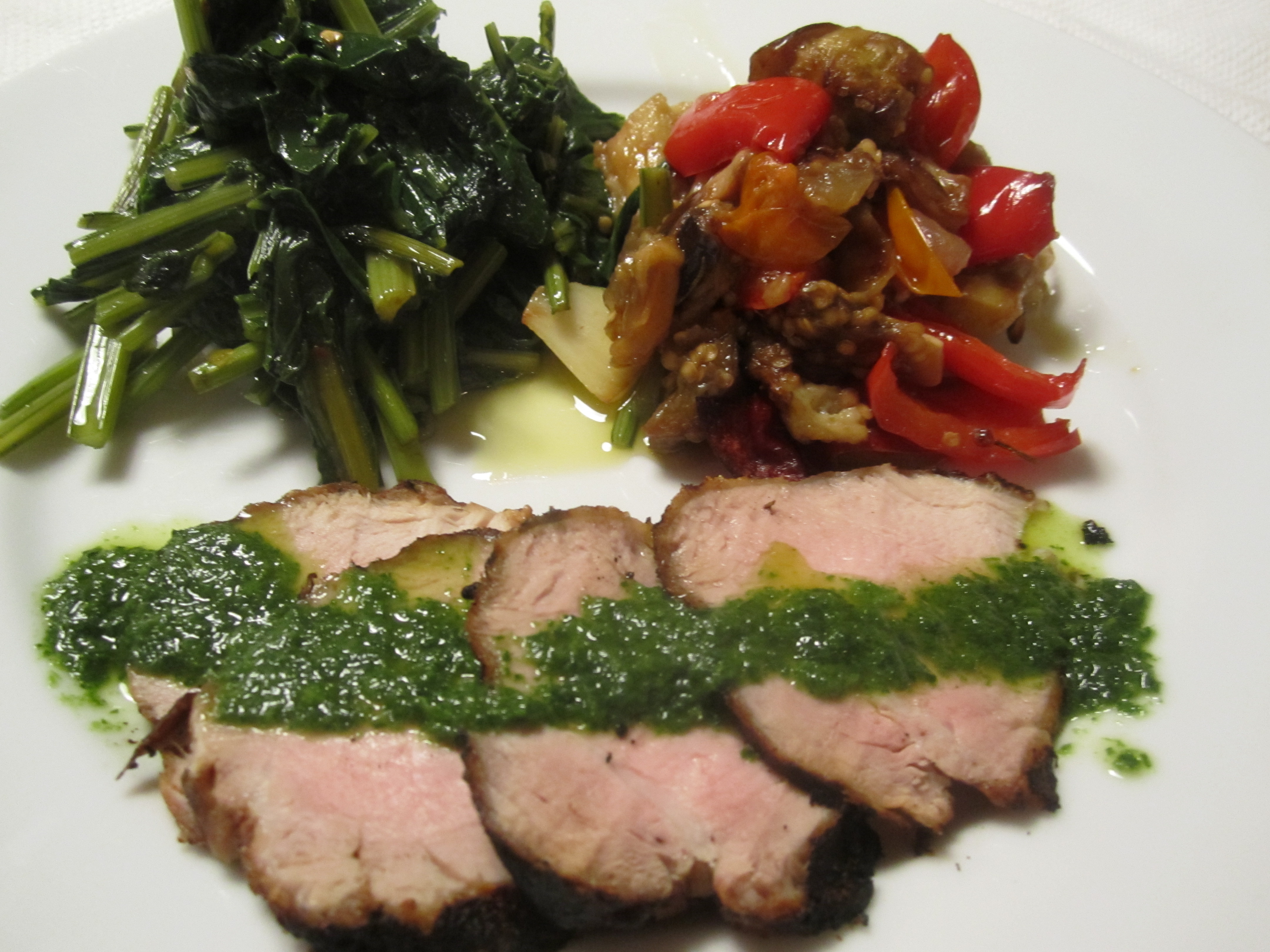
For my green sauce, I’ve added chives and left the sauce unstrained.  I’ve also added a touch of red wine vinegar as a nod to the Italian salsa verde.  I wanted a tiny bit of tartness but not enough to discolor the green herbs.  You can use this sauce on almost anything–grilled meats, chicken or fish.  It adds a nice herbaceous and slightly acidic bite to whatever you put it on, not to mention making your plates look quite expert and sophisticated!

Tonight our dinner consisted entirely of recipes which I’ve posted before:  dry-rubbed pork tenderloinroasted eggplant, peppers and tomato,  and sauteed beet greens with garlic and chili flakes (see mom’s pizza post).

The tenderloin was grilled earlier, to be sliced thin and served at room temperature.  I made the green sauce simply to liven it up and it was brilliant–it also tasted great with everything else on the plate.

Green Sauce

serves 4 – 6 as a condiment

1/4 c chopped fresh parsley

1/4 c chopped fresh chives

1 c olive oil

1/2 tsp salt

1/2 tsp red wine vinegar

2 tbls water

Place all ingredients in blender and process to a green paste.  Add water if not easily pourable–it should be able to be drizzled with a spoon.

Posted in Sauces | Leave a comment

Pasta with Shrimp and Pesto

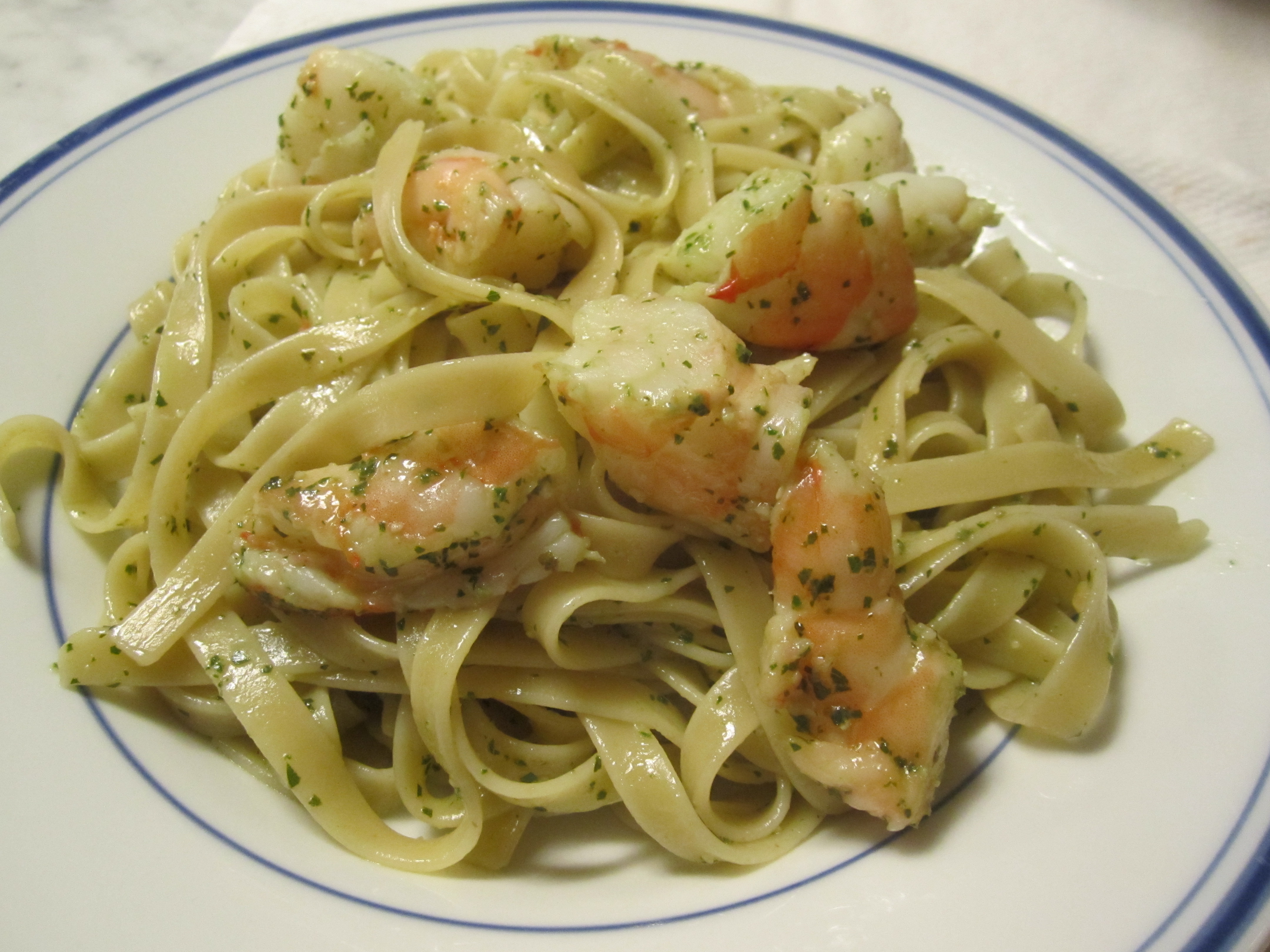
My neighbor Beppi’s garden is exploding with basil this time of year, and his pesto is legendary.  His late wife was from Genoa, the birthplace of the “original” pesto alla Genovese, and he has been kind enough to share his pesto recipe with me.  The recipe that follows is my rough approximation of it.  It should be noted that Beppi is allergic to garlic, an irony that’s not lost on him as a native Italian and former restaurateur–so garlic is conspicuously omitted from the recipe.  I find that I don’t miss it in my pesto either.

I’ve tried all kinds of protein additions to basic pasta with pesto (chicken breasts, thighs, sausage, etc.), but I find that the only one that actually enhances the pesto is shrimp.  You might not expect shrimp to go well with pesto, but in fact, it’s a brilliant combination.  The brininess of the shrimp and the salty, green bite of the pesto are perfect together. Also, this dish could singlehandedly revolutionize the whole aversion that most Italians profess toward combining seafood and cheese!

Pasta with Shrimp and Pesto

serves 4

1 lb dried fettucine

1 lb fresh shrimp, cleaned, deveined and cut into bite-size pieces

1/3 c pesto (see recipe below)

salt to taste

grated parmiggiano for sprinkling at the table

In a pot of cold salted water large enough to eventually hold the pasta, place the shrimp.  Turn the heat to high and remove shrimp just before water comes to a boil.  They will be tender and barely cooked through–they’ll continue cooking as they rest.  Set aside and let rest while you boil the pasta.

Boil pasta the recommended cooking time (usually 8-10 minutes for fettucine).  In a large mixing bowl, stir together the pesto and 2 tablespoons pasta cooking water.

Toss in the pasta with the water that clings to it–the pesto needs a good deal of pasta water added to stay nice and loose–the pasta will absorb the water as it sits on the table.   Add the shrimp and mix all together.   Serve immediately with additional grated parmiggiano on the side.

Pesto Sauce

2  c basil leaves, tightly packed

1/4 c pine nuts

1/4 c. grated parmiggiano

1/4 c. grated pecorino

1/2 c + 2 tbls extra-virgin olive oil

salt to taste

Place all ingredients except oil in food processor and process until a coarse paste forms.  Add oil gradually until the sauce becomes a bright green puree.  Taste and add salt, if necessary.  Store covered with a film of oil.

Posted in Pasta | Leave a comment

Grapefruit and Jicama Salad with Mint Vinaigrette

As the temperature gets hotter and hotter, I find myself more interested in cold or room-temperature foods.  Salads are ideal first courses or light lunches on their own.

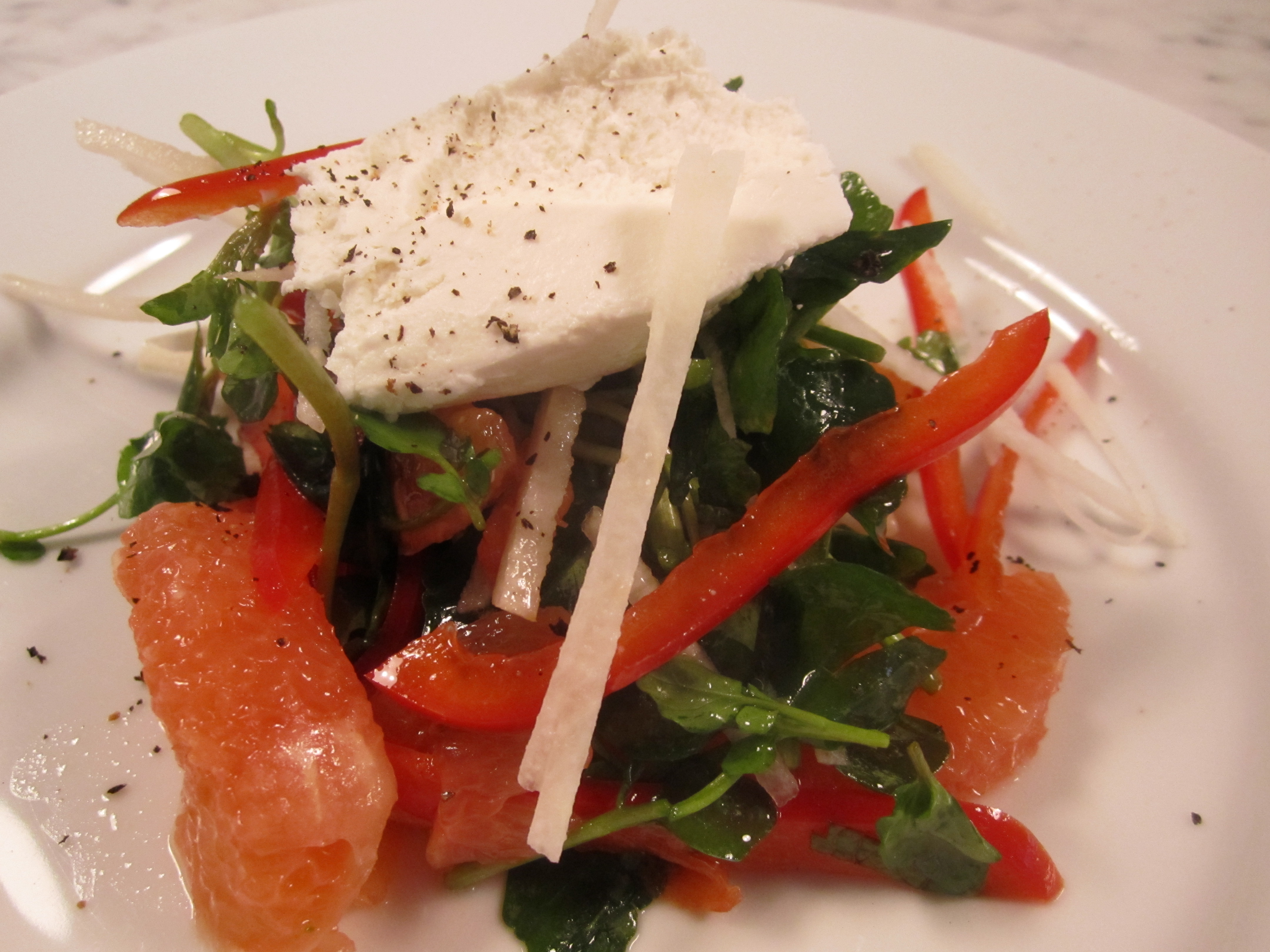
This salad is interesting and particularly refreshing.   Although Jicama is not an Italian ingredient, it’s a great addition to many salads–crispy and sweet, with its own distinctive flavor.  It pairs well with other crispy things like sweet peppers, fruit and peppery greens.

In this salad, jicama is combined with grapefruit, julienned red pepper and topped with a slab of honey goat cheese (plain goat cheese would suffice).  The dressing is my usual olive oil, red wine vinegar and agave. Laced with some mint, this salad is the perfect encapsulation of summer!

Grapefruit and Jicama Salad

serves 4

2 bunches watercress, large stems removed

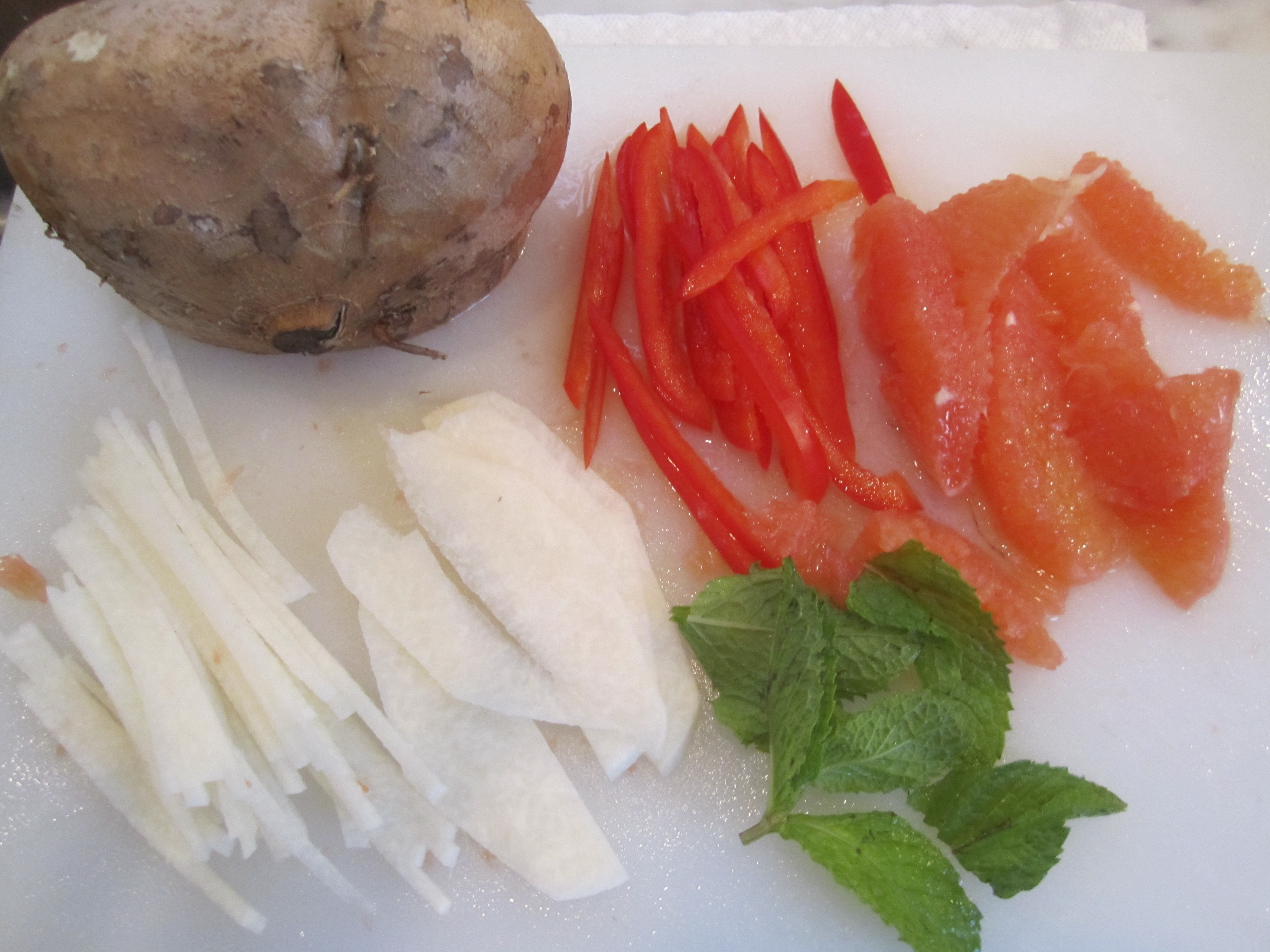
1/2  jicama, peeled and sliced into fine julienne

2 grapefruits, peeled, with sections removed from membranes

1 red pepper, sliced into fine julienne

20 mint leaves, slivered into fine ribbons

1 tbl extra-virgin olive oil

1 tbl + 1 tsp red wine vinegar

2 tsp agave

4 oz. honey goat cheese (or plain)

salt and pepper to taste

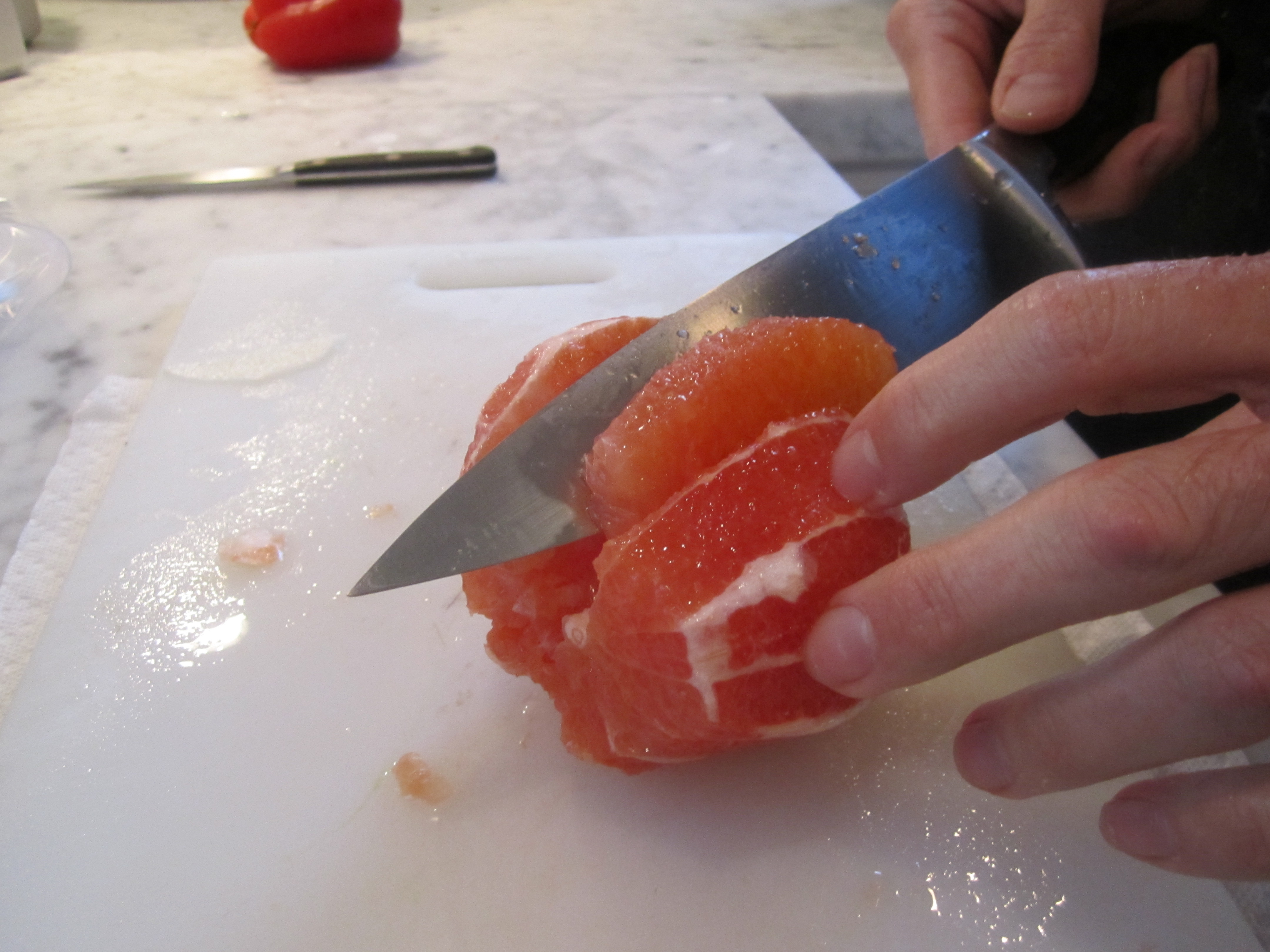
To remove sections of grapefruit, peel with large chef’s knife and gently cut out sections.

In a mixing bowl large enough to hold the salad, combine oil, vinegar, agave and mint. Stir dressing and add watercress, peppers, jicama and grapefruit sections.  Toss, taste and add salt and pepper.  Top each portion of salad with a slab of goat cheese and some black pepper.

Posted in Salads | Leave a comment

Pasta with Shrimp and Scallops

Pasta with seafood is something I make often in the summer–not only because it’s delicious, but also because it’s quick, easy and very elegant.  Thr preparation of this dish is very similar to pasta with lobster, chilis and mint, only using raw shrimp and scallops, rather than pre-cooked lobster meat.  Think of this as the everyday version of the pasta with lobster. 

While the pasta cooks, the seafood and aromatics get quickly sauteed.  The white wine and chopped tomatoes are added, along with a ladle of chicken broth and a handful of fresh chopped parsely.  Simple as it may sound, it’s magnificent. 

This can be made with either fresh or dried pasta, but I prefer the sturdiness of dried spaghetti  in this preparation. 

As a first course, I’m serving broccoli di rapa with cured sausage.

 Pasta with Shrimp and Scallops


serves 4

1 lb dried spaghetti

3/4 lb shrimp, cleaned and de-veined

3/4 lb sea scallops

4 tbls olive oil

4 cloves sliced garlic

1/2 tsp chili flakes (optional)

1/2 c peeled, seeded and chopped tomato

1/2 c white wine

1 c chicken broth

2 tbls chopped parsley

salt to taste

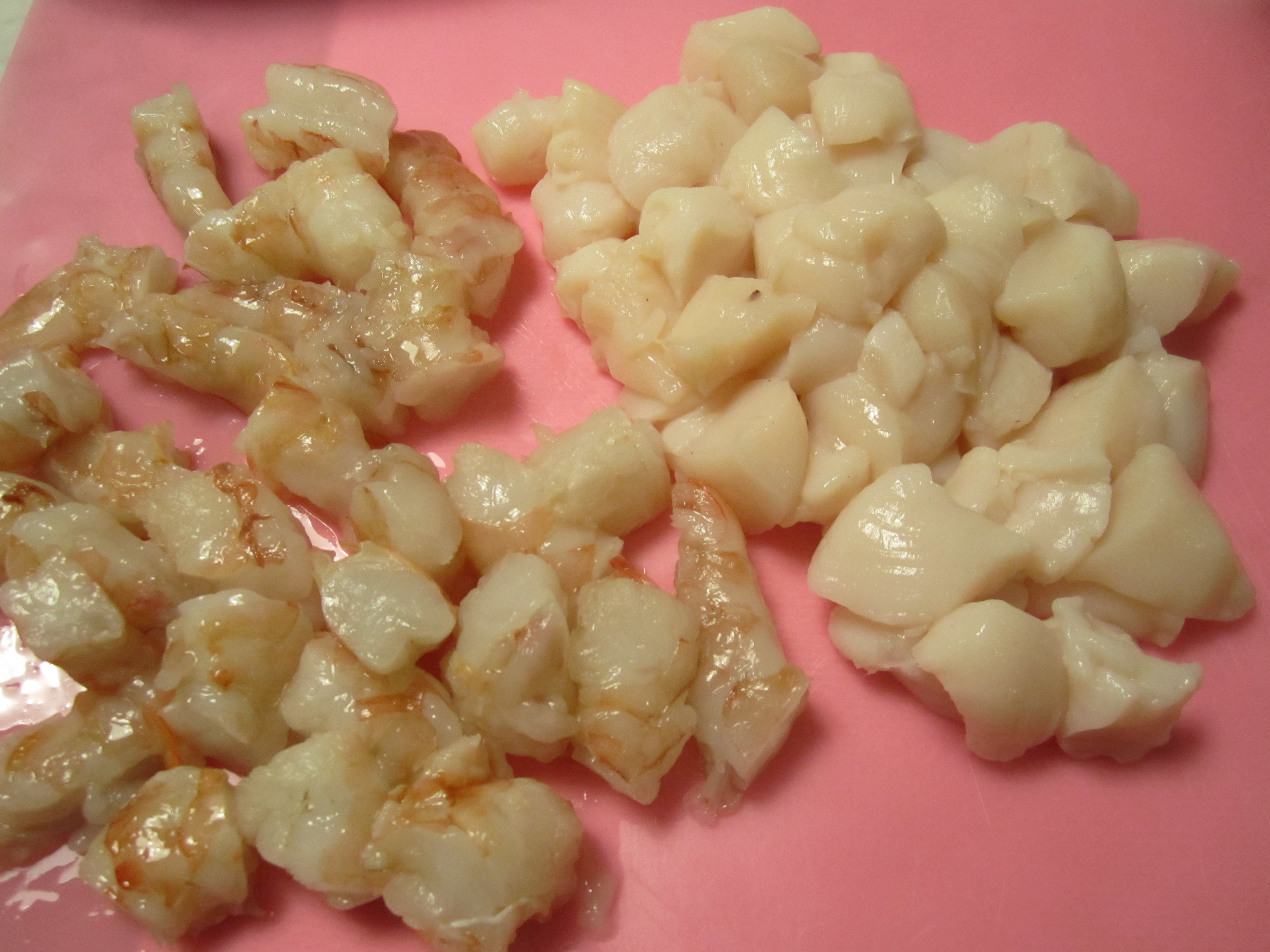
Cut seafood into bite-size pieces.

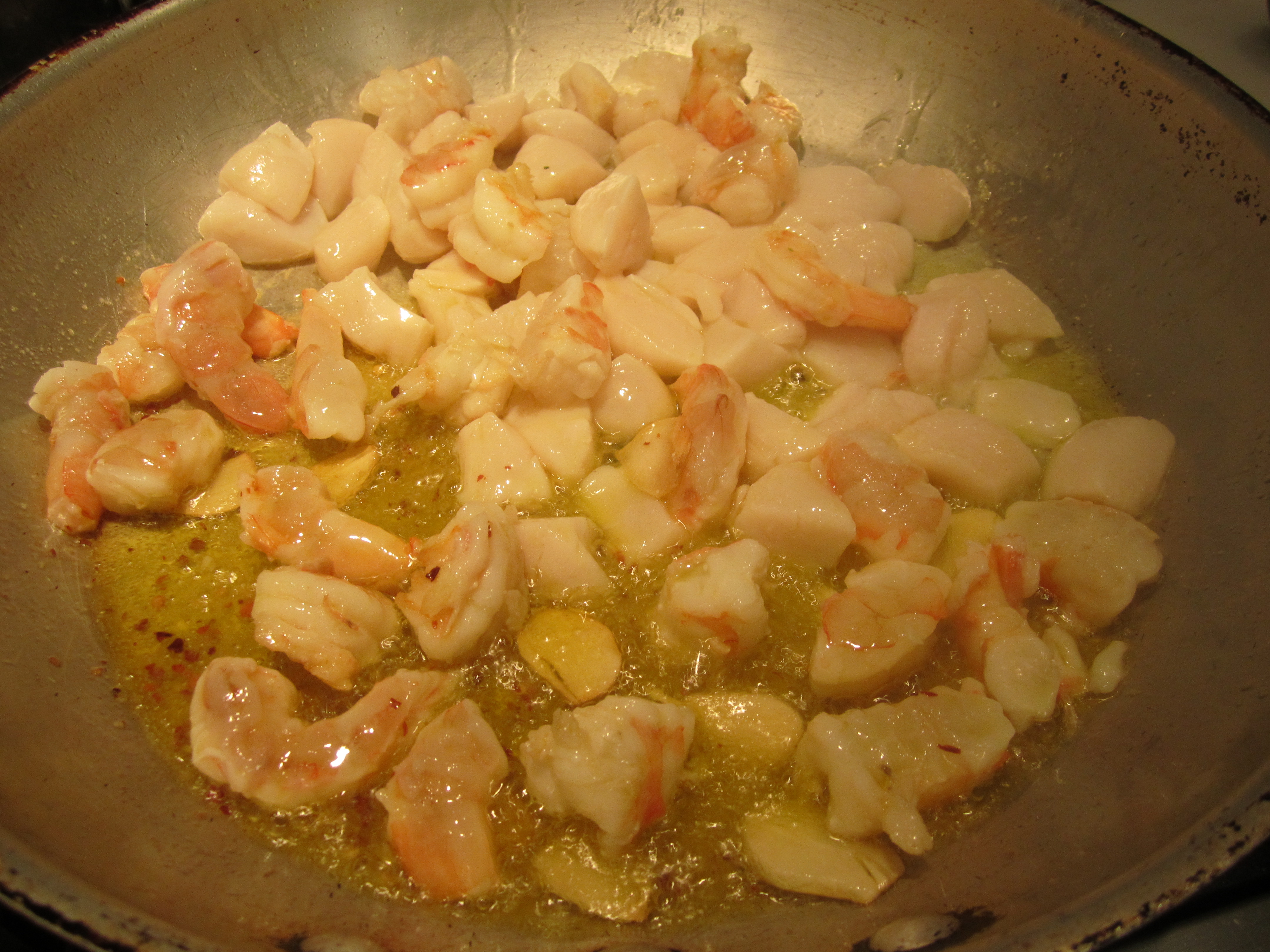
While spaghetti is boiling, in a large skillet, saute the garlic and chili flakes for a minute on high heat, then add seafood.

Cook for only a minute or so, then splash with white wine.  Reduce for a minute, then add broth and tomatoes.  Continue to cook on lowest heat until pasta is a minute shy of done. 

Add in pasta and saute for a minute to incorporate.  Taste and add salt.  Drizzle with plenty of extra-virgin olive oil off the heat.

Posted in Pasta | Leave a comment

Broccoli di Rapa with Cured Sausage

I have some cured Italian sausage left from my pizza last week and this is the perfect salty bite for some bitter broccoli di rapa.  Needless to say, this could easily be combined with pasta (orrechiette or rigatoni) but tonight, I’m serving it as a first course to my pasta with shrimp and scallops

Simply blanch the broccoli in plenty of salted boiling water for about 2 minutes (2 bunches for 4 persons), then drain well in a colendar. 

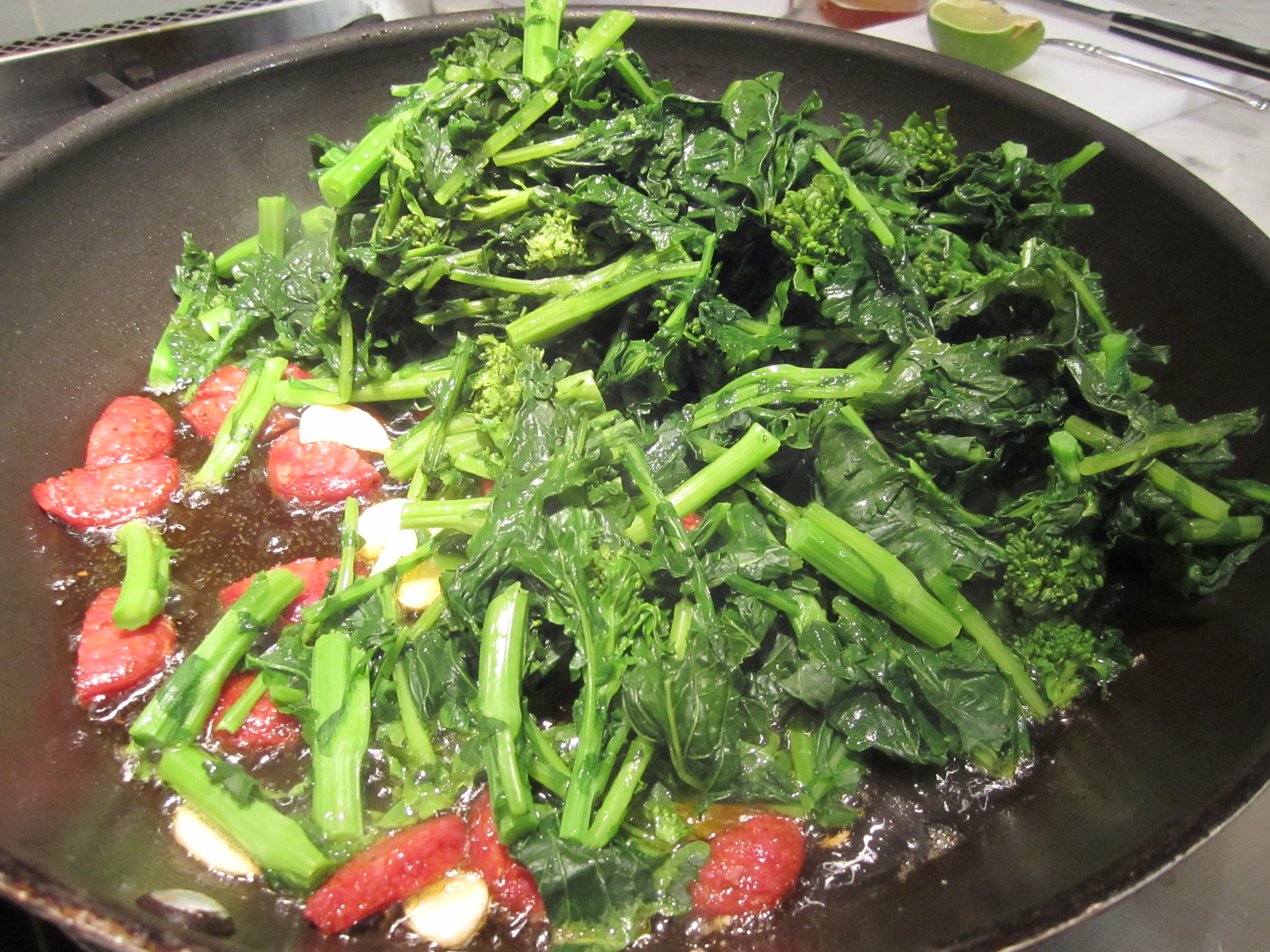
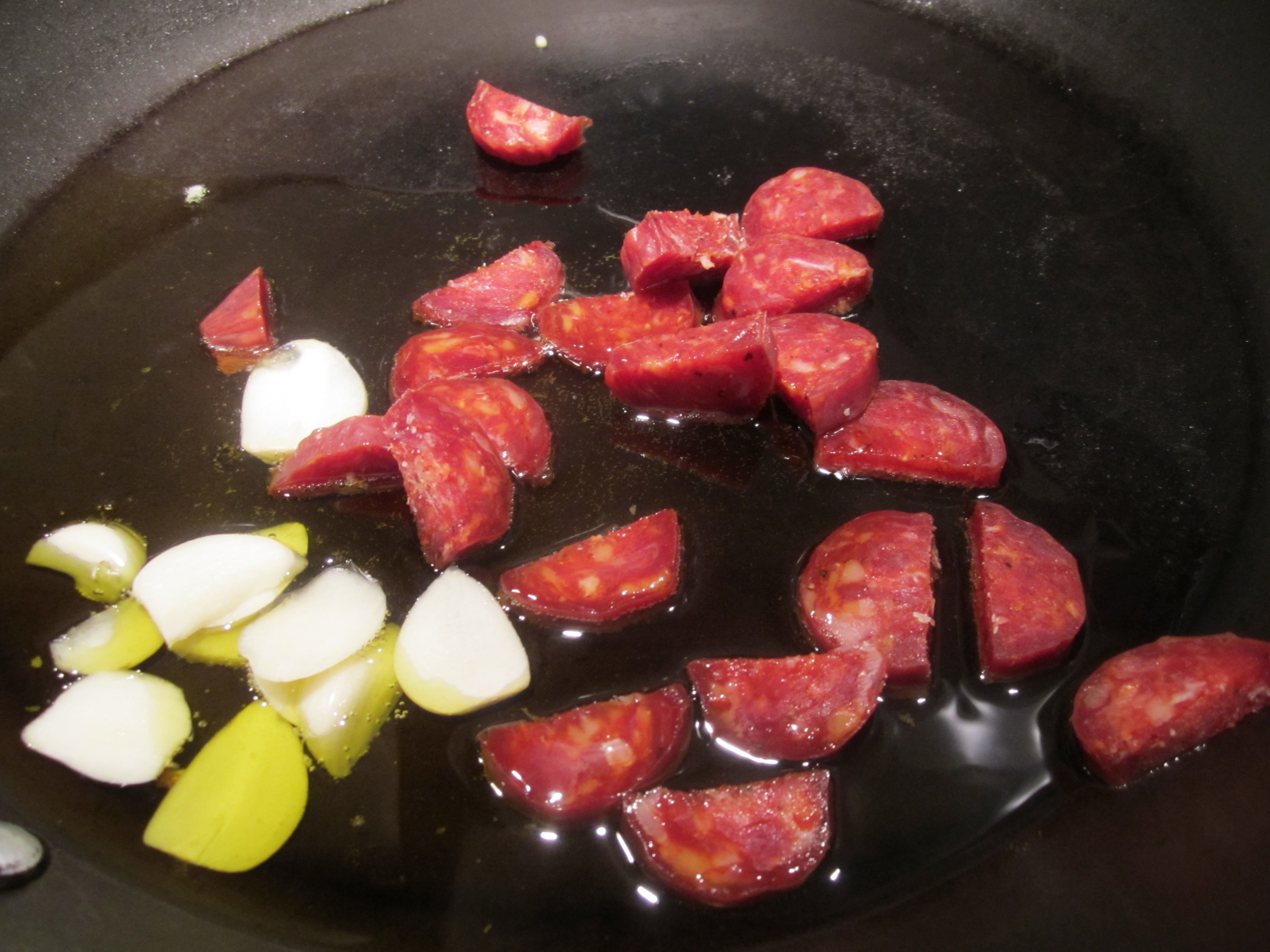
In a large skillet, lighlty brown a couple of cloves of sliced garlic, along with some sliced cured sausage, and saute for a few minutes.  Add in the drained broccoli and saute on high heat for about 3 or 4 minutes.  Taste and add salt. 

Posted in Vegetables | Leave a comment

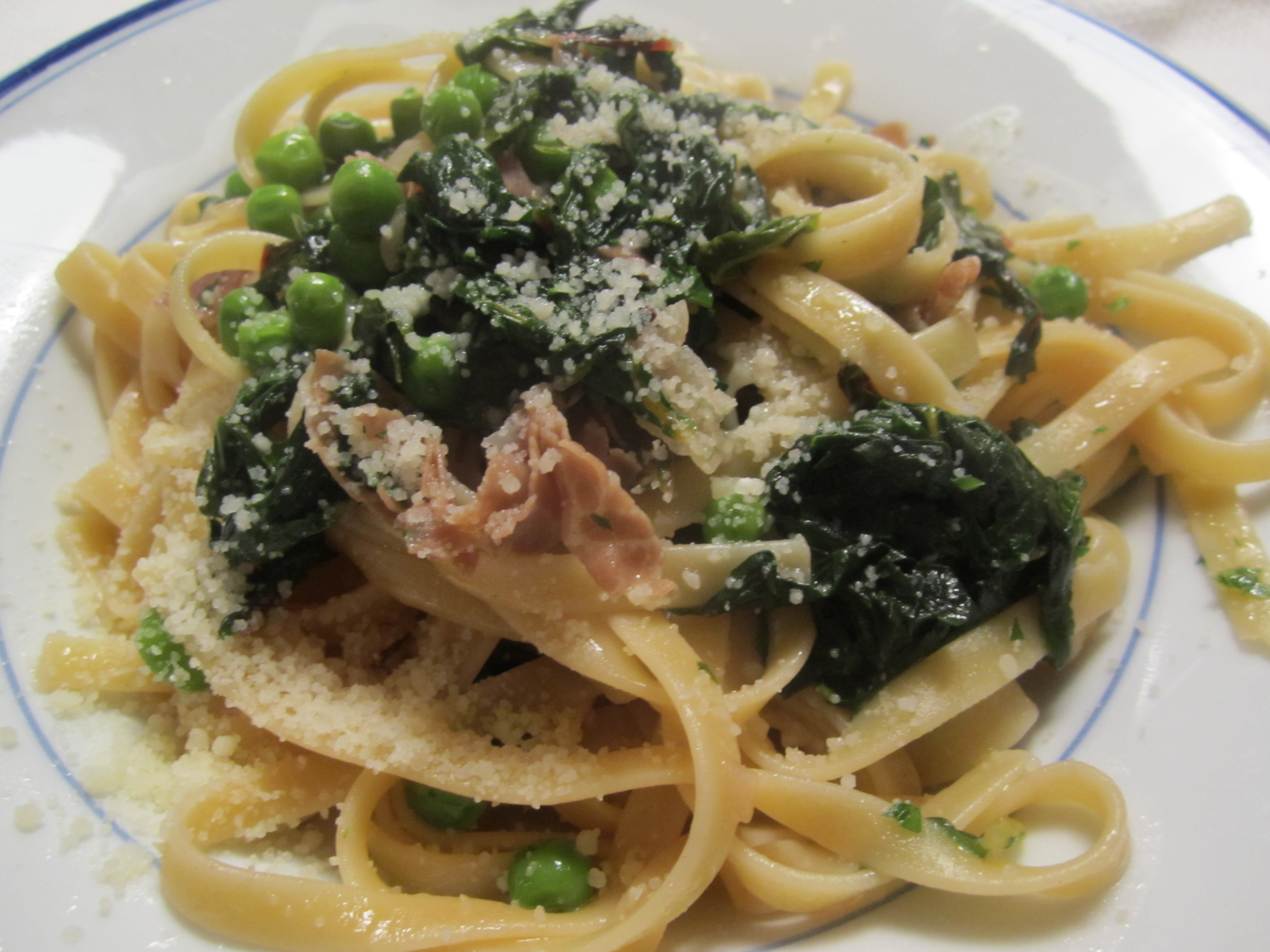
Pasta with Swiss Chard, Prosciutto and Peas

Prosciutto and peas are a great combination, often combined with heavy cream or butter.  Today, however, I wanted to pair them with something green and make a lighter, more summery dish with only a touch of butter.  

I was inspired by the rainbow swiss chard at my local farm stand.  The beauty of swiss chard is that you can eat the entire stalk–leaves and stems.  The other beautfiul thing about swiss chard is that it freezes beautifully (after blanching)–I can’t say the same about many vegetables.   For this dish, I’m using only the leaves, stripped from the stems and sliced into ribbons, however I’ve cleaned and chopped the stems for later use in a frittata or soup.

Unlike spinach, which may be tossed into a pasta sauce raw, swiss chard must be boiled–not just blanched, but boiled for at least five minutes.  There is a certain bitterness that must be boiled out of those leaves in order to enjoy the sweet green underlying flavor. 

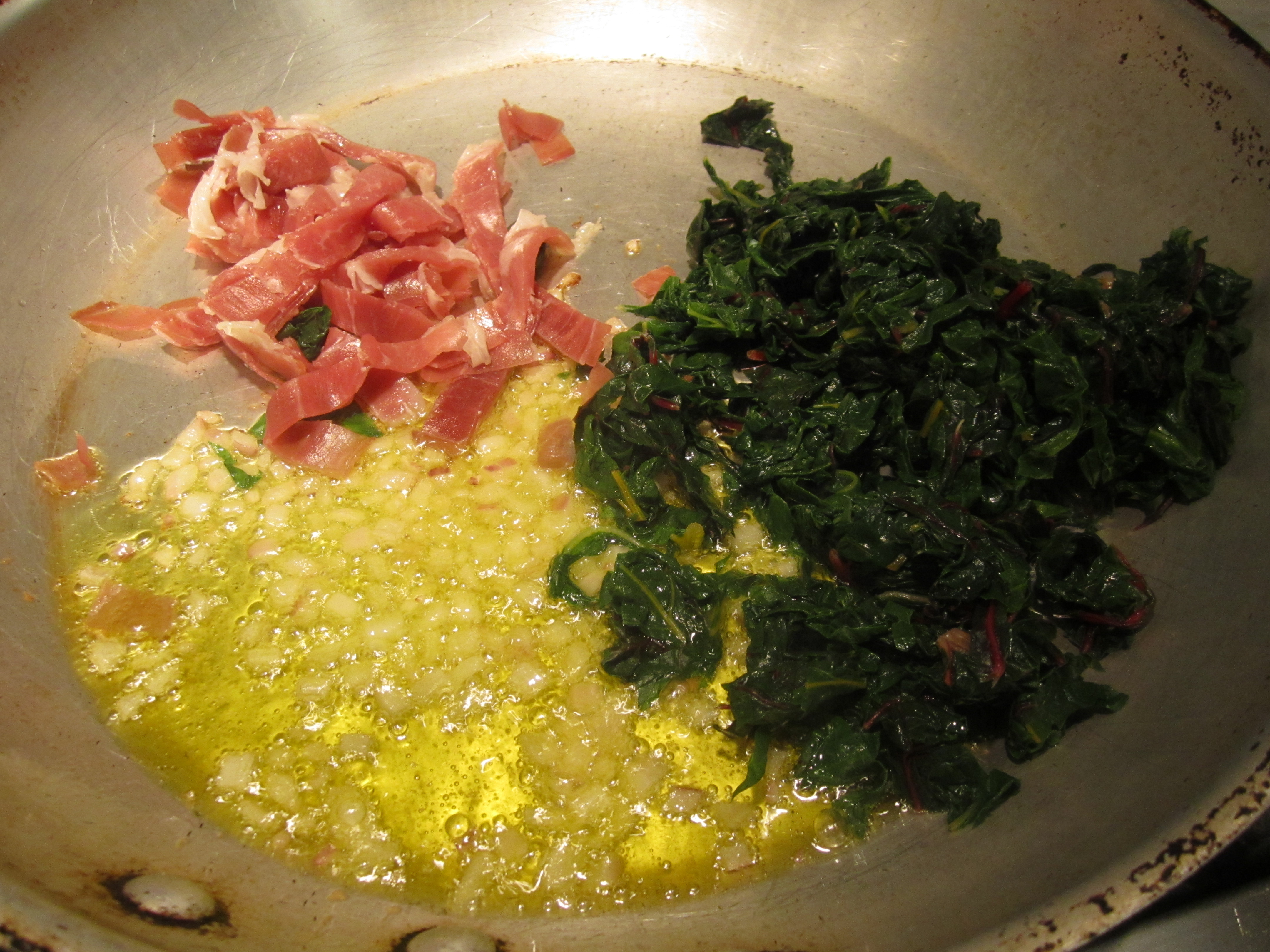
The rest of the dish goes quickly–sliced prosciutto, peas, and a touch of finely chopped onion.  In addition, for that certain depth of flavor, I’ve added white wine, butter and chicken broth.  This combination makes for a luscious sauce that is in part, absorbed by the pasta.

Pasta with Swiss Chard, Prosciutto and Peas

serves 4

1 lb fettucine

4 oz. prosciutto, thinly sliced, then cut crosswise into 1/2″ ribbons

2 c fresh or frozen peas

1 – 1/2 lbs swiss chard, leaves only, cut into 1/2″ ribbons, boiled for 5 minutes, then drained and squeezed

1/4 onion, finely minced

4 tbls olive oil

2 tbls butter

1/2 c white wine

1 c chicken broth

2 tbls fresh chopped parsley

grated parmiggiano for sprinkling at the table

While pasta is boiling, in a broad skillet, saute onion in oil until translucent.  Add the prosciutto and swiss chard and saute on medium heat for 2 or 3 minutes

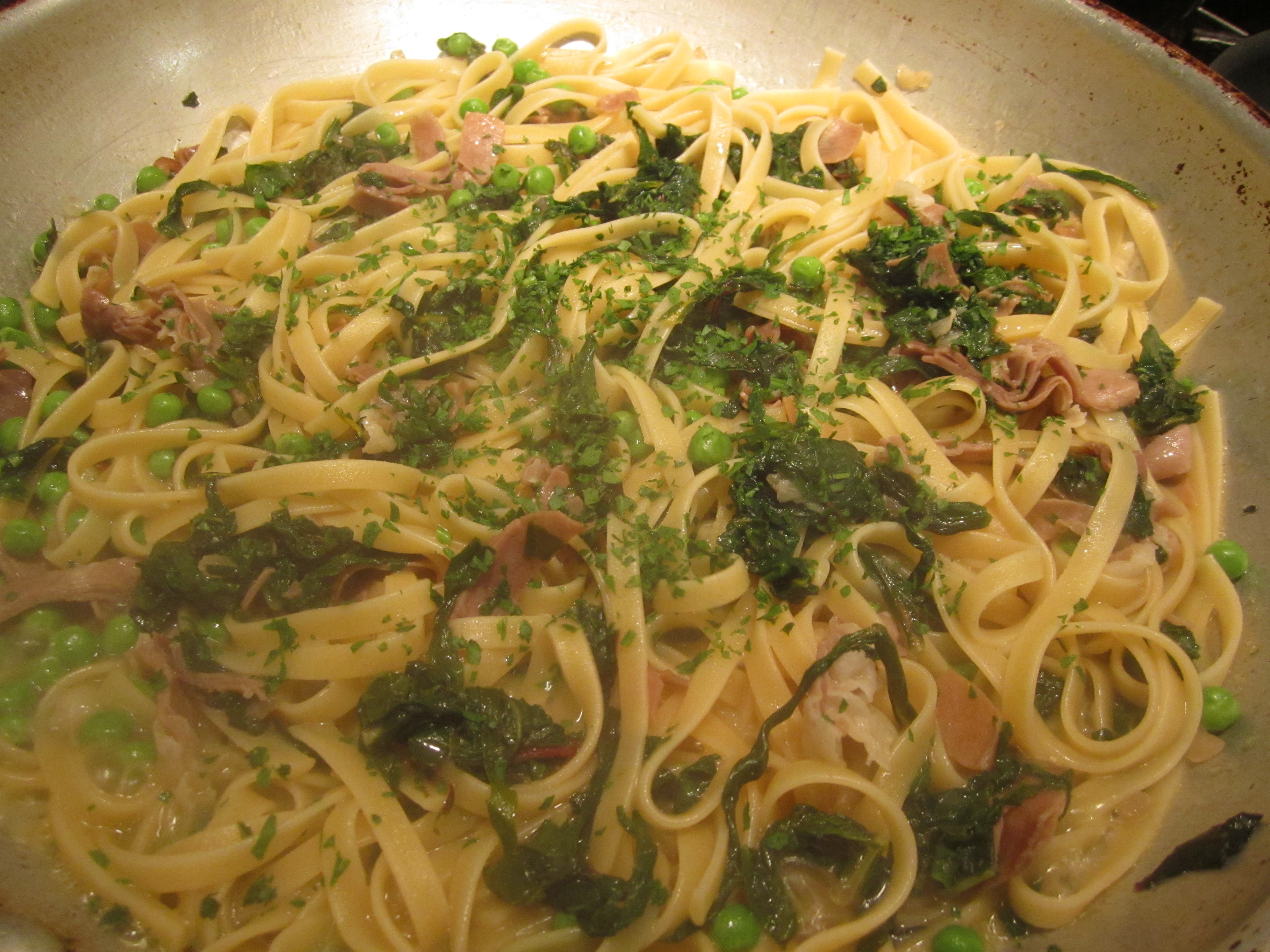
Add in peas and white wine and cook until wine evaporates.  Add broth and peas and continue cooking on low until pasta is ready.  Add pasta to the skillet, along with 1/2 cup cooking water,  the chopped parsley and butter.  Saute on high heat for 30 seconds or until all is combined.


Posted in Uncategorized | 1 Comment

Roast Chickens on the Grill

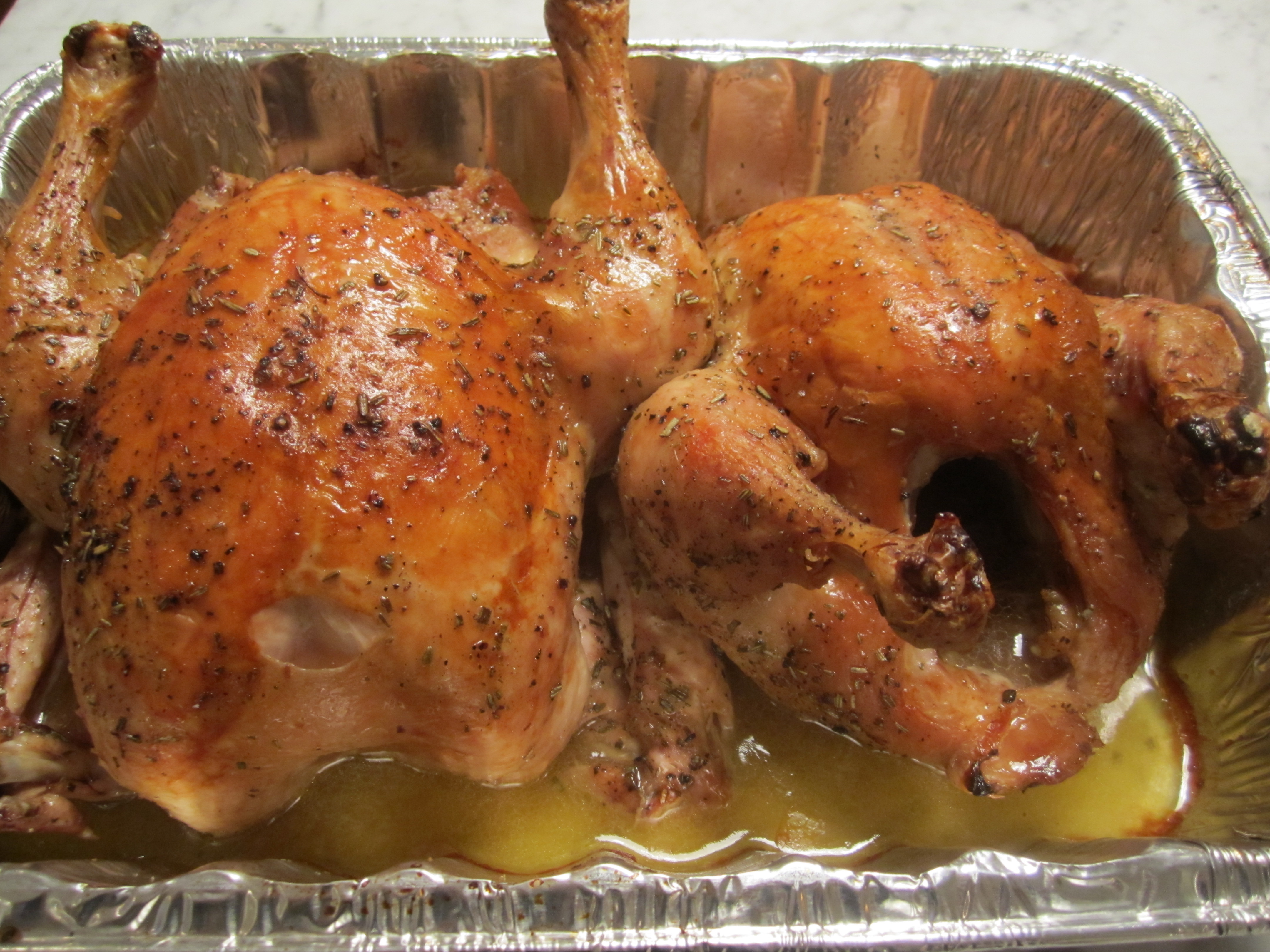
Although I make this dish on the grill, I can’t really call it grilled chicken–it’s more of a high-heat roast chicken that happens to cook in a pan on the grill.  It has a couple of advantages over traditonal grilled chicken pieces.  It’s nearly foolproof–it doesn’t need to be watched closely and turned constantly for fear of flareups.  Therefore, it’s great to make for guests because it can cook on its own for an hour or so, then be allowed to rest for up to a half-hour and stay piping hot when it’s carved.  Also, because these birds are roasted whole, you can fit several on the grill (2 to a pan) and potentially feed a crowd from just one round of grilling.

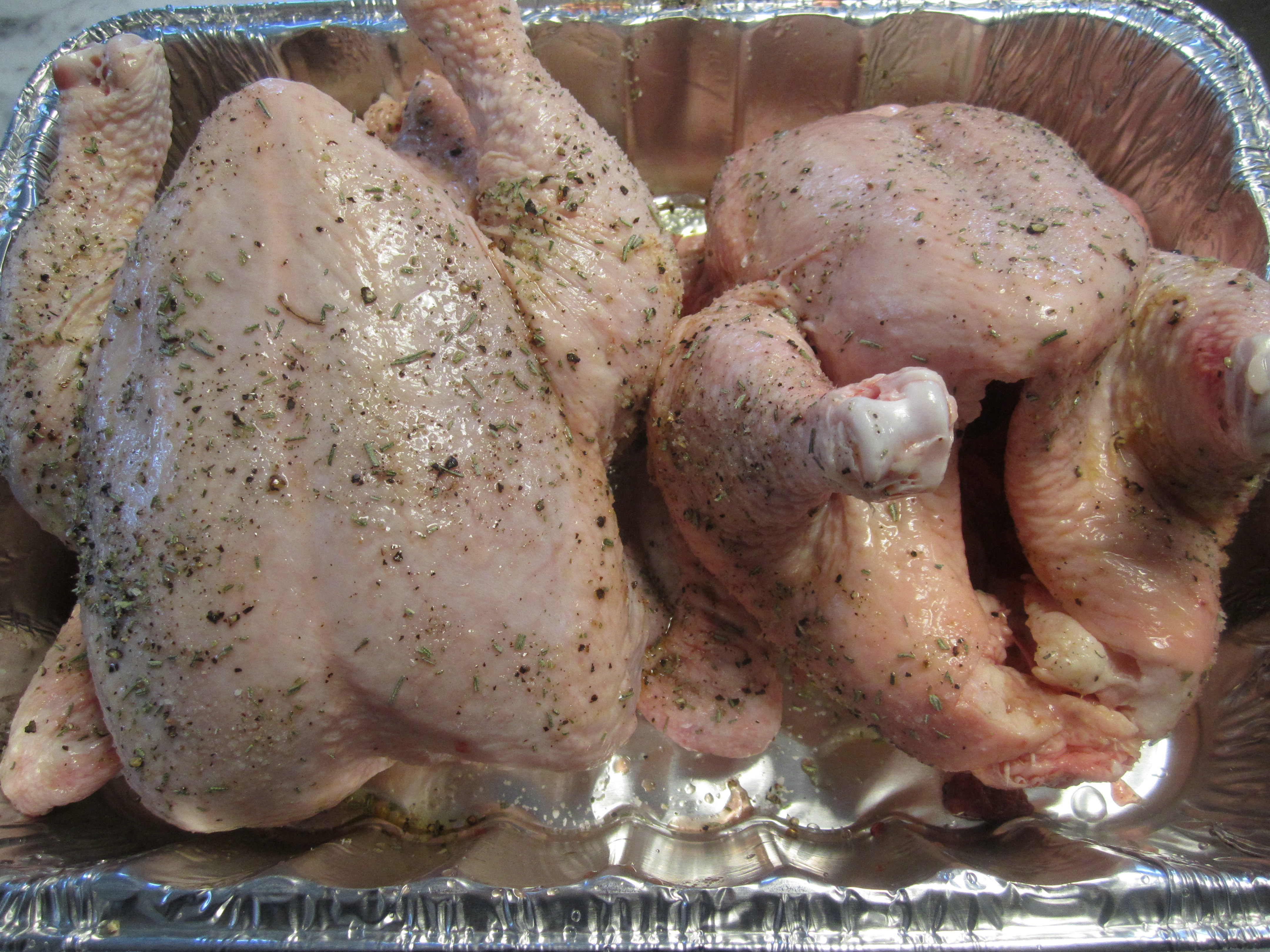
I’ve bought my chickens from a local farm that raises their own chickens (no need to label these “organic”) and they are always a treat–much more succulent and tender than commercially raised birds. I’m making two chickens tonight because they’re small and I want leftovers for lunch.  Earlier in the day (about 5 or 6 hours ahead of cooking them), I season the chicken with herbs, salt, pepper and oil.  They are placed side by side in a foil baking pan, covered tightly with foil and allowed to sit in the fridge until about a half-hour prior to roasting.

The grill is preheated to high, then the entire covered foil tray is placed on the grill rack and the grill cover closed.  I turn the grill to medium and let these roast covered for about a half-hour, then I remove the foil cover and continue to roast for another half hour or until they become mahogany brown.  Let rest for up to a half-hour (but at least 10 minutes), then carve.

I like to carve my chicken in the following way:  remove wings, legs and thighs, then remove breast lobes from the bone and cut each lobe in halves or thirds, so everyone can have a little white meat and a little dark meat.  One small chicken (3 lbs) serves about 3 people.


Serve with roasted eggplant, peppers and tomatoes and a green salad.

Roast Chickens on the Grill

serves 4

2 small (about 3 lbs each) chickens

1 tbl salt

1 tsp black pepper

1 tsp dried rosemary

1/4  c olive oil

About 5 or 6 hours prior to cooking, place chickens in foil baking tray and rub with olive oil, salt, pepper and rosemary.

Remove baking dish from fridge a half-hour prior to roasting.

Preheat grill on high and place covered foil tray on grill rack.  Close grill lid, reduce heat to medium and roast for a half-hour.  Remove foil and baste.  Roast for another half-hour uncovered, but with grill lid still closed.  Baste from time to time.  Let rest for at least 10 minutes (and up to 30 minutes) prior to carving.

Posted in Poultry | Leave a comment

Mom’s Pizza

Whenever I have leftover vegetables in the house, my favorite way to recycle them is on a pizza.  My mother’s method of making pizza is to start with a thick crust and cook in a low oven (around 325 degrees) for 45 minutes to 1 hour.  This will provide you with a crisp crust and bottom, but moist center pieces.

As I’ve stated before, I’m not a baker.  I’ve made my own pizza dough in the past, but I’ve never made it enough to become proficient at it.  Working with dough–particularly yeast dough requires a familiarity with the “feel” of the dough.  There are days when the humidity is higher and the dough requires more flour and less liquid than on other days.  You must know how much or how little to kneed the dough, etc.  Therefore, to make my foolproof pizza, I buy the pizza dough from my favorite pizzeria.   This allows me to concentrate on the toppings.

The sauce for pizza is a bit different from sauce for pasta.  I use whole peeled tomatoes (or my mother’s home canned tomatoes).  The sauce doesn’t need to be cooked (although if you have some leftover pasta sauce, by all means, use it).  The sauce, in my opinion, must be very oily and rich. In the blender, I combine the whole peeled tomatoes with a good amount of extra-virgin olive oil until it has formed an emulsion and has turned more orange than red.

Then I remove the sauce from the blender and add some fresh chopped oregano leaves and basil leaves (don’t process the herbs in the blender or else the sauce may become too pungent).  Taste and add salt.

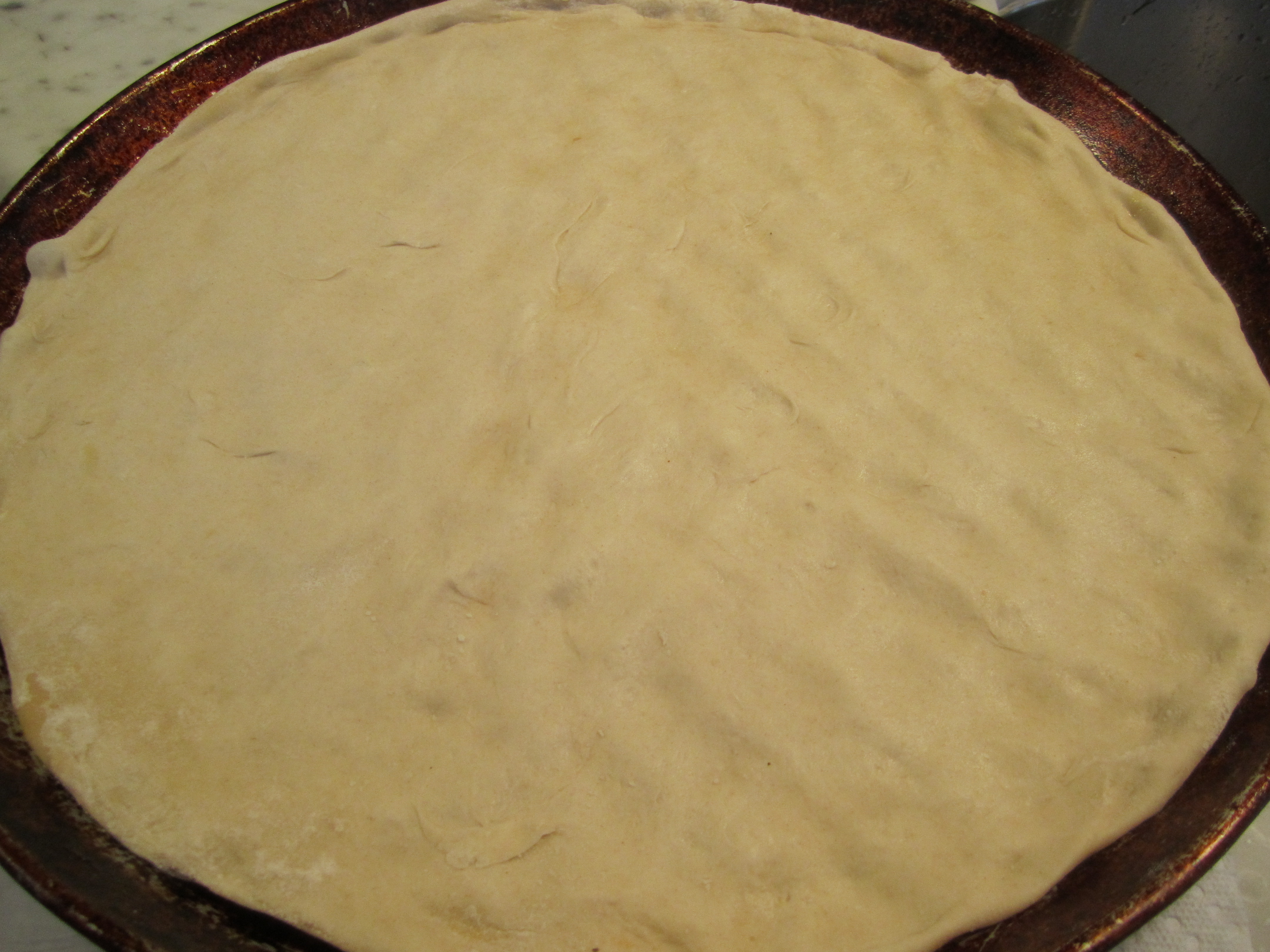
Add a tablespoon of oil to the pizza pans and spread the dough out evenly on each pan.

These pizzas will be on the thicker side (the dough should be about 1/2″ thick when spread out).  This may necessitate using more than one round of pizza dough per pizza (simply piece them together and spread them evenly).

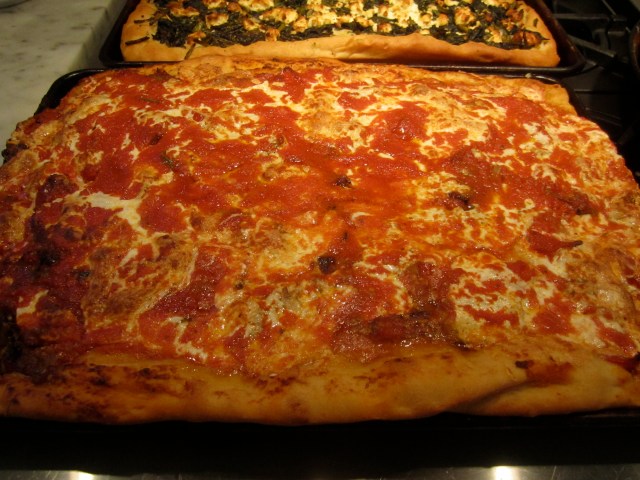
The mozzarella is sliced by hand as thinly as possible–I prefer this to shredded mozzarella.  One of the interesting things about my mother’s pizza is that she places the mozzarella and any toppings on the dough before the sauce–the sauce comes last and covers the other ingredients.  Because these will bake for a while, this prevents the mozzarella and toppings from drying out and overcooking–it works brilliantly.

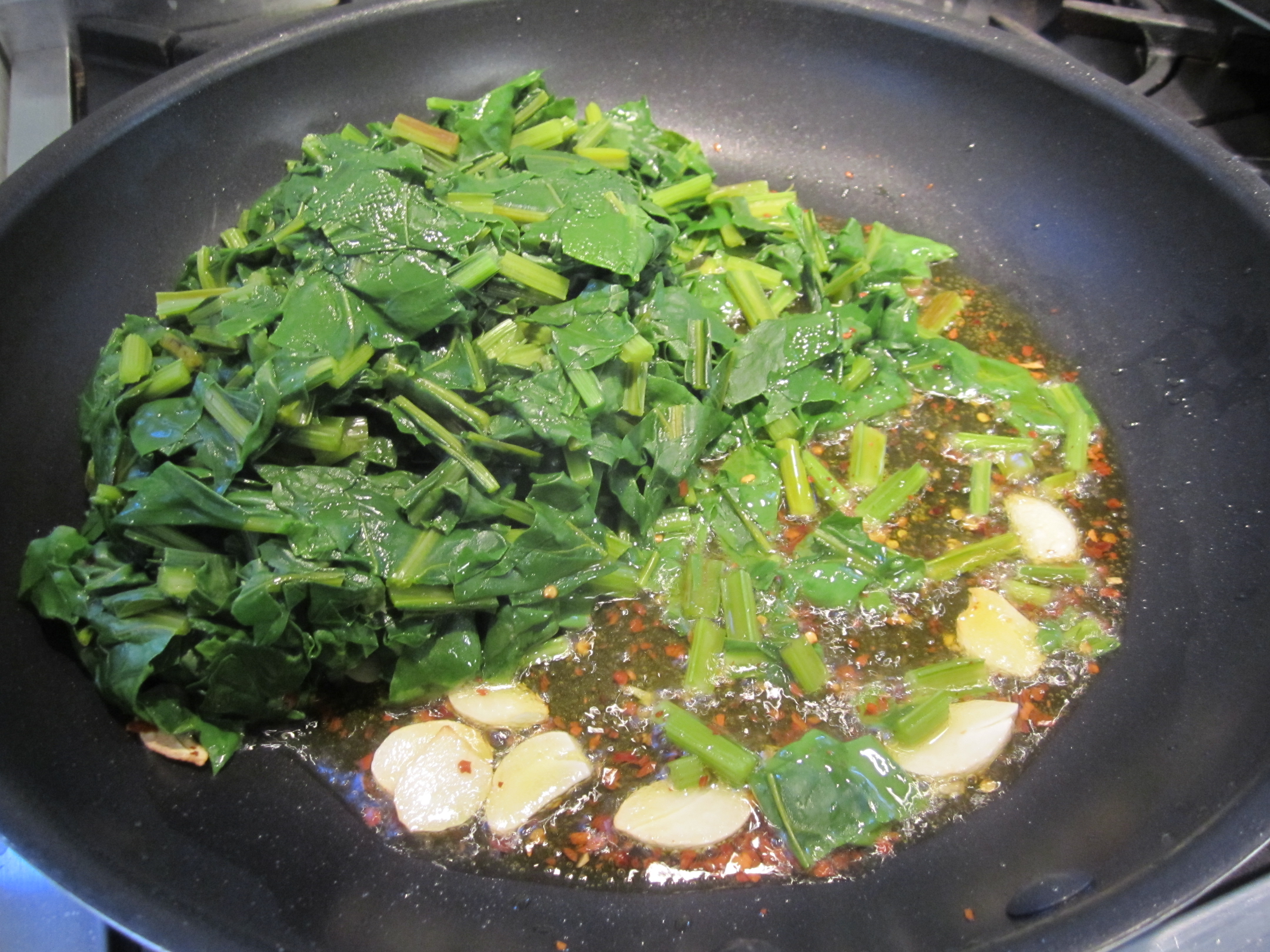
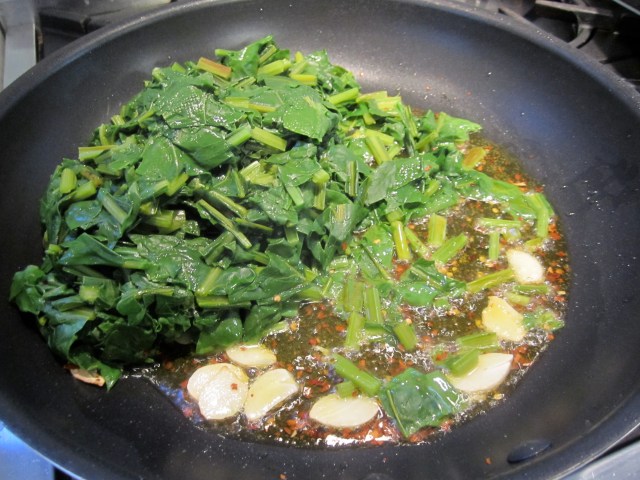
Which brings me to additional toppings–the most fun part of making pizza.  Tonight I have two fun toppings to use in addition to tomato and mozzarella.  You may recall that I made roasted eggplant, peppers and tomato the other day–those leftovers are PERFECT for pizza.  In addition, I have those wonderful unblemished beet greens and some goat cheese left from my golden beet and goat cheese salad the other day.  Those have been boiled and sauteed with lots of garlic and chili flakes, for a great greens and goat cheese pizza.
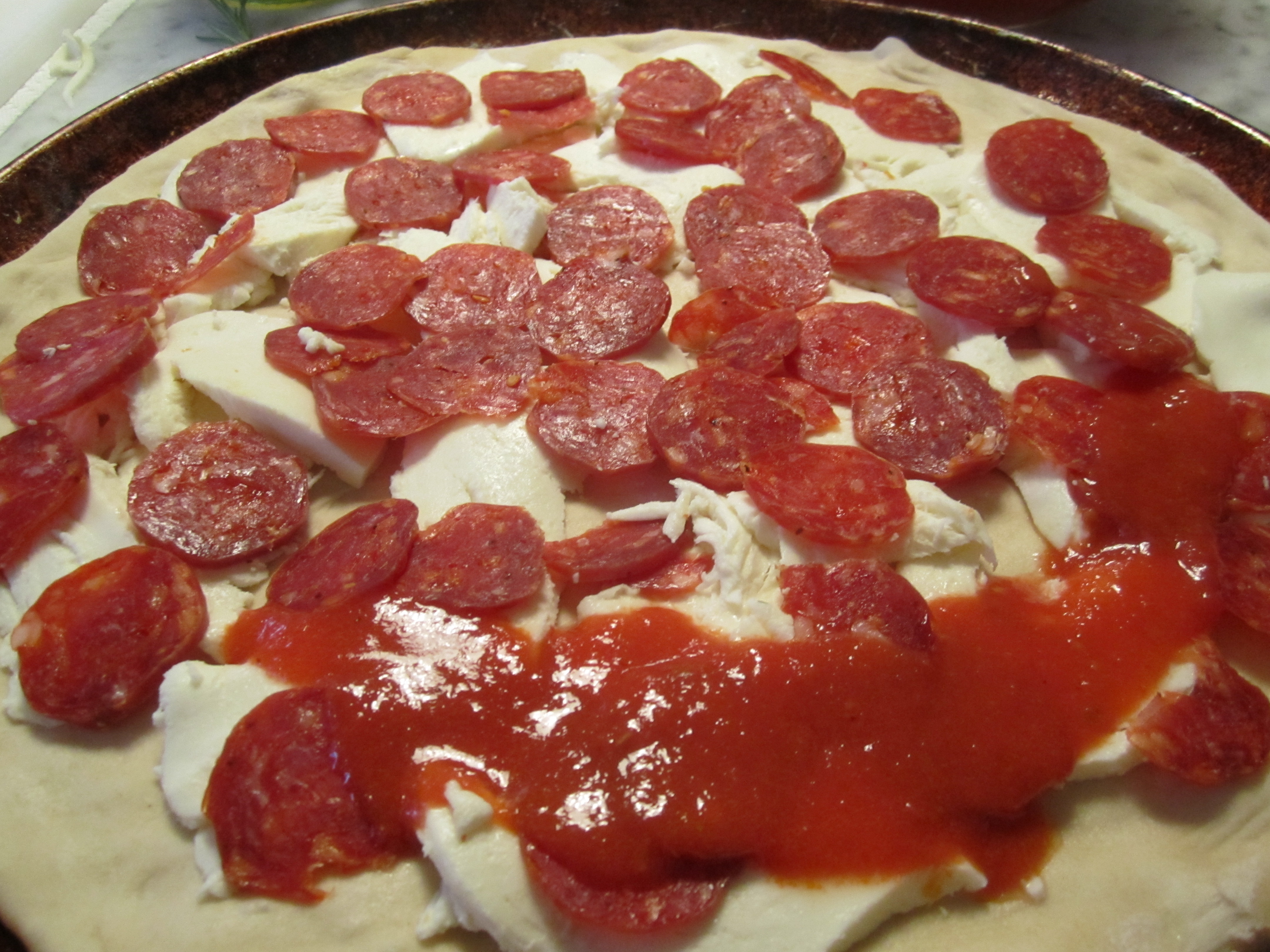
Pizza night wouldn’t be complete without a cured sausage pizza.  This sausage is one I buy at Citarella Market, and is a Calabrese-style sausage (not to be confused with the American sausage known as pepperoni).  Sliced thinly, it sheds some of its wonderfully fragrant fat into the pizza and once you try it, you’ll never go back to pepperoni.  Before I added the rest of the sauce, I took the photo below to give you an idea of the proportions of ingredients.

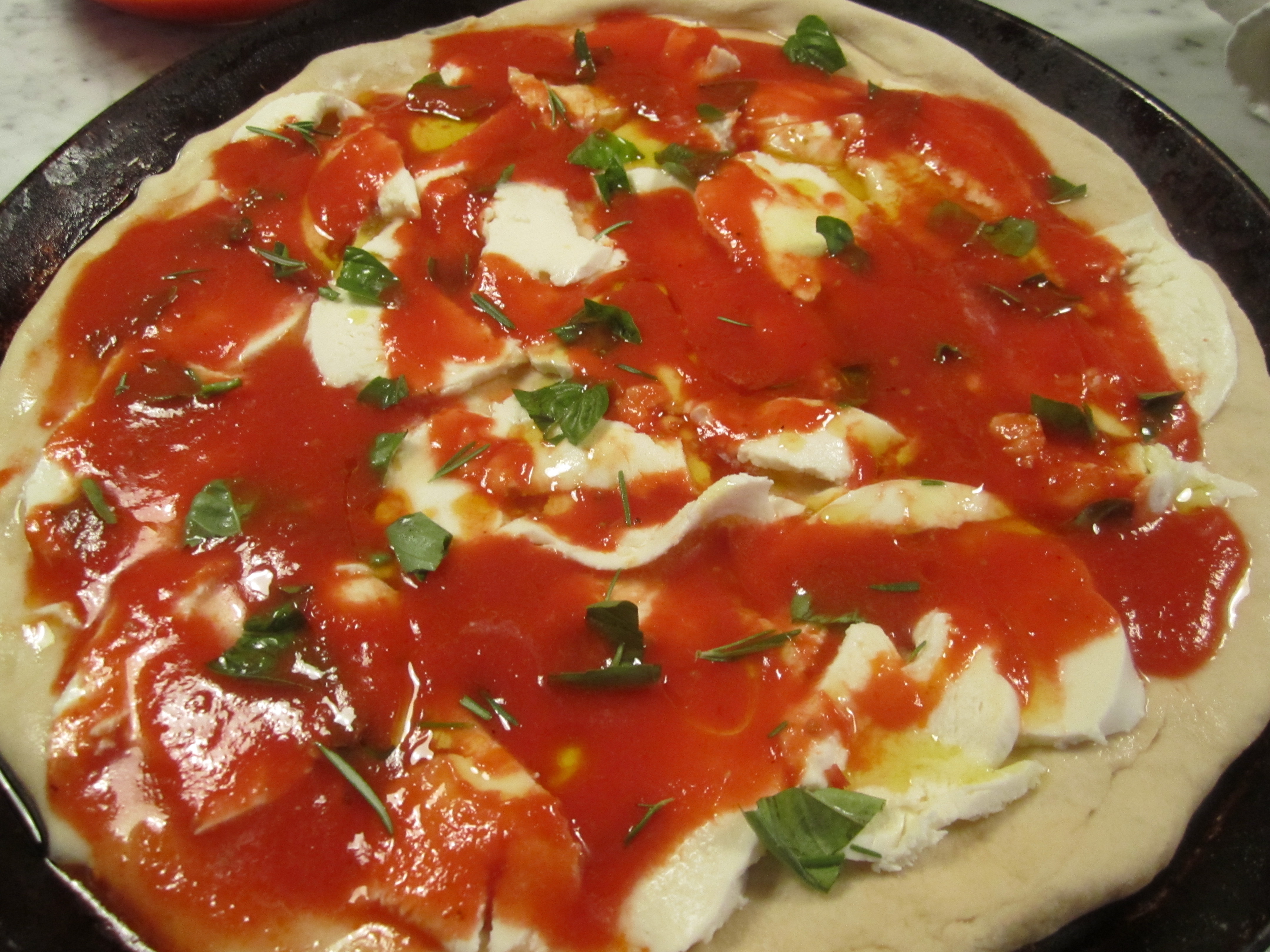
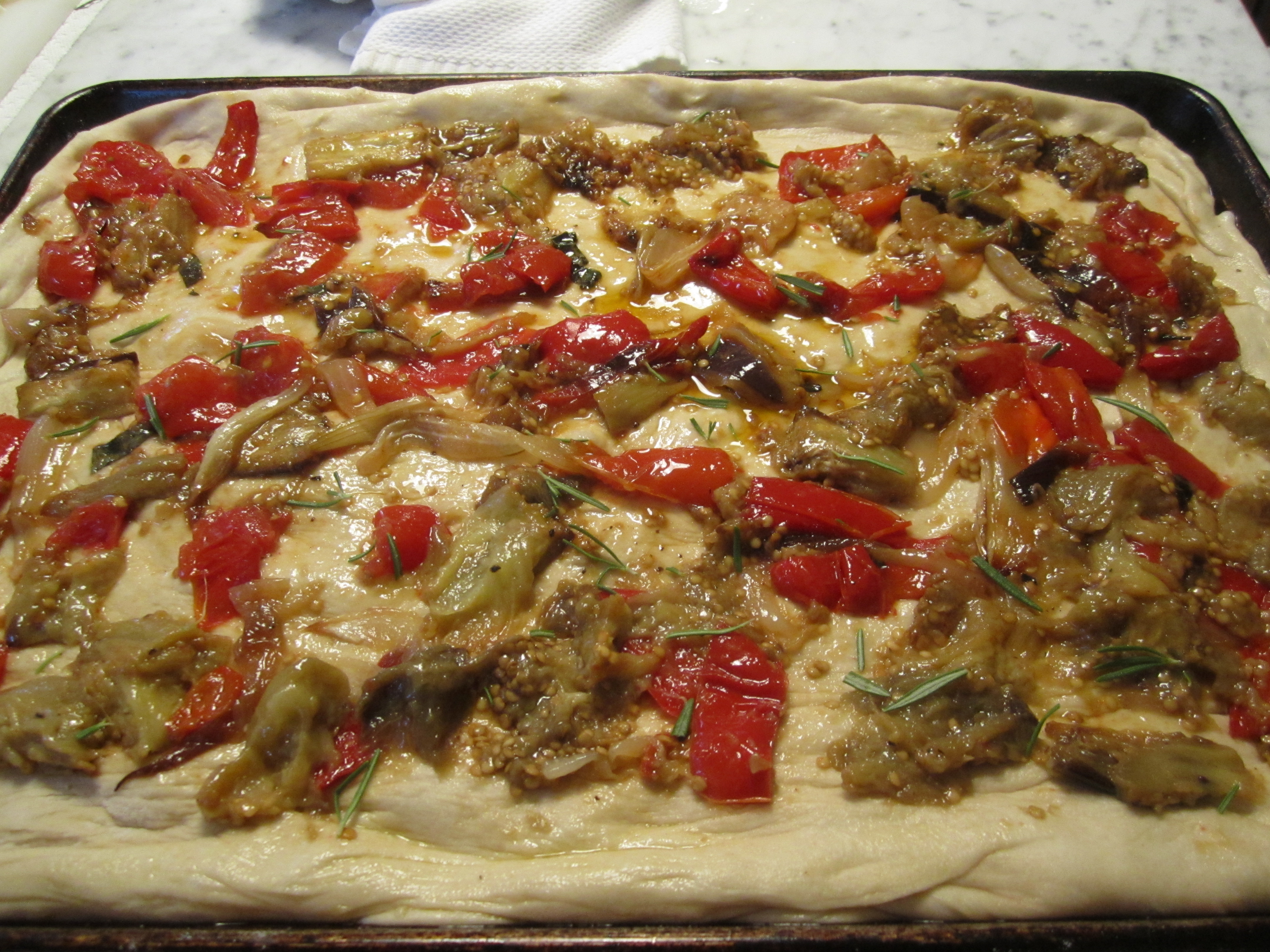
I’ll give you the sauce recipe, but for making the pizzas on this post, the photos will be most helpful in guiding you to figure out the amount of topping and proportions of ingredients to use on your pizza.

To assemble the basic margherita pizza spread a layer of cheese, then top heavily with sauce and small pieces of freshly snipped oregano and basil.  In addition, you’ll notice a couple of needles of fresh rosemary–my neighbor, Beppi’s suggestion.  Drizzle liberally with extra-virgin olive oil.

For the roasted eggplant and pepper pizza, the same formula applies–place toppings and cheese on the dough first, then add sauce on top.  See the proportions in the photo below.  Once again, I’ve added the sauce after photgraphing.

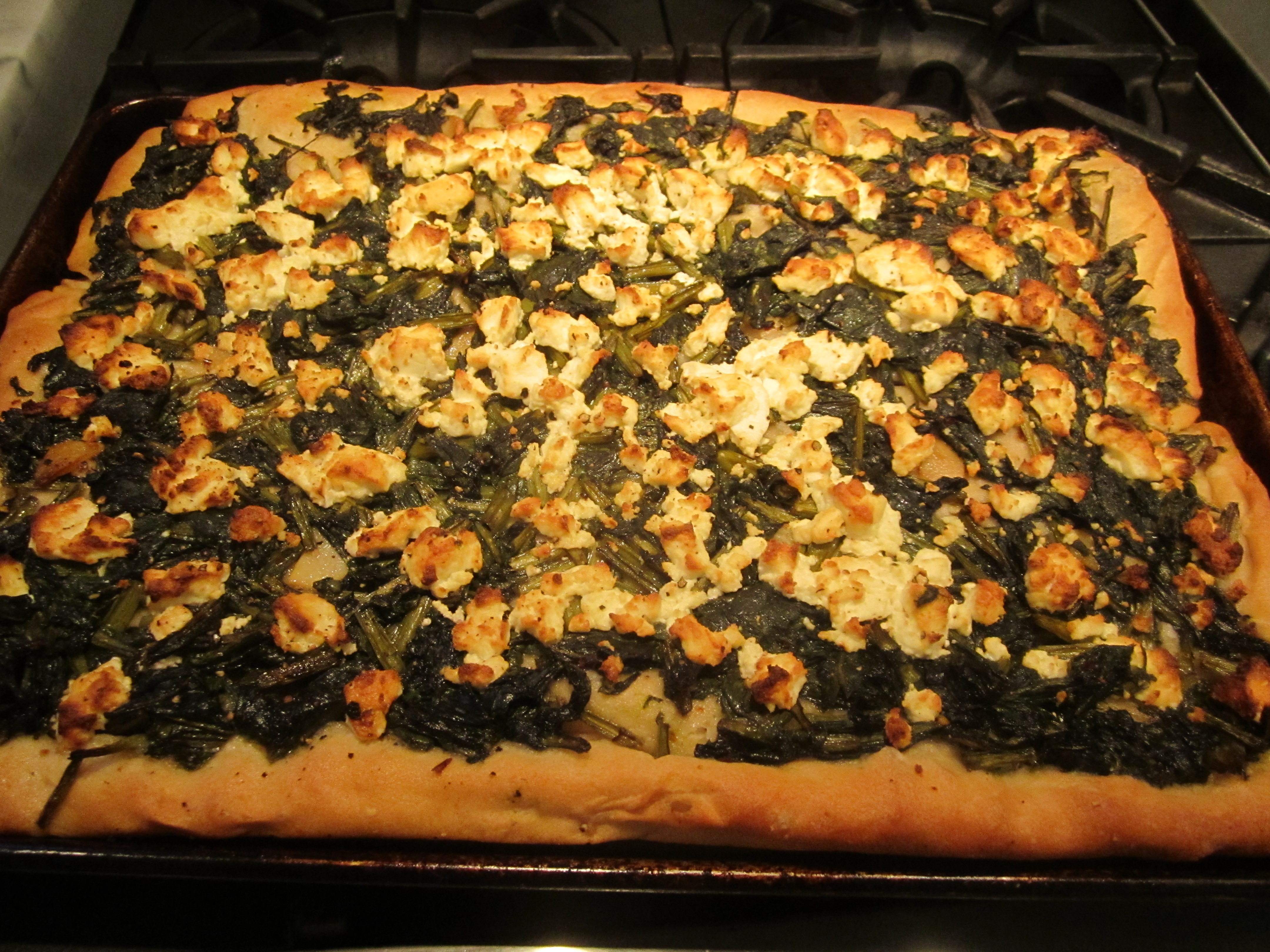
 The only pizza I’m making without tomato sauce is with beet greens and goat cheese. To keep this pizza moist, use an extra-liberal amount of olive oil drizzled on top (several tablespoons).
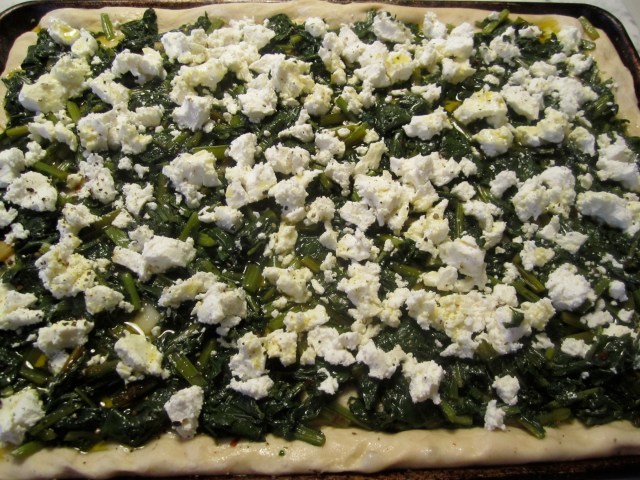
Bake all for about 45 minutes to one hour, depending on the strength of your oven.  Because I had so many pizzas in one oven, I used convection, but it’s not absolutely necessary.  To test for doneness, make sure the edges are a nice deep golden color, then lift the crust and make sure the bottom is lightly golden as well.

Pizza Sauce

to make 3 large pizzas

28-oz can of whole peeled tomatoes

1/3 c extra-virgin olive oil

2 tsp freshly chopped oregano leaves

6 basil leaves, slivered

salt and pepper to taste

Blend tomatoes and oil in blender to emulsify.  Add in chopped herbs and stir by hand.

Posted in Pizza | Leave a comment

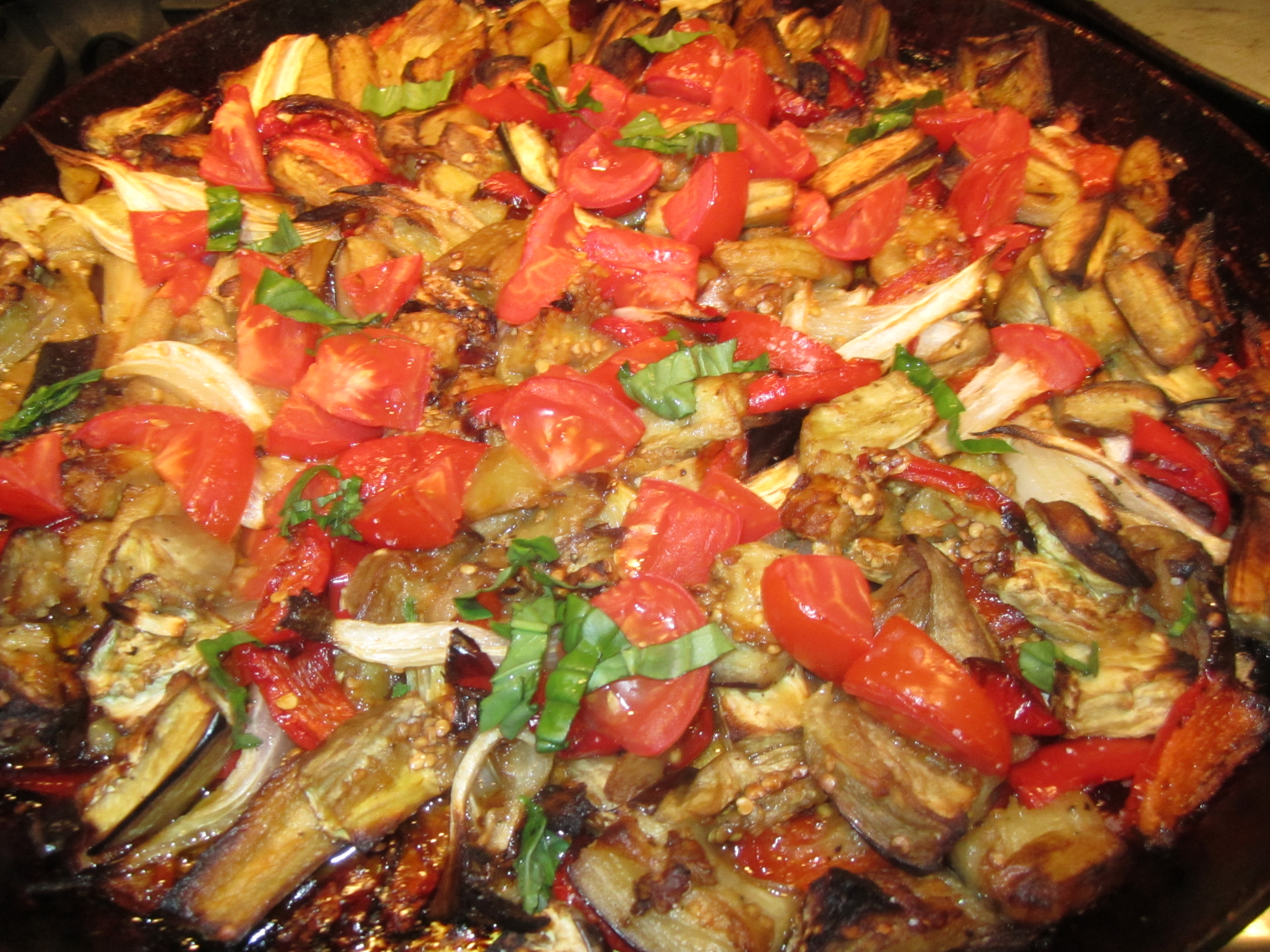
Roasted Eggplant, Peppers and Tomato

Eggplants are in season and that’s the only time I’m really interested in them.  It’s not out of principle–it’s more that I eat them so often during the summer, I’m basically tired of eating them by fall.

This dish is a great accompaniment to roast chicken on the grill, or any other grilled meat or fish.

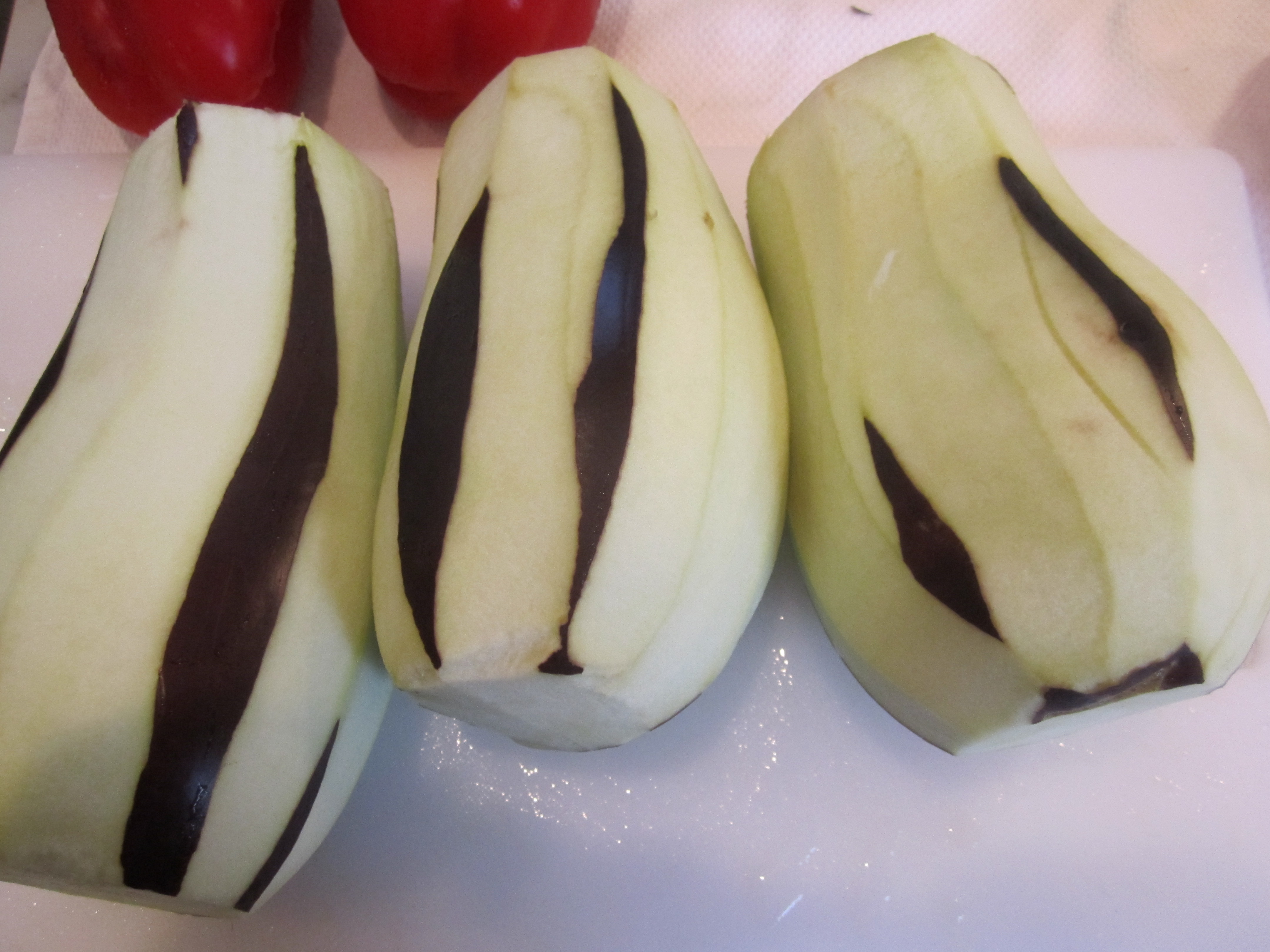
The eggplants get peeled, but not completely–leave a little stripe of black here and there–it adds nice smokey flavor and crispness.

If you leave them unpeeled entirely, however, the peel chars and the whole dish becomes acrid and burnt-tasting.

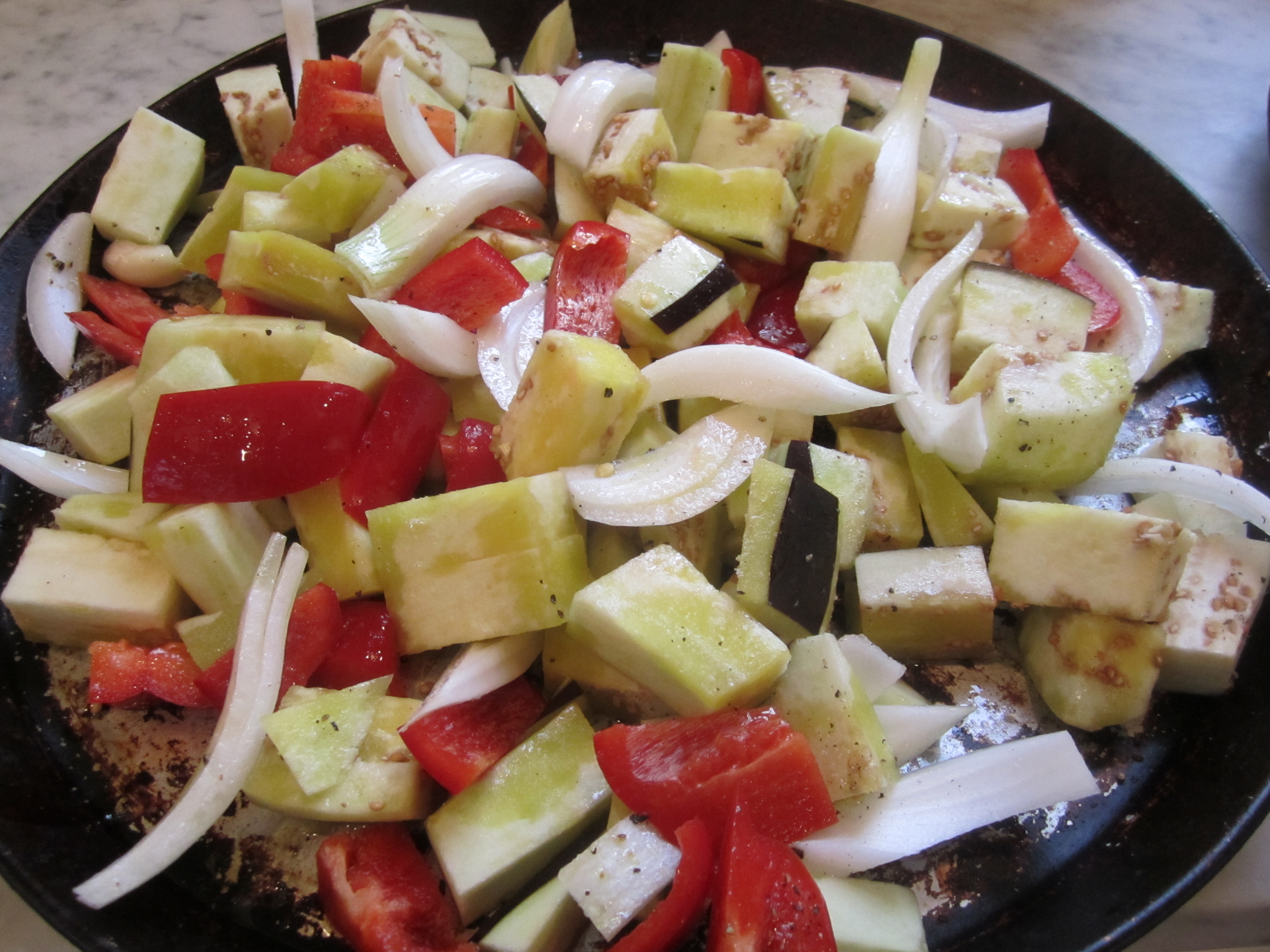
The peppers are diced into large chunks, along with some onions.  I add a couple of split cloves of garlic as well.  All is tossed with oil, lots of salt, and some black pepper.

The tomatoes are added in a little later, lest they blacken and scorch.

Depending on your oven, this dish takes about an hour to roast,  but holds well at room temperature (or covered, in a warm oven).

Roasted Eggplant, Peppers and Tomato

serves 4

2 large eggplants, firm and without bruises, peeled (mostly) and diced into 1″ cubes

1 large onion, diced into 1″ pieces

2 red peppers, cut into 1″ cubes

2 plum or beefsteak tomatoes, cut into quarters, lengthwise

2 cloves garlic, peeled and halved

1 handful of basil or mint

1/2 c olive oil

approx. 1 – 1/2 tsp salt or to taste

black pepper to taste

Preheat oven to 375 degrees.

In 2 large roasting pans, spread out all the vegetables except tomatoes. Do not overcrowd pans.  Sprinkle with oil, salt (liberally) and pepper.  Toss with hands to coat with oil and seasonings.

Roast, uncovered for approximately 1/2 hour.  Do not stir until the pieces begin to caramelize on the bottom–then stir them gently.  After the pieces begin to brown and wilt (approximately 1/2 hour) combine the contents of both pans into one.  Add chunks of tomato and  continue roasting until all is moist and lightly charred (about another half hour–longer if necessary).

Sprinkle with torn basil  or mint leaves and additional raw olive oil.

Posted in Vegetables | Leave a comment

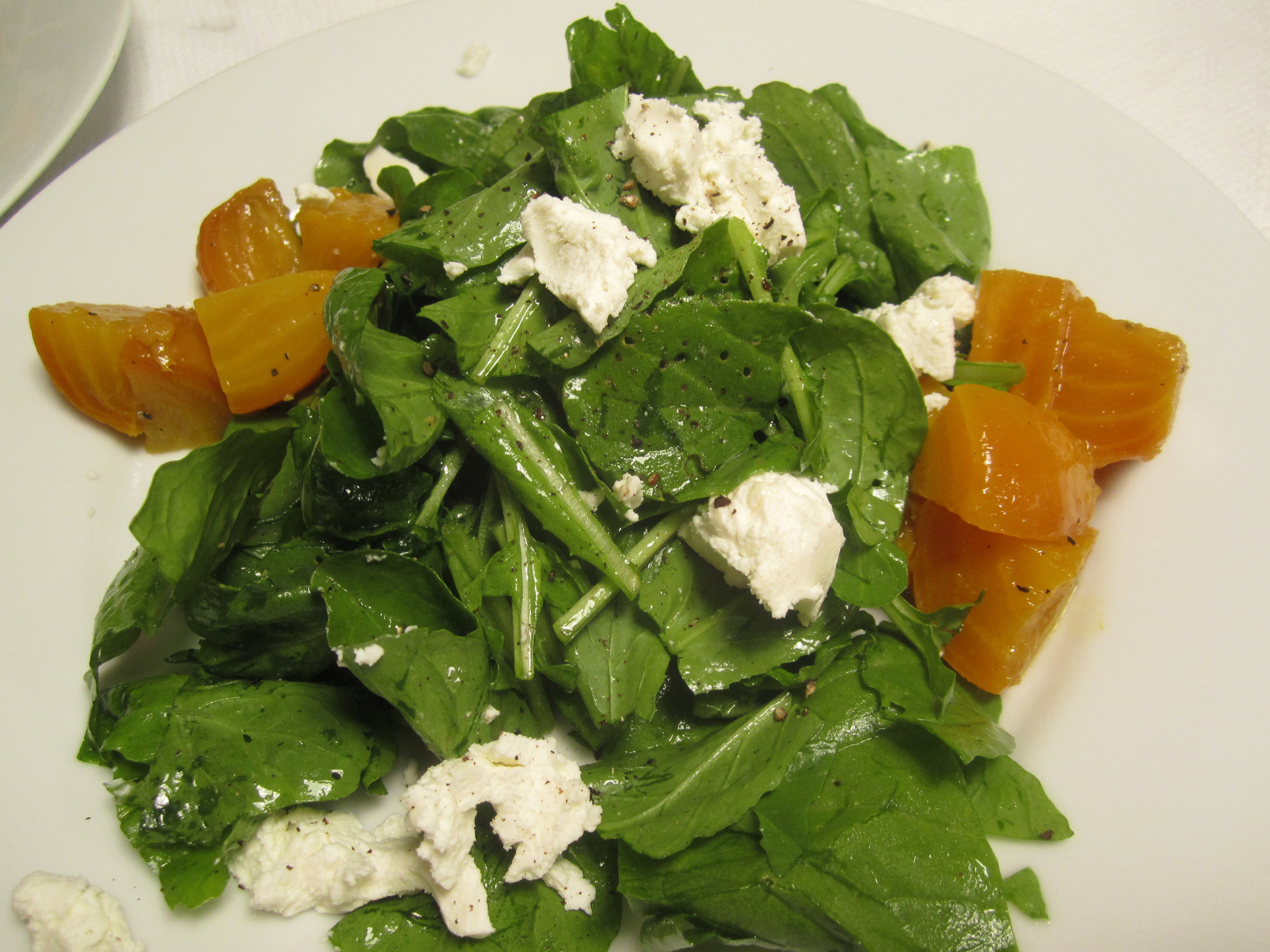
Golden Beet and Goat Cheese Salad

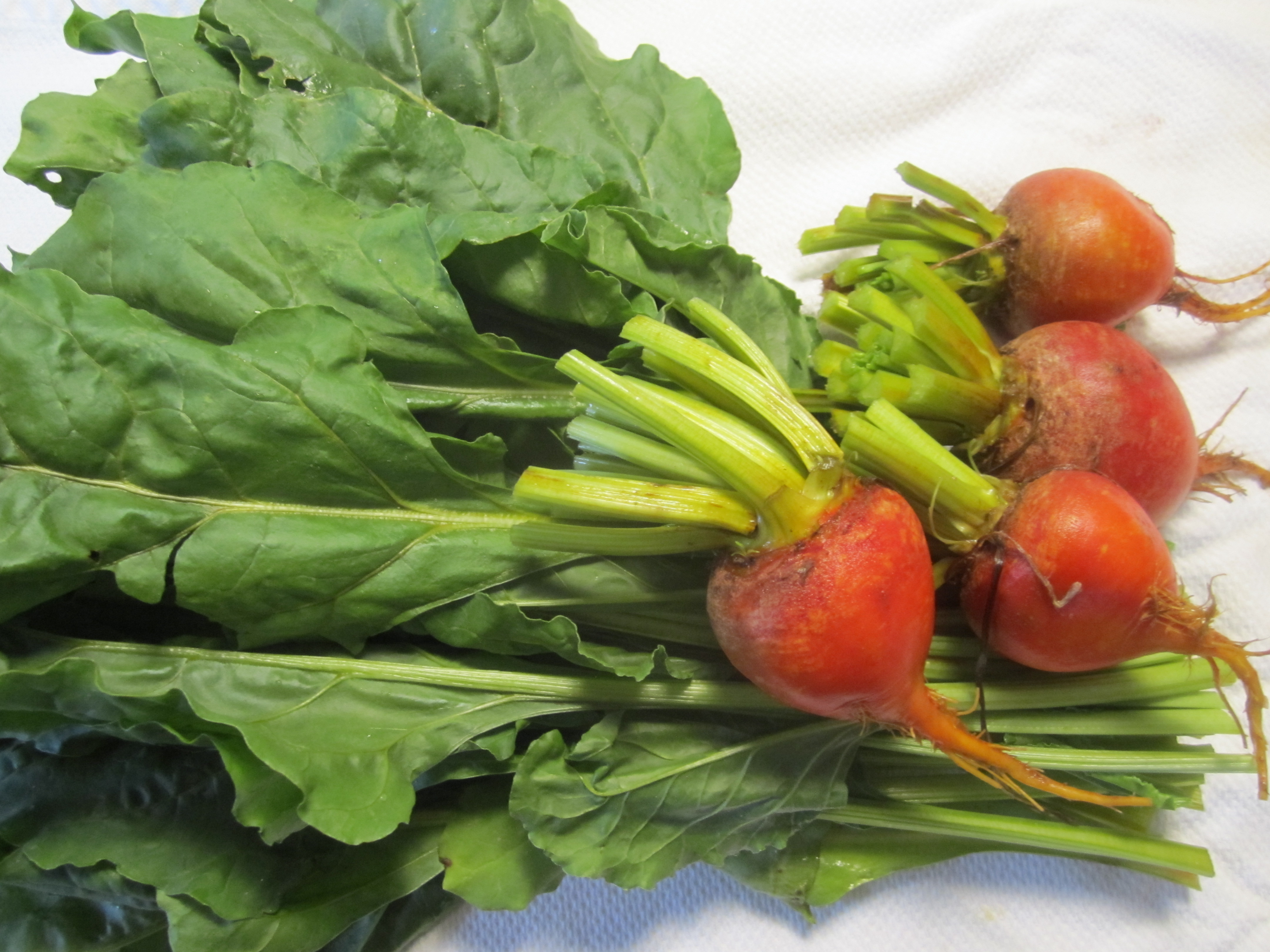
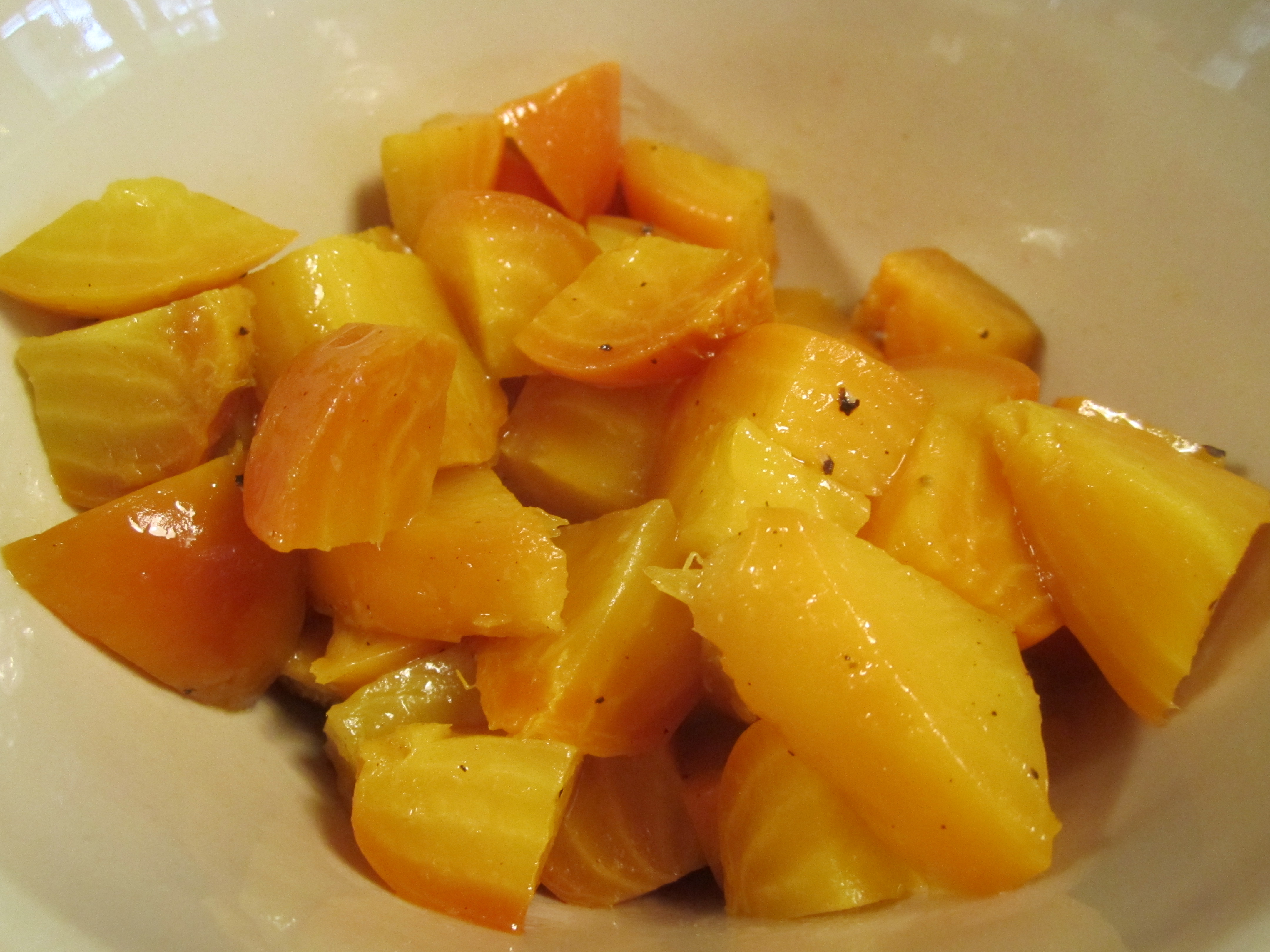
This may look like many other salads on this blog but it’s summer and it’s all local and just-picked.  These exquisite golden beets elevate this salad to an other-worldly level of goodness.  They’re so naturally sweet that it’s difficult to go wrong in their preparation.

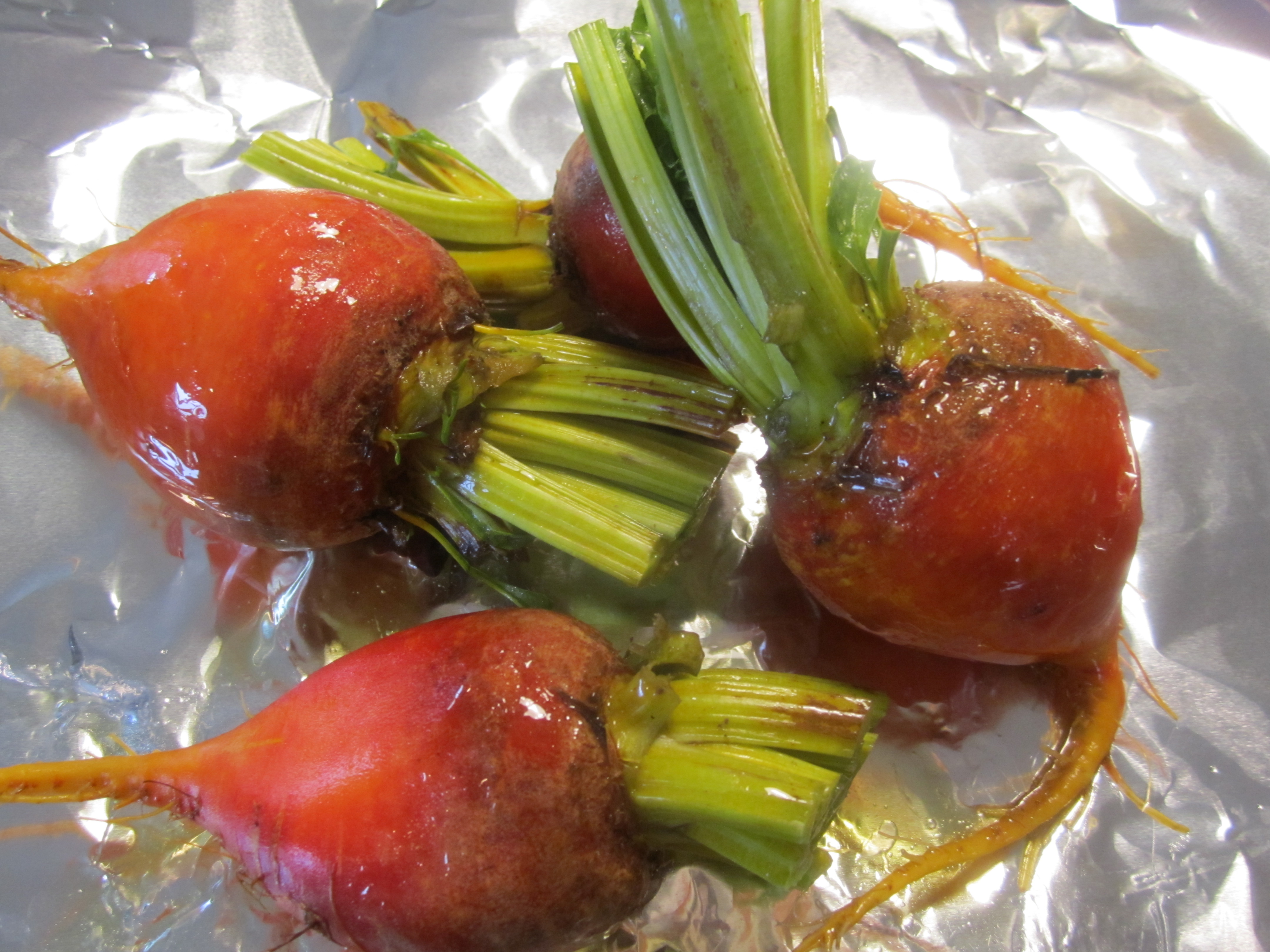
I think the nicest way to prepare beets while keeping their sweet syrupy juices intact is to roast them whole in foil.  They can be roasted al-dente or totally soft–they only get better with more time in the oven.  Save their leafy tops if they’re green and hearty-looking–they can be boiled and sauteed as a wonderful side dish.

I like to dress the beets a few hours ahead of serving.  This is as easy as a splash of red wine vinegar and a nice coating of extra-virgin olive oil, as well as some salt and pepper.

At the last minute, the greens are dressed with red wine vinegar, agave and extra-virgin olive oil, then topped with crumbled fresh goat cheese (although aged goat cheese or bleu cheese are great as well).

This is a great first course for guests because the beets can be roasted ahead, the salad greens washed in advance, and the plates assembled at the last minute.

 Golden Beet and Goat Cheese Salad

serves 4

1  1b fresh arugula, washed

2 bunches golden beets with 1″ of stem still attached

1 – 1/2 tbls extra-virgin olive oil

1 tbl red wine vinegar (less if you’re using a very strong one)

1 tsp agave

salt and pepper to taste

A couple hours ahead, preheat oven to 375 degrees.  Wash beets, place them in foil and drizzle lightly with olive oil.  Seal and roast for 1 – 1-1/2 hours, depending on their size.

To test for doneness, open the foil and stick in the largest beet–if it passes easily all the way through the beet, they’re all done.  When they’re cool enough to handle, rub off their skins with a paper towel–it will rub off quite easily.

In a bowl, drizzle a teaspoon of oil and a half-teaspoon of red wine vinegar over the beets and season with salt and pepper.  Taste and add salt or vinegar, if necessary.

When ready to serve, dress the salad greens with the remainder of the oil and vinegar, plus a teaspoon of agave.  Add salt and pepper and toss well.

Place beets around greens and top with goat cheese and addtiional black pepper.

Posted in Salads | Leave a comment