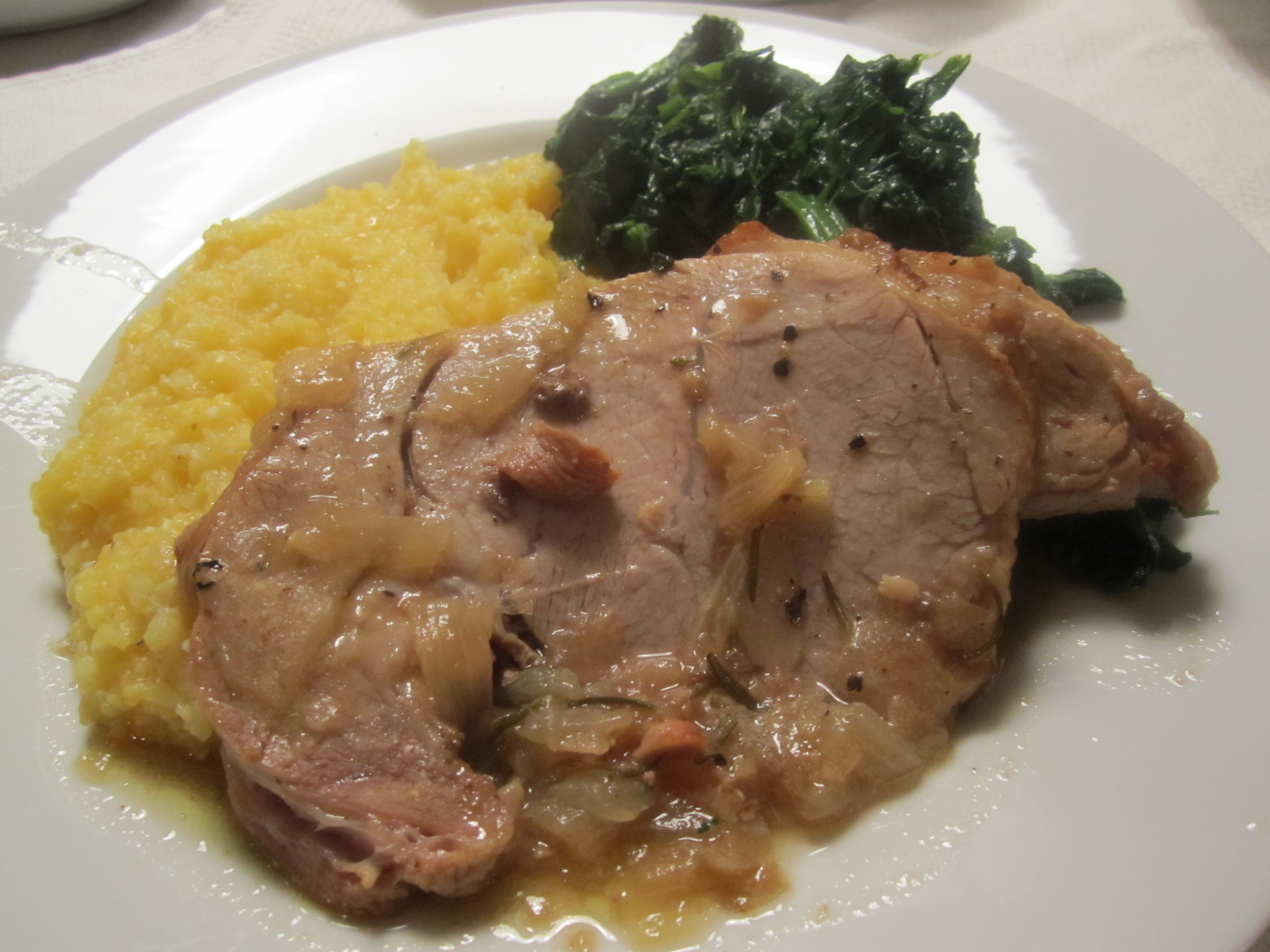
Shoulder of Veal with Polenta and Spinach

I’ve already written about all of the dishes in tonights’ meal, but I’ll share the menu with you, give you a recap of the technique, then tell you about any new discoveries I’ve made in the preparation of any of the dishes, since there are often new discoveries whenever I make something–no matter how many times I’ve made it.

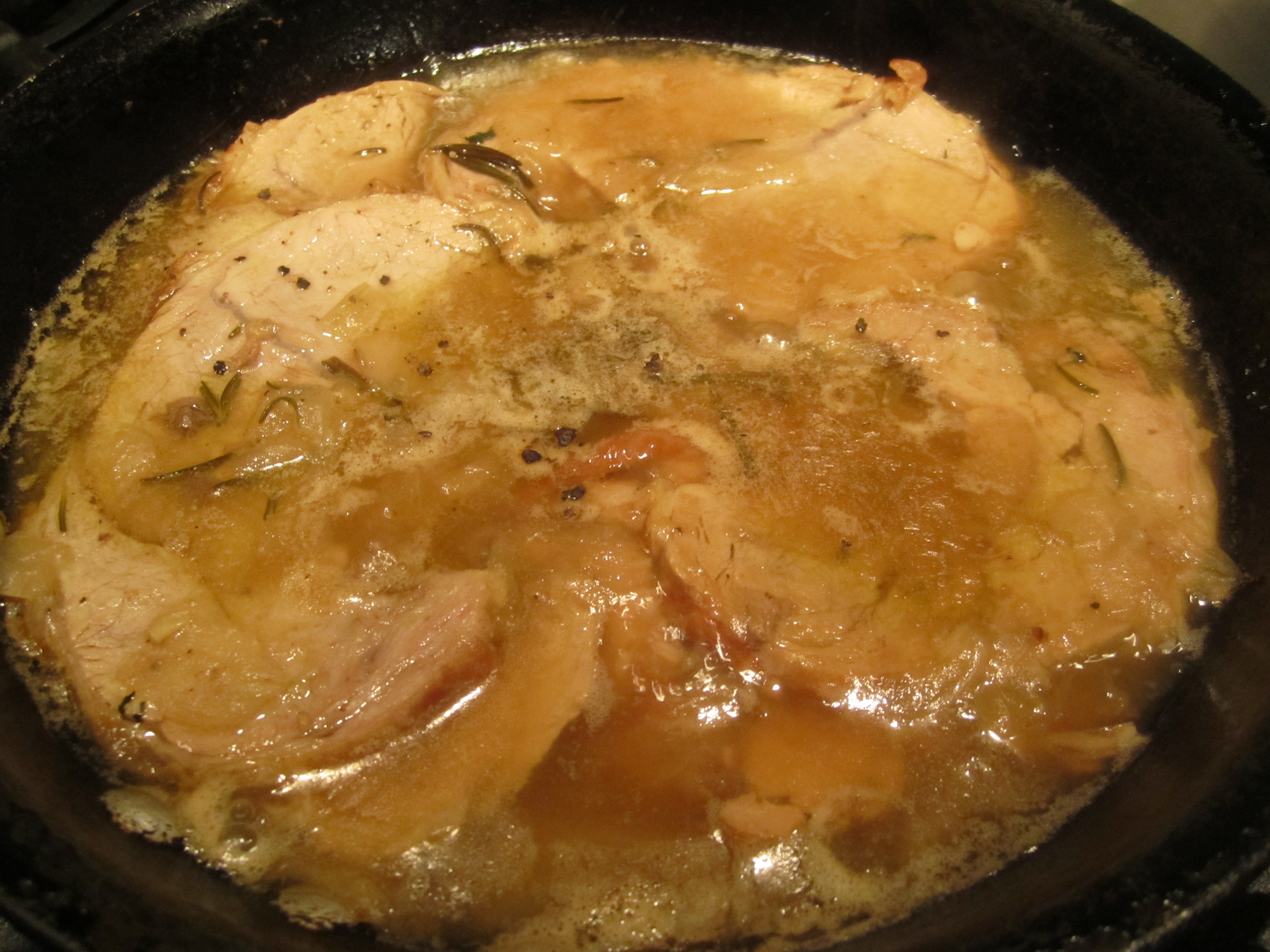
The main course, a boneless shoulder of veal, was my New Year’s Eve dinner and my very first post.  As I wrote in that post, this dish should be made at least one day before serving it.  So this was made the other night, and I’m serving it tonight.  The technique is typical for a braised dish–the veal gets lightly dredged in flour, browned in oil, then seat aside.  In to the dutch oven, go a couple of coarsely chopped onions, 3 sprigs of fresh rosemary, 2 cups white wine and 2 cups chicken broth.   After simmering the sauce for about 5 minutes, add back the roast, cover and bake at 325 degrees for 2 hours.  Refrigerate overnight and slice cold.  To serve, simply reheat slices in a bit of the pan jus.
For my polenta tonight, I’m using the last of the outstanding artisanal polenta that a friend gave me a few months ago and which I’ve kept in the freezer.  To order it, go to www.loganturnpikemill.com.  I posted about this a month or so ago, and tonight I made a new discovery while making it . . . I’ve always made my polenta with 5 parts water/1 part cornmeal.  The last time I made it, it resulted in a watery polenta that I couldn’t seem to cook long enough to thicken it (I cooked it for 3 hours).  So tonight, I decided to go with a 4 to 1 ratio.   Well, it worked wonders . . . I was able to get the polenta to a nice porridge within 1 hour.

Since I had counted on 3 hours to make it, I simply turned off the flame and left it covered for  a few hours, then when I was ready to serve, began slowly reheating it and breaking it up with the back of a wooden spoon.   I added some broth to it while reheating it (about a cup), and it turned out perfectly–sturdy and thick, but not undercooked.  All I needed to do was add a bit less water and let it sit for a while!

The sauteed spinach can also be found in my first post, “New Years Eve Dinner”.  No surprises here, just boil it, squeeze it well, saute it in oil with some garlic, and add some homemade chicken broth to it at the end–the broth makes all the difference in the world.  I now only make sauteed spinach when I have homemade chicken broth in the house (either freshly made or in the freezer).  I’ve tried it with chicken bouillon and it doesn’t compare.
Posted in Meat | 3 Comments

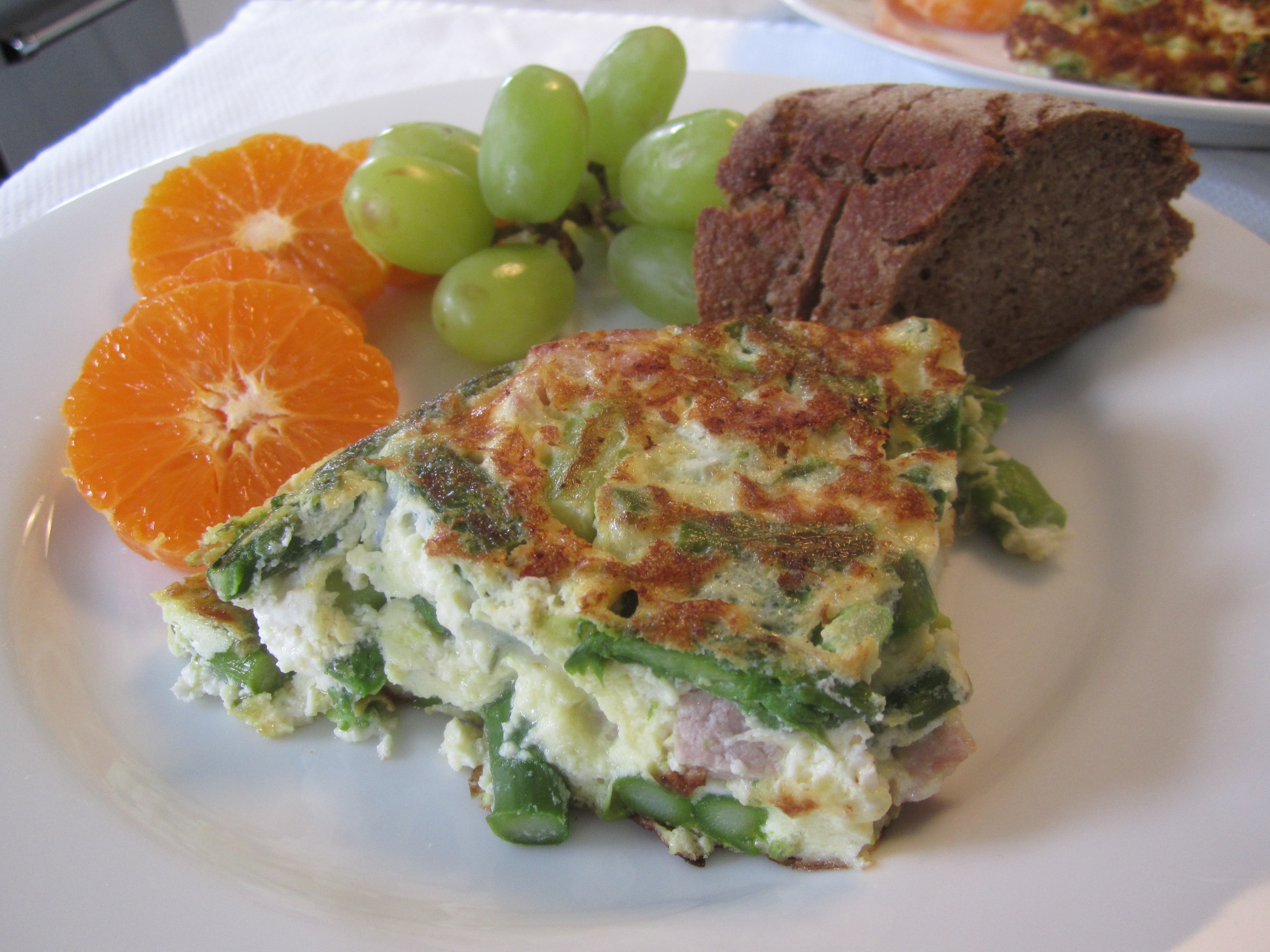
Frittata with Asparagus, Ham and Feta

I had asparagus left over from my Spring Pasta with Asparagus and Ramps the other night–I intentionally made double the necessary amount of asparagus the other night,  looking ahead to a frittata for Sunday brunch.

My mother always made frittata for breakfast on Easter Sunday morning, as did her mother, along with most people in their town in Calabria.  Although the term “frittata” means any combination of fried things with eggs, to my mother and her neighbors,   the term always implied the exact same combination of ingredients–asparagus, soppressata (or any homemade cured sausage) and parmiggiano or pecorino

My frittate are a little different from my mother’s in a couple of ways . . . first, I like to make them with any number of combinations–not just asparagus and cured sausage.  In the fall and winter, I love making them with broccoli or spinach, and with feta, or ricotta, or any other cheese that goes well with vegetables and melts well.  In the late summer, I love making them with zucchini or leeks.

The second way in which my frittate differ from my mother’s is that I like to make them taller and fluffer, with an abundance of vegetables, and less eggs.  My mother uses more egg, less vegetable, and a broader skillet, which results in a flatter frittata.  Also, I add a touch of half and half to lighten up the eggs. 

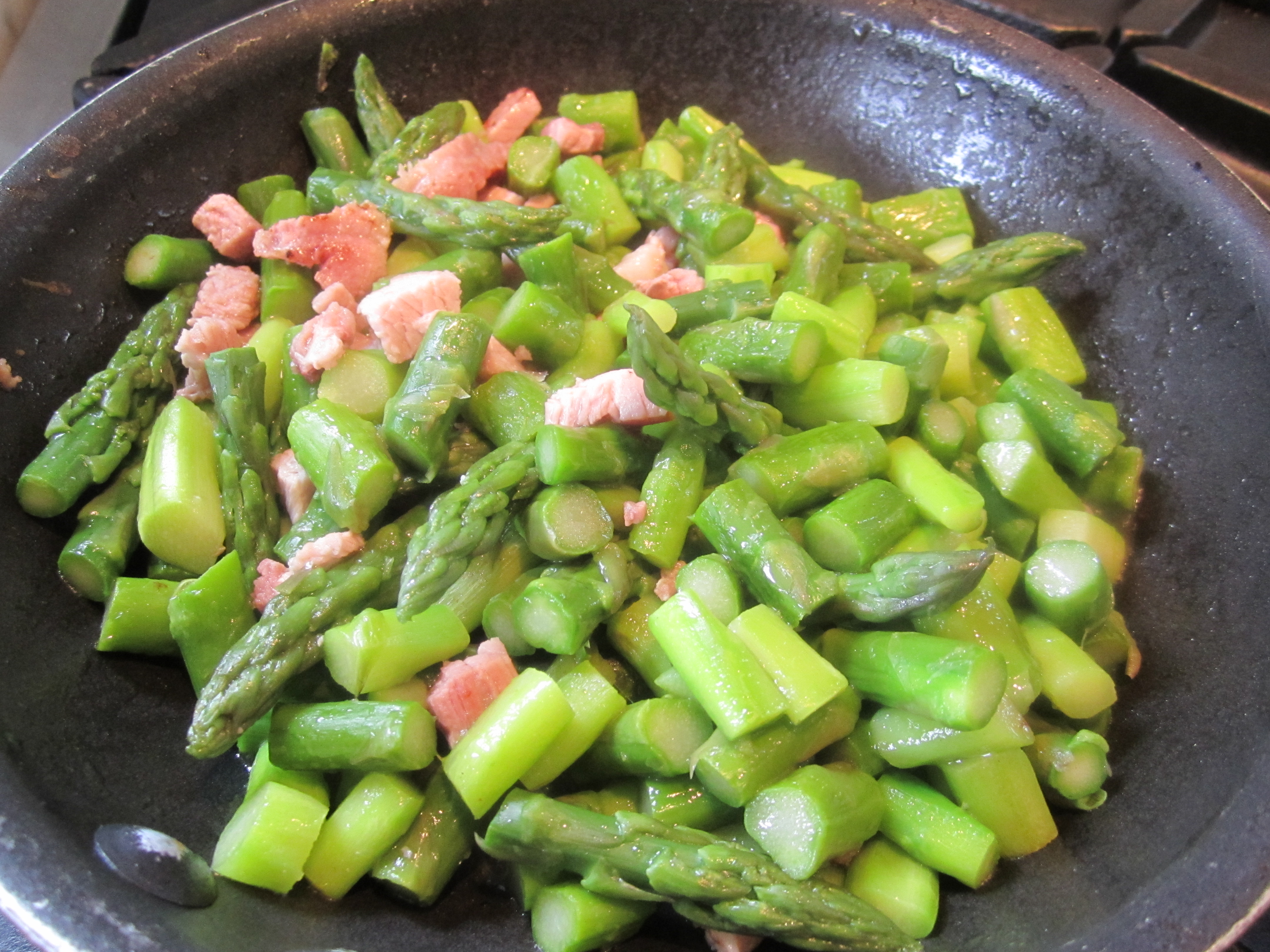
I had leftover ham from the pasta dish as well, so I began by sauteing the cubes of ham in a bit of olive oil.  Then I added the pre-peeled and cooked asparagus pieces to the skillet and sauteed for a few minutes while I prepared the eggs. 

I used 4 large eggs for this frittata, along with some ricotta (it contributes to a fluffier frittata).  I had some french feta in the fridge as well, so, in place of grated cheese, I’m adding feta for salt and tang. 

This frittata can be made ahead and served at room temperature, or cold from the fridge.  Wedges of it are great as a sandwich in a heated buttered burger bun or soft ciabatta roll, and it keeps well for days in the fridge.  It should be allowed to rest at least ten minutes before cutting, to allow the cheeses to solidify after melting. 

Frittata with Asparagus, Ham and Feta

serves 4

4 large fresh eggs

2 cups diced, blanched asparagus pieces (approx. 1″)

1/2 c diced ham

3 tbls olive oil

1/4 c fresh ricotta

2 tbls feta cheese, crumbled

2 tbls half and half

3/4 tsp salt

1/8 tsp black pepper

In an 8″ nonstick skillet, heat the olive oil and ham cubes on low.  When the ham begins to sizzle and turn golden, add the asparagus and continue heating for about 3 minutes.

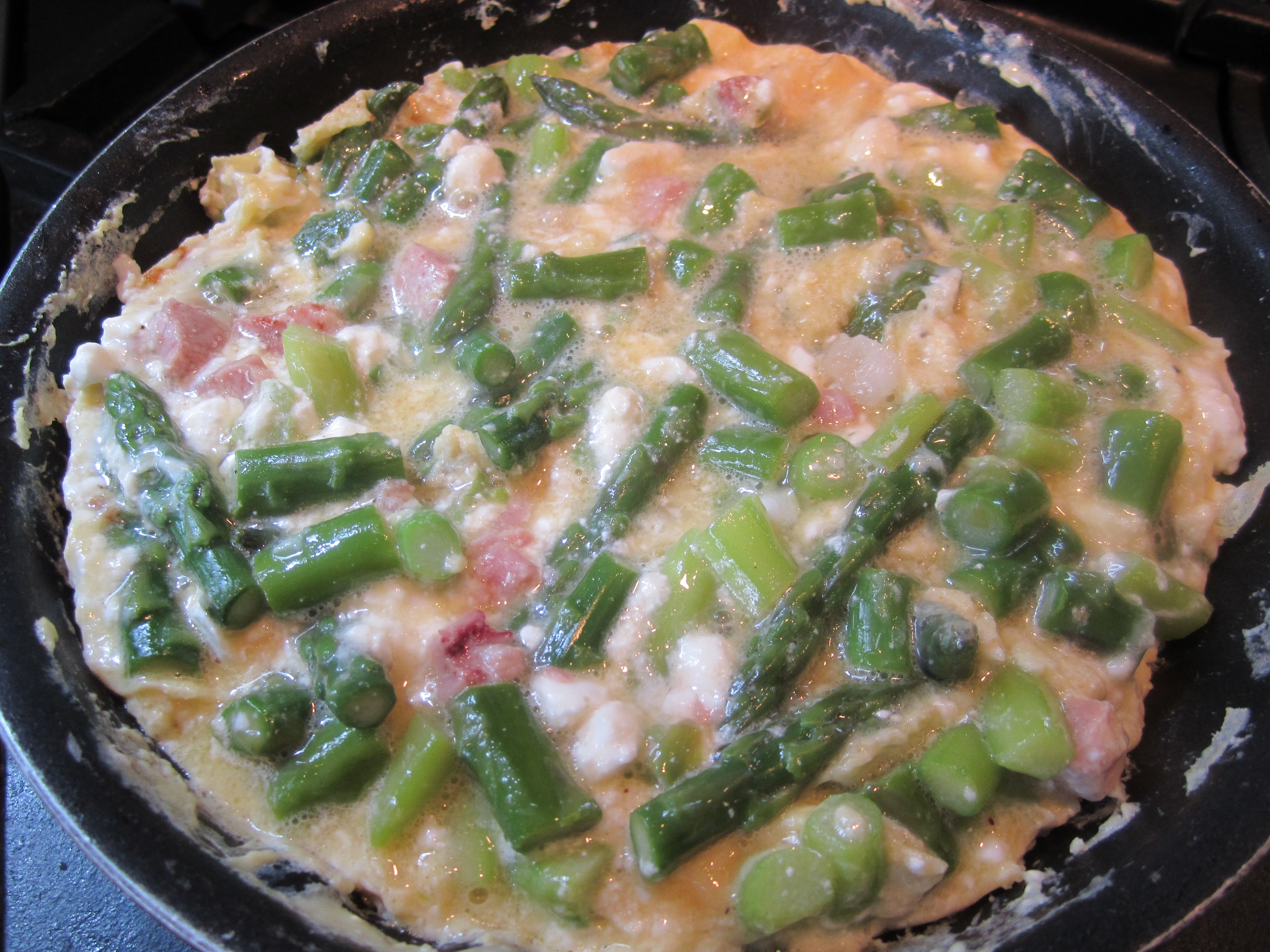
 Prepare the egg mixture . . .  Into a mixing bowl, crack the eggs.  Add the remainder of the ingredients and beat the mixture with a fork. 

Slide egg mixture into the skillet and let set for 30 seconds. 

Begin stirring from the center of the mixture for a couple of seconds.  Continue stirring the mixture and letting it set for a few seconds.  Lift the sides of the mixture and allow the liquidy ingredients from the top to run over and underneath the eggs and cook. 

After gently stirring for about 30 seconds, allow the mixture to begin to set.  Make sure heat is very low and let mixture cook, undisturbed, while occasionally lifting a side gently and peering underneath to see if the underside is golden–it should take about 6 or 7 minutes.

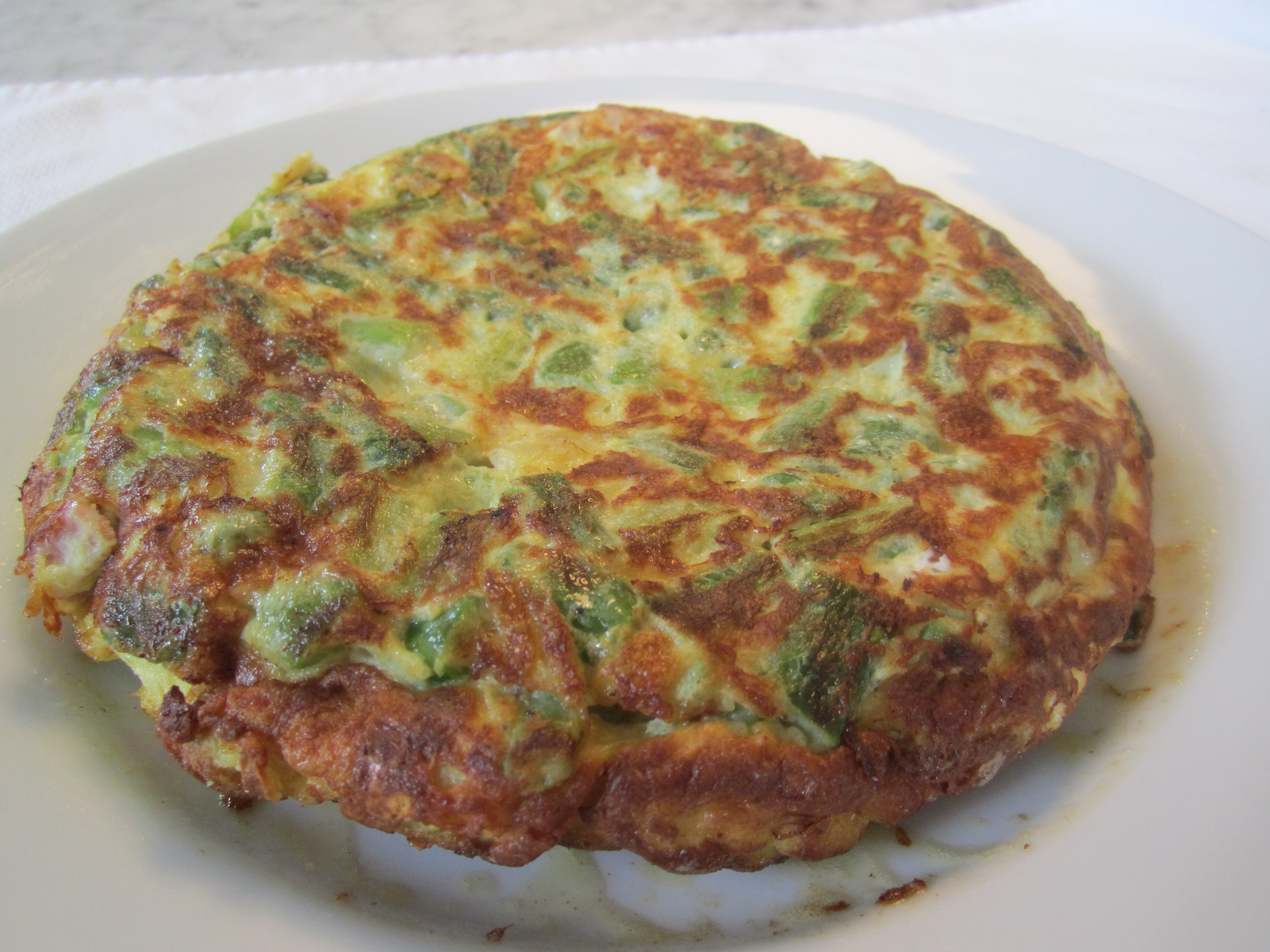
When the underside is golden, take a large plate and invert it onto the skillet, and in one motion, flip the frittata onto the plate.  If there are any bits sticking to the skillet, remove them and add a drop more oil.  Slide the frittata back onto the skillet and pat it into a nice fluffy circle (if it’s lost its shape from the flipping) with a heatproof rubber spatula.

Continue to cook on low heat for another 6 or 7 minutes, until the underside is golden.  To serve, you can either slip the frittata onto a clean plate or invert the clean plate onto the skillet, flip it again, and serve it on the first side–whichever side looks better.  Allow to rest for at least 10 minutes prior to cutting.

Posted in Eggs | Leave a comment

Pasta with Ramps, Asparagus and Peas

I’m trying to rush spring along, but the chill in the air still tells me otherwise . . . The only hint of spring in my produce market are fresh ramps.  Ramps are labeled “wild leeks” at my produce market, but actually, they’re more like wild garlic. 

When I cooked with Mario, we made the simplest of pasta dishes with sliced garlic, ramps, olive oil and a touch of chicken broth, over dried fettucine. It was like pasta with garlic and olive oil, with the garlic flavor amplified by the ramps.  Since then, whenever I see ramps, which appear for a very short time in early spring, I always buy them and make some version of this dish. 

The ramps should be rinsed and separated into two pieces–the lower stem, including the bulb and white part, and the long green leaves. 

The bulb portion should be sauteed for several minutes, like a clove of garlic; the leafy greens can go in 30 seconds prior to the completion of the dish–they are mild.

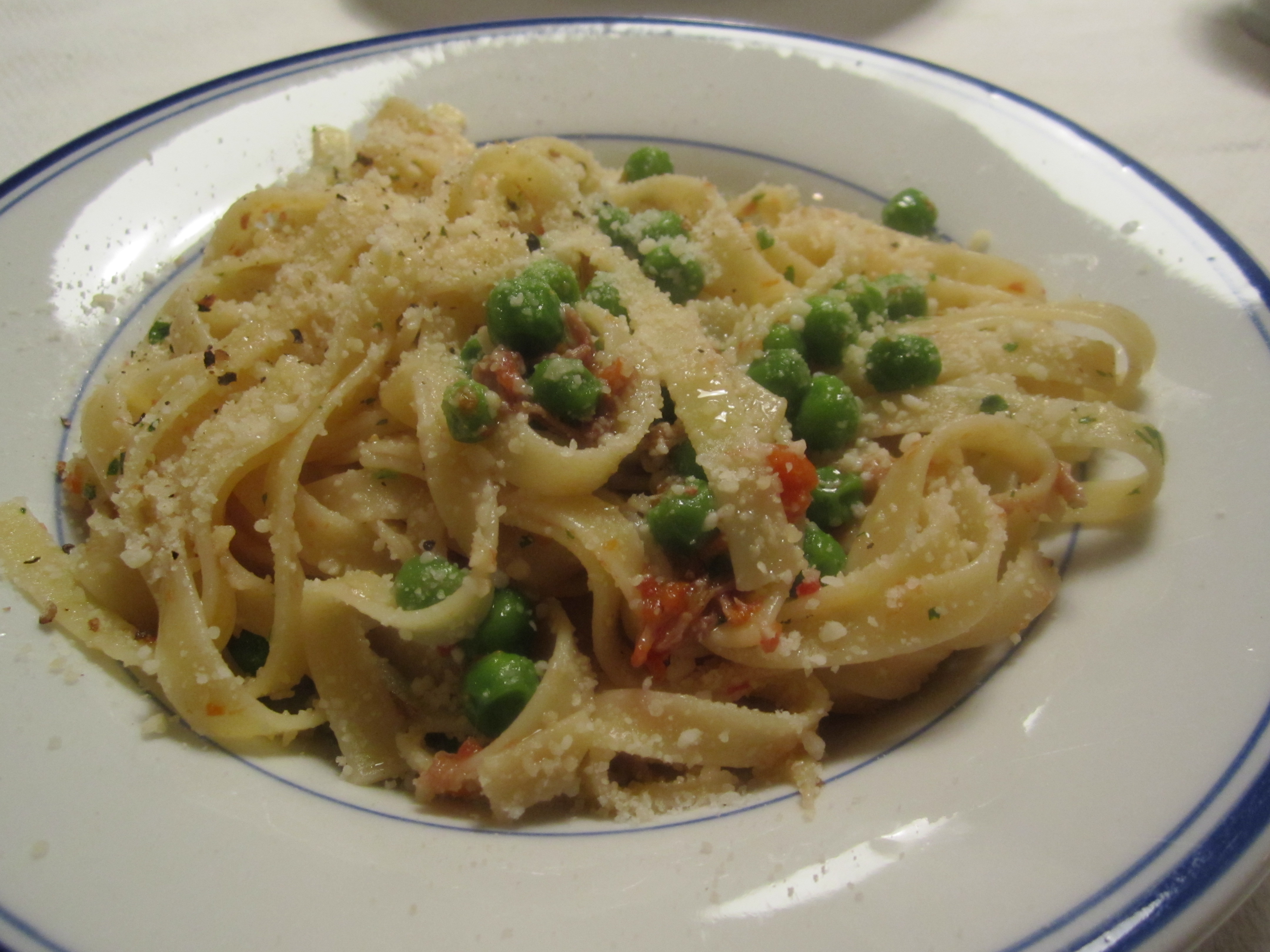
Tonight, I’m making the dish heartier with the addition of ham.   Ham has that wonderful salty, slighlty smokey flavor, but it’s not as overpowering as bacon or pancetta.  Asparagus gives the dish an additional earthy note of springtime (although they’re not local asparagus yet), and peas are always good wherever ham goes.

Try this early spring dish and omit the ham if you want, but tonight it’s our main course, so I wanted to give the dish some protein.

Pasta with Ramps, Peas and Asparagus (and Ham)

serves 4

1 lb dried fettucine

1 small bunch ramps, rinsed and divided into white and green part

1 lb asparagus (look for tight, perky green tips that are not withering or limp in any way)

1 cup ham, cut into 3/4″ cubes

1 cup frozen peas

1/2 c chicken broth

2 tbls olive oil

4 tbls butter

parmiggiano cheese for sprinkling

Boil a pot of water large enough to hold the pasta, then add a generous pinch of salt.  Begin by preparing the asparagus.  If you’re using fatter asparagus (in the case of asparagus, fatter is better than thinner), you can either peel the lower portions of the spears with a vegetable peeler, or simply bend the spears and let them break where they want, then discard the lower portion of the spear.   I prefer to peel the spears, which takes about the same amount of time as it takes for my pot of water to boil.   Cut the spears crosswise into 1/2″ pieces and drop in salted boiling water for about 3 minutes.  Drain and set aside.

Begin boiling the pasta in the asparagus cooking water–stir frequently.

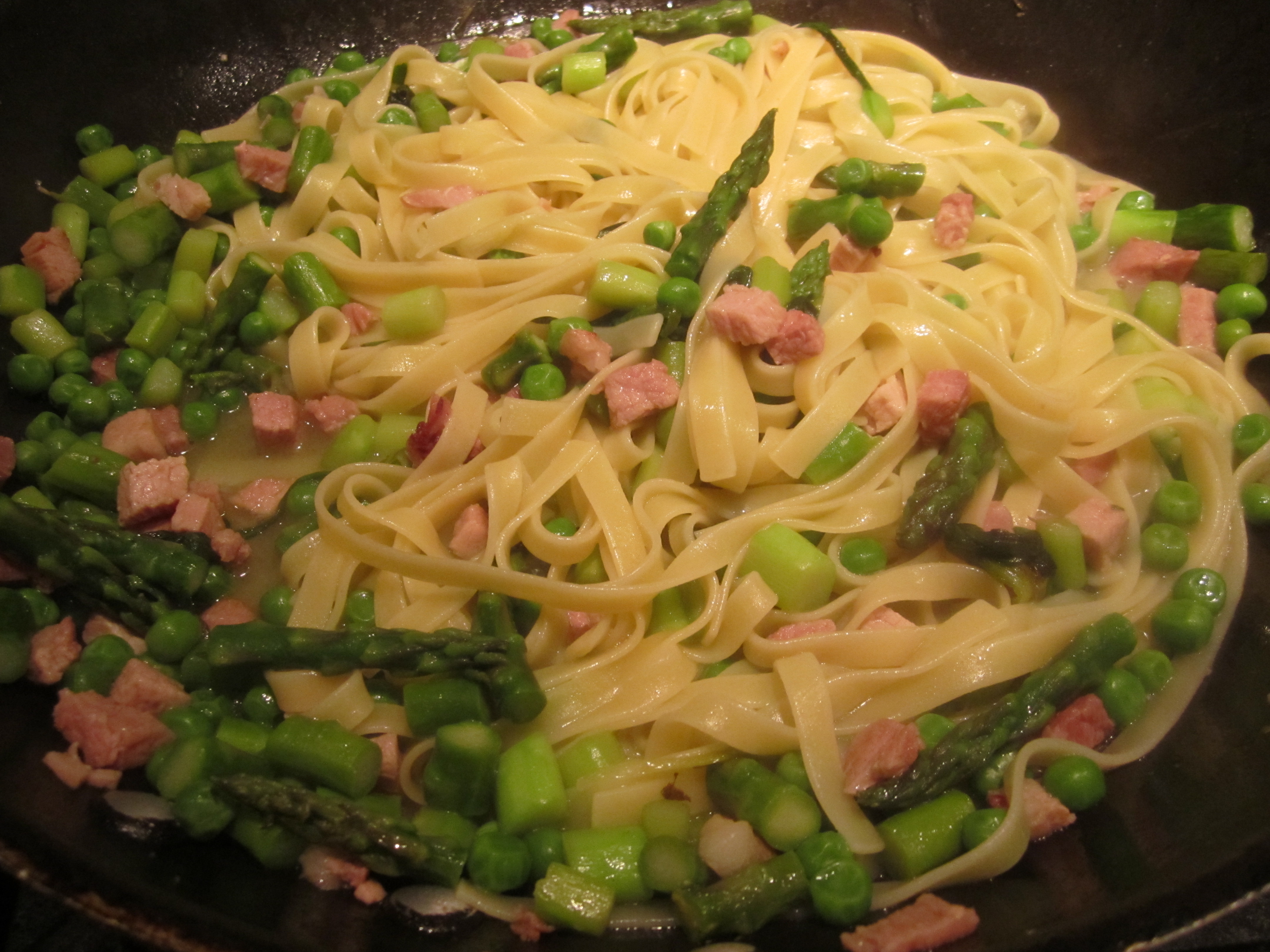
While the pasta cooks, in a broad skillet large enough to hold the pasta, on medium heat, saute the whites of the ramps in the olive oil and half the butter for about 3 minutes or until they are wilted and beginning to turn golden.  Add ham cubes and continue sauteing for another minute.  Add asparagus and peas and saute for another minute.  Turn up heat and add broth. 


When pasta is about a minute shy of done, add to skillet with the vegetables.  Add a couple of tablespoons of pasta cooking water and the remainder of the butter.  Toss and saute for a minute, stirring constantly. 

Taste for salt and add salt and pepper, if necessary. Serve with plenty of grated parmiggiano at the table.

Posted in Pasta | Leave a comment

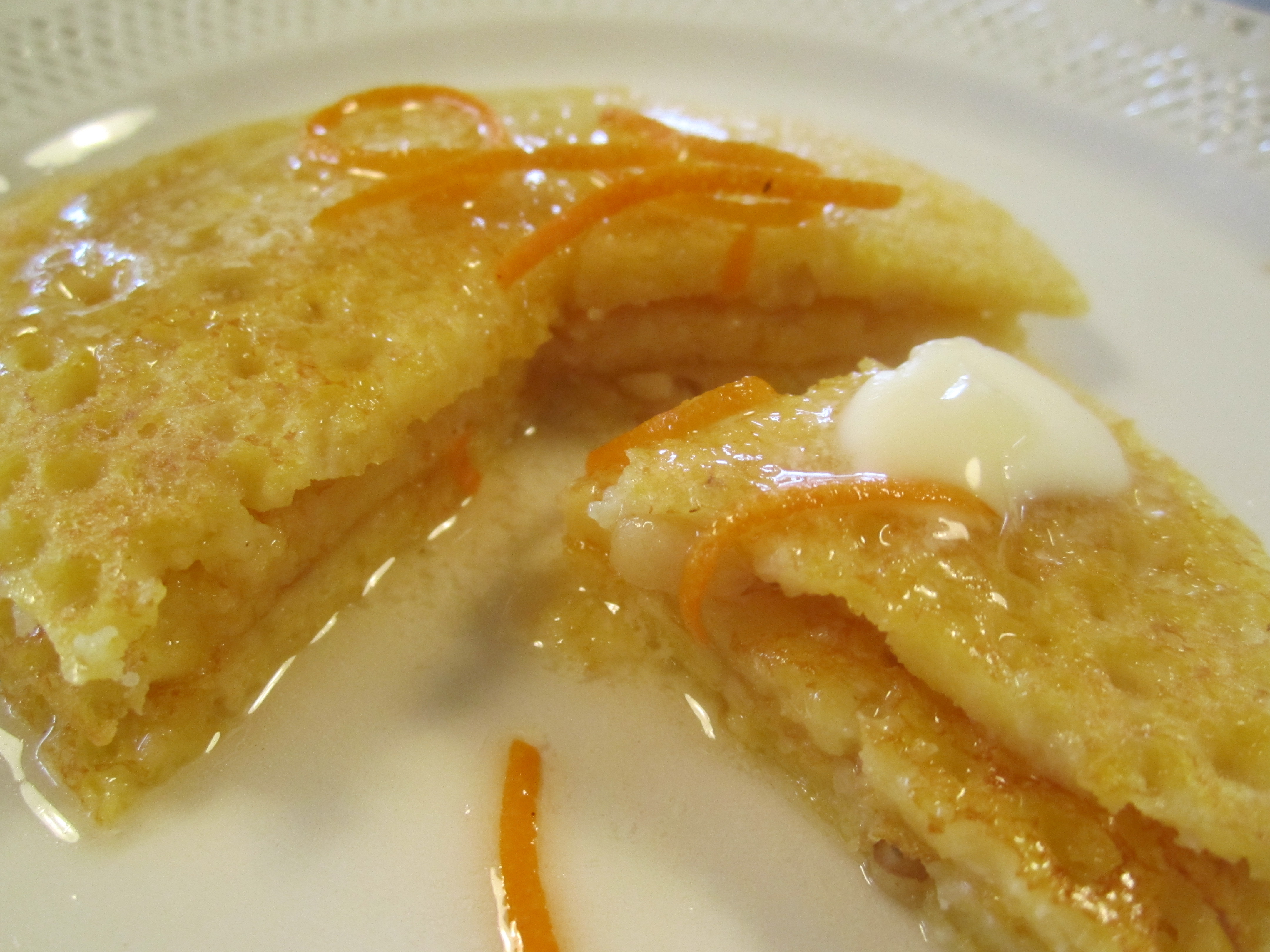
Cornmeal Pancakes Scented with Orange and Pine Nuts

I love pancakes but never make them because I think of them as a bit of a production (for the morning) and I don’t always have buttermilk or baking powder or soda in the house (I’m not a baker).  Nor do I keep maple syrup on hand regularly.   I like having some sort of whole grain in the morning and I haven’t seen many recipes for pancakes that consist solely of grains with no flour. 

Several months ago, the New York Times published a couple of interesting recipes for whole-grain pancakes and this was by far the simplest one.  I LOVE cornmeal in any form, and for this recipe, the main ingredients were cornmeal, water, salt and milk.  No eggs, butter, baking powder, buttermilk, etc.    Pancakes this simple I could make every day, if I wanted. 

I started experimenting with this recipe in the ensuing weeks and have come up with my own version that I’m very happy with.  First, I made the recipe exactly as called for in the newspaper.  The recipe called for steeping the cornmeal in an equal amount of boiling water for about ten minutes, then adding milk.  The recipe said to keep the consistency of the batter quite thick.  That’s where I had problems–when I kept the batter thick, the cakes were absolutely leaden (nice cornmeal flavor but terribly heavy). 

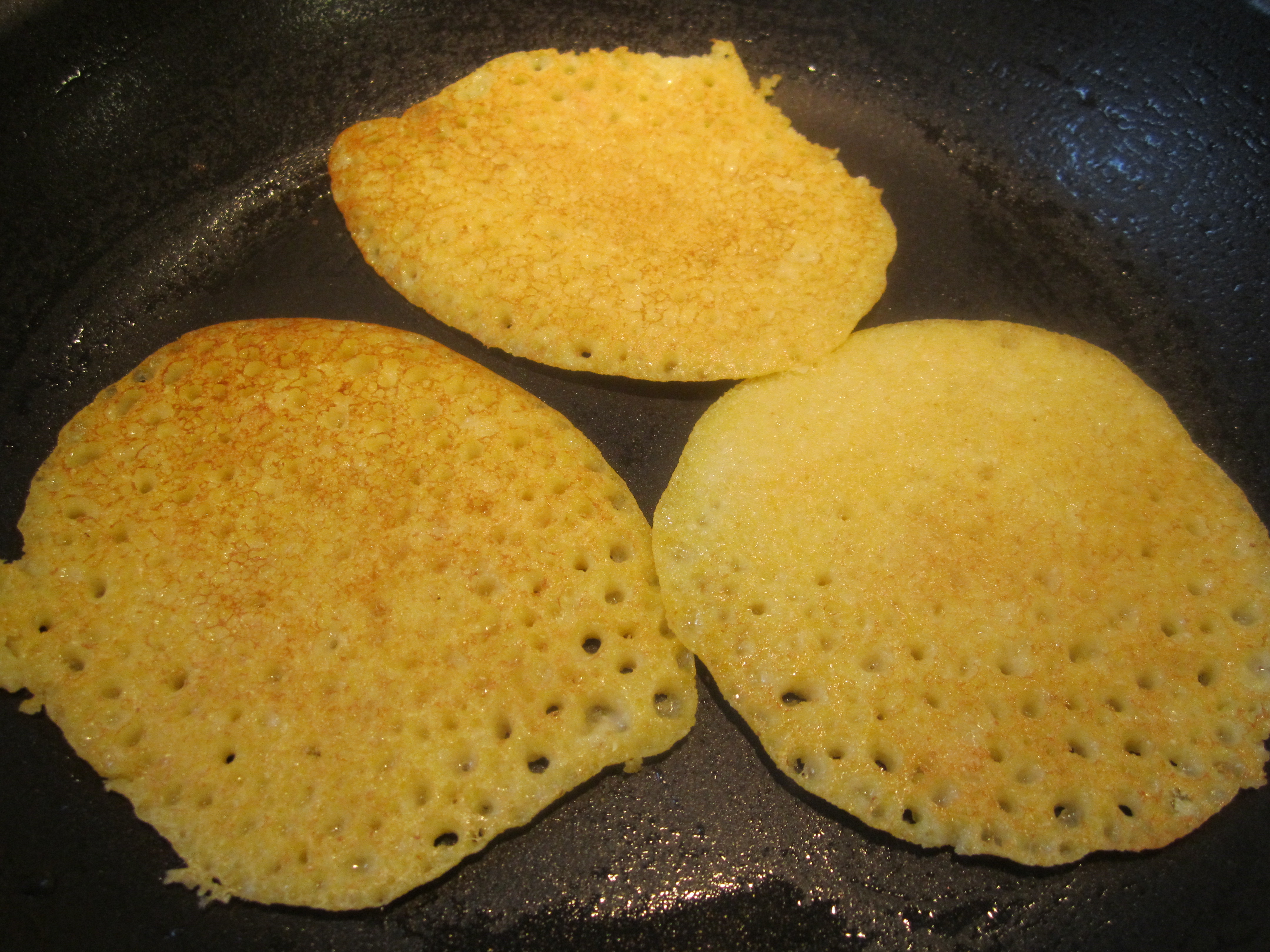
I tried thinning the batter a bit, but still too heavy (I ate them anyway).  One day I made the batter and only used half of it that morning.  So as not to throw it away, I refrigerated it til the next morning, when it had become quite watery.  I decided to try using it anyway.  As soon as the batter hit the hit skillet, it spread out like a crepe and was instantly bubbling and full of holes.  I cooked it on both sides and was certain I’d discard it, but I tasted it, and much to my surprise–it was much better than the too-thick version.  

Since then, I’ve tried to approximate some middle ground of thinness.  The best way to describe it would be the consistency of light cream.  The cakes should form open air bubbles on top almost instantly, but not spread out to the point where they all merge into one big pancake in the pan.  I’ll try to give you exact amounts, but you’ll have to experiment on your own as I did. 

The recipe in the Times called for vanilla, but I preferred orange zest, after trying them both.  The recipe also called for pine nuts, which I’ve included–but the cakes are perfectly wonderful without pine nuts as well. 

Lastly, the recipe in the Times recommended serving the pancakes with honey on top.  I don’t always have honey in the house, but I usually have agave nectar, which is actually sweeter than honey, but very clean and neutral-tasting.  It also pours better than honey and doesn’t add any extraneous flavor to the dish.  It’s great!

These pancakes take all of fifteen minutes to make and require you to have only cornmeal and milk in the pantry. 

Cornmeal Pancakes Scented with Orange and Pine Nuts

Serves 2

3/4 c fine cornmeal (Aunt Jemima is fine–don’t use very coarse cornmeal)

3/4 c boiling water

1/2 tsp salt

2 tbls pine nuts (optional)

a little less than 1/2 c of milk, added gradually and stirred after each addition

a touch of olive oil for greasing skillet

zest of half an orange

butter and agave for serving

Combine cornmeal and salt.  Pour boiling water over cornmeal and blend with a fork to break up lumps.  Let  sit for about 10 minutes.  Add enough milk to make the batter as thin as light cream.  Add pine nuts (if using) and pour onto greased, heated griddle or nonstick skillet.   When the batter hits the skillet, you want to see air bubbles form on top almost immediately.   If no bubbles form, the batter is too thick–add some milk to the remaining batter and try again. If the batter spreads to one big pancake, it’s slightly too thin, but better too thin than too thick.

Cook for about 3 minutes per side, or until each side becomes golden brown.


On the plate, immediately top the pancakes with a bit of orange zest, butter and agave.  If you’re making more than one batch, place them on a greased tray and hold them in a 200 degree oven.  Do not overlap them–if you need to make more than one layer, place damp paper towels between them.

Believe me, if you’re a cornmeal lover, this ratio is worth experimenting with until you get it right!

Posted in Dessert | Leave a comment

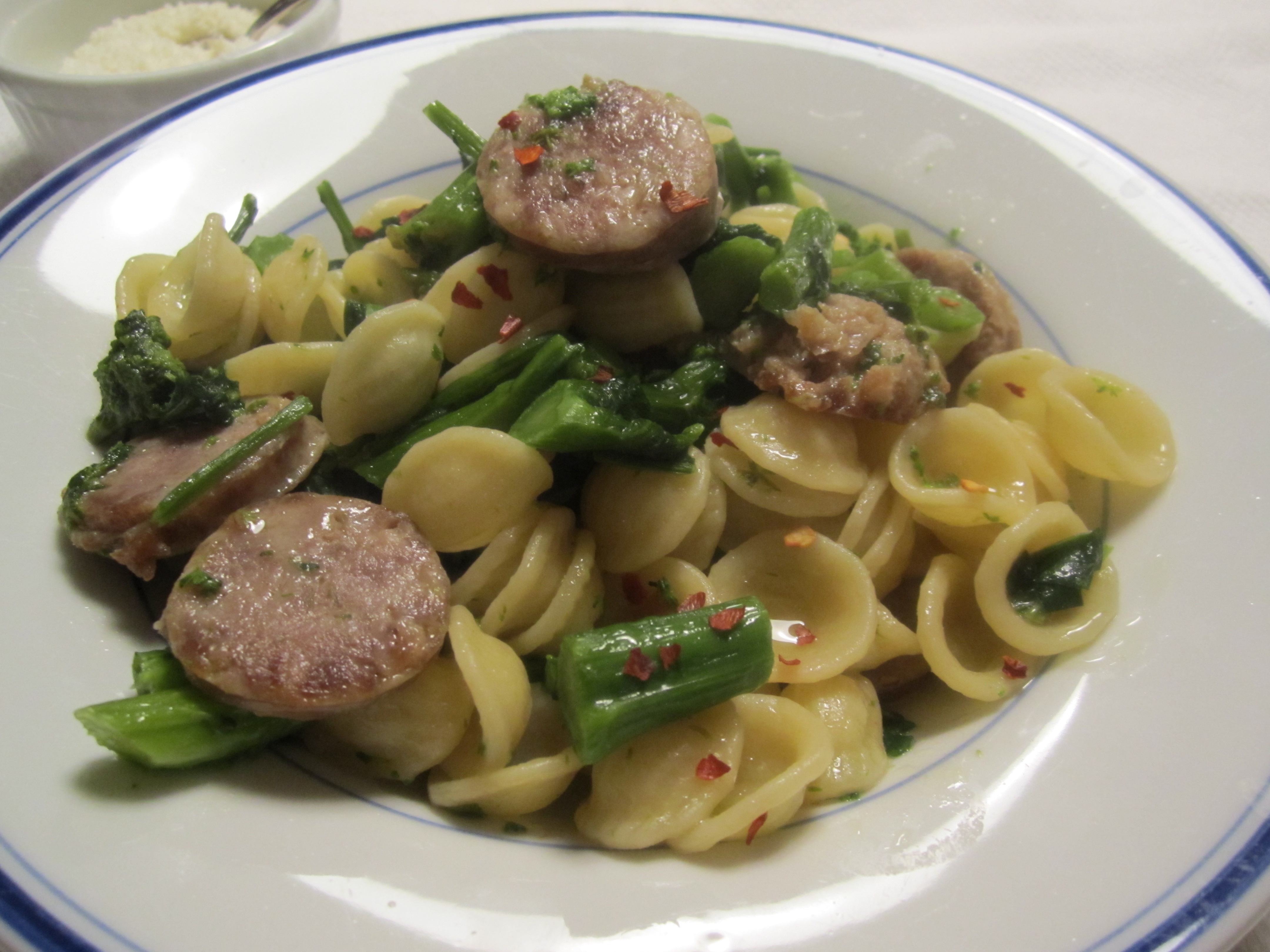
Dinner for One-Orrechiette with Broccoli di Rapa and Sausage

This is an all-time favorite of mine, and readily adaptable for one person.  It’s one of those dishes that I eat often and never tire of.  You may recall I made Broccoli di Rapa with Chorizo the other evening . . . I have some leftover chopped, blanched (but not sauteed) broccoli di rapa in the fridge

In the freezer I (usually) have some sweet Italian sausage that’s been boiled  prior to freezing.  I love being able to simply pull out a link of already-cooked sausage, slice it and throw it into a pasta or stew. 

I never used to boil my sausages before I met my neighbor, Beppi.  I’d always thought that searing the raw sausage resulted in a moister sausage with a sexy, crispy exterior.  Well, it does result in a crispy exterior, but by the time the interior is cooked (pork sausage should always be cooked well), the sausages seem to dry out and become mealy.   Boiling them for 15 to 20 minutes prior to a light sear in a skillet seems to result in much moister sausage, and allows for a much shorter searing time, since the sausages are already cooked all the way through.

Although I already posted this recipe a while back, this is for those of you who want it adapted to one portion . . .

Orrechiette with Broccoli di Rapa and Sausage (For One)

1  cup orrechiette

1 c chopped cooked broccoli di rapa (blanched in salted boiling water for about 3 minutes)

2 tbls extra-virgin olive oil

1 plump Italian sausage, boiled for 15 – 20 minutes, then sliced into 1/4″ discs

1 clove garlic, split in half

pinch of chili flakes

pecorino cheese for sprinkling

While pasta is boiling, slowly brown the garlic clove in oil until golden.  Turn up the heat and add the sausage pieces and brown on one side, briefly.  Sprinkle the chili flakes into the hot oil and saute for about 30 seconds.  Add broccoli and saute on high heat for a minute or so.  Add the pasta and about 2 tablespoons of cooking water and saute over high heat for about 30 seconds.  Off the heat, add a drizzle of raw olive oil and some pecorino cheese.

Posted in Pasta | Leave a comment

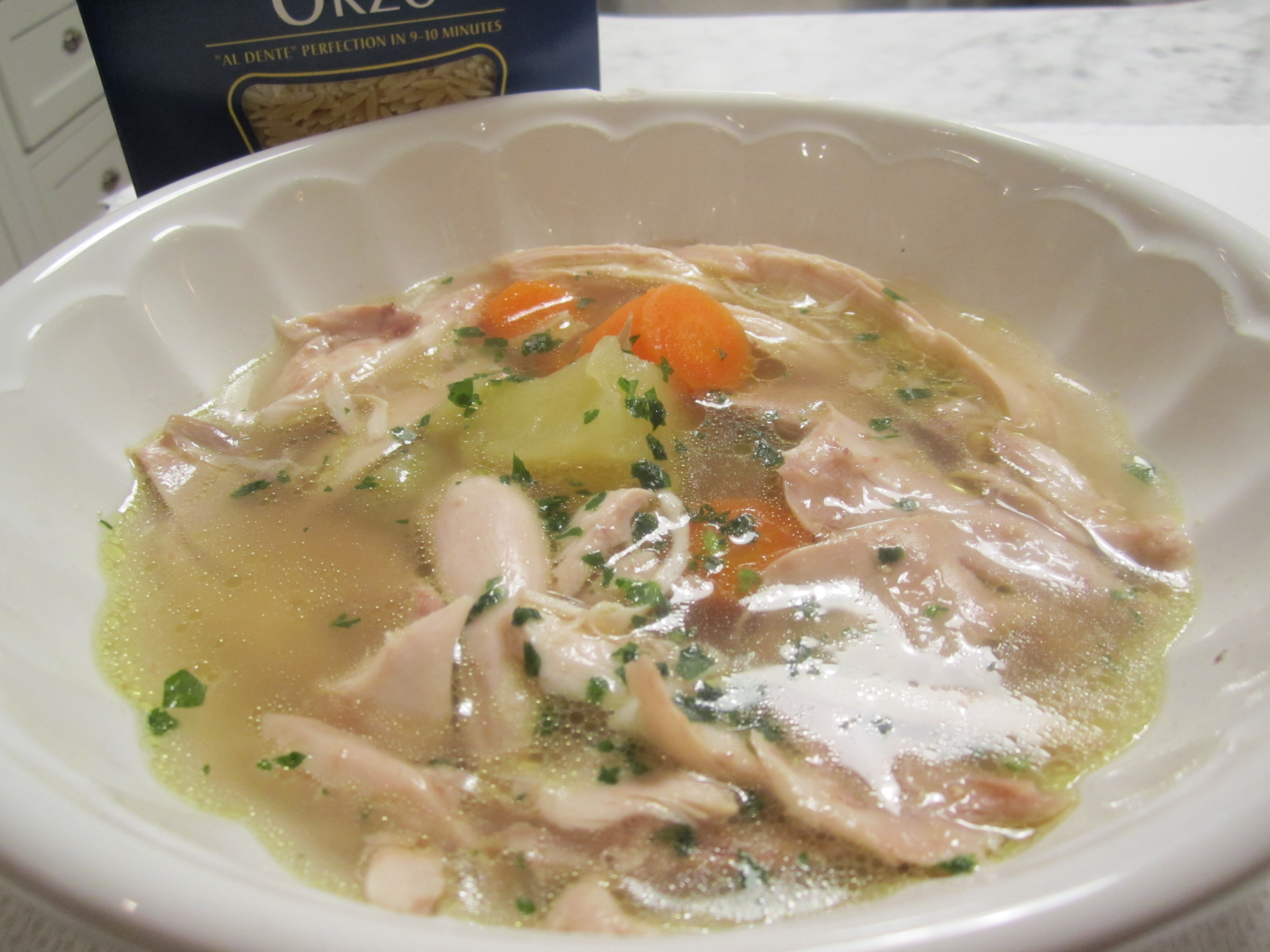
Chicken Soup for Beppi


My eighty-nine year-old neighbor Beppi is returning from his annual 3 month stay in Florida tomorrow and I’m making a pot of chicken soup with which to greet him when he arrives.  Chicken soup is a dish that Italians traditionally serve to someone who’s been traveling–for its restorative qualities, my mother says.   Besides, Beppi and I have a tradition of bringing each other food and returning each other’s container filled with other food.  Before Beppi left for Florida, he gave me a large plastic container filled with his leek and potato soup, so I’m simply returning his container filled with chicken soup.

My dilemma is what pasta shape to present with the soup.   I don’t know if he would prefer something delicate like angel hair, or something sturdier like tubettini or ditalini.  I’ve decided on orzo, since it’s small and delicate, but sturdy, and goes well with broth.  I won’t actually cook the orzo, since it would get gummy and soft sitting in the broth overnight.  Instead, I’ll simply give him a small box of orzo to make (or not) with a pot of broth.

I’m going to make the broth with celery, carrots, onions, some parsley stems and a bay leaf.  (For the full recipe, see my prior post “Mom’s Chicken Soup”).  After the vegetables have released their flavors, I’ll discard them and boil a new potato and some new carrots and leave them in the broth.  I’ll take the chicken meat off the carcass after it cools a bit and add it to the broth, and leave the whole thing in the fridge overnight.   Tomorrow, I’ll present the broth with the  box of orzo on the side.

Last fall, Beppi made us a meal upon our return home from a two-week vacation in Italy, and I’ll never forget how much I appreciated coming home to that meal.  The meal he welcomed us home with was leek and potato soup (leeks from his garden) with orrechiette, pot roast (red-winey and sublime), a salad of baby greens from a local farmstand, and a loaf of bread.  It’s one of my most treasured memories of that trip.

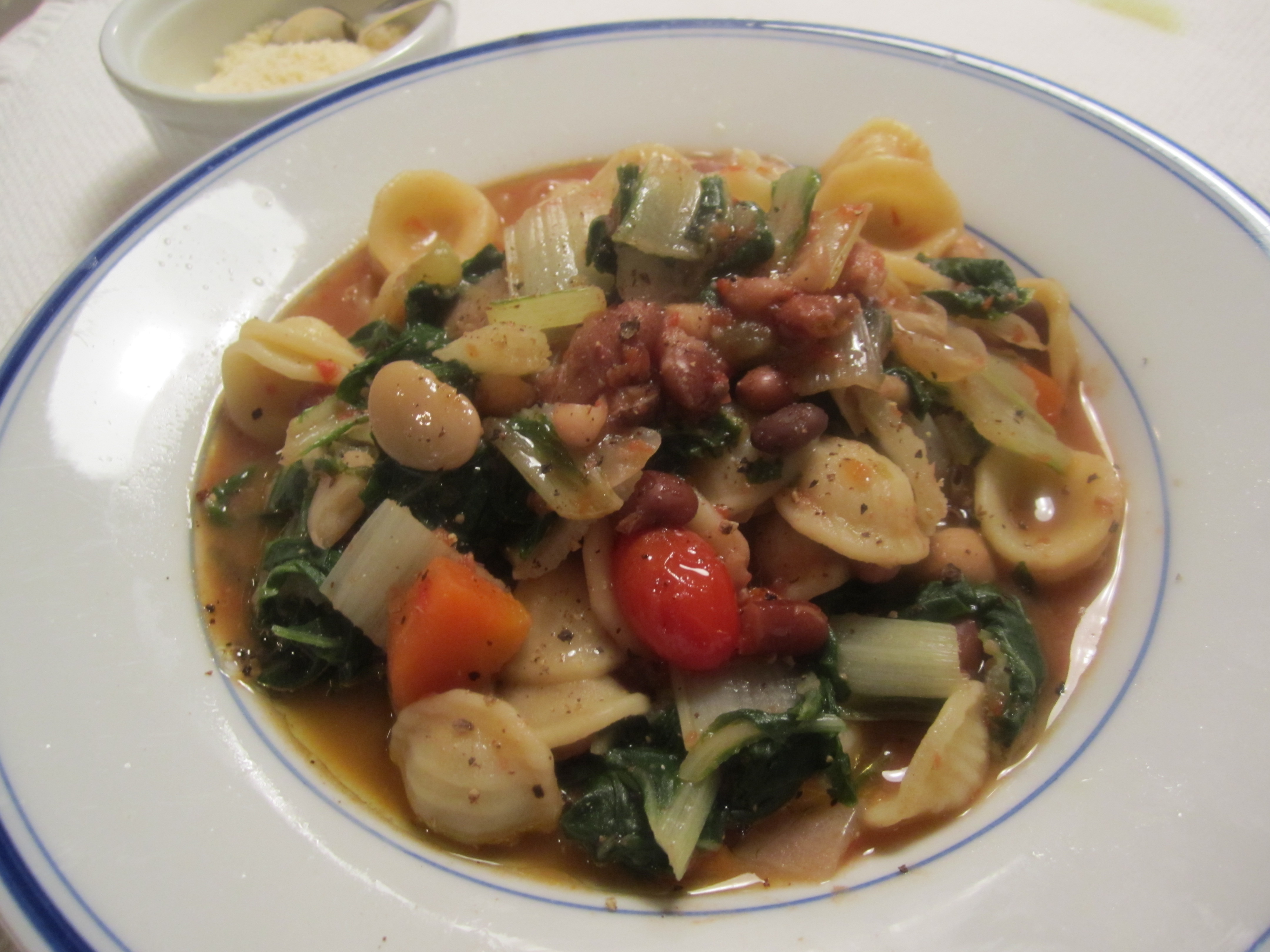
For my own dinner tonight, I’m going to have  the last of the leftover bean soup from my “Mixed Bean Soup” post the other evening, with a couple of additions . . .  I’ve added some tomato puree to the beans and simmered the soup for about fifteen minutes, then added  some cooked swiss chard and cooked orrechiette.  That touch of tomato really perks up the deep flavor of the beans and makes it taste like an entirely different and new dish.  The dense bean mixture ends up acting more like a sauce for the pasta and swiss chard, rather than a bowl of soup–it’s a great transformation!

Posted in Soup/Stew | Leave a comment

Sweet Potato Farro

Tonight’s main course is calves’ liver with caramelized onions.  I try to buy calves’ liver whenever it looks great at the market, since it’s a potent source of iron and relatively lean and light, while tasting rich and luxurious.  I’m making the liver and onions in the same manner I wrote about in my prior post (“Calves Liver My Way”), so I won’t be featuring the liver in this post.  Instead, I’m writing about one of my side dishes.

I love to make butternut squash with grains–almost any grain–quinoa, rice, bulgar–they all taste good with cubes of soft sweet butternut squash.  Sweet potato is another source of rich starchy sweetness which combines well with other grains.  There are white-fleshed sweet potatoes and orange-fleshed ones.  Tonight I’m using the orange-fleshed variety because it’s much easier to come by in most markets. 

The sweet potatoes get peeled and cubed, then slowly sauteed with a touch of onion and thyme, covered on low heat until they’re soft and lightly caramelized.  The farro gets boiled in a bit of chicken broth or salted water for about a half-hour.  The two are combined and anointed with a little raw extra-virgin olive oil.  This combination of starch and grain is deeply satisfying, nutty and sweet.  It’s great with pork and smokey meats of all kind.

Along with the liver and farro, I’m serving some plain boiled broccoli.  Not that I’m eating this meal strictly for my health, but it truly is a meal teeming with vitamins and minerals.

Sweet Potato Farro

serves 4 as a side dish

3 medium orange sweet potatoes, peeled and diced into 1/2″ cubes

4 tbls olive oil

1/4 c finely diced onion or shallot

1 cup farro

2 1/2 c chicken broth or water with 1/2 tsp salt

salt and black pepper to taste.

Place farro in cold broth or water and bring to a boil.  Simmer, covered, for 30 minutes.   While simmering the farro, saute the sweet potato cubes in olive oil with spices on low heat, covered for 10 minutes, then uncovered for 10 minutes, or until golden on the edges and soft on the inside. 

Combine sweet potato and farro and drizzle with a bit of raw olive oil.  Taste for salt and pepper and adjust seasoning.

Posted in Vegetables | Leave a comment

Mixed Bean Soup


My mother makes a stew with a bean mixture that she buys in her supermarket in Florida (Publix).  The mix comes with a “flavor packet”, which she summarily discards.  I’ve been looking for the beans in my supermarket and can never find them, so when I was in Key West last week, my mother thought to buy me a couple of bags of the bean mix to take home with me.

The beans get soaked overnight, then simmered in water for about an hour.  To this blank canvas, you can add a variety of things:  my mom adds carrots, celery, onion, pancetta, chopped mushrooms, and tomatoes. 

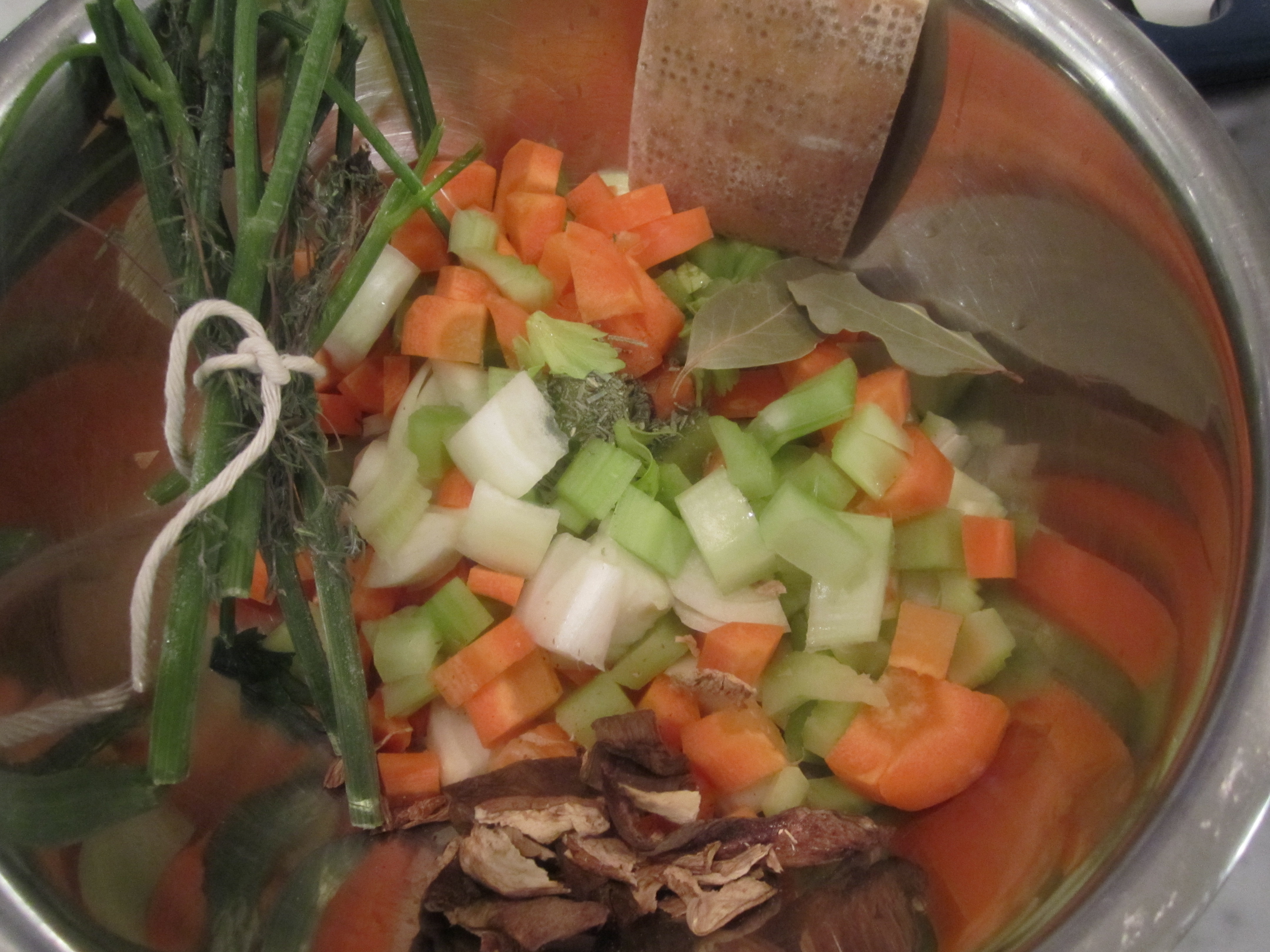
I’ve decided to add a few more things that I have in my pantry–some freshly dried rosemary, some sprigs of thyme, some parsley stems (from the freezer),  some crumbled dried porcini,  a piece of parmiggiano rind (from the freezer) and some chicken bouillon. 

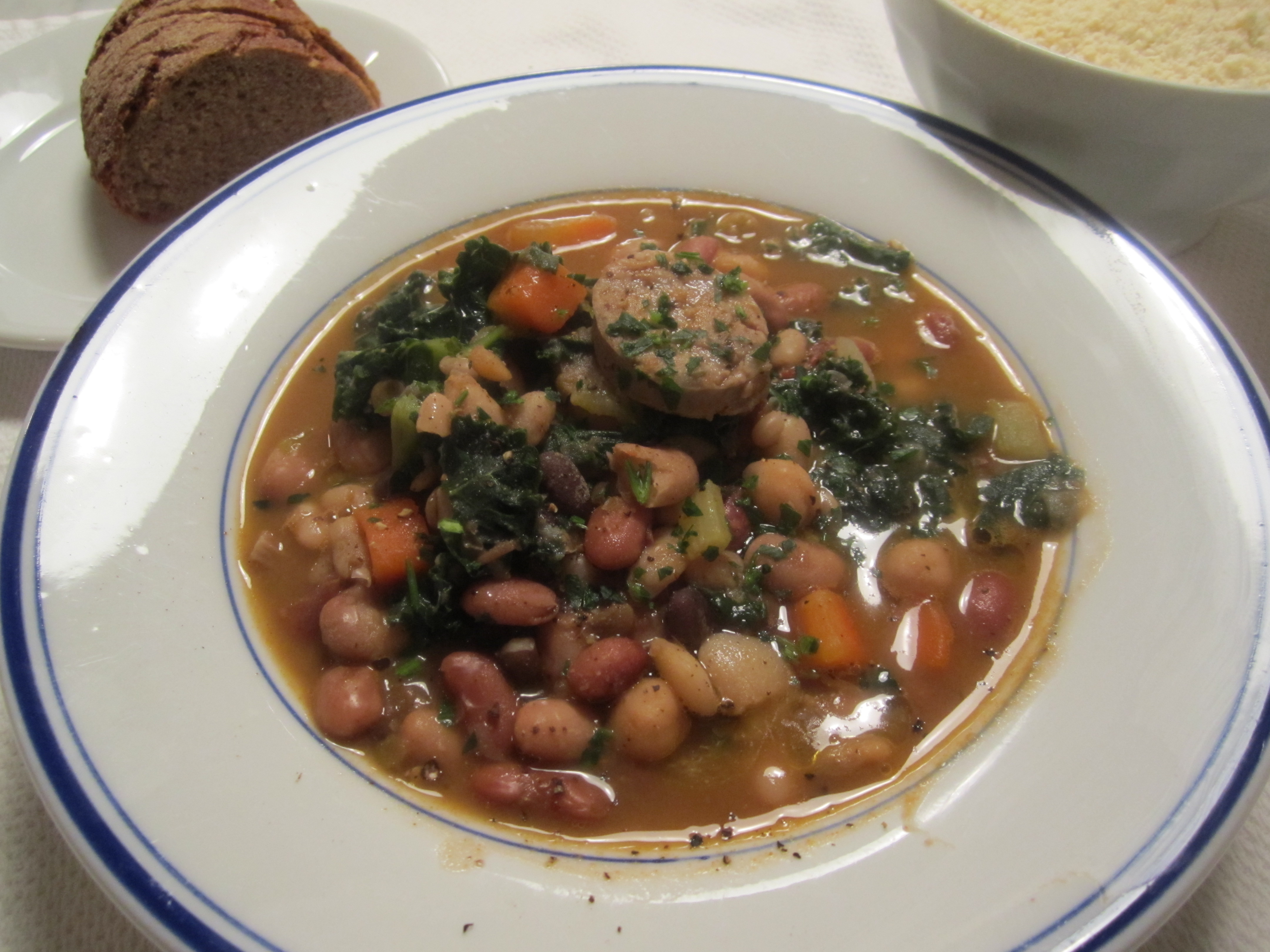
I usually feel compelled to saute these aromatics in a separate skillet, then add them to the beans, but tonight, I’ve decided to simply add everything to the bean cooking water and let everything simmer together.  This gives the stew more of a delicate flavor, rather than the deeper, more caramelized flavor of sauteed aromatics (they’re both good but this way’s less work).  I’ll add some raw olive oil to the bowls of soup as I serve them.  That’s the basic soup recipe.  

Tonight,  since the soup will be our entire meal, I’m taking half of the basic soup and adding some some boiled, chopped kale (the last little bag I have in the freezer from this past fall) and some sliced, pre-boiled Italian sausage.  The rest of the basic soup will go into the freezer for another night.

 Bean Soup

1 lb mixed beans (lentils, black beans, navy beans, cranberry beans, cannellini) or use 1-lb of a single bean, like cannellini or navy beans, soaked overnight then drained.

1 medium onion, diced in 1/2″ chunks

2 stalks celery, diced in 1/2″ chunks

1 carrot, peeled and diced in 1/2″ chunks

1/2 cup grape tomatoes, cut in half

2 bay leaves

1/8 tsp dried rosemary (or one sprig fresh)

2 thyme sprigs

6 parsley stems, tied (with thyme and/or rosemary sprigs) for easy removal

5 or 6 pieces of dried porcini, crumbled

1 – 2″ square piece of parmiggiano rind (washed)

3 or 4 chicken bouillon cubes (I’m using 1/4 c”Better than Bouillon” chicken base)

2 tbls tomato paste

Place beans in a dutch oven and cover with water by a couple of inches.  Bring to a boil and simmer partially covered for an hour, skimming any foam that floats. 

Add remaining ingredients and simmer for another hour or until beans are tender. 

If using, add pre-boiled sliced Italian sausage and boiled chopped kale.

Top with grated parmiggiano and raw olive oil at the table.

Posted in Soup/Stew | Leave a comment

Broccoli di Rapa with Chorizo

The main course in tonight’s dinner is actually pork shoulder (yes, another bag of the same pork shoulder that I made and froze about a month ago).  Once again, I’m serving the braising liquid over Fettucine, but this time, I’m brightening it with some parsley and peas for added greenness.

Then I’m serving the meat as our main course (I’m sure you’ve seen enough photos of my braised pork, so I’ll spare you the photo!) 

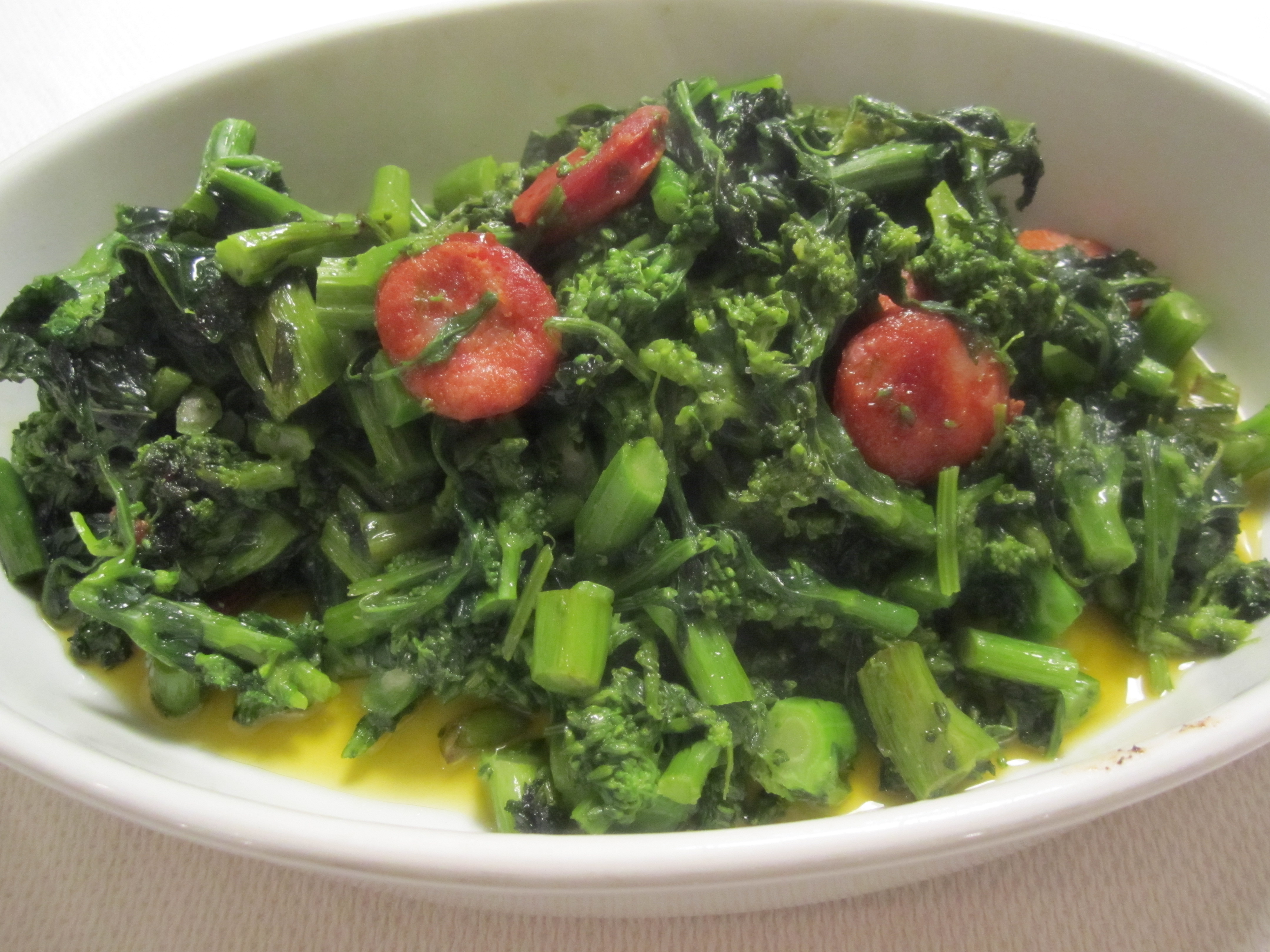
The feature of tonight’s post, however, is the side dish–broccoli di rapa with chorizo, a spanish sausage made with pork, garlic and paprika.  Chorizo can be found fresh at certain butchers, but more often, it is found cured in vaccuum pack.  D’Artagnan makes a very good Chorizo which I buy in my regular supermarket (Waldbaum’s).

This dish is reminiscent of my mother’s broccoli di rapa, in that she always sauteed the greens raw with lots of garlic and some cured sausage–more commonly known in this country as pepperoni.  (In Italy, pepperoni are “large peppers” and “pepperoni sausage” is unknown).  I love pepperoni, but I love chorizo even more!

Tonight, I’m not sauteing the greens raw, but rather blanching them briefly (only a couple of minutes) in boiling salted water, then draining.  This can be done a couple of hours ahead.

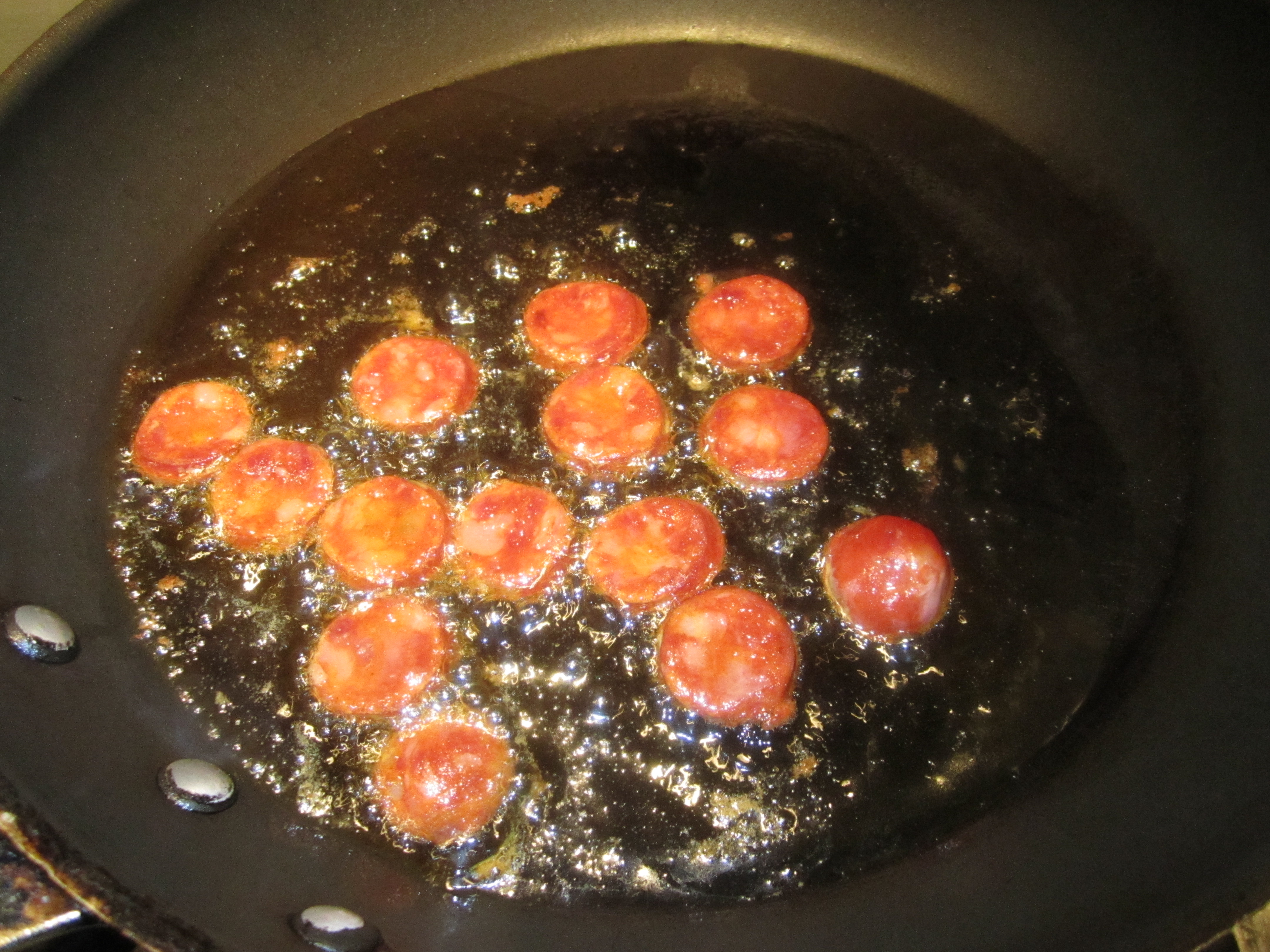
After they’re drained, I saute some sliced chorizo in olive oil–the chorizo makes the oil red from all of the paprika in it.  It also imparts that wonderful smokey aroma into the oil and the greens.  Not in the mood for additional garlic tonight–there’s enough in the chorizo

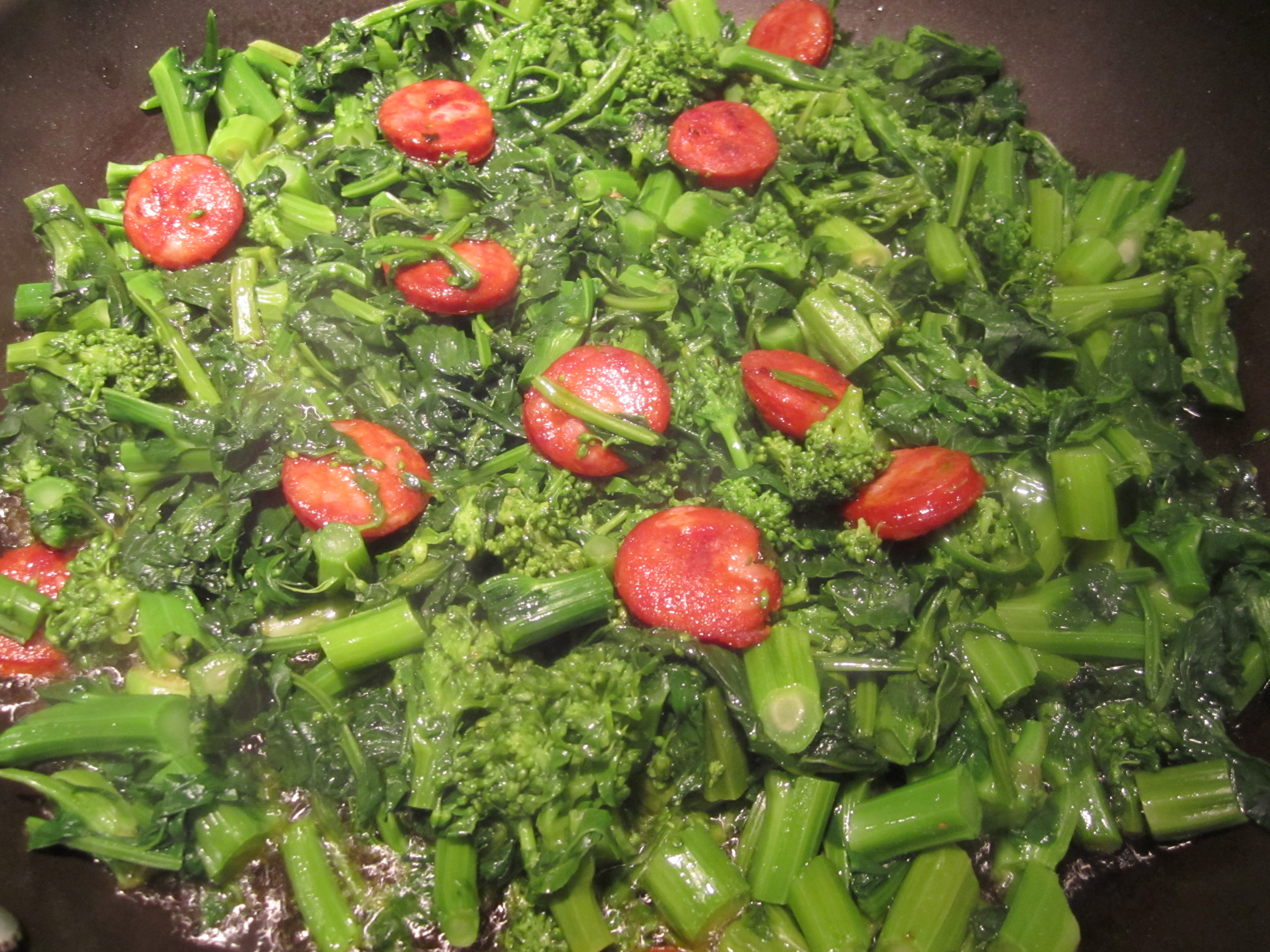
The greens are then added to the sizzling sausage and sauteed on high heat for about 5 minutes. 

This is not only a great side dish, but a wonderful appetizer with fresh bread and raw olive oil.  It is also wonderful at room temperature the next day.

Posted in Vegetables | Leave a comment

Potato with Fennel and Green Olive

Since I’ve gotten back from Florida it seems that winter is still upon us, so I was in the mood for some meat and potatoes (Italian-style, of course).  The meat is simply my favorite juicy Italian pork sausage (from Citarella); the potatoes are my version of a steakhouse hash-brown with fennel and green olives. 

Since I’ve already discussed my method of cooking sausage in a prior post (my first “dinner for one” post), the real feature of tonight’s post is the potato and fennel . . .

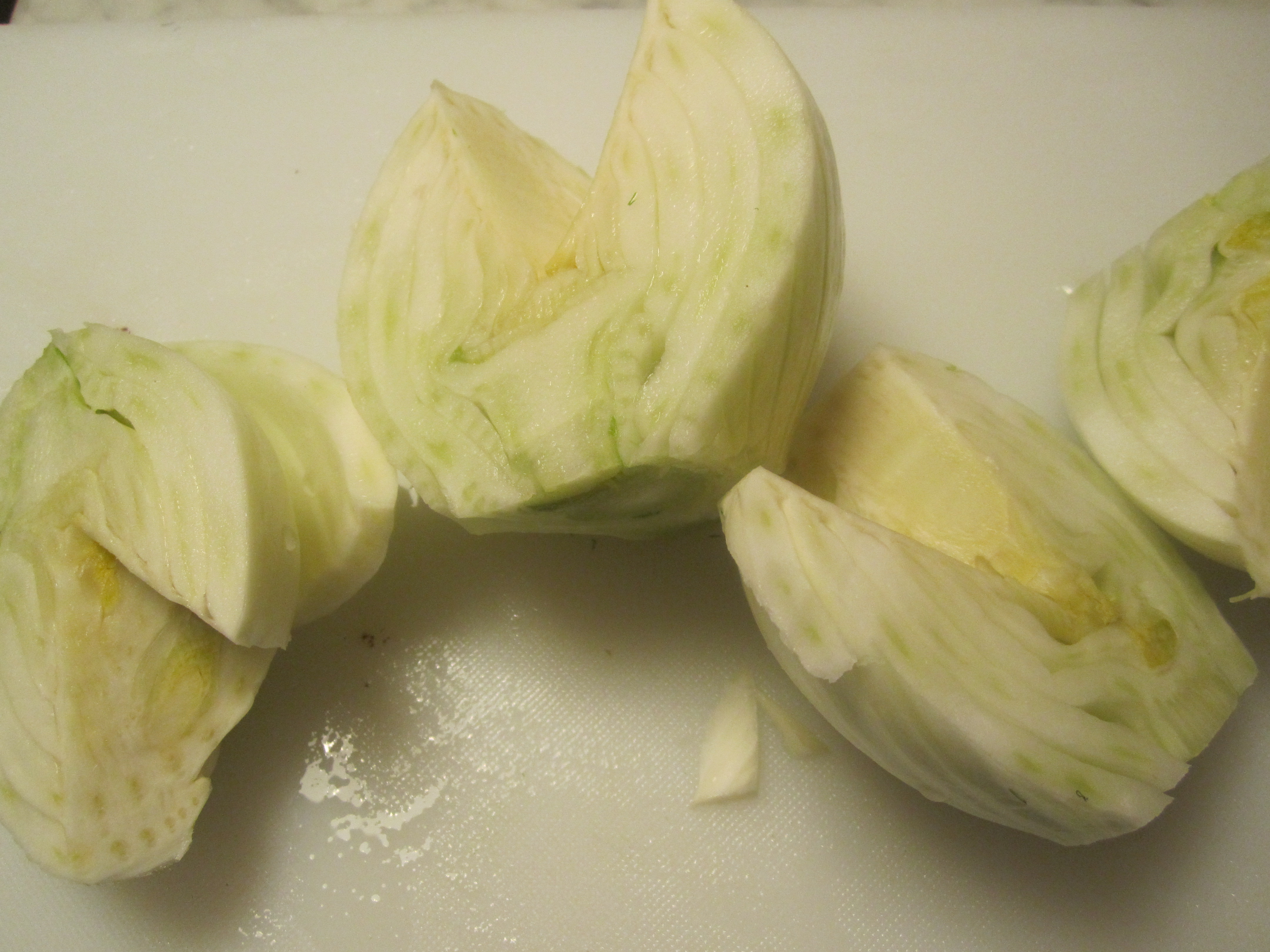
The fennel is first trimmed of its stalks, then of its tough outer layers (sometimes they are quite thick and it seems you’re discarding half the bulb, but they must be discarded because they’re too fibrous and chewy).  Then cut the core out of the bulb, resulting in a triangle-shaped hole in the base of the bulbs.


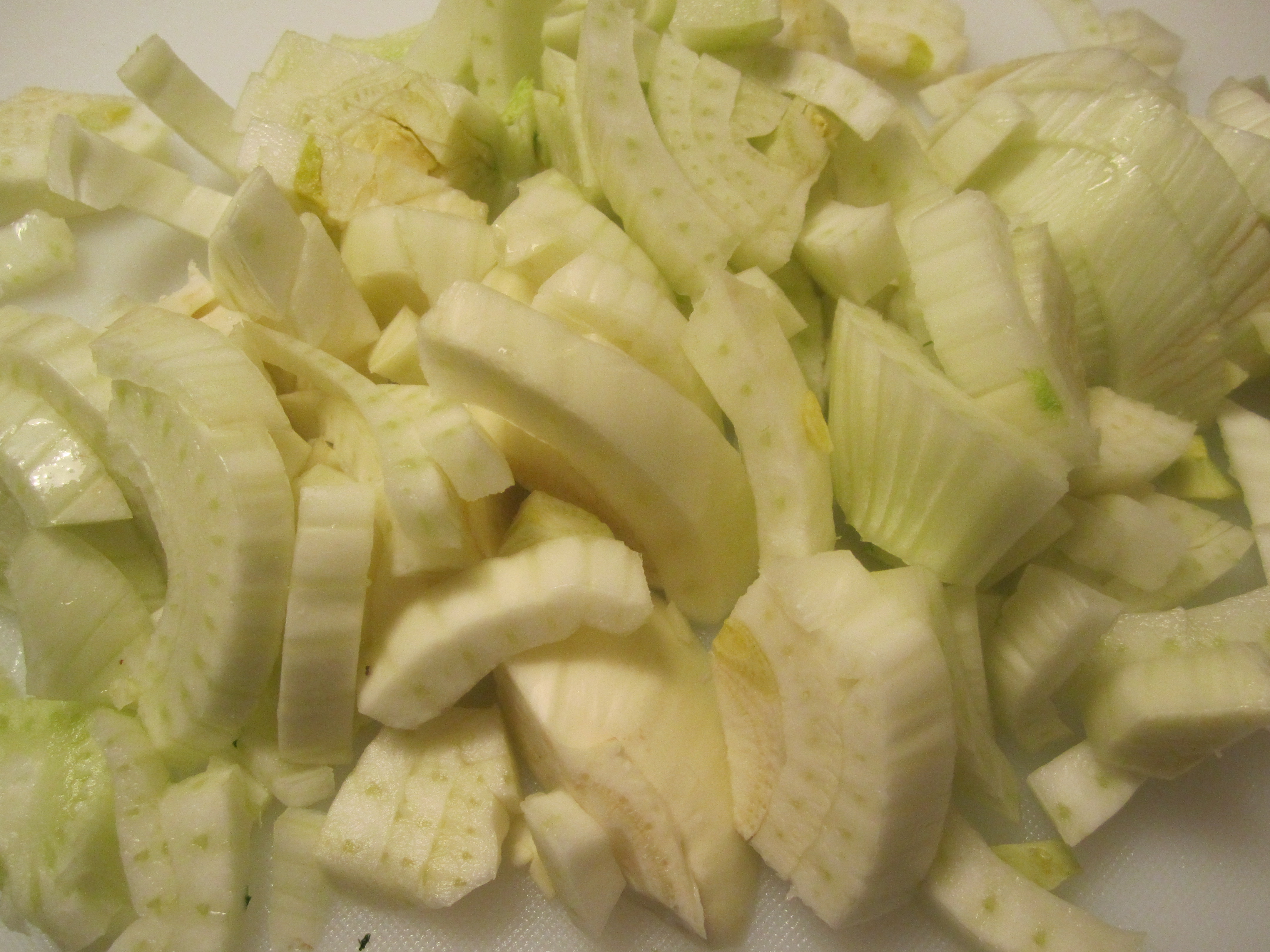
Then slice crosswise into 1/2″ half-moon slices.


The potatoes are peeled and sliced into similar half-moon slices (slightly thinner than 1/2″ slices), and all is placed in a nonstick skillet with a couple of tablespoons of olive oil, a good sprinkle of salt, and a couple of peeled halved garlic cloves.  Use one potato per person and half a bulb of fennel per person.  

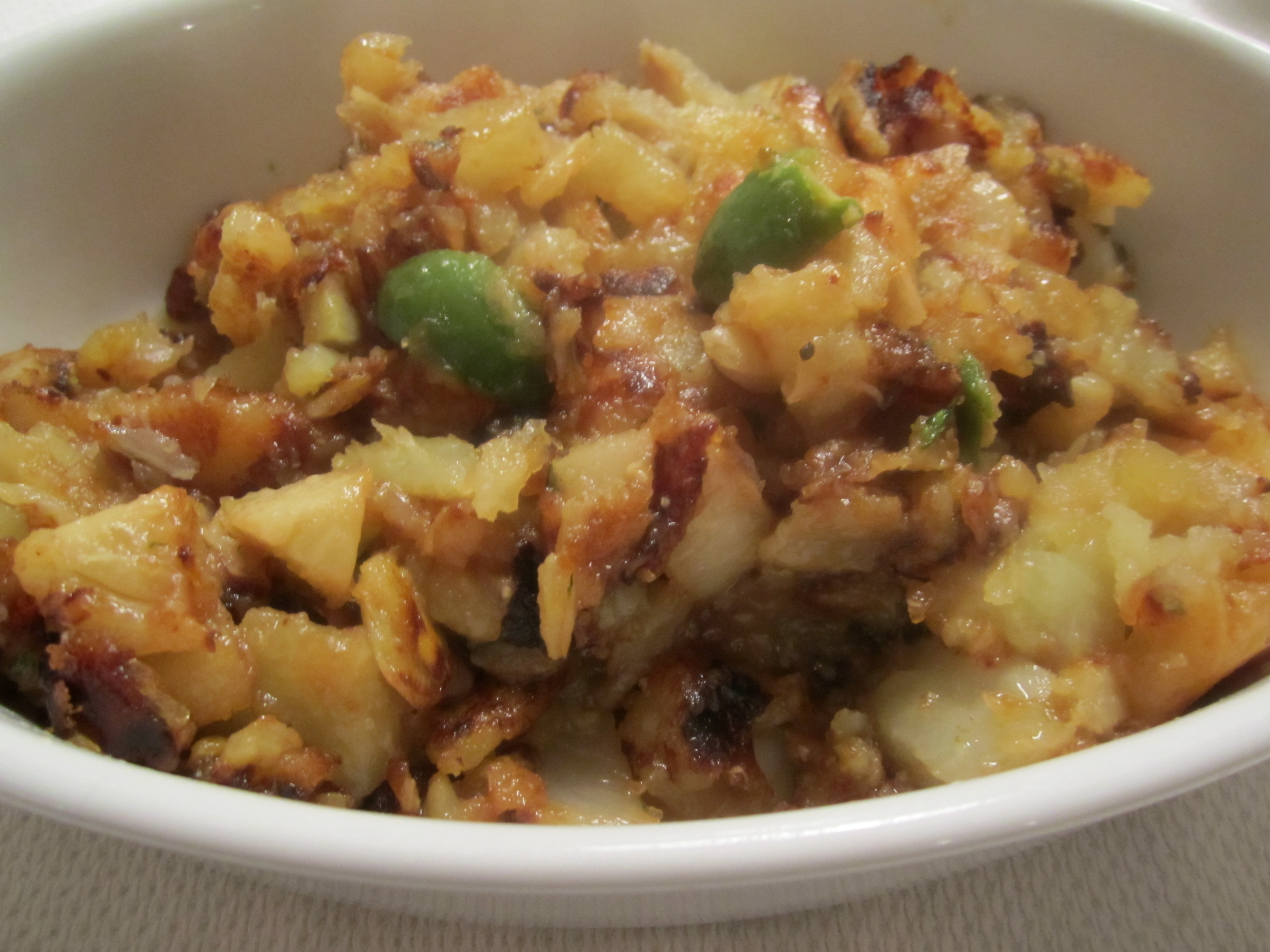
Cover and saute on low heat for about a half-hour, turning occasionally, then uncover.  Add some pitted green olives (I’m using plump, firm bright green cerignola olives) and let everything brown for about 15 minutes, adding more oil if it begins to stick.  Taste for salt and add salt and black pepper.

The pre-boiled sausages are browned in a separate skillet for about 5 – 8 minutes prior to serving. 

As a vegetable, we’re having broccoli di rapa–nothing tastes as good with sausage.  For the broccoli di rapa recipe, see my earlier post “Fritto di Mare”.  The fennel adds a tartness and sweetness to the potatoes, and they both become meltingly soft and caramelized. The broccoli add their own bitterness which works so well with the salty, fatty sausages.  It’s a very nice marriage.

Posted in Vegetables | 2 Comments