Olive Oil Poached Tuna with Roasted Pepper and Anchovy Salad


I love fine imported Italian tuna packed in olive oil and I always use it in my salade nicoise during the summer, when tomatoes and green beans are at their peak.  A few years ago, I started making my own approximation of fine canned tuna, with various ingredients added to give the tuna some subtle notes of flavor. 

The main ingredients in my slow poached tuna are lemon zest, black peppercorns and bay leaves.  In order for the tuna to really develop some flavor, it should be made the day before and allowed to rest in the fridge overnight.  The beauty of this preparation is that the salt and oil act as preservative for the otherwise delicate and perishable tuna.  Even though you’re not actually canning the tuna, you are preparing it in such a way that it can hold in the fridge for about 4 or 5 days and taste better each day.  Therefore, when I make it for dinner, I like to make enough for several lunches as well. 

Now that it’s winter and I’m not thinking about salade nicoise, I am making a variation in my poaching medium which will serve as a sauce for the tuna.  Tuna is great in tomato sauce–a couple of ounces tossed with tomato sauce and capers and olives is always a great pantry-based pasta sauce.  

 The sauce in this dish is more a tomato flavored oil than a tomato sauce per se.  I start with a straight-sided sauce pan that can comfortably hold the tuna without too much room around it–you’ll need a lot of oil.  I add several bay leaves, black peppercorns and strips of lemon zest.  I coat the tuna steaks with a generous amount of salt and ground black pepper before placing them in the pot.  Add a bunch of chopped tomatoes, some black and green olives then enough extra-virgin olive oil to cover the tuna steaks by about three-quarters and place on the lowest heat, covered.  After about 5 minutes, lift cover and make sure it’s barely perkiing.  Continue cooking covered for about 8 to 12 minutes, then let sit in the pan, covered, for about 10 minutes.  Store the tuna in its poaching liquid and use the poaching liquid as a sauce. 

Olive Oil Poached Tuna

Serves 4 with leftovers

2 to 2 1/2 lbs fresh tuna, sliced into steaks about 2″ thick

4 dried bay leaves (if using fresh, use 2–california bay leaves can be strong)

12 black peppercorns

zest of one lemon

1 cup chopped fresh tomatoes (I used grape tomatoes for this dish)

1/4 cup mixed black and green olives

salt and pepper to taste

extra virgin olive oil to cover the steaks by three-quarters

Coat tuna steaks well with salt and black pepper on all sides.  Add other ingredients, then cover with oil.  Place on lowest heat and cover.  Let simmer approximately 8 to 12 minutes, then turn off heat and let rest for another 10 minutes.  Transfer to a baking dish, cover and refrigerate in its oil overnight. 

To serve, flake the tuna with 2 forks and cover with poaching liquid.  Can be gently reheated or served at room temperature.

Roasted Pepper and Anchovy Salad
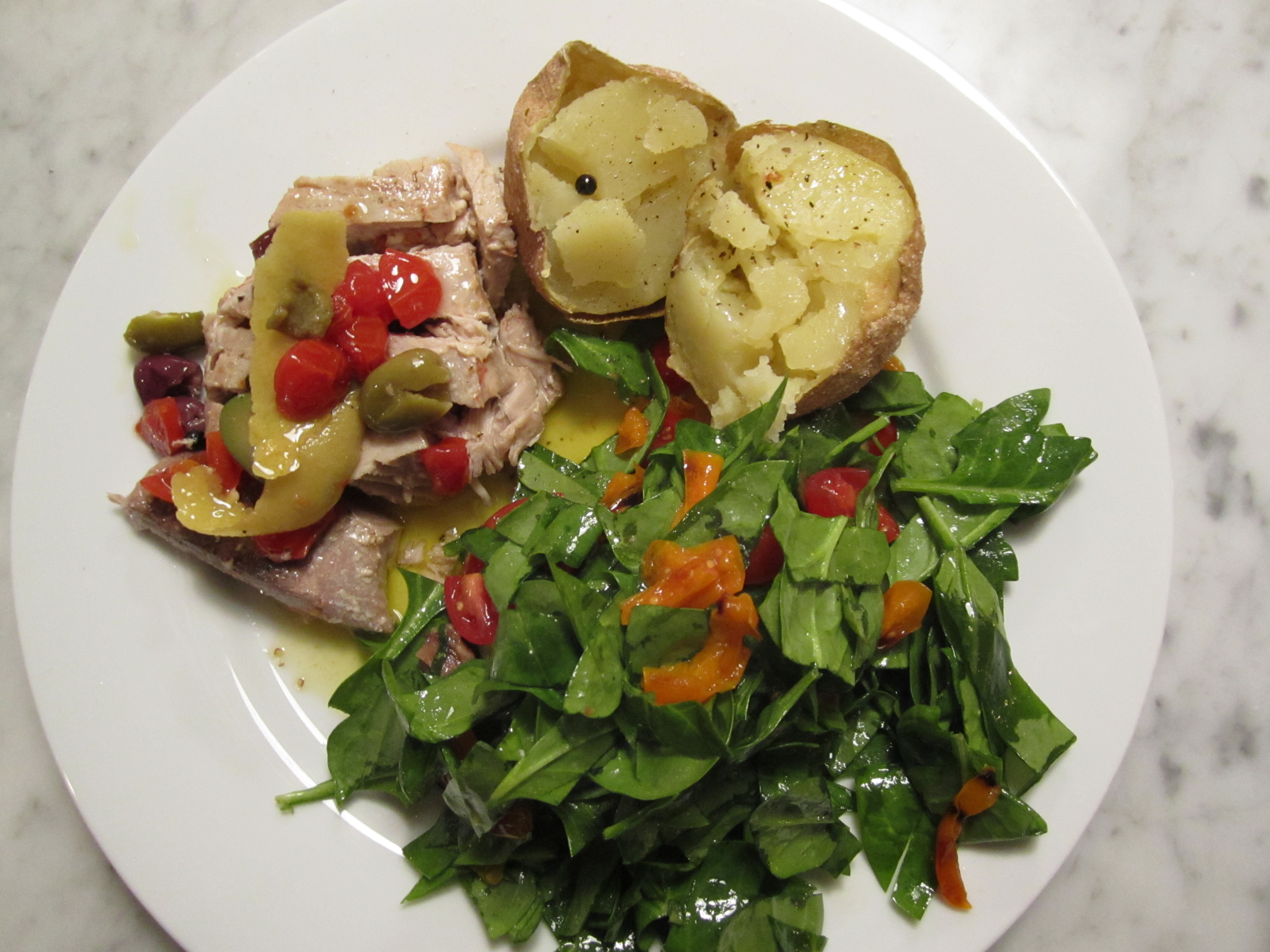
Alongside my tuna, I’m serving smashed  baked potatoes (dressed with the oil from the tuna as well as the following great salad. 

Roasted sweet peppers and anchovies are a common antipasto in Italy–they’re a great combination of super-sweet and super-briny that I love.  Tonight, I’m chopping them and tossing them with baby spinach, tomatoes, lemon and olive oil.  It’s a great light, fresh salad that goes beautifully with fish or steak.  In fact, you might also recognize this dish as a chopped salad from a steakhouse menu.   

I have a great easy way of roasting the peppers in a hurry–it’s something my mother taught me.  Believe it or not, peppers can be julienned, tossed with salt, pepper and oil and roasted uncovered, in the microwave.  I’m not a microwave cook by any means but when I need only one pepper roasted, I can do it in 7 to 9 minutes in the microwave–it’s a great technique. 

Normally it would take much longer to roast the peppers in the oven.  To roast in the oven, you can either broil each side of the pepper until it blisters, then peel it and julienne it.  Or, you can julienne the raw pepper and toss with oil and salt and roast in a 425 degree oven for about 40 minutes. 

Roasted Pepper and Anchovy Salad

Serves 4

1 sweet pepper (yellow, orange or red)

1-5 oz. container of baby spinach, coarsely chopped in ribbons

1/2 cup of grape tomatoes, cut in half

4 anchovies, chopped finely

juice of half a lemon

2 tbls extra-virgin olive oil

salt and pepper to taste.

Sliver pepper, drizzle with oil, sprinkle with salt and place on a microwave plate.  Microwave on high for 5 minutes, then check for doneness.  Continue cooking until it begins to shrivel and softens (length of time depends on the strength of your  microwave)–keep checking it every minute or so.  Cool.

Place spinach, peppers (with their oil), tomatoes, and anchoveis in mixing bowl.  Add salt and pepper–careful with the salt–the anchovies will be salty little bites in themselves.  Toss and serve.
Posted in Salads, Seafood | Leave a comment

Linguini with Scallops

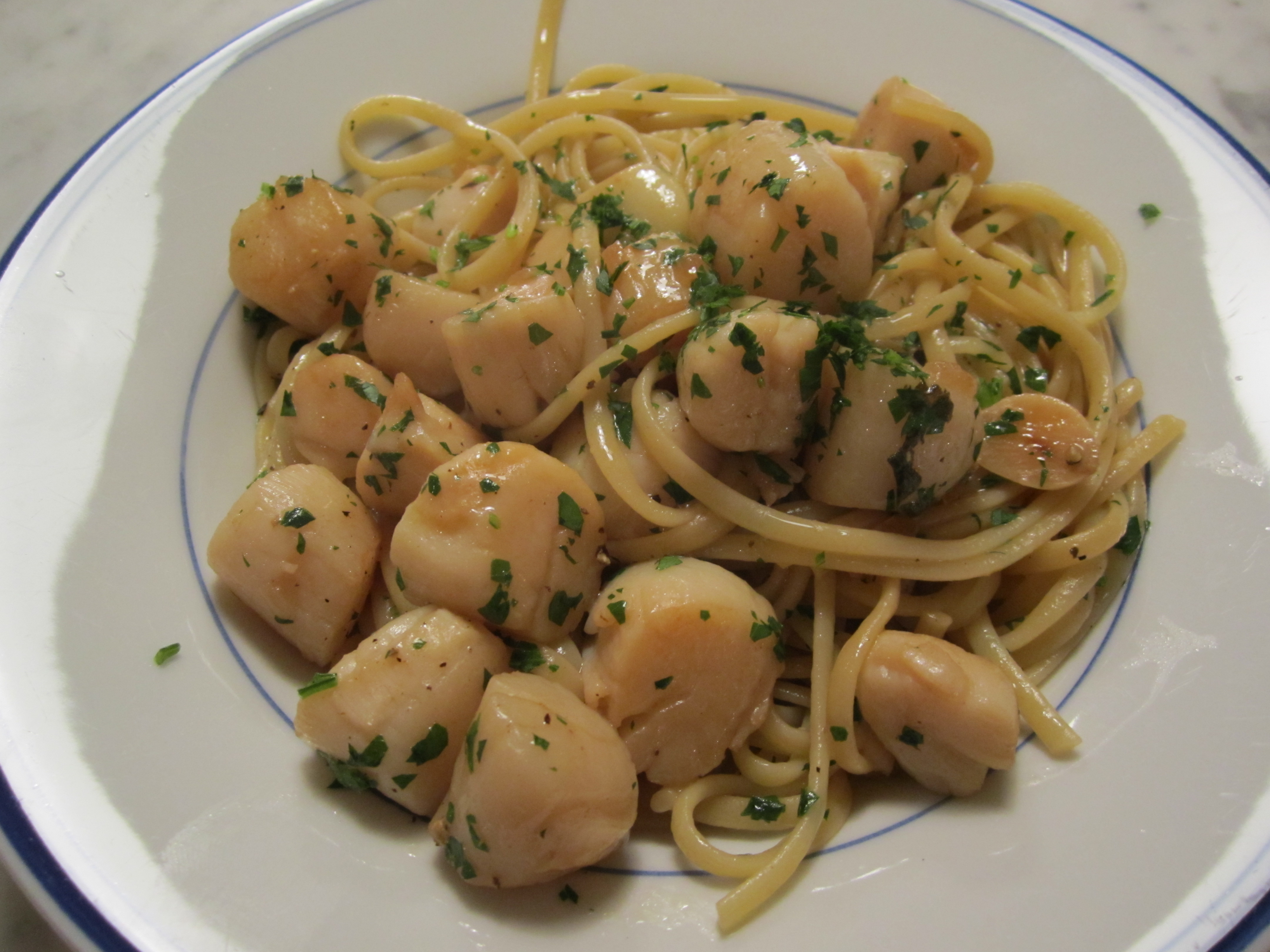
Bay scallops are in season for a short time in the winter and when they’re around, I like to make them often.  They’re small and succulent, and I prefer to cook them in a moist medium rather than just searing them in oil. 

This is my take on linguini with clam sauce, using scallops, instead of clams.  When I worked with Mario, we used to make clam sauce with pancetta, onions, garlic, butter, white wine and chili flakes.  Here, I’m omitting the pancetta because the bay scallops are very delicate and I don’t want to overpower them with pancetta.  Otherwise, the preparation of my scallops is very similar to the clam sauce we used to make at Po.

This is one of those dishes that can be cooked in the time it takes the pasta to boil.  First I sear the scallops in a combination of oil and butter, then remove them and set aside.  I proceed to make the sauce in the same skillet by adding garlic, onion, chili flakes and white wine.  Reduce, and return the scallops to the skillet, add a bunch of chopped parsley, and the cooked pasta and saute for a minute.  The scallops add their sweetness to the sauce and although they’re small, they’re much meatier than clams.  If I make the dish with large sea scallops, I cut them into small pieces before adding them to the dish.


Linguini with Scallops 

Serves 4

1 lb bay scallops, dried with a towel

6 tbl olive oil

2 tbl butter

2 cloves garlic, sliced thinly

1/2  small onion, diced finely

1/2 cup white wine

1/4 cup finely chopped parsley

1 lb dried linguini

salt and pepper

1/8 tsp chili flakes (if desired)

Place linguini in boiling salted water, then begin making the sauce.

Heat 4 tbl oil and 1 tbl butter in large skillet.  Add scallops and saute on high heat for about 2 minutes or until they just begin to take on a golden color, then remove them and set aside–better to remove them too quickly than to let them overcook–it’s not so important that they become too golden for this dish.

Add another tablespoon oil.  Add onions and garlic and saute on medium heat for 2 minutes, then add chili flakes (if using).  Add wine and reduce by half.  Taste and add salt and black pepper. 

When pasta is almost cooked, add the scallops back to the skillet, along with the parsley, remaining butter and the pasta, along with a half-cup of pasta cooking water.  Cook on high heat, stirring and tossing.  the remaining olive oil off the heat, just before serving.

Drizzle the remaining olive oil off the heat and serve immediately.

Posted in Pasta, Seafood | 1 Comment

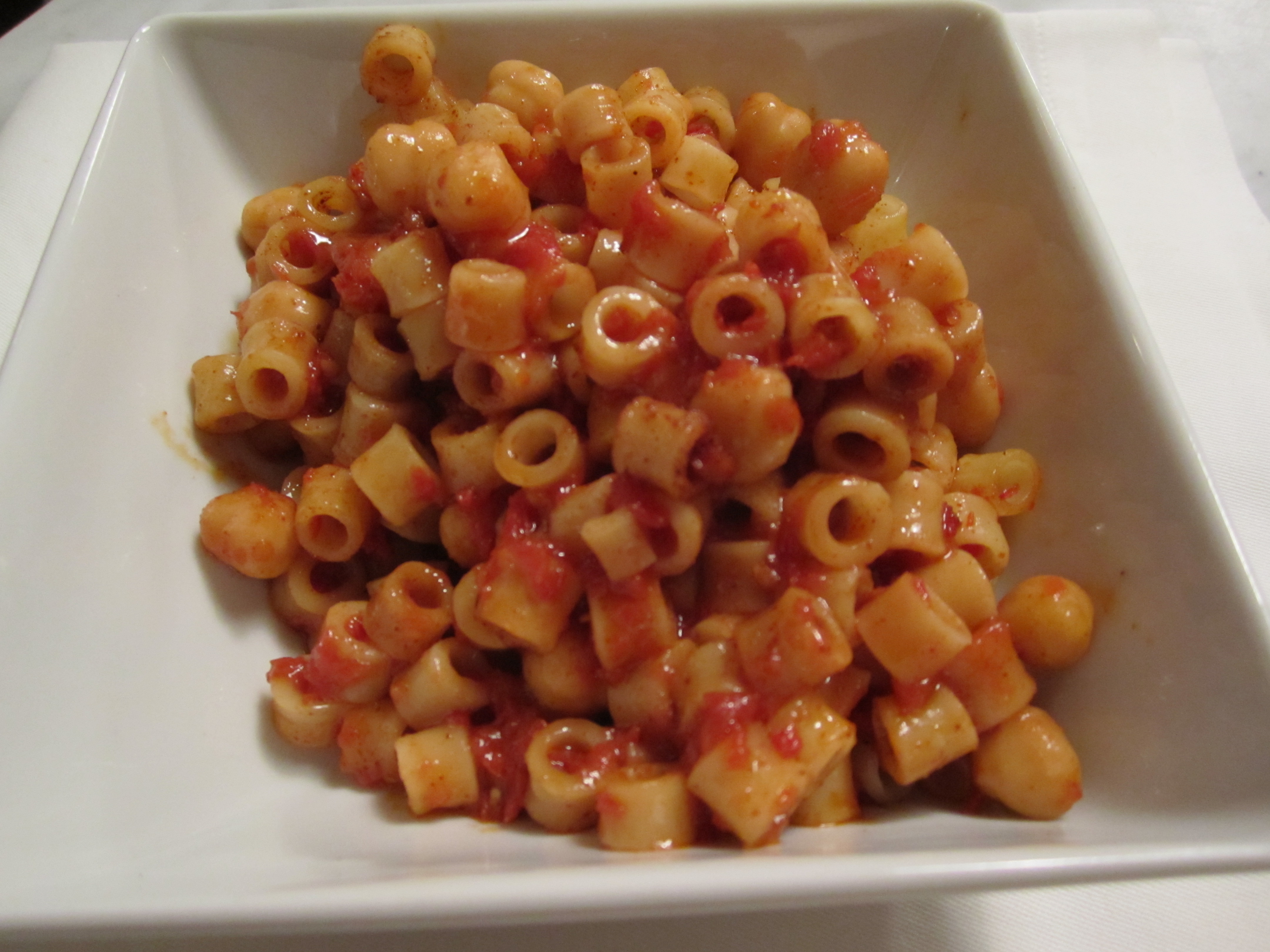
Pasta e Ceci


This is pure southern (Italian) comfort food and almost embarassingly easy to make.  Chickpeas are one of the few canned items that I keep in my pantry and perhaps the only beans which I prefer canned over fresh.  The reason is that fresh chickpeas are unpredictable–they can sometimes be tough and not ever soften.  They need to be soaked overnight but even then, depending on their age (which you have no way of knowing)–they can take an hour to cook or three–and still be tough.  Unlike other canned beans which become overly soft, chickpeas maintain a nice crunch and bite. 

The first of today’s two recipes is my mother’s.  Since my mother canned her own tomatoes every fall (and still does), she would often make a simple tomato sauce by sauteing a bit of onion, adding the tomatoes, then adding the can of chickpeas with a bit of their liquid. She would simmer the sauce while the pasta (always ditalini) cooked.  She would sometimes add some chopped dill to the sauce–or instead,  she would finish the sauce by sauteing a spoonful of paprika  in olive oil for a half a minute, then drizzling the sizzling red oil over the pasta at the last second.  Try it–it adds a deep spicy finish to the dish without any heat. 

Pasta e Ceci

Serves 4

2 -15 oz cans chickpeas

1/2 small onion, diced finely

28 oz. can of whole peeled tomatoes, squeezed by hand or slightly pureed in blender

8 tbls olive oil

1 lb ditalini pasta

2 tsp paprika

salt and pepper

Saute onion in 5 tablespoons olive oil on low heat until it just begins to color.  Add canned tomatoes and simmer uncovered for about 10 minutes.  Add chickpeas with half their liquid and continue simmering.

Boil pasta in salted water until it’s halfway cooked, then combine with sauce and let all simmer together until the pasta is cooked. 

When all is ready to serve, place the paprika in a small skillet with 2 tablespoons olive oil and saute for a minute or so or until it sizzles for about 30 seconds.  Drizzle over pasta.

Additionally, drizzle the remaining tablespoon oil over pasta and serve.

I like grated pecorino over this–my mother frowns upon it!

Insalata di Ceci


The second dish is an innovation of mine.  I discovered a couple of years ago that canned chickpeas can be dry-roasted in the oven–not just simmered in a stew.   It’s a wonderful thing–they’re as addictive as salted nuts when served this way.  Simply coat them with salt and oil and roast on a sheet pan in a 425 degree oven until they become golden and crunchy–usually about twenty minutes. 

They are great to add to a salad of winter greens like baby spinach, arugula or radicchio.  I like to add grape tomatoes to this salad and dress with extra virgin olive oil and red wine vinegar–adding an extra generous dose of vinegar.   I usually prefer my salads more  oily than acidic, but in this case the vinegar gives the rich deep chickpeas some fresh balance.  As a nod to my mother’s pasta with ceci, sometimes I’ll saute a spoonful of paprika in olive oil and toss the roasted beans with it before sprinkling them over the salad.  Needless to say, this is great with a piece of rosemary foccaccia. 

Insalata di Ceci

1 – 15 oz. can of chickpeas

1 – 5 oz. box of baby spinach, slivered into 1/2″ ribbons

1/2 box grape tomatoes, cut in half lengthwise

3 tbls extra virgin olive oil

1 tbl red wine vinegar

1 tsp paprika

Preheat oven to 425

Drain chickpeas and dry brifely with paper towels.  On a sheet pan, drizzle them with a tablespoon of the oil and some salt (to taste).  Roast, shaking occasionally until they turn golden (about 20 minutes). 

Place a teaspoon of paprika in a small skillet of cold olive oil.  Saute the paprika, shaking the pan, until it bubbles for about 30 seconds.  Toss with the roasted chickpeas.

Place the spinach and tomatoes in a mixing bowl, drizzle with the vinegar, oil,  salt and pepper and toss well.   Top with roasted chickpeas.


Posted in Pasta, Soup/Stew | 2 Comments

Pasta with Kale and Bacon


This past fall I decided to try a little experiment with freezing produce.  I just couldn’t bear to part with the local vegetables for the entire winter, so I decided to see what froze well and what didn’t.  At around the end of November, I went to some of my favorite farm stands and bought large quantities of fall vegetables–kale, broccoli, cauliflower, cabbage and winter squash. I  would come home, wash, chop and briefly blanch each of the vegetables (except butternut squash, which can be frozen raw).  Then I froze them in ziploc bags. 

I have been using all of those vegetables, with mixed results.  The main disappointment was broccoli–it loses much of its texture and flavor when frozen.  Although the sweetness remains in the thawed broccoli, it’s waterlogged.  I definitely won’t throw it away, but I’ve limited my use of the thawed broccoli to soups (which will appear in a later blog).  As a side dish, it’s too limp and mushy.

I had a similar experience with cabbage, but the local cabbage was so sweet that I’m still glad I froze it, if only to add that melting sweetness to my bean stew and other soups.

The best vegetable to blanch and freeze was, by far, kale.  The thawed kale is indistinguishable from freshly picked and blanched kale.  Although I can certainly buy serviceable kale at my local gourmet market throughout the winter, the local stuff is still a marvel.

Assuming you don’t have frozen kale already cleaned and blanched in your freezer, cleaning the kale is the most time-consuming part of the dish –some kale is sandier than others.  Generally, the non-local kale that I can buy in my supermarket is much less sandy than the local stuff (having been washed before traveling far and wide).  Therefore, all that remains to be done is to strip the leaves off the tough woody stems, cut them into ribbons crosswise, give them a quick bath in a deep bowl of cold water, then boil them in salted water for about 5 minutes.    Keep some of the remaining liquid from boiling the kale to add to the pasta dish or to add to soup or stew–it has a nice mellow green flavor–you can use it as a vegetable stock.

This pasta dish is an earthy, nutritious and deeply comforting combination of kale, bacon, onions and olive oil–simple, easy and a complete meal all by itself.  As with most oil-based  pasta dishes, I love a heavy dusting of grated pecorino romano cheese on top.


Pasta with Kale and Bacon


Serves 4

1 bunch kale,  leaves stripped off the stems, cut into ribbons, blanched for 5 minutes

1 large onion

6 tbls olive oil + additional for drizzling

1/4 pound of slab bacon, cut into 1/2″ cubes

1 lb short fat pasta such as rigatoni or ziti

salt and pepper

pecorino romano for sprinkling

While boiling pasta, saute bacon on low heat, letting the fat render for about 5 minutes; add onion and saute for about 10 minutes more, add kale.

When pasta is done, saute with kale mixture plus a 1/2 cup of pasta water and drizzle with extra virgin olive oil and black pepper.

Posted in Pasta | 5 Comments

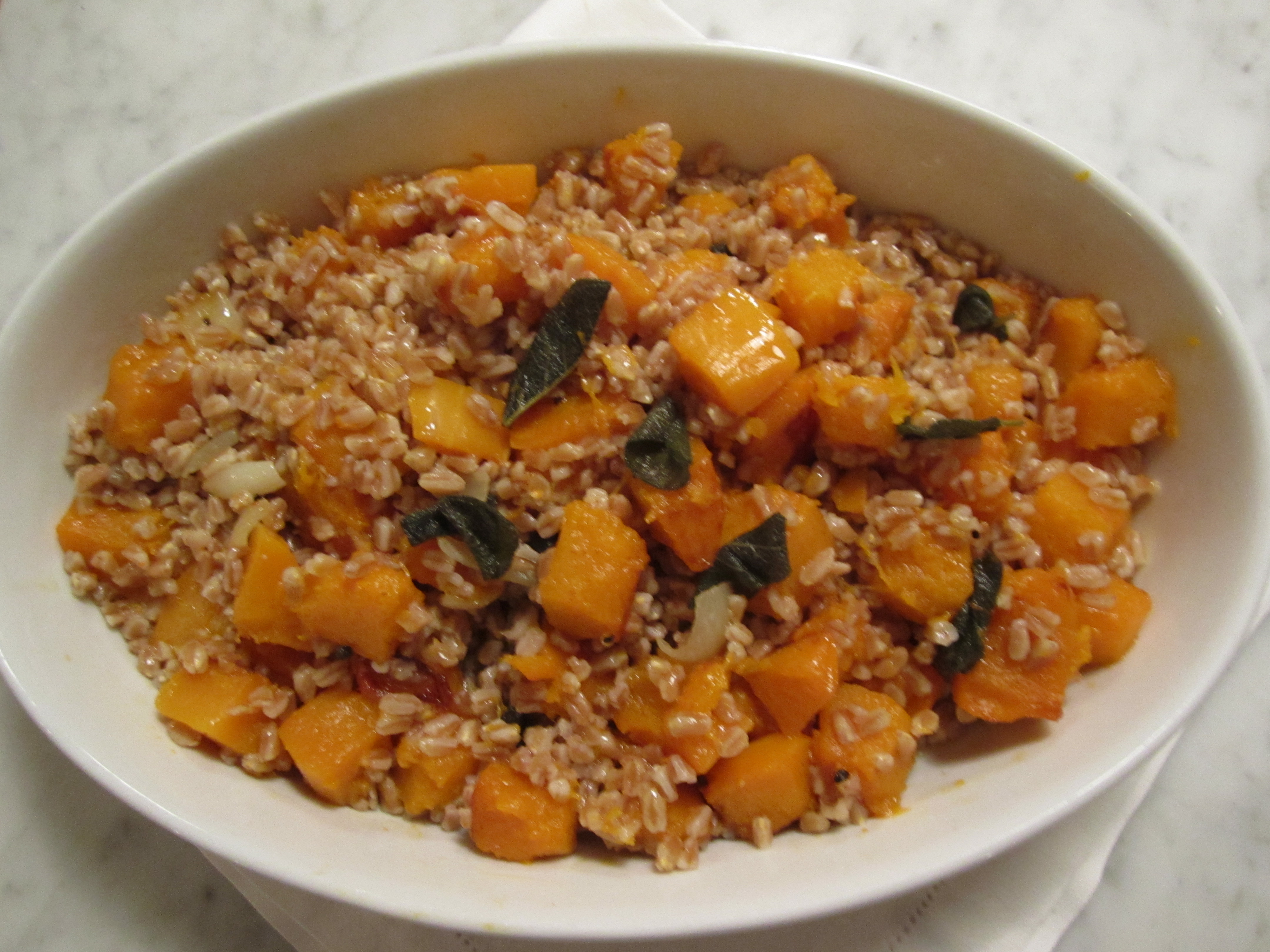
Butternut Farro


This simple combination of butternut squash and farro is as soothing and comforting as it gets.  It’s sweet, nutty and rich-tasting without actually being rich.  It can serve as a main course (totally vegetarian) or side dish.  It reheats beautifully in a skillet with a couple of tablespoons of broth or salt water.

For this dish, the butternut gets peeled, seeded and cubed, then sauteed with onions and sage.  The finished squash is simply tossed with cooked farro and some of the cooking liquid from the farro. 

I like to make more squash than I need for the farro and use the extra cooked butternut later in the week to toss into a salad with some sturdy chopped baby greens like baby arugula, or watercress,  mint, parsley, some oil and red wine vinegar, and it ends up acting a bit like an Italian tabbouleh–I’ll make it for you sometime.

Alternatively,  you can heat up the leftover butternut and toss it with pasta like cavatelli or ziti, drizzle with butter or extra virgin olive oil and add lots of parmiggiano on top.

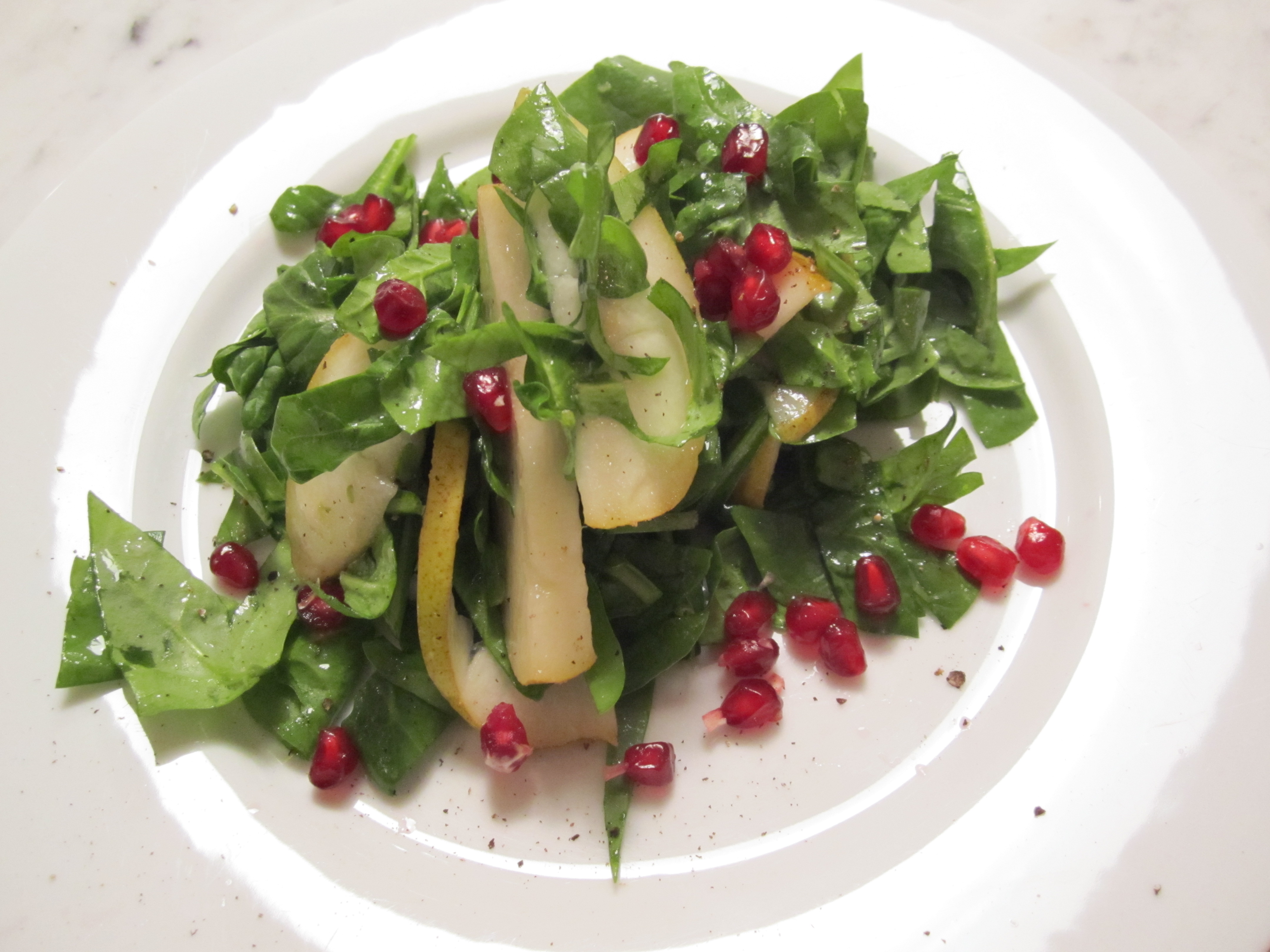
While I was at the market, I got inspired to make a salad to go with the farro . . . I noticed the pomegranates were extraordinarily plump, red and firm–I held one and could tell it would be good (heavy and solid–no soft spots).  

I’ve had some pears ripening at home for about 4 days now, so I’m going to combine sliced pears with the pomegranate seeds and baby spinach.  It’s a salad that is light but wintry.  I’m dressing it with my simple combination of red wine vinegar, olive oil and agave. 

Tonight, I’m serving the salad after the pasta, since it’s a refreshing palatte cleanser and almost feels like dessert.

Butternut Farro 

Serves 4 as a side dish

1 medium butternut squash, peeled, seeded and cut into 1″ chunks

1 medium onion, quatered and sliced

4 tbls olive oil

6 sage leaves

1/8 tsp nutmeg

1 cup farro

salt and pepper 

Place farro in a saucepan filled with cold water.  Bring to boil, add salt and cook uncovered for about 20 minutes or until tender.

Heat oil in skillet and add butternut cubes, sage and nutmeg.  On medium-high heat, cover and saute for about 8 minutes (stirring it and shaking the pan every few minutes to make sure it’s not stickiing).  Add onion and cover again for another 8 minutes.  Uncover and saute until squash is tender and onions are slightly golden.  Add salt and pepper to taste.

Set aside half the squash for later use.  Combine the squash and farro and add some cooking liquid from the farro.  Taste and add salt and pepper.  Drizzle with extra-virgin olive oil and serve.


Salad of Baby Spinach, Pears and Pomegranate Seeds


Serves 4

5 ounce package of baby spinach, cut into 1/2″ ribbons (or serve them whole)

1 large plump ripe pear, quartered and sliced thinly

1 cup of pomegranate seeds

1 tbl red wine vinegar

1 tbl extra virgin olive oil

1 tsp agave or honey

salt and pepper

To seed a pomegranate, take off any valuable sweaters and put on an apron (even if all you’re wearing is a tee-shirt).   Place a deep mixing bowl in the sink and work inside the bowl–it’s very messy and the juice will squirt and stain anything in sight.  Simply cut the fruit in half crosswise and start pulling apart each little section of the honeycomb inside.  Run your fingers along the inside wall of the peel and between the membranes and gently scrape out all of the seeds from each little section of the white honeycomb. Discard the white membranes.  When you’re done, you’ll have  a nice juicy bowlful of ruby-colored seeds to sprinkle or just eat as they are.  It’s a little messy, but don’t be dissuaded–once you taste a spoonful of seeds, you’ll be happy you did it! 

In a mixing bowl, toss spinach and pears with vinegar, then agave, then oil.  Add salt and pepper and toss.  Sprinkle with pomegranate seeds and serve.

Posted in Pasta, Vegetables | Leave a comment

Brasato di Tacchino


I’ve decided to braise the other half of my turkey breast.  This is a moist, stew-y dish, like a pot roast.  Like many braised dishes, this dish is best eaten after it’s been allowed to rest in the fridge overnight. There is some wine and some sherry in the recipe and those flavors meld and soften the next day.  The wonderful thing about a braise is that there is always a nice liquid medium in which to reheat it (or even  freeze and re-heat).

Because this is a turkey breast and not a fatty roast, it’s important to cook it gently (this includes re-heating it gently).  When lean protein is allowed to boil too hard, it toughens quickly.  Therefore, after the breast has been browned on the outside, it is simmered in a low oven, partially submerged in its braising liquid.

The braising liquid is a fragrant blend of aromatics, rosemary, tomato paste, white wine and sherry.  I have to credit my neighbor Beppi for the wine/sherry combination.  He makes a spezzatino di pollo (chicken stew) that uses this combination and it’s a very luxurious and partly sweet flavor.  It pairs equally well with turkey as it does with chicken.

I have chosen to roll and tie my breast into a nice compact little roast, but don’t let this dissuade you from preparing the dish if you only have a bone-in turkey breast.  A bone-in breast works very nicely for this dish.  In fact, the bone makes the meat a little more forgiving if you cook too hard or too long–the bone keeps it moist.

I chose to take mine off the bone simply because I was interested in making broth out of the carcass.  Otherwise, I’ve made it on the bone before and it’s delectable.  I’ve also made many different braising liquids, and I’ll share them with you as I make them in later posts.

The use of tomato paste instead of whole peeled tomatoes is also Beppi’s influence on my cooking.  Being northern Italian, he has a partiality for non-tomato-based sauces.  Butter, white wine and stock figure prominently in the region of Venice and Verona.  The tomato paste is added for a bit of color and sweetness, but not necessarily for a tomato flavor per se.  My mother, instead, will braise meats in tomato sauce almost exclusively.

Because of the luxurious braising liquid in this recipe, you’ll want to have it with something bland and starchy on the plate to soak up all of the wonderful juices.  I’ve chosen rice, simply boiled in broth, but  polenta would be equally wonderful.

Brasato di Tacchino

 2 lb turkey breast (without bone) will serve 4 persons

1 half of a turkey breast about 2 lbs (if boneless, tie into the shape of a roast so it cooks evenly)

flour for dredging

2 carrots, sliced thinly

1 rib celery, sliced thinly

3 onions or 6 shallots, sliced thinly

2 whole sprigs rosemary

2 tbl butter

3 tbls olive oil

1/8 tsp nutmeg

salt and pepper

1 heaping tbl tomato paste

1 cup white wine

1/2 cup sherry (dry or medium)

2 cups chicken or turkey broth

salt and black pepper


Preheat oven to 300 degrees

Season turkey well on all sides with salt and pepper.

Heat half the butter and oil in dutch oven.

Dredge turkey breast lightly in flour.  Shake off excess.  Brown turkey breast on all sides (about one minute per side on high heat).  Discard oil and butter then replace with the rest of the oil and butter to the pot.  Add the carrots, celery, onion, nutmeg, and rosemary sprigs.  Saute on medium heat for about 10 minutes until it starts to color.

Add wine and sherry and wine.  Cook on high heat for about 5 minutes until alcohol is reduced by one third.  Add tomato paste and broth and return to simmer. 

Cover and place in oven for 45 minutes.  Uncover and cook for another 15 minutes or until a meat thermometer reads at least 165 when inserted in center of the roast.  Note: if you’re cooking a bone-in breast, it may take fifteen minutes or so longer to cook it through. 

A couple of tips:  the size of turkey breasts can vary widely; if you’re cooking a larger one (say 4 to 5 lbs), add more liquids and cook longer.  Always taste for salt and adjust toward the end.  If the sauce looks too watery (it should be liquid-y but not quite soupy) and the meat is cooked, remove the meat and reduce the sauce a bit on the stovetop.

Let rest overnight if at all possible and slice when cold the next day.


Posted in Poultry | Leave a comment

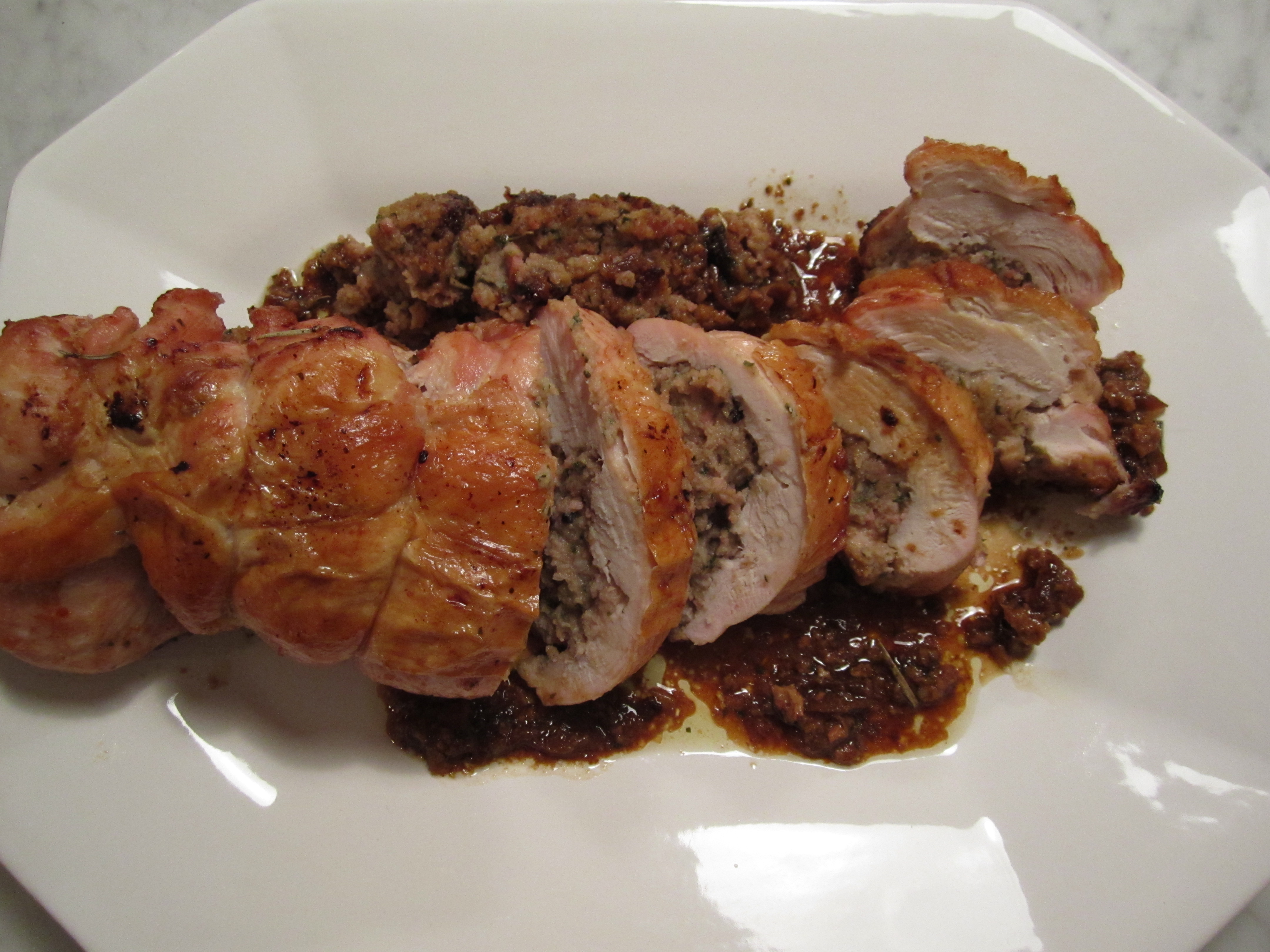
Rotolo di Tacchino


I went to my local butcher looking for a boneless turkey breast already tied into a roast, but instead I found only a large full turkey breast on the bone–organic and free-range.  It was irresistable, so I instantly thought of making two separate meals as well as a pot of broth with the bones.  This is the first of the two dishes–tune in tomorrow for the second.

For this dish, I debone one of the breast halves, butterfly it, scoring and spreading the flesh with my knife until I have a large flap of meat that I can cover with a stuffing of some sort, then roll the meat around the stuffing, making sure to cover the whole package with the skin, then tie and roast.   It’s a bit of a labor, but the final presentation is very rewarding.

Ever since my neighbor Beppi showed me his stuffing, with which we filled a capon for Christmas, I’ve been wanting to make it myself and use it in a slightly different way.   He uses mortadella, bread crumbs and sausage in his stuffing.   I’ve chosen to omit the sausage because I find that the mortadella is rich and meaty enough on its own.  The stuffing is a very simple assembly that gets pureed in the food processor with no sauteing of aromatics beforehand.  Then the seasoned crumbs are added to give the mixture firmness.  Then a copious amount of chopped fresh parsley is added.  

After I’ve taken both breast halves off the bone,  I throw the carcass into a pot of water with some celery and onion to let simmer while I’m doing everything else.  You can skip this step and use already prepared chicken broth or bouillon if you’re using a breast that you’ve bought without the bone.

Another  technique in this dish is one I’ve borrowed from my late friend, Margie, who made the best turkey breast.  She used to saute a bunch of onions and place the turkey breast on top of the caramelized onions to roast.  It resulted in a ready-made sauce that was sweet and complex.  I’ve added a touch of Marsala to this onion mixture because it enhances the turkey beautifully.

After the breast comes out of the oven, remove it from the pan, then you  may want to add a little water to the pan and reduce those juices–the onions are a mahogany brown by then.

Rotolo di Tacchino

2-lb turkey breast serves 4 

1 boneless turkey breast approx. 2 – 3 lbs., butterflied

6 slices whole wheat or white bread

3/4 cup chicken broth

2 small shallots

1/4 lb mortadella, diced into small chunks

approx. 3/4 cup seasoned breadcrumbs

1/2 cup parsley

1/8 tsp nutmeg

1/2 tsp black pepper

3 or 4 small onions or 6 shallots, peeled and sliced

3 tbl olive oil

1/4 cup marsala

Preheat oven to 375 degrees

Soak bread in broth for 10 minutes. 

In the food processor, chop the shallots and mortadella until it is a coarse paste.  Add the bread and broth.  Turn mixture into a mixing bowl and add nutmeg, parsley, black pepper and some seasoned crumbs.  Test for firmness and if it’s not stiff enough, add more seasoned crumbs–it should be fairly dense. 

Season both sides of the turkey breast lightly with salt and pepper.

Lay the stuffing in a log across the non-skin side of the butterflied turkey breast and wrap into a bundle, then tie crossways, then lengthwise. 

In an ovenproof skillet, saute the shallots or onions in the olive oil for about ten minutes until golden.  Add marsala and reduce for about 5 minutes.  Let cool.

Place turkey breast on top of onion mixture and roast, uncovered for about 45 minutes, basting occasionally and adding water or broth if the pan gets dry.

Let rest at least 10 minutes before slicing.


Posted in Poultry | Leave a comment

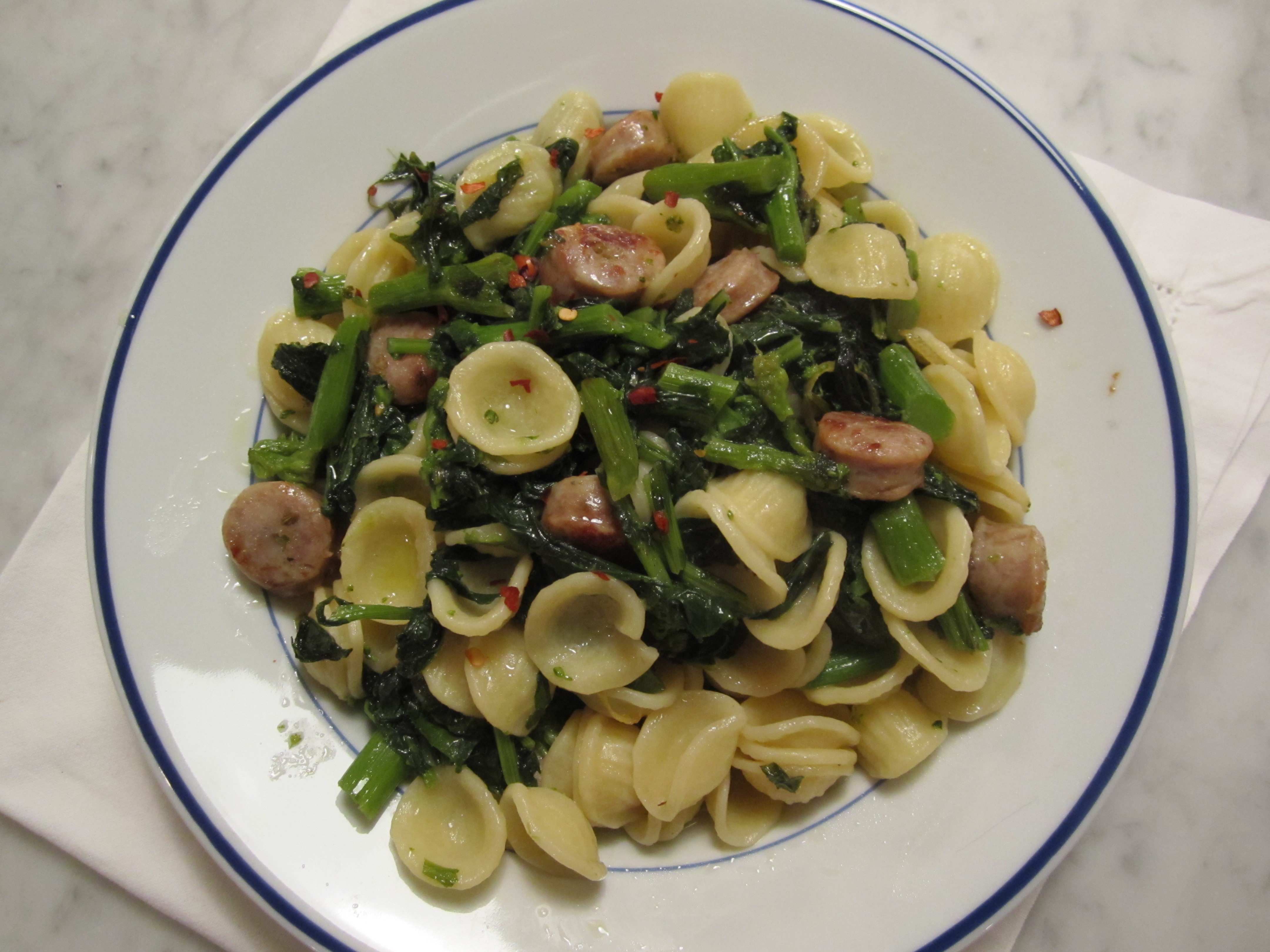
Orrechiette with Sausage and Broccoli di Rapa


An oldie but goodie.   I have some leftover broccoli di rapa from my seafood dinner (see previous post) and that was intentional–I’ve been looking forward to orrechiette with broccoli di rapa and sausage. This dish, a specialty from Apulia, can be varied in a few different ways. 

First of all, any short, fat pasta can be substituted for the orrechiette–cavatelli, rigatoni, fusilli, etc. 

I’m using sweet Italian sausage, but you can vary the type of sausage or use a cured or smoked variety of some sort (chorizo or andouille work beautifully).   You can eliminate the sausage entirely and it makes a very elegant vegetarian dish. 

You can saute some anchovies in the skillet with the garlic and then top the finished dish with toasted bread crumbs, instead of pecorino romano (Italians would never put grated cheese on something that had anchovy in it).

You can make the dish on the soupy side, or more on the oily side (I prefer the more oily version).  If you seek to make it soupier, just add some additional pasta cooking liquid at the end and serve in bowls.

Although recipes for this dish abound, I’ll give you mine in case you simply want to look no further.


Orrechiette Sausage and Broccoli di Rapa

Serves 4

1 bunch broccoli di rapa, sliced crosswise into 1/2″ pieces (stems, leave, and all)

1 lb sweet Italian sausage

4 cloves of garlic, peeled and split in half

1 lb orrechiette

salt and black pepper

chili flakes, if desired

pecorino romano for sprinkling

Precook sausage by placing in boiling water and simmering for 10 -15 minutes (depending on how fat the sausage is).  Drain and slice into 1/2″ rounds.

Chop and wash broccoli then let drain in colander. 

In broad skillet, brown garlic pieces on low heat for about 10 minutes. 

Add sausage disks to skillet with garlic and brown sausage for a few minutes over medium heat.  Add broccoli and cover for about 8  minutes, lifting lid from time-to-time and stirring or shaking.  Taste and add salt and black pepper. 

Drop pasta in boiling salted water and continue sauteing the broccoli mixture on low heat while the pasta cooks, turning and stirring from time-to-time.

When pasta is cooked, fish it out with a spider or strainer and add it to the skillet with the broccoli mixture along with some cooking water.  On high heat, saute for a minute or two. 

Turn off heat and add a generous drizzle of extra virgin olive oil and serve with pepper flakes and  grated pecorino romano


Posted in Pasta | 2 Comments

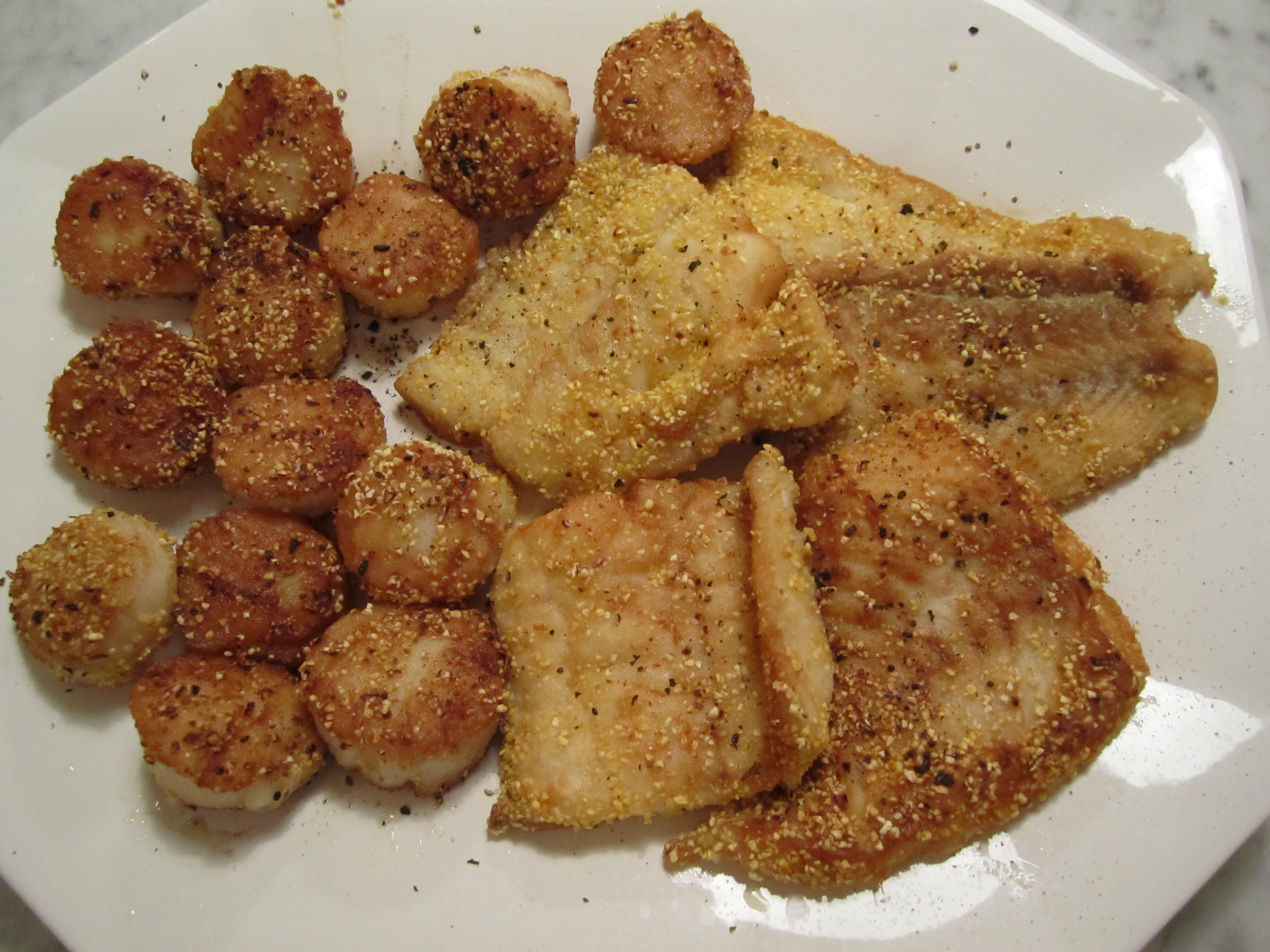
Fritto di Mare with Broccoli di Rapa, Lemon and Garlic


Mixed fried seafood always reminds me of summer, but actually, here in eastern Long Island, there is local seafood twelve months a year.  Right now the sea scallops and fluke are sweet and tender, and they were irresistable at the market.  I could tell just by looking at this seafood that it was fresh, but I always ask to sniff anyway–there are no surprises that way. 

For me, the best way to prepare fluke or any other thin white fish is to coat it with something crunchy and pan-fry it.  My preferred coating for seafood is cornmeal–two parts cornmeal to one part flour.  The flour helps the cornmeal adhere and ensures an even coating.

This dish does not require a recipe as there are no other ingredients besides cornmeal, flour, seafood and olive oil.  What it requires instead, is a set of directions, which I will attempt to outline.

The amount of cornmeal and flour you use depends on how much seafood you’re coating.  I just put a generous amount of cornmeal and flour (2 to 1) in a pie pan and mix it well.  Any remaining after I’m finished, I simply discard.

In pan-frying, you must get the oil hot enough for the seafood to begin sizzling immediately upon hitting the skillet.  The way to test is to dip the tail-end of one of the coated fish pieces in the oil and if it immediately sizzles, you can start adding pieces to the oil.  If not, pull it out and wait until the oil heats.

The oil should start out on high heat, depending on how powerful your flame is, then be reduced slightly (if at all) once everything is sizzling.  It’s difficult for the oil to be too hot, but if the pieces begin browning too quickly (you don’t want to scorch the cornmeal), just turn down the flame or remove the skillet from the flame for a moment.  Worse would be for the oil not to be hot enough–then the seafood will simply poach and never get crisp. 

Do not crowd the skillet–let there be a bit of circulation room around each piece of seafood.  Fry in more than one batch and you’ll be fine.  If there’s too much scorched cornmeal and flour in the skillet when you’re finished with a batch, discard the oil and heat some fresh oil before proceeding. 

With all of these caveats in place, this is how the dish goes . . . simply take each piece of fish and cut in half or thirds, depending on how large you want the finished pieces to be.  Don’t dry the fish or scallops before coating–simply dredge in the cornmeal/flour mixture, shake off the excess, then gently place in about a half-inch of sizzling hot olive oil.  Sprinkle generously with salt (I use kosher because I can feel the grains and judge how much I’m using) Let brown on one side–this should take about 2 minutes or so, then gently flip and let brown on other side.  Salt the other side as well.   In about 2 or three minutes, or when golden on both sides, lay on platter, dust with black pepper, drizzle with extra virgin olive oil and serve.  

In my opinion, this should be eaten either sizzling hot or cold from the fridge the next day (with a salad).  At room temperature, I feel it gets fishy, but cold, it’s brilliant.

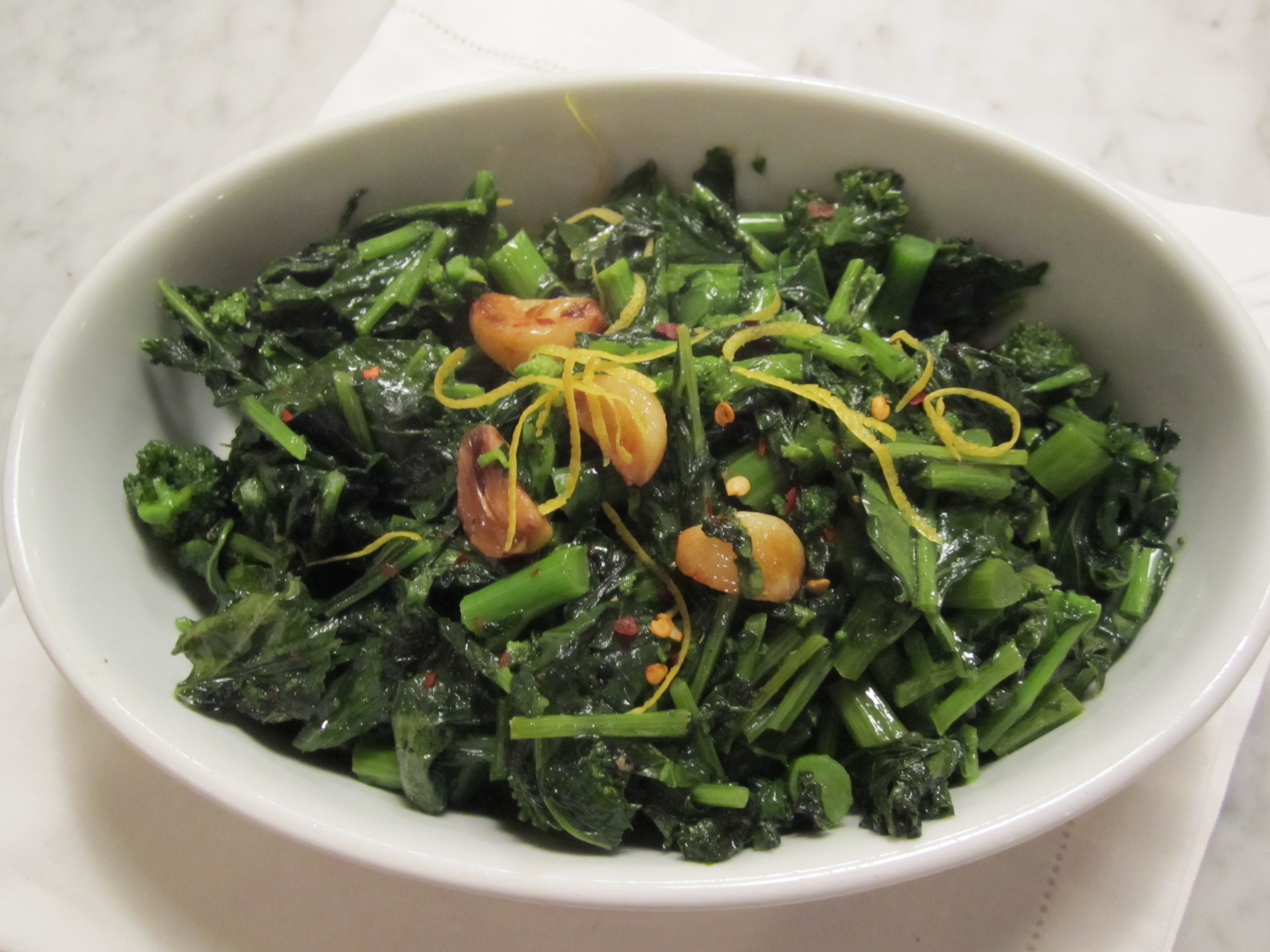
Broccoli di Rapa with Garlic, Lemon and Chili Flakes


As an accompaniment to the seafood, I’m making broccoli di rapa.  There are two basic ways to make this vegetable–one is to saute it raw; the other is to blanch it first in boiling water, then saute it.   Sauteing it raw results in the characteristically bitter dish that most Italians associate with broccoli di rapa.  Boiling it first, results in a much milder less pungent flavor–I truly love it both ways. 

There are several flavors that pair well with broccoli di rapa–the most obvious one is garlic, along with chili flakes.  Other assertive flavors which complement it well are sun-dried tomatoes (slivered and sauteed along with the garlic), or anchovies, or pine nuts/raisins.  My mother used to saute little rounds of cured sausage with the broccoli and would never blanch it first.

When I’m serving it as an accompaniment to seafood, I love to add not only garlic to the broccoli, but lemon zest–right in the skillet while I’m sauteing it.  It combines with the garlic and gives the broccoli a wonderfully bright quality that cuts the richness of the fried seafood.  In addition, because I’m adding something as strong as lemon zest, I’m going to saute the broccoli raw, and cook it for a while.  Once the broccoli sautes for a while and softens, if you leave it undisturbed for a few minutes in the hot oil, it begins to caramelize, which adds yet nother dimension to the flavor and also sweetens the bitterness a bit. 

Sauteed Broccoli di Rapa with Garlic, Lemon and Chili Flakes

Serves 4

2 bunches broccoli di rapa, the bottom 1/2″ removed, then cut crosswise into 1/2″ pieces

8 tbls olive oil

4 cloves of garlic, split in half

zest of 1 lemon

chili flakes

salt

Wash the greens and let them drain in colander, leaving the water that clings to them. 

In a large skillet, heat olive oil and garlic on low until the cloves are golden (about 10 minutes).  Add lemon zest and saute for about 2 minutes.  Add broccoli pieces and cover, leaving the heat on medium-high, for about 8 minutes.  Taste and add salt.  Remove lid and saute until the pieces begin to caramelize, about another 4-5 minutes.

Posted in Seafood, Vegetables | Leave a comment

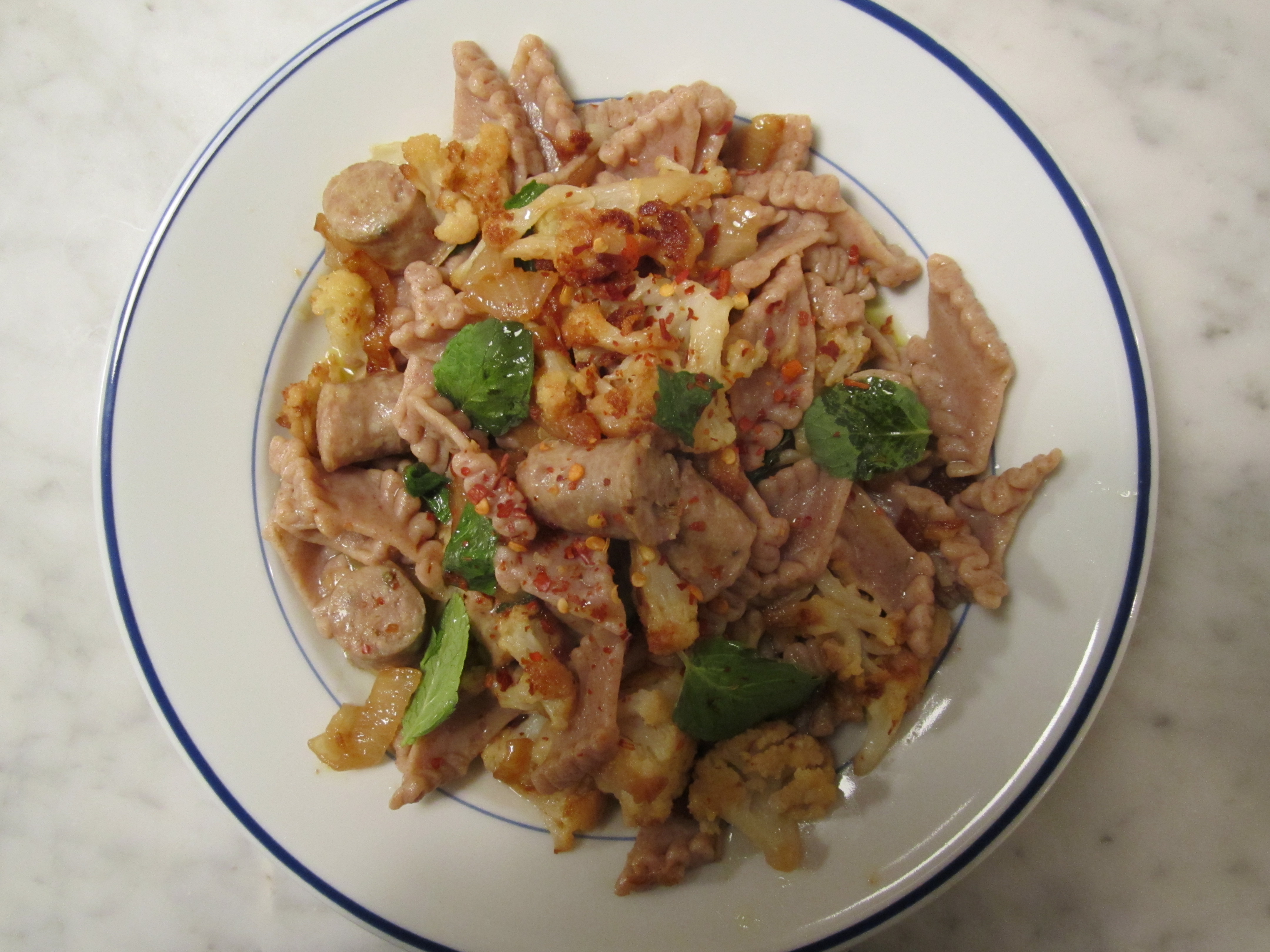
Farro Pasta with Luganega, Cauliflower and Mint

Farro is a whole grain which can be boiled and tossed with a variety of vegetables and sauces.  In its traditional form, it’s a chunky nutty pilaf.  But there are some artisanal pasta makers in Italy making some very high-quality pastas with 100% farro.  They are found in gourmet markets (I buy them at my local market, Citarella) and are expensive–but worth trying for a change of pace from whole wheat pasta. 

Theses pastas all have the dense, nutty quality that whole wheat pastas have, and in fact, you could substitute whole wheat pasta for the farro pasta in this recipe.  The difference is that the farro pasta has a sweetness and delicacy that whole wheat pasta does not.  I like them both equally but since I happen to have farro pasta in the house, that’s what I’ve chosen to use for this recipe. 

Cauliflower is a natural complement to whole grains because of its own earthiness and nuttiness. 

Luganega sausage is a sweet Italian sausage made from pork, fennel and other spices.  It’s often available in the supermarket and has a nice mild flavor (almost like a breakfast sausage but without the sage).  Regular Italian sausage (hot or sweet) may be substituted in this recipe. 

The reason I sought out Luganega sausage was that my neighbor Beppi uses it as a component in some of his dishes (including his stuffing).  It has a subtle refined flavor that doesn’t overpower other ingredients, and as such, is perfect for the delicate marriage of cauliflower and whole grain pasta.

Mint happens to pair well with cauliflower.  Here, it is especially good, because in this dish, there are three very earthy flavors (whole grain pasta, cauliflower, and pork sausage).  A bright note is needed to give the dish a little freshness–you could use a sprinkle of parsley instead, but there is no substitute for mint.   A dusting of grated pecorino and maybe some chili flakes at the end are optional but highly recommended!

Farro Pasta with Cauliflower, Luganega and Mint


serves 4-6

1 lb Luganega sausage, boiled and cut into 1″ pieces

1 head of cauliflower, cut into bite-size pieces

1 small onion, cut in quarters, then sliced

6 tbl extra virgin olive oil

1/2 cup chicken broth

1 lb farro or whole wheat penne

Place sausage in boiling water and simmer, uncovered for about 12 minutes.  drain and let cool a bit.

In a broad skillet, saute cauliflower in olive oil on high heat, covered, for about five minutes (keep opening and stirring and turning every couple of minutes).  Add onion and re-cover for about ten minutes  Keep checking and turning or shaking, often.  When onion begins to color, add sausage pieces.  Add broth and continue cooking uncovered to evaporate broth.  Taste mixture and add salt and pepper and turn heat to very low.  At this point, boil pasta.

When pasta is done (it seems to take much longer to cook than the 12 minutes recommended on the box) toss the pasta along with some of its cooking liquid (maybe a 1/4 cup) into the cauliflower mixture, then toss in mint leaves.  Saute for a minute, then serve with abundant grated pecorino and red pepper flakes.

Posted in Pasta | 2 Comments