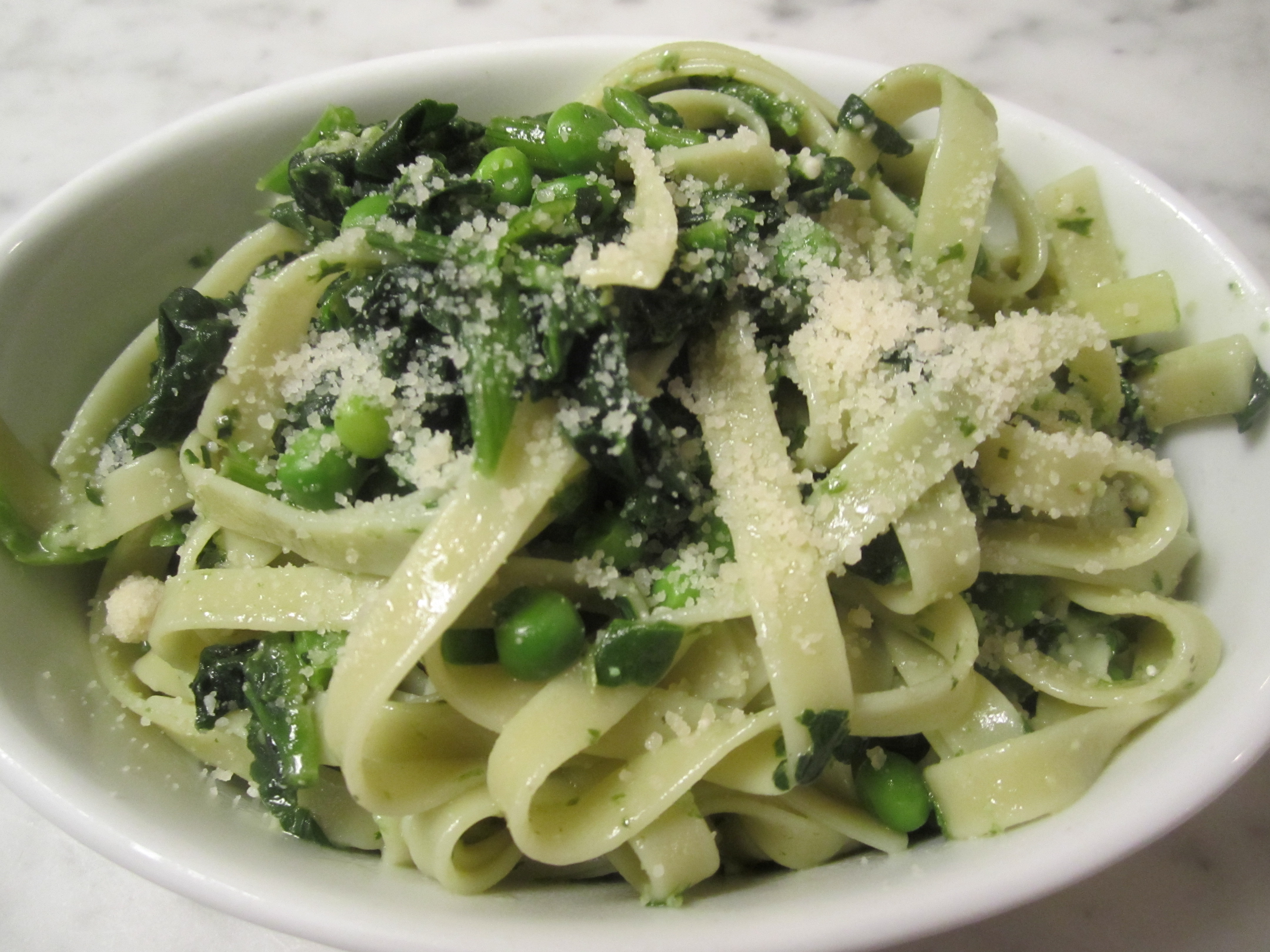
Pasta with Spinach, Pesto and Peas

As I mentioned in my last post, large, curly spinach leaves with fat stems are in local markets, and they are the best and tastiest kind of spinach.

We’ve all gotten a bit used to the varieties of spinach that come pre-washed, such as baby spinach, or even the larger spinach leaves that are packaged and triple-washed.

These pre-washed varieties pale in comparison to the large curly-leafed variety of spinach with stems and even some tiny roots (and lots of soil) attached.  The light green stems are part of the reason–they are the sweetest, most delicate part of the spinach plant.  I’m always perplexed when I see spinach recipes that direct you to strip the leaves from the stems and discard the stems–it’s nothing short of a gastronomic crime.

In addition, many spinach recipes direct the cook to place the raw leaves in a skillet and saute in hot oil or butter.  Although this results in a nice bright green vegetable, I feel it’s better to boil the spinach first, then squeeze thoroughly in small bunches to remove the bitter iron flavor.  This is admittedly much more time-consuming than simply sauteing the raw leaves, but produces a much more elegant dish.

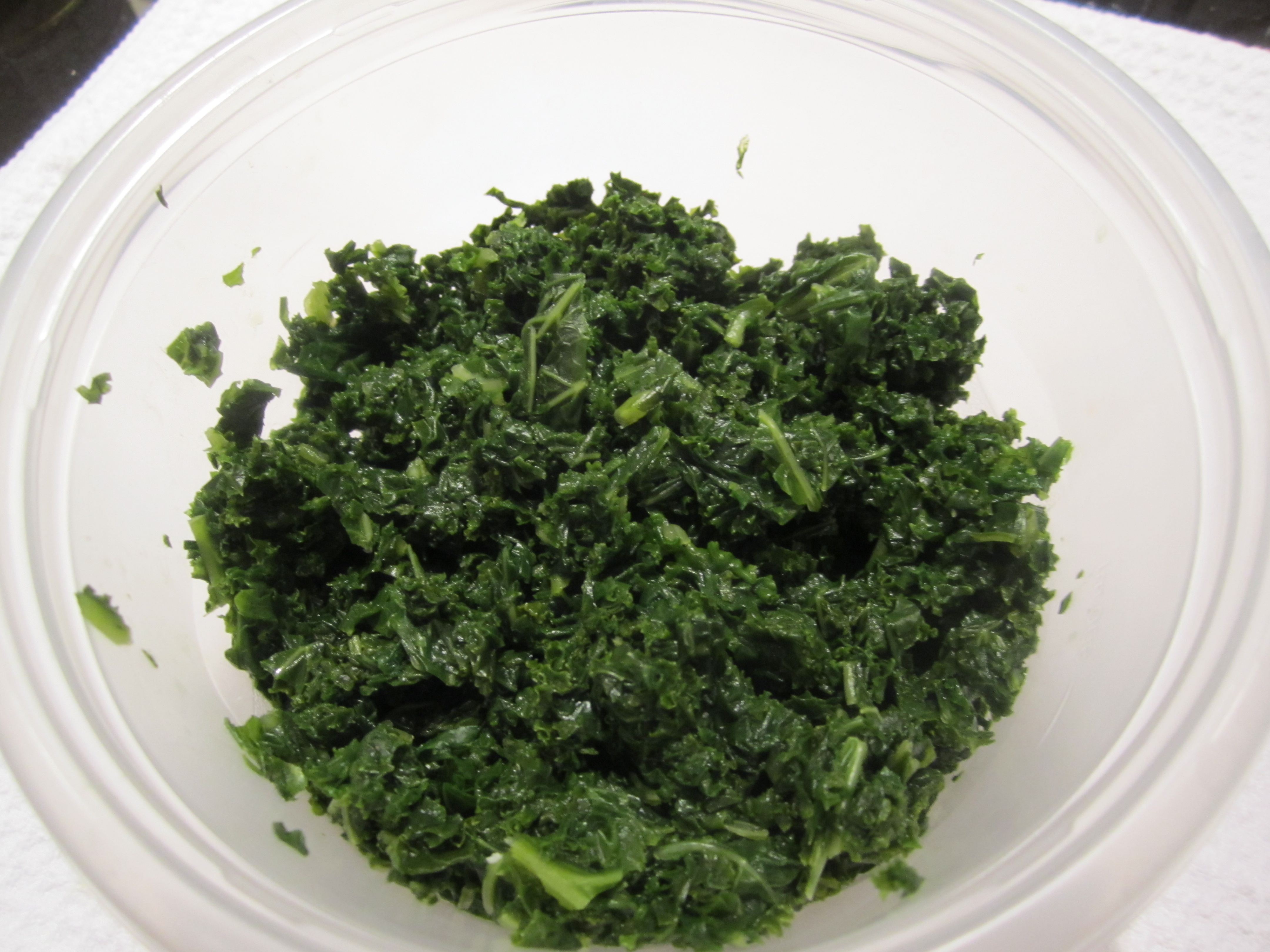
This time of year when spinach and peas are coming into season, I celebrate them in a pasta dish that’s as much vegetable as pasta.  The spinach is first boiled, squeezed, chopped, then sauteed with a bit of butter and broth, then combined with pasta and blanched peas.  A touch of pesto is added for herbal flavor, but not so much as to overpower the star of the dish–spinach.

Tonight, as a second course, I made breaded chicken cutlets, topped with a salad of baby greens and grape tomatoes–crispy, salty and lemony.

Pasta with Spinach, Pesto and Peas

serves 4

1 lb dried fettucine

1 lb fresh spinach (about 2 bundles of large curly leaves with stems)

1/4 c basil pesto (see Pasta with Shrimp and Pesto)

4 tbls butter

1 c peas, fresh or frozen

1/2 c chicken broth

salt and pepper to taste

plenty of grated parmigiano for sprinkling

Wash spinach in 3 or 4 changes of water in a deep bowl, large enough to allow the leaves to float on the surface of the water while the soil falls to the bottom.  The number of washes is determined by whether there is still soil remaining on the bottom of the bowl when you empty the water after each successive wash.  My spinach took 5 full washes until there was no soil left in the bottom of the bowl.

Drop into boiling salted water only long enough for the water to return to the boil.
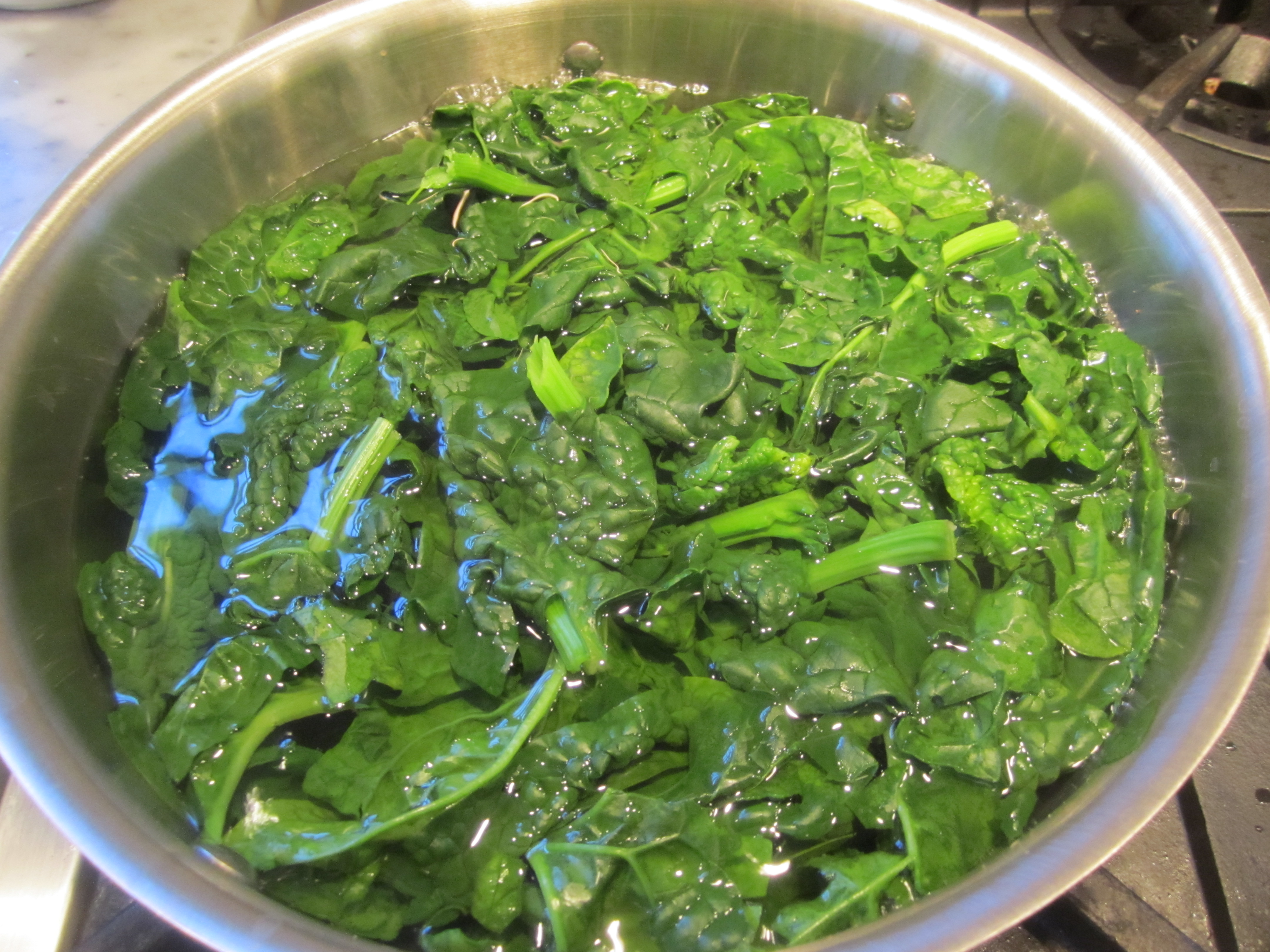
Drain, refresh in cold water, then squeeze in small bundles until there is no more liquid left.
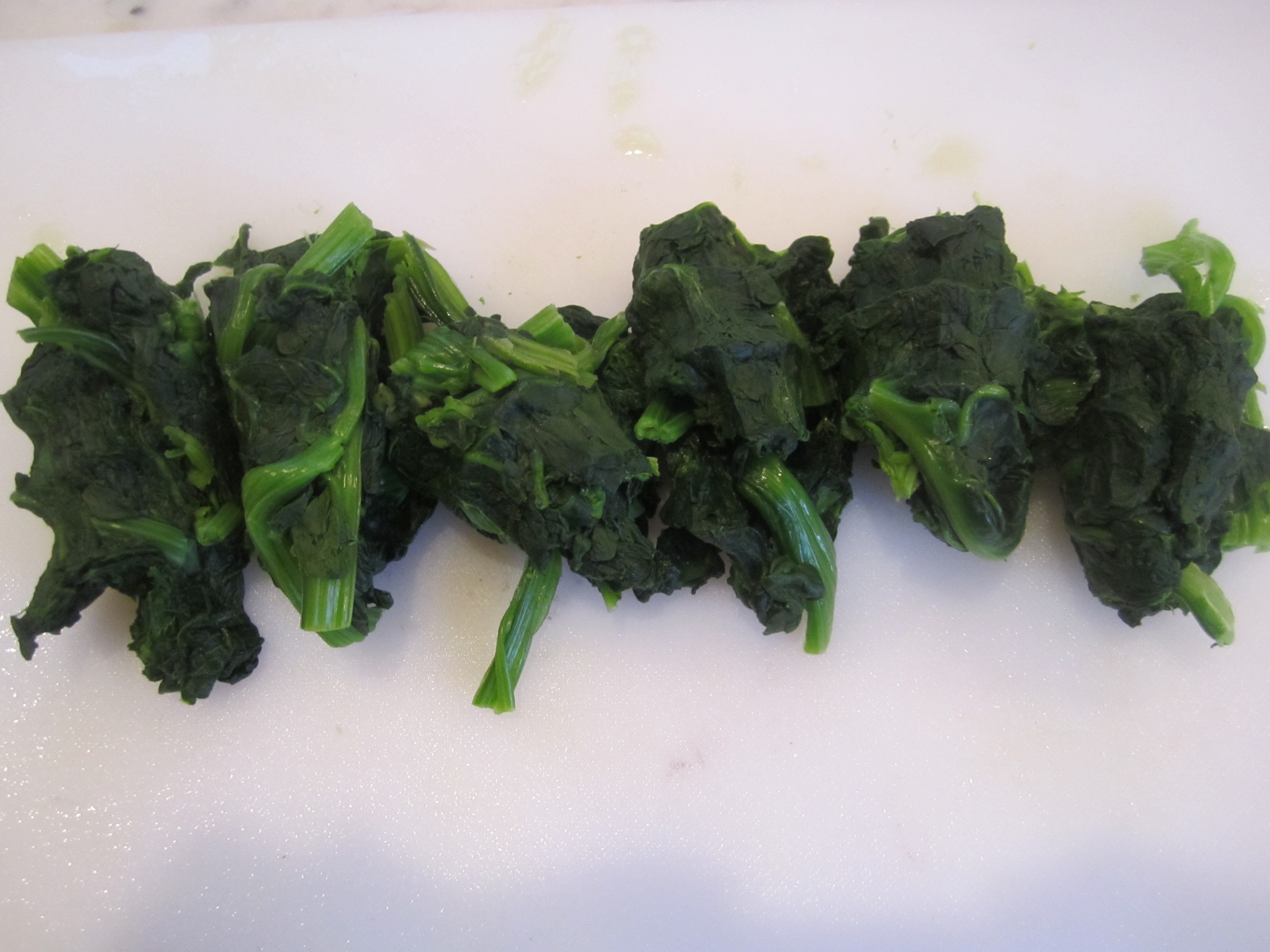
Spread the bundles with fingers, so that the leaves are free, loose, and no longer in clumps.  Then give it a rough chop in both directions, to break down any extra-large leaves or stems.
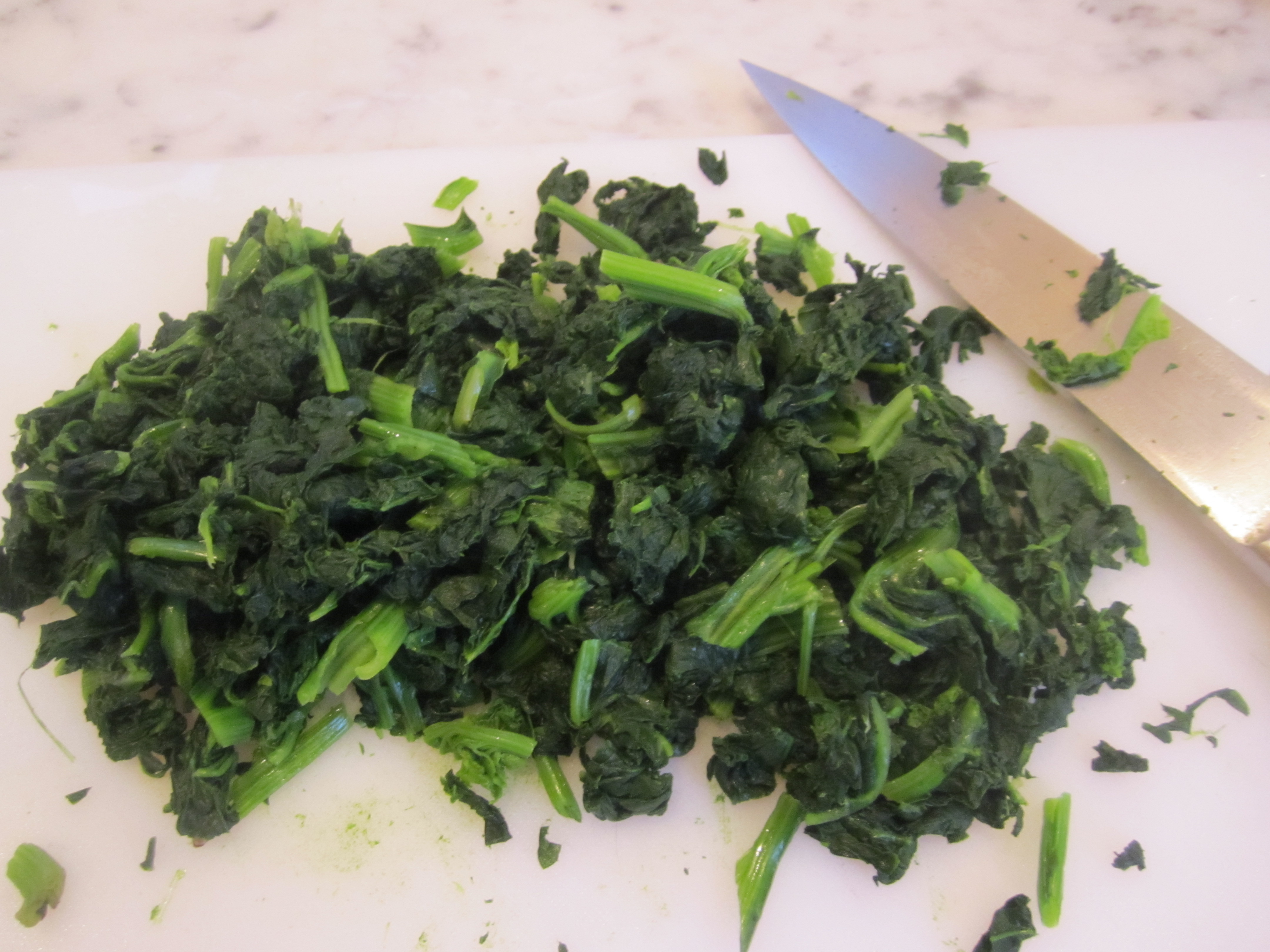
While pasta boils, Melt butter in large skillet and add spinach.  Saute for 2 or 3 minutes on high heat.
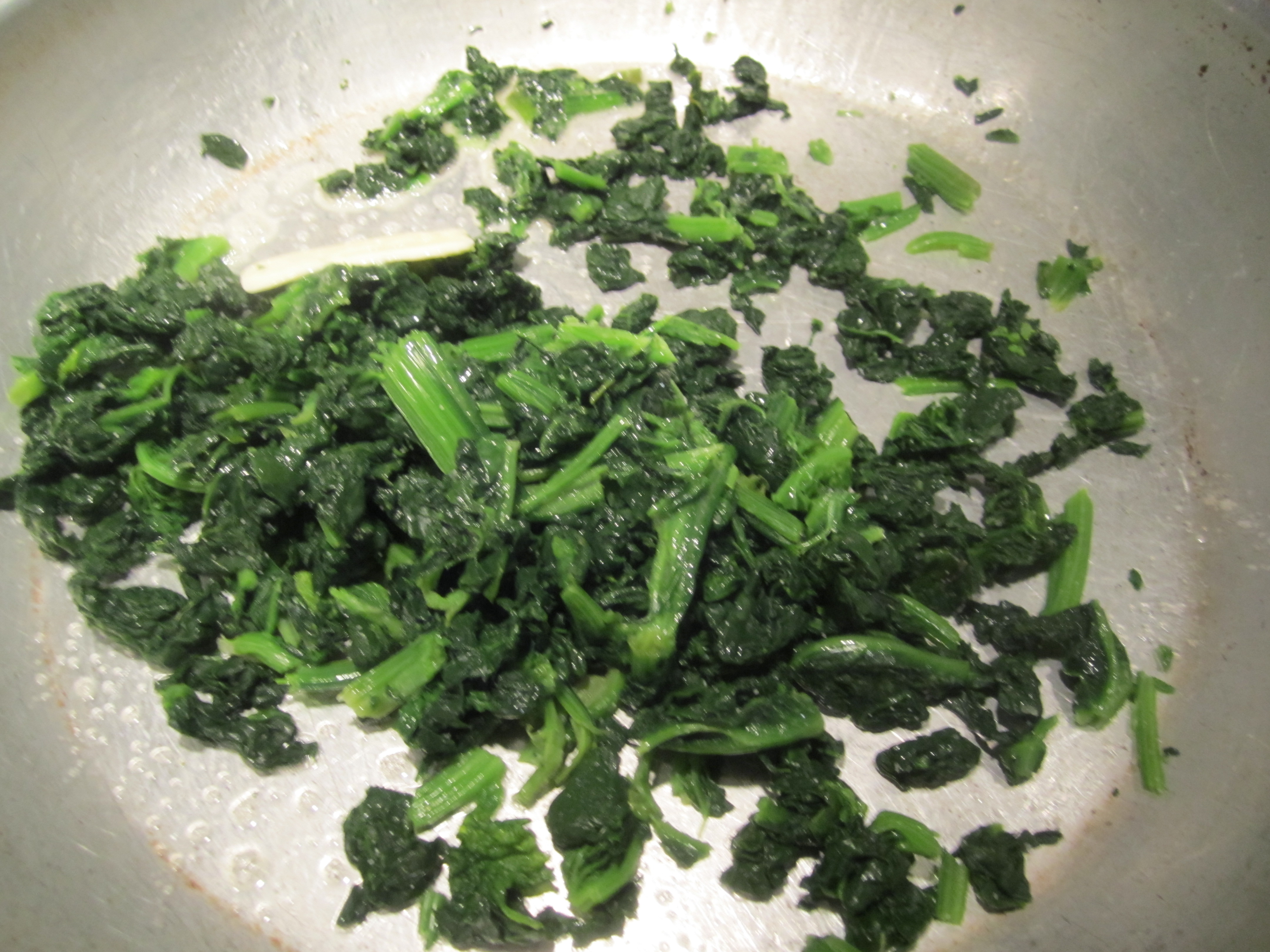
Add broth and reduce heat until pasta is cooked.

30 seconds before pasta is cooked, add peas to the boiling water.  Remove pasta and peas from boiling water and place in the skillet with spinach.

Turn off heat and add pesto.
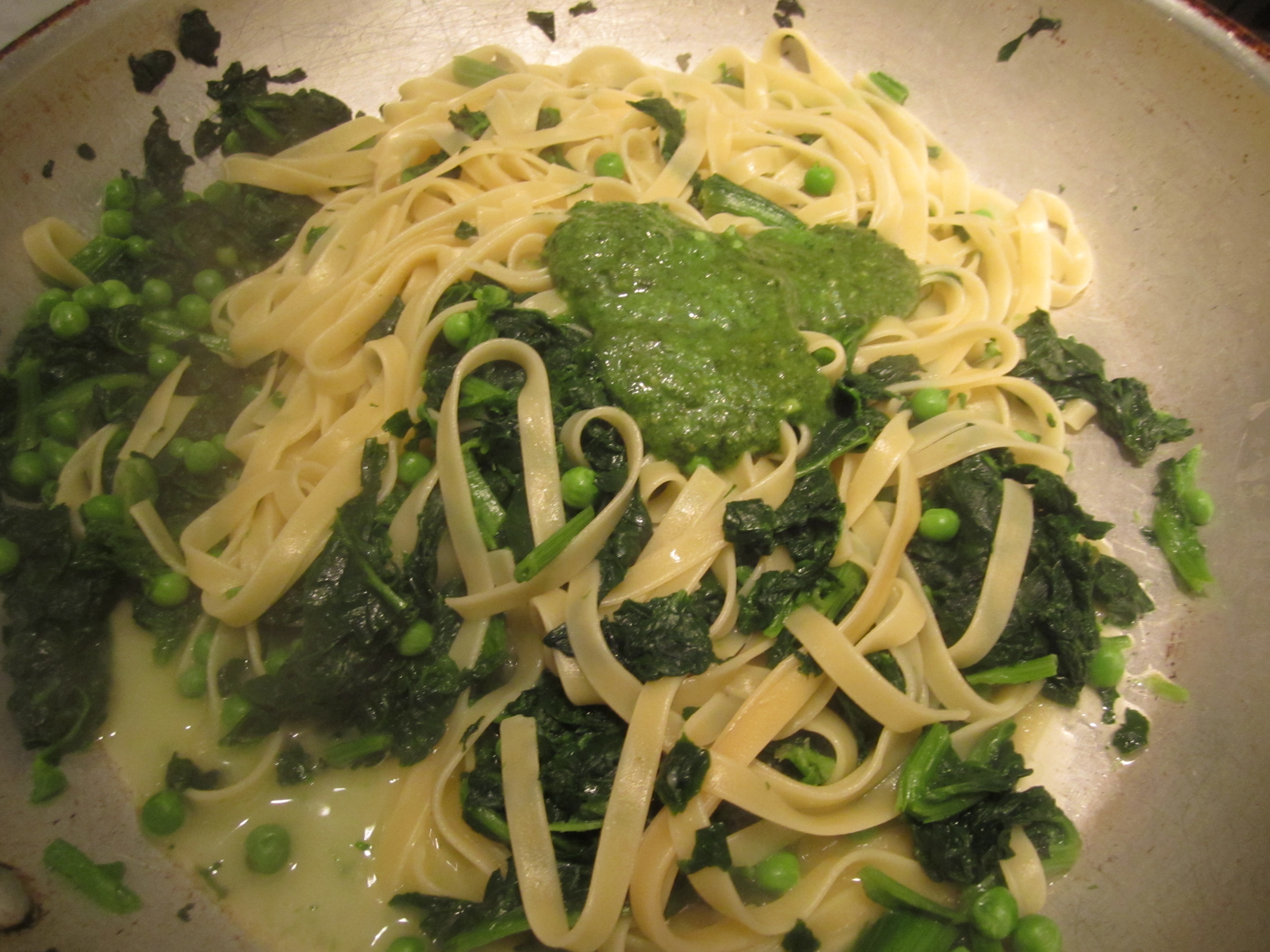
Mix and place in heated pasta bowls.  Sprinkle with plenty of grated parmigiano.
Posted in Pasta | Leave a comment

Pasta with Asparagus, Goat Cheese and Sage Butter

Yesterday I made a special trip to a farm stand about a half-hour away which is always first to open and the last to close every year (closing day is New Years’ Eve).  I was planning dinner for guests and I needed some inspiration.

I bought whatever was local and looked good.  Spinach, asparagus, leeks and fava beans (not local) looked terrific–all were oversized and bursting with green goodness. I decided to plan my meal around these four items.

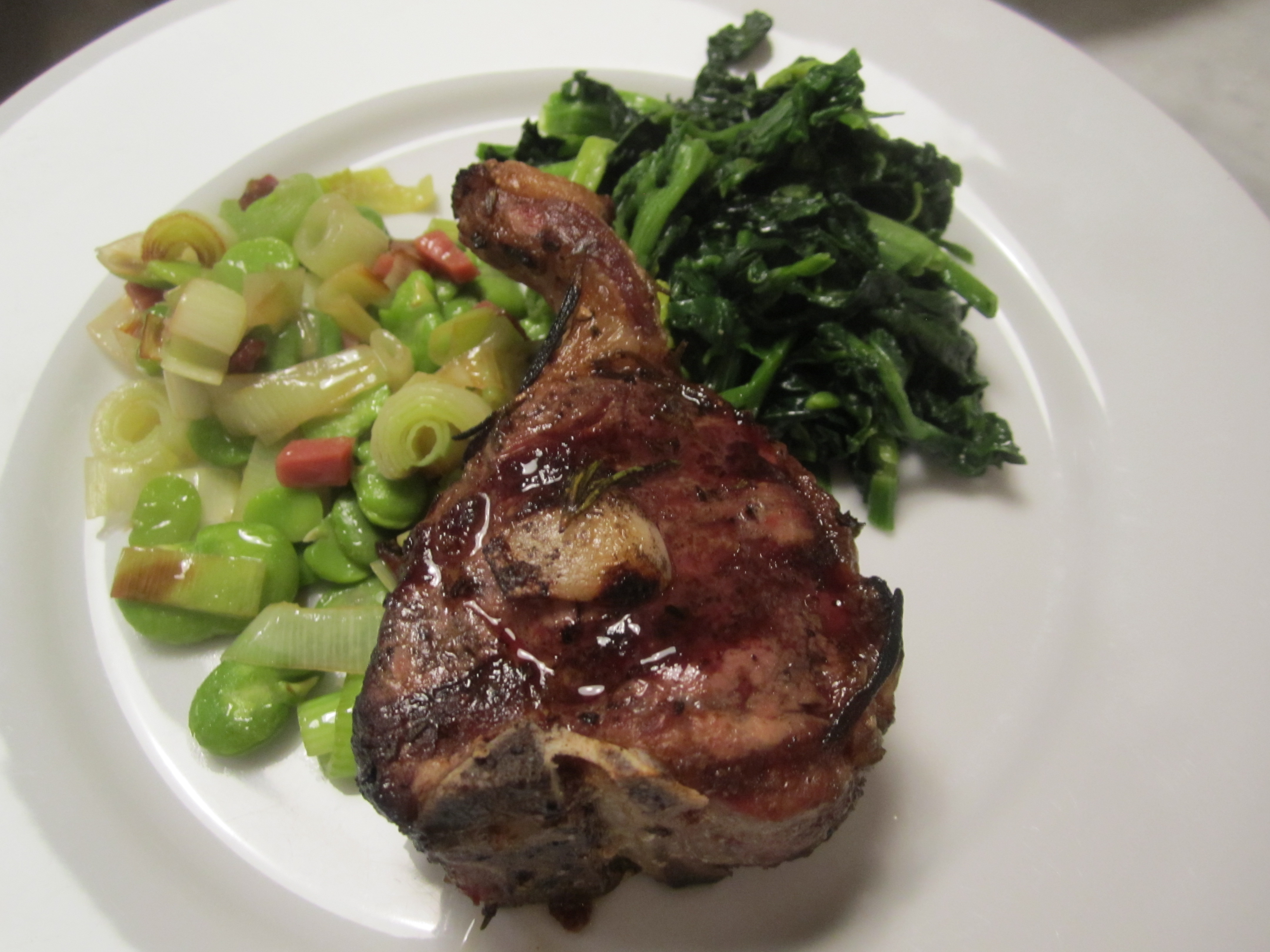
I didn’t have any time to prepare a stew or a braise the day before, so as a main course, I decided to serve simple grilled lamb loin chops (see Perfect Grilled Lamb Loin Chops), accompanied by sauteed spinach and fava beans.

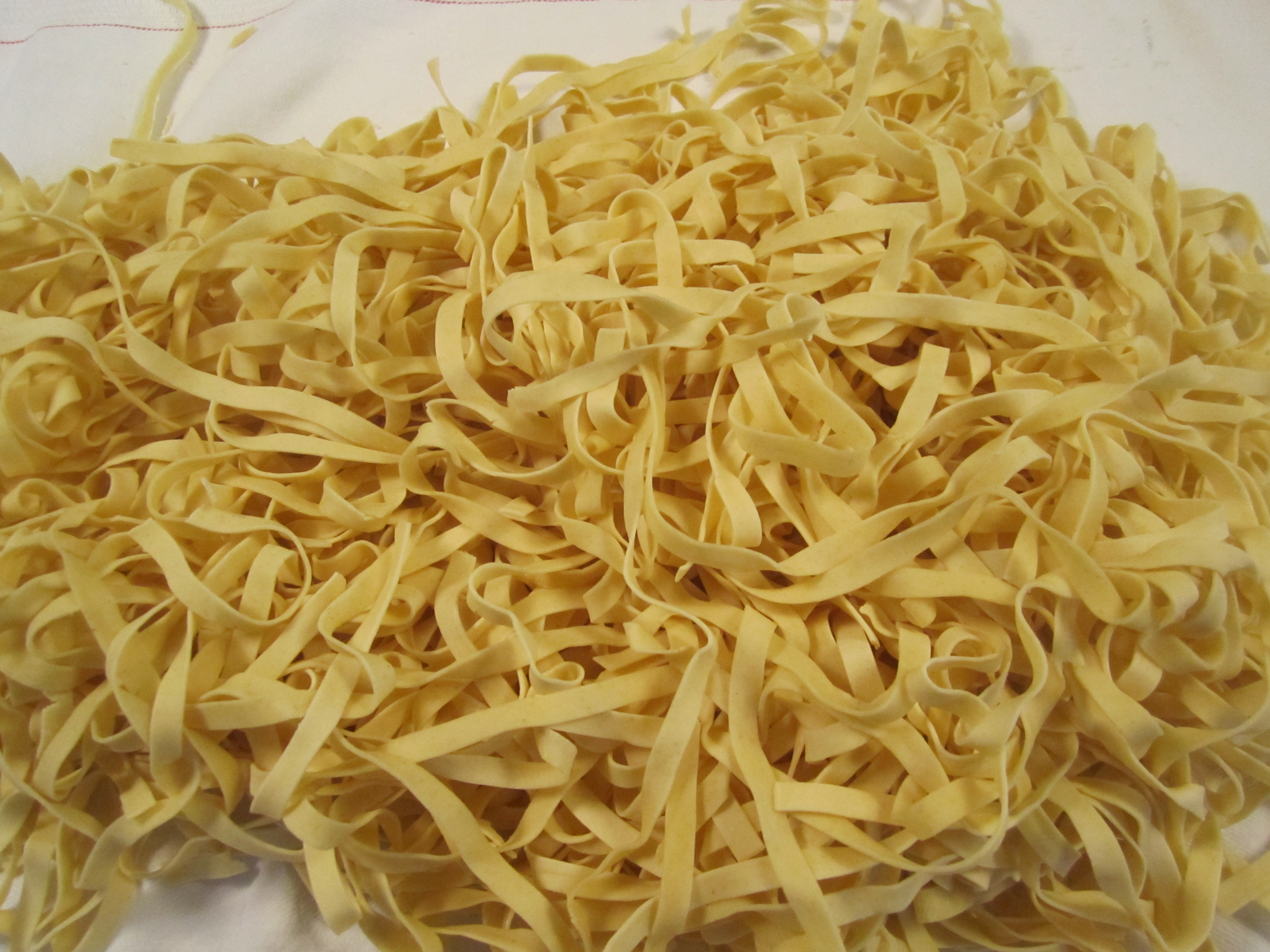
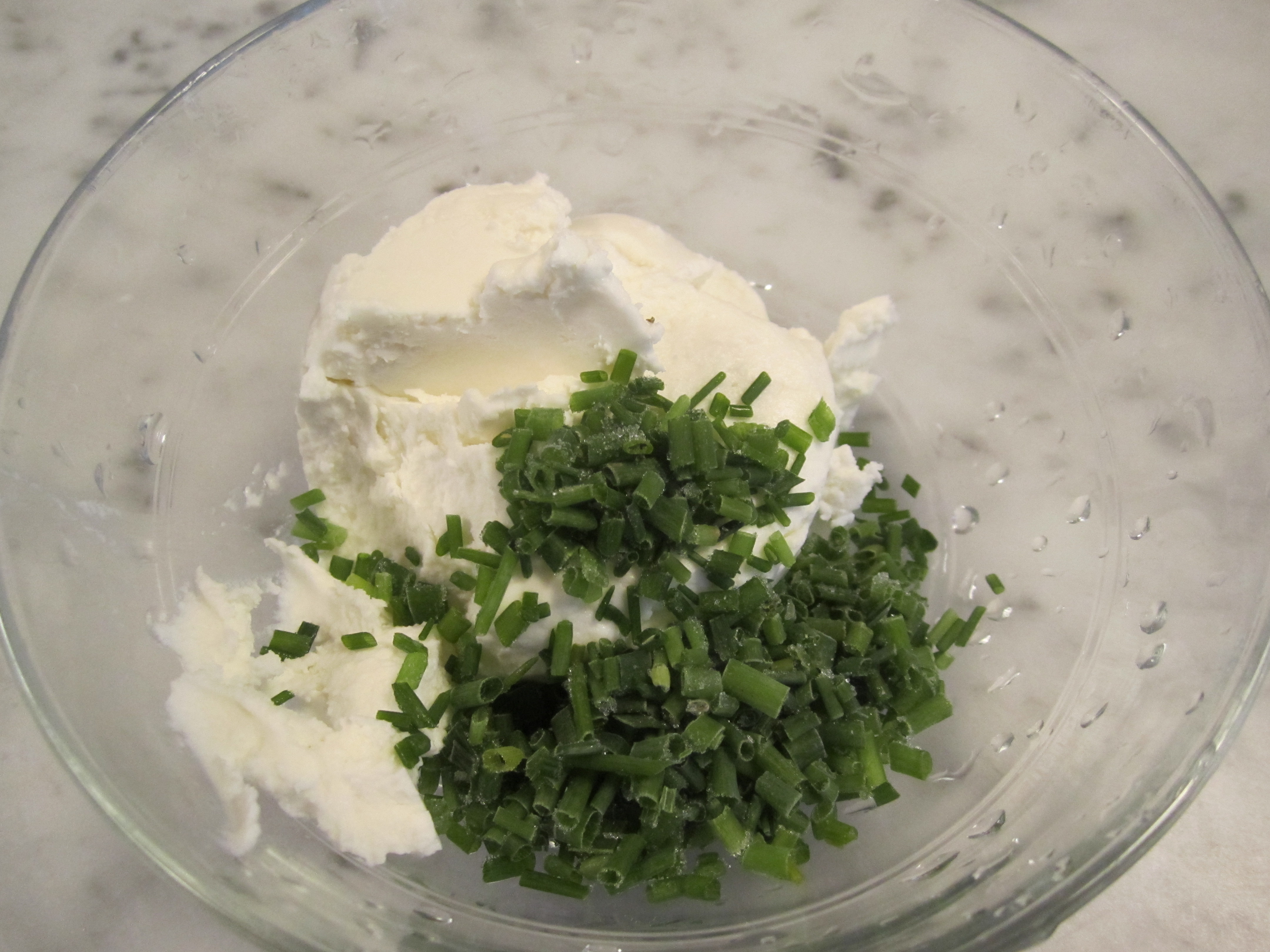
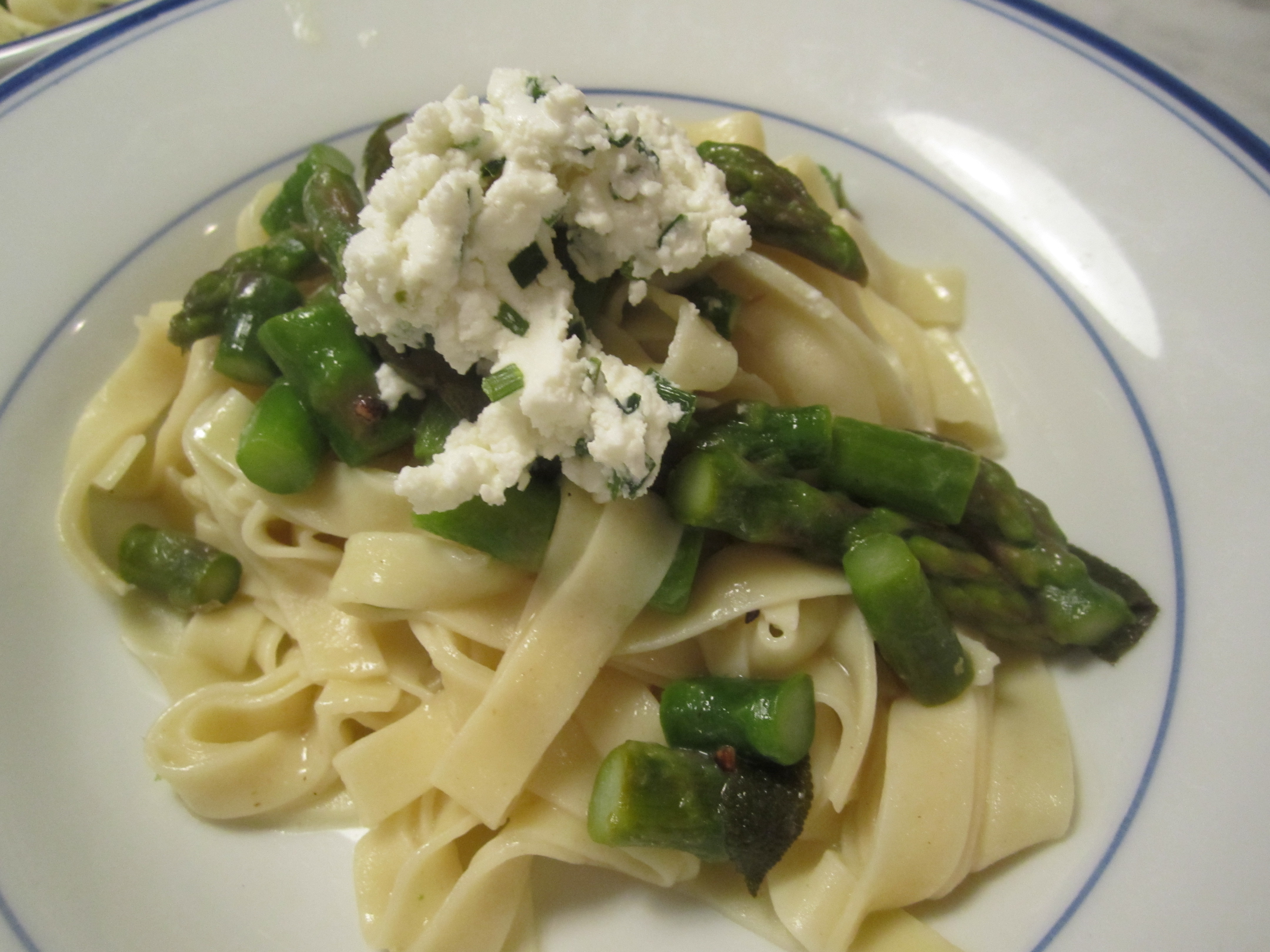
As a first course, I toyed with the idea of making goat cheese and asparagus ravioli–a very involved affair which would have been fun but taken all afternoon to accomplish.  Instead, I decided on an abbreviated, deconstructed version of the same ravioli–fresh egg fettucine, tossed with asparagus, sage butter, and topped with a dollop of fresh goat cheese blended with chives.

This shortcut allowed me to enjoy my afternoon and prep the entire meal at (relatively) the last minute (about 2 hours prior to the arrival of guests).   At that time, I blanched, squeezed and chopped the spinach, cleaned and sliced the leeks, blanched and diced the asparagus, and shucked and peeled the fava beans (with the aid of a willing helper).

That provided me with the mise en place to finish preparing the meal when my guests arrived.  When they arrived, I simply boiled and assembled the pasta, and seared the lamb chops on the grill.  When the lamb chops were finished searing, they went into the oven, at which time we sat down and enjoyed our pasta.  When we were finished the pasta, the chops came out of the oven to rest.

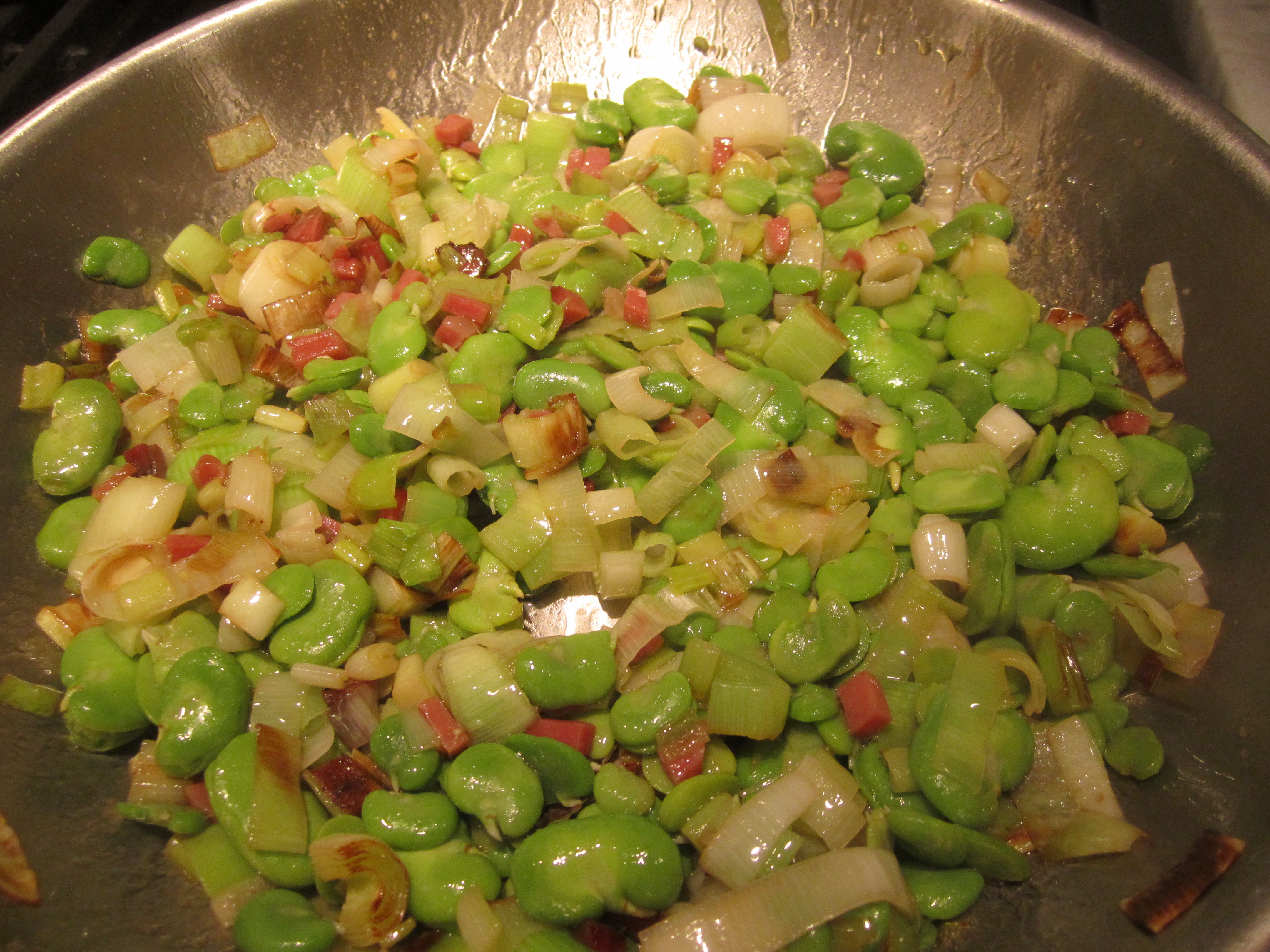
While they rested, I prepared the vegetables.  The spinach was sauteed in some butter and chicken broth.  The fava beans were sauteed with some diced Italian speck (pancetta or bacon would do just fine) and leeks.

The meal was beautiful and fairly effortless, thanks to advanced planning of the exact timing and sequence of preparation.

Tonight I had a table of very sophisticated palettes and they were truly appreciative of every detail–the ultimate pleasure for a cook!

Pasta wth Asparagus, Goat Cheese and Sage Butter

serves 6

1 1/2 lbs fresh egg fettucine

2 lbs. asparagus

12 tbls butter

6 sage leave, torn in half

8 oz. fresh goat cheese

2 tbls fresh chives

1 c chicken broth

plenty of grated parmigiano for sprinkling

salt and pepper to taste

In a large pot of boiling salted water, drop in asparagus spears and blanch for 1 1/2 minutes.  Remove and shock in cold water.  Cut into 1″ pieces and set aside.

In a bowl, combine goat cheese and chives and set aside.

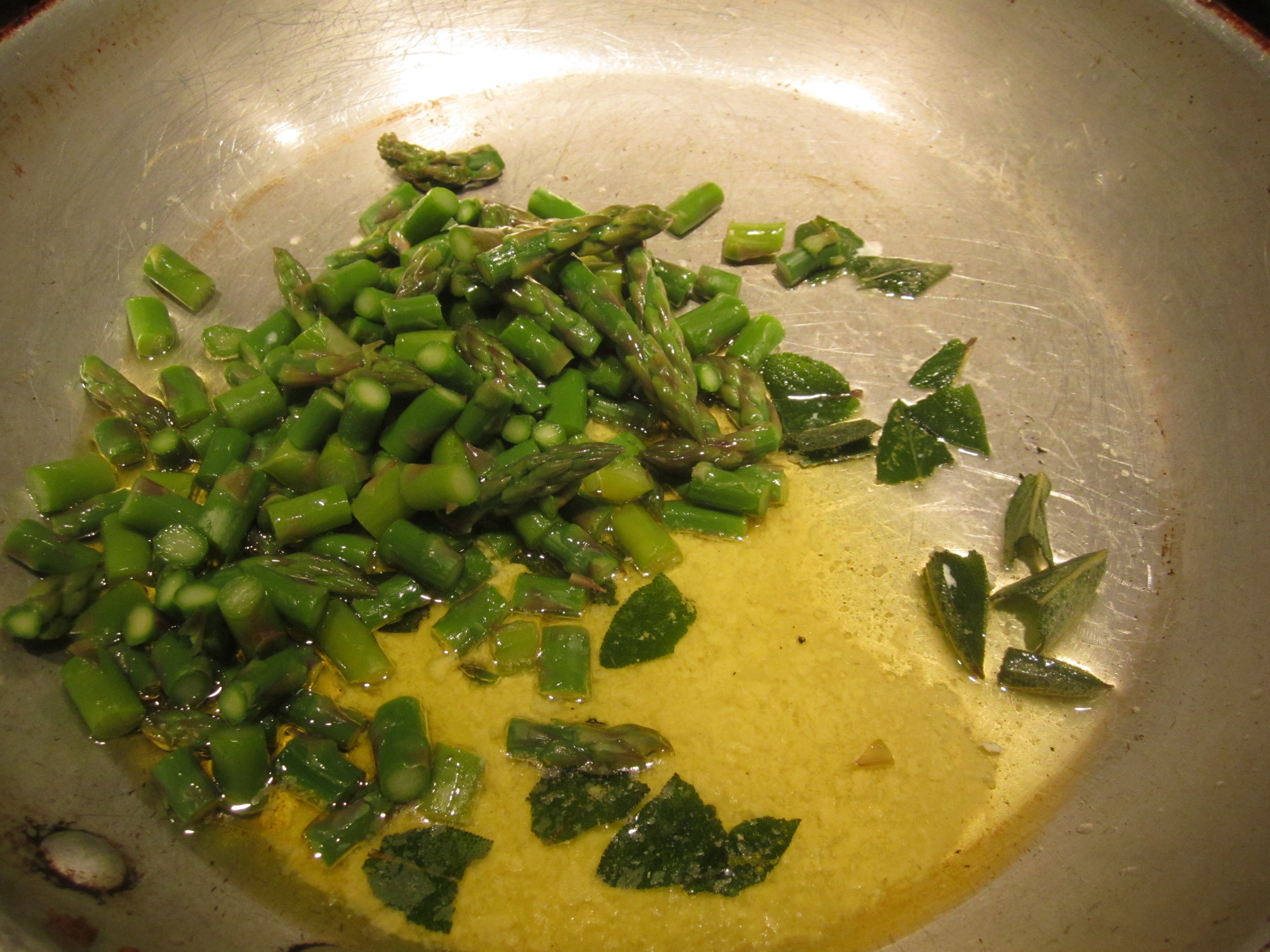
While pasta boils, gently steep the sage leaves in butter on lowest of heat for about 2 minutes.  Turn heat to high and saute asparagus.

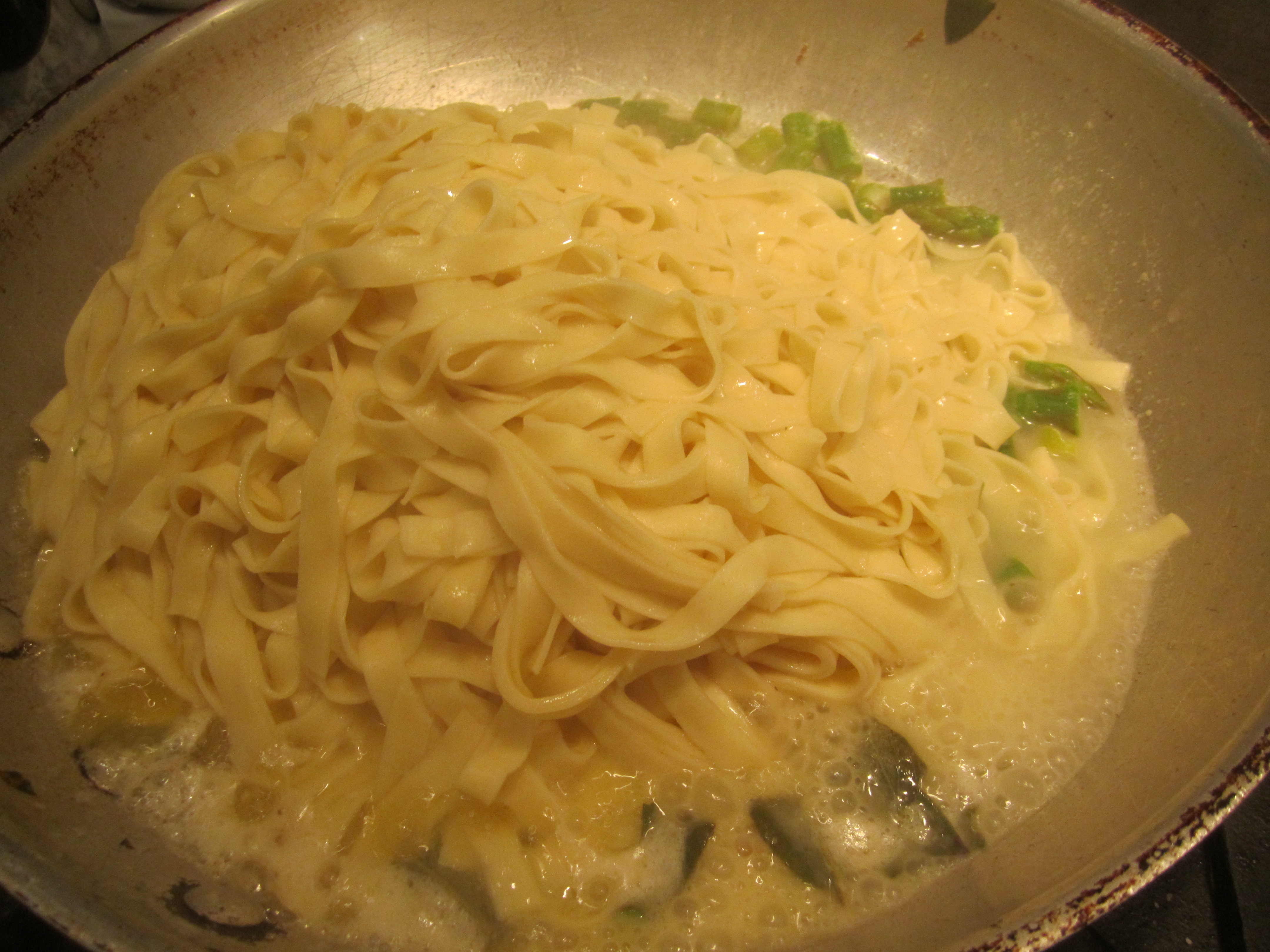
When pasta is cooked (fresh pasta only takes 2 – 3 minutes to cook),  add pasta, along with the broth and some pasta cooking liquid.  Toss and add salt and pepper, if necessary.

Serve in warmed bowls with plenty of grated parmigiano on the side.

Posted in Pasta | Leave a comment

Veal Meatballs in Mushroom Sauce

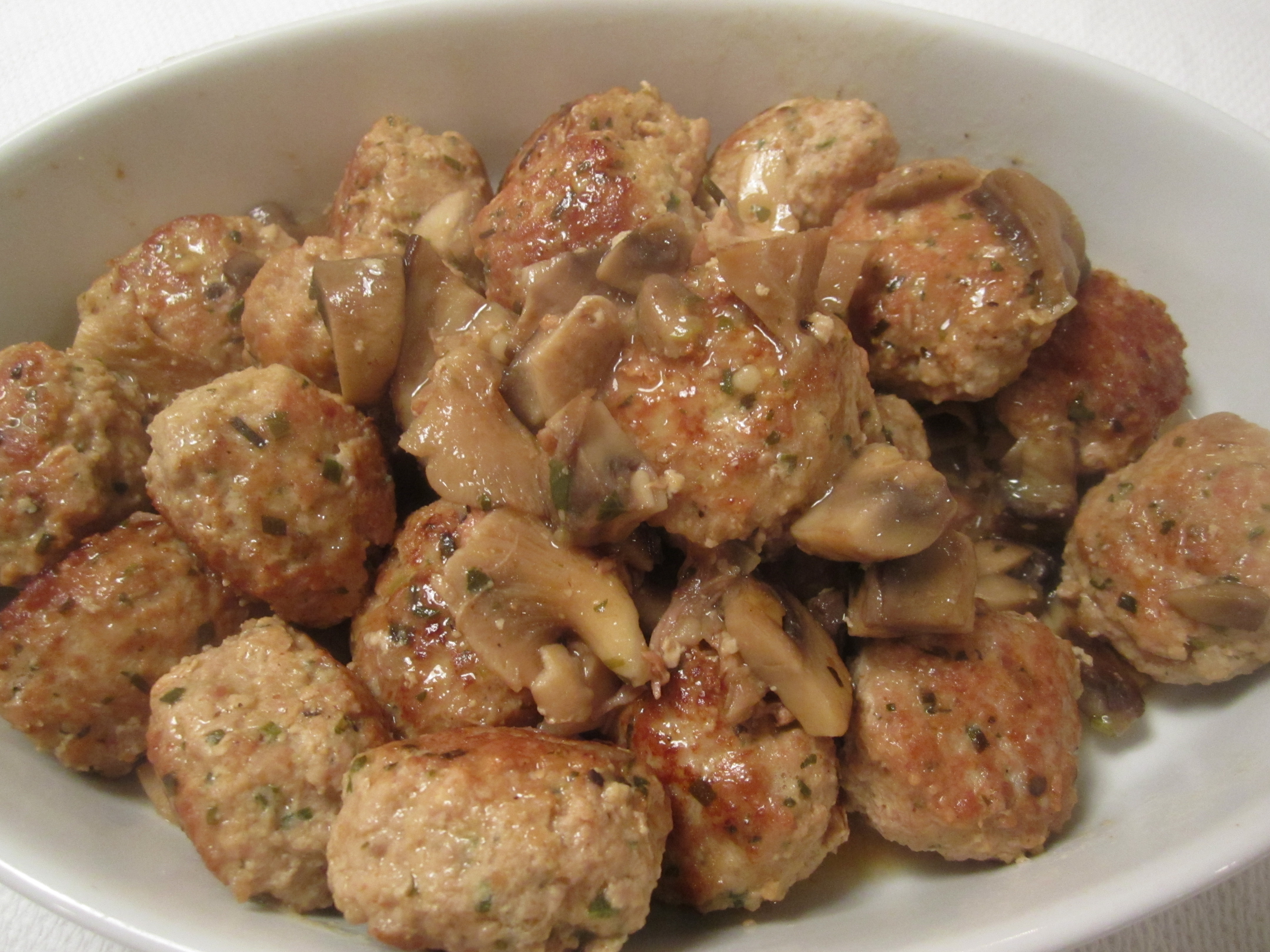
These meatballs have a light and decidedly Northern touch, with their seasoning of parsley, chives, nutmeg, parmigiano and broth-soaked breadcrumbs.  The sauce is an equally refined composition of shallots, mushrooms, white wine and broth.

Preparation time for these meatballs is quick–a half-hour at the most.  Start the sauce, then set it aside to simmer on lowest heat, then mix and form the meatballs.  As the meatballs brown, they can be dropped into the sauce to poach for about fifteen minutes (or longer, if need be).

The beauty of meatballs is that they can be reheated in their sauce at the last moment, making them the ideal party dish–leaving you free to concentrate on making the pasta–which takes more concentration than people think (stir often and don’t overcook or undercook).

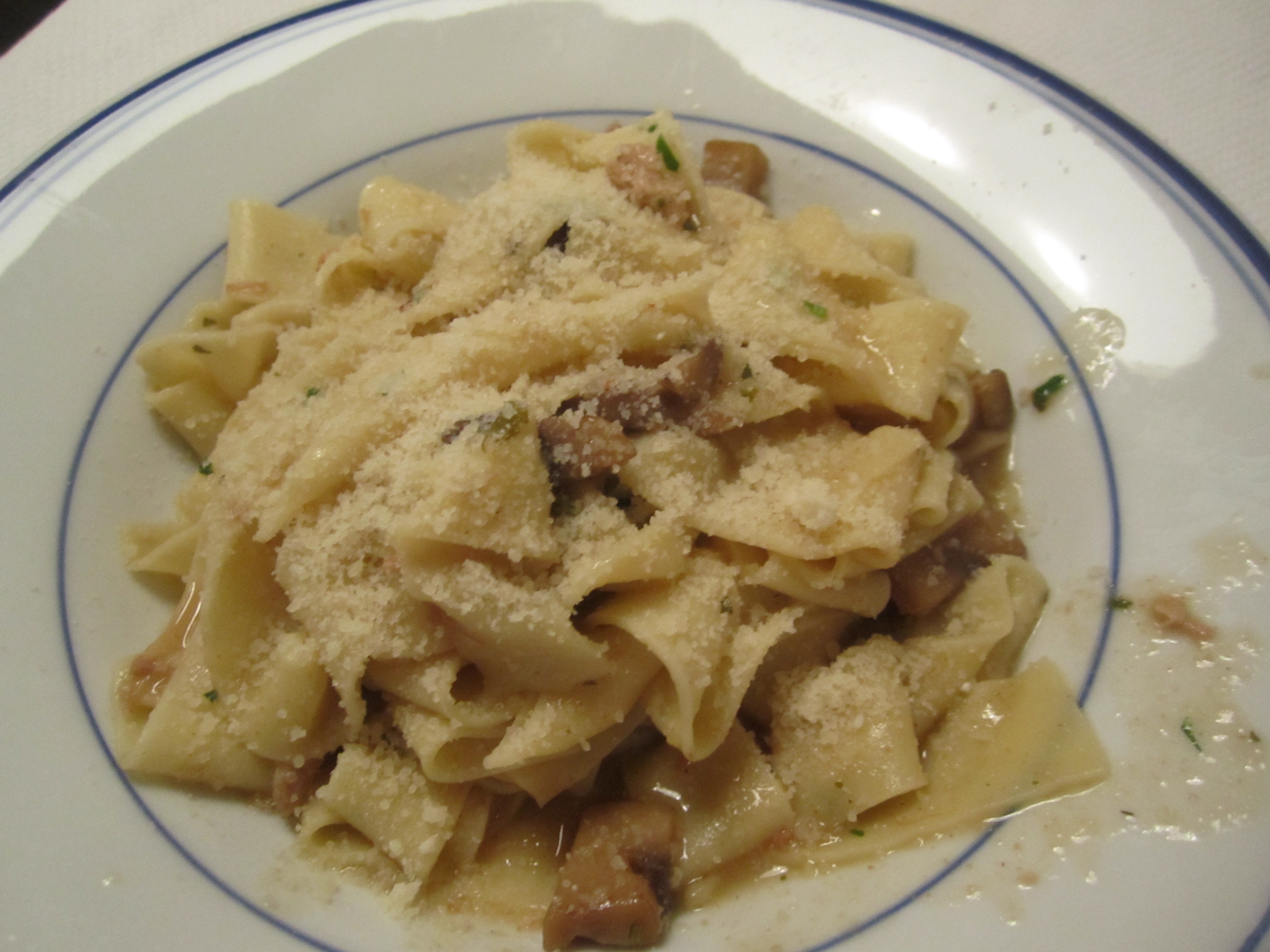
Tonight, as a first course, we had fresh egg pappardelle–always a treat, dressed with the mushroom sauce and lots of grated parmigiano sprinkled on top.

As a second course, I served the meatballs, along with sauteed kale.

Veal Meatballs in Mushroom Sauce

serves 4 – 6

1  1/2  lb ground veal

3 thick slices of country-style white bread

2  c chicken broth

2 tbls fresh chopped parsley

2 tbls fresh chopped chives

1/4 tsp nutmeg

6 tbls grated parmigiano

2 eggs

1 tsp salt

1/2 tsp black pepper

1/4 c olive oil, for pan-frying

mushroom sauce (below)

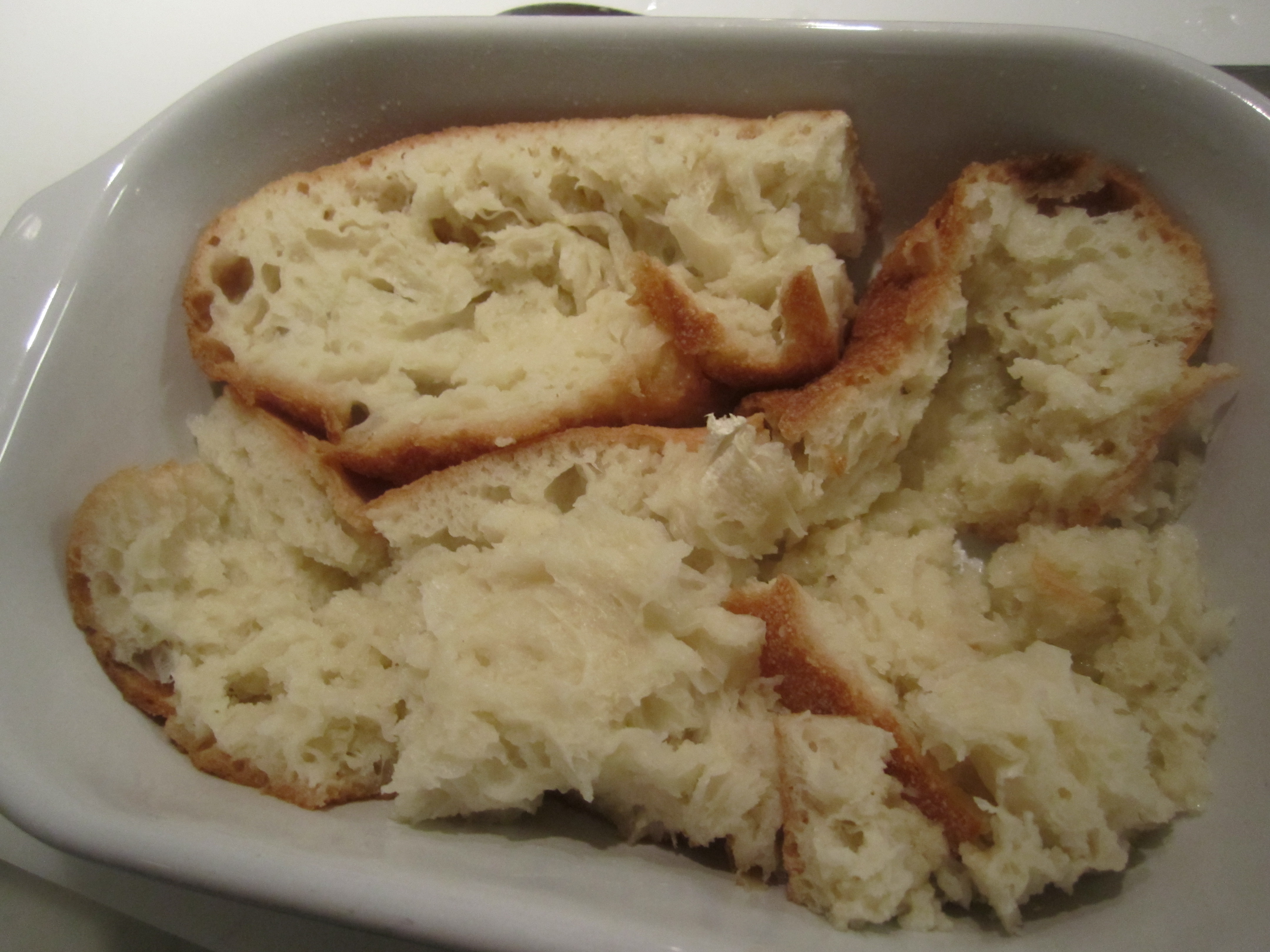
Arrange bread cubes in a baking dish and pour hot broth over them.  Let them absorb the broth for about 10 minutes.

Process soaked bread in the food processor until it reaches the consistency of mush.

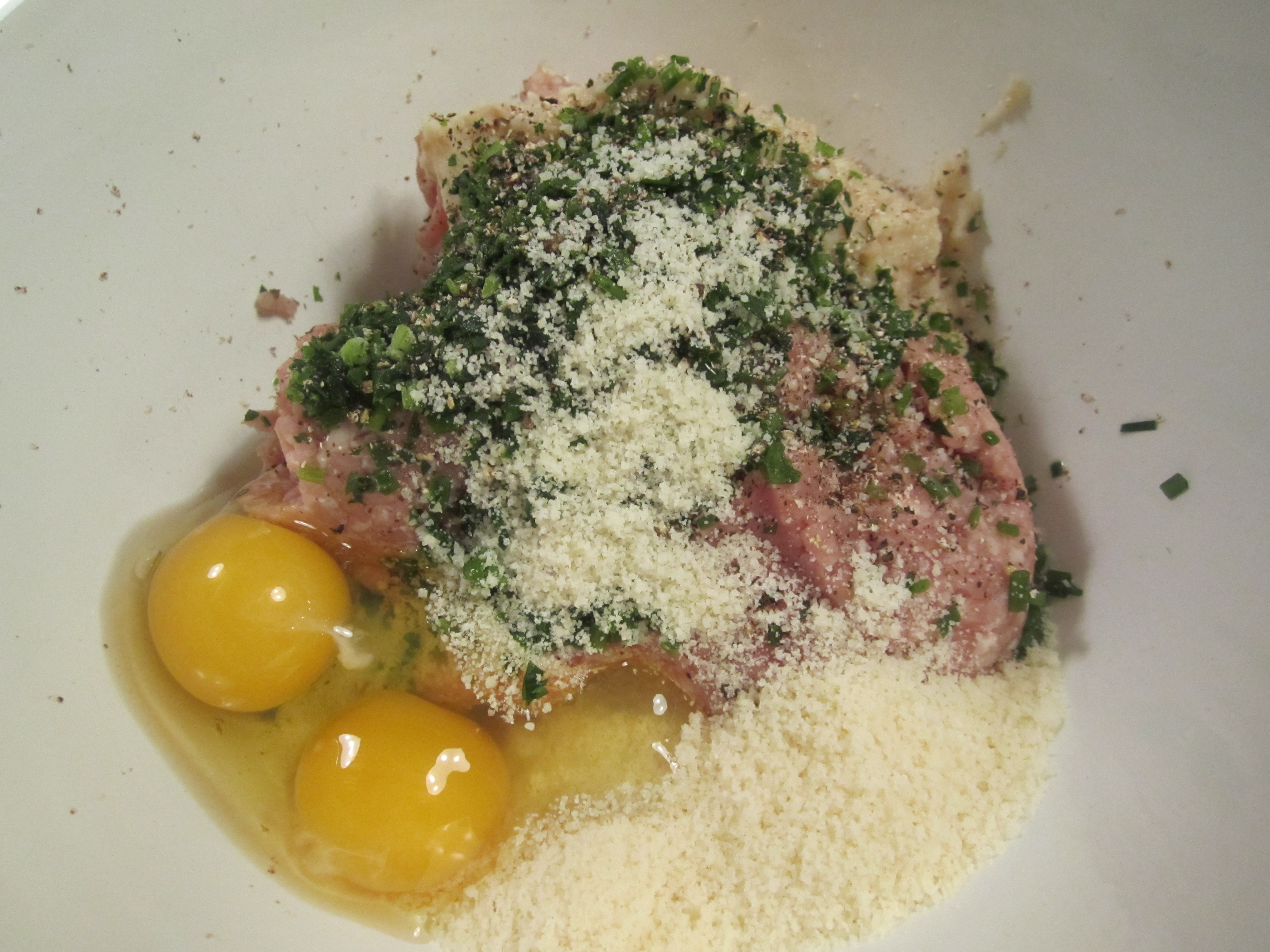
In a mixing bowl, combine veal, bread puree, cheese, herbs, eggs, salt, nutmeg and pepper.

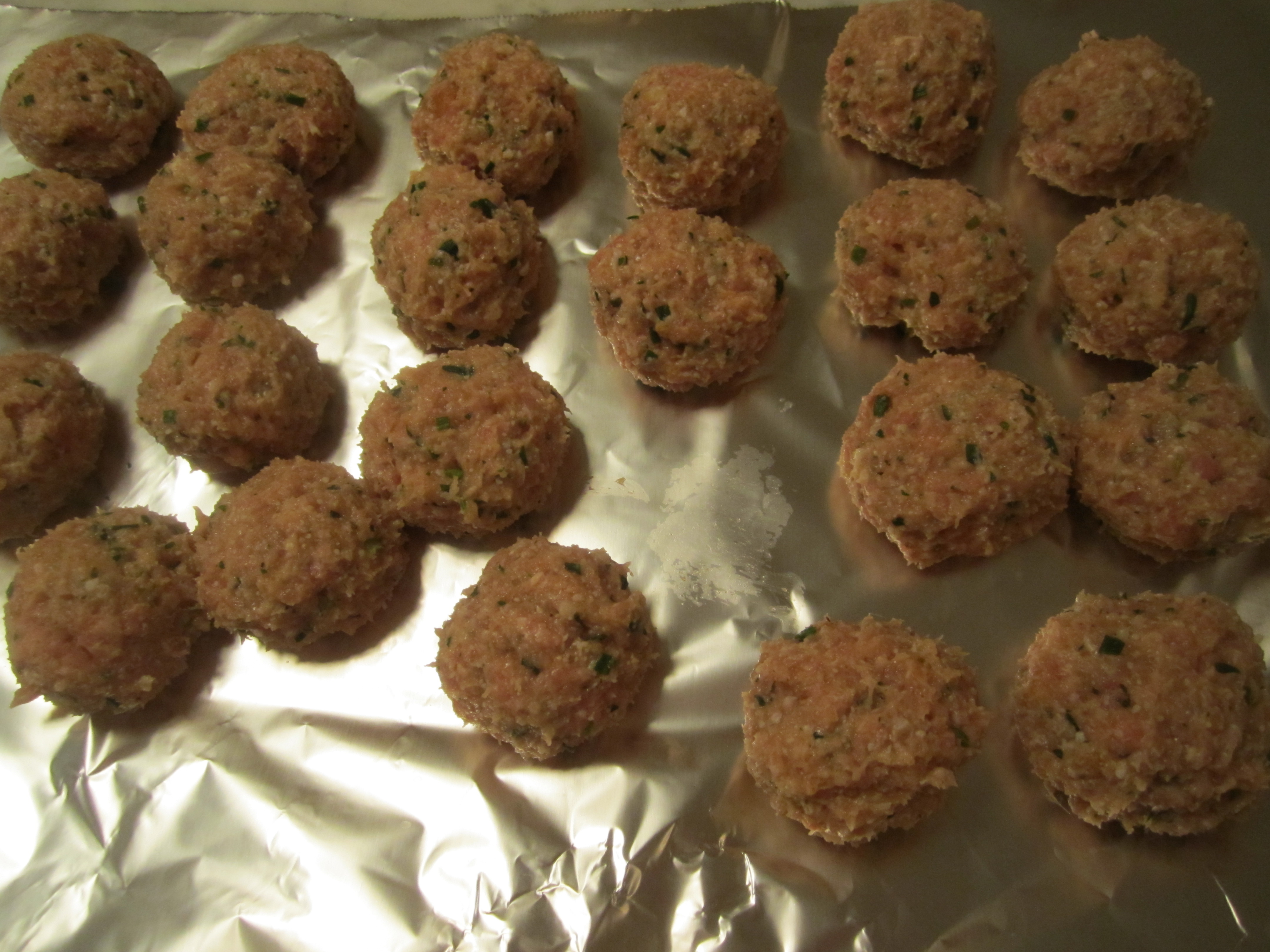
 Mix gently to combine with hands or a fork.  Form into 1 1/2″ balls and set aside.

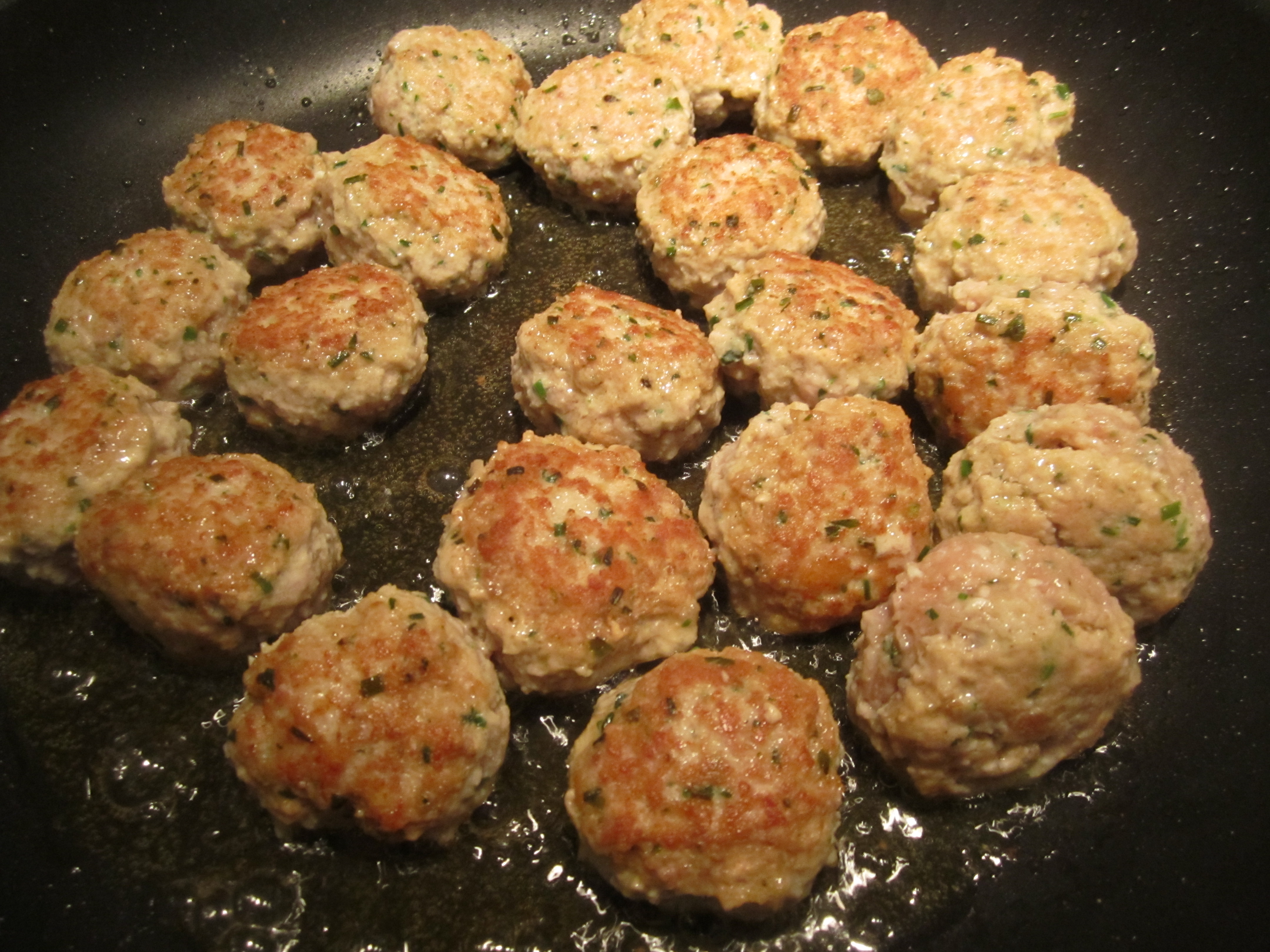
In a broad skillet, brown in olive oil, gently turning often, to assure even brownness all around.

As they become golden brown on all sides, drop into mushroom sauce and simmer on low heat for about 15 minutes.

Mushroom Sauce

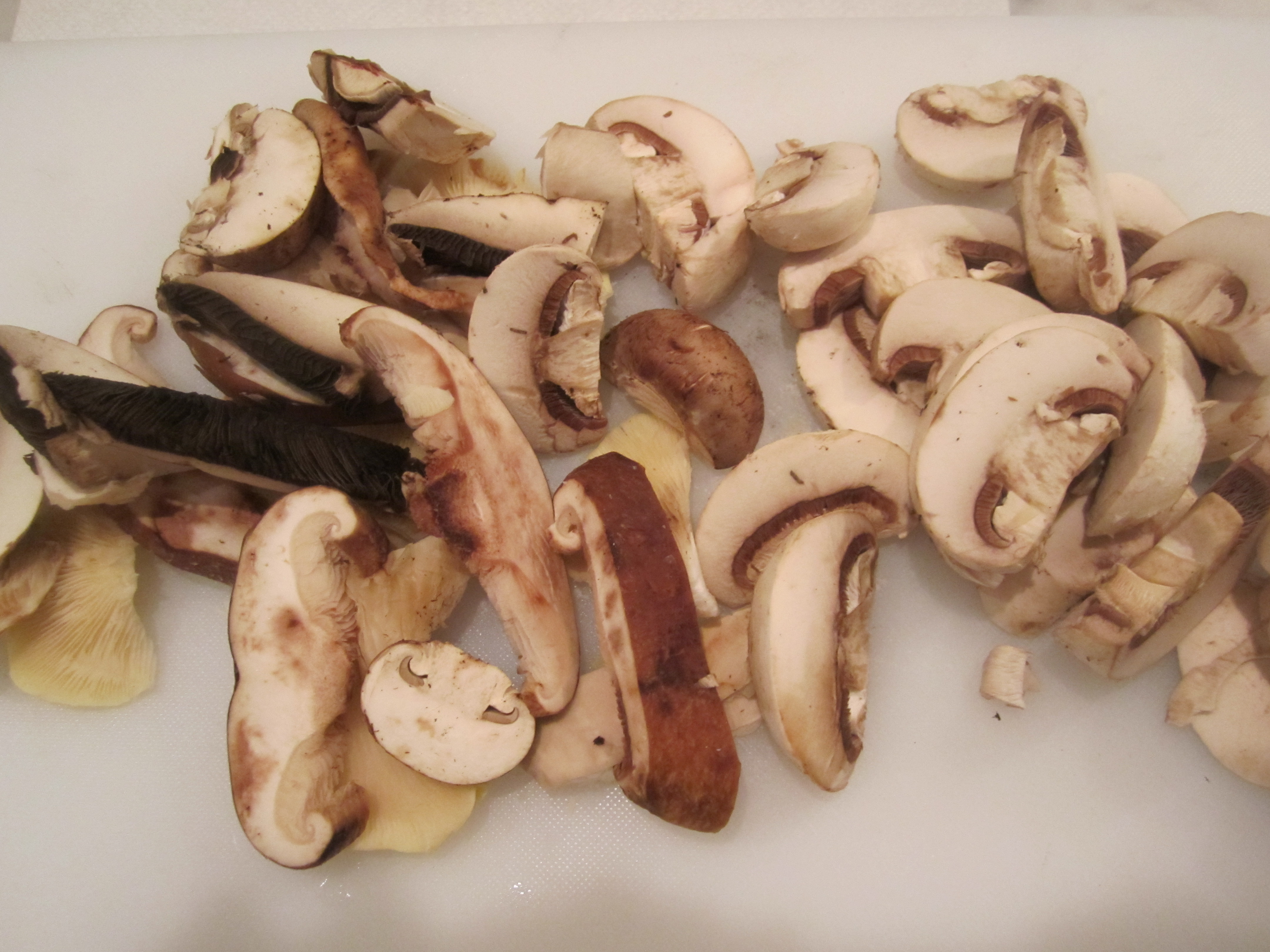
1 lb mixed white and wild mushrooms, diced into roughly 1/2″ pieces

1 small shallot, finely diced

4 tbls butter

1 1/2  tbls flour

1/2 c white wine

1  1/2 c chicken broth

1 tbl fresh chopped parsley

salt and pepper to taste

In a large skillet on high heat, brown mushrooms and shallot for about 5 minutes, or until golden.  Add wine and flour, stir and reduce for a minute or so.

Lower heat and add chicken broth.  Transfer to narrower, higher-sided pot in order to  poach the meatballs.

Taste and add salt and pepper.

Simmer for another 5 minutes or so.

Posted in Meat | Leave a comment

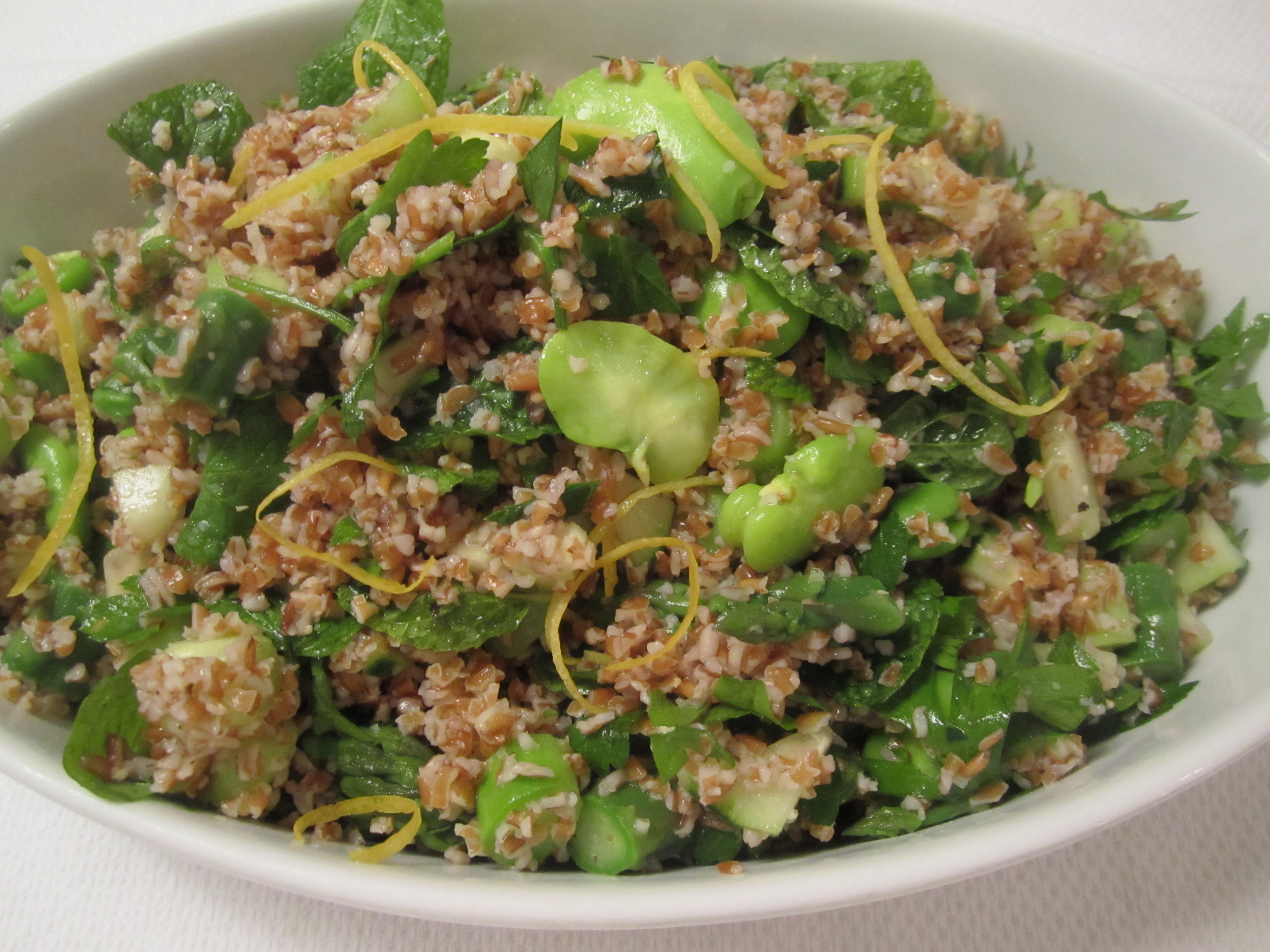
Italian-Ate Bulgur Wheat Salad with Spring Vegetables

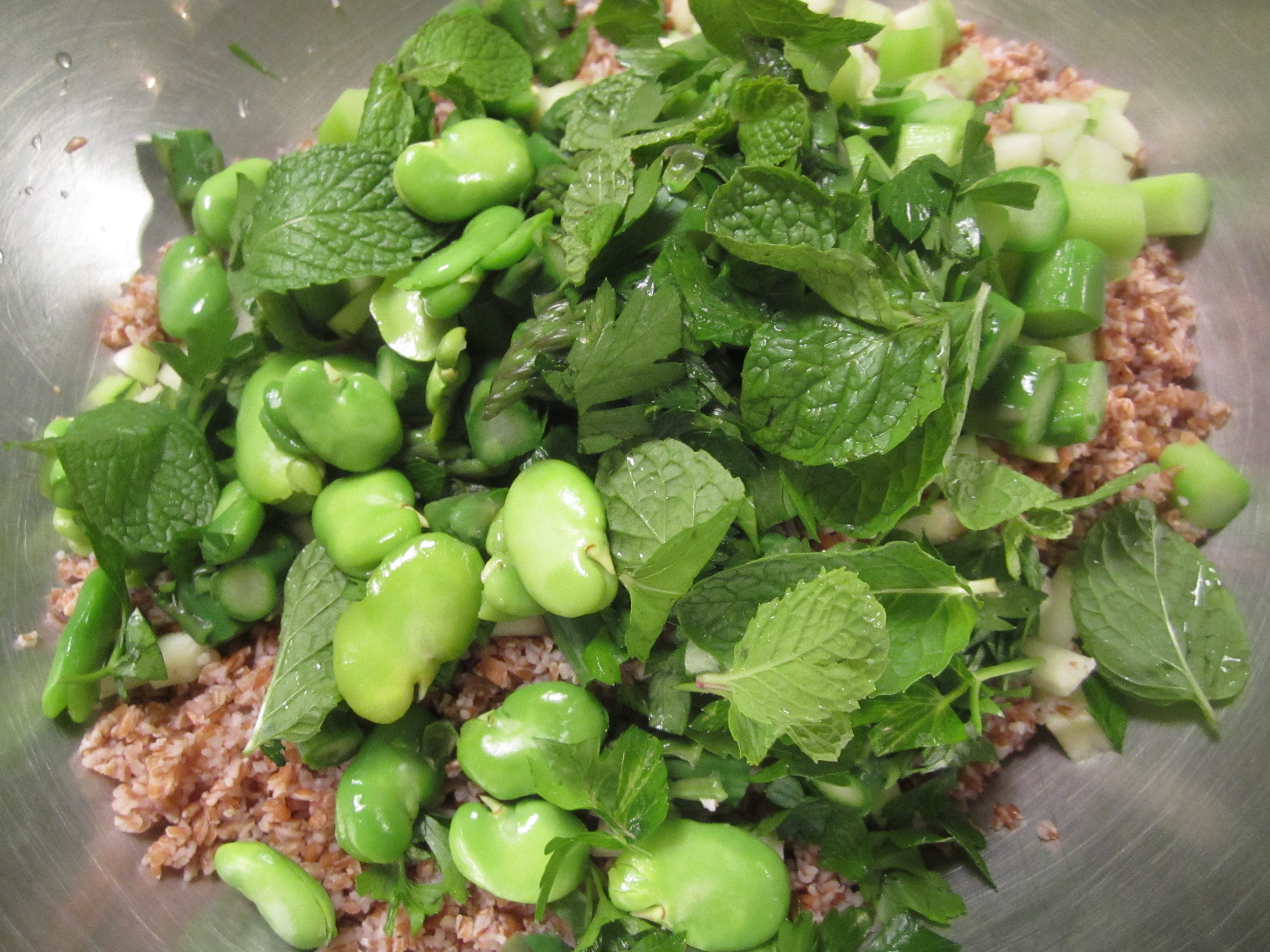
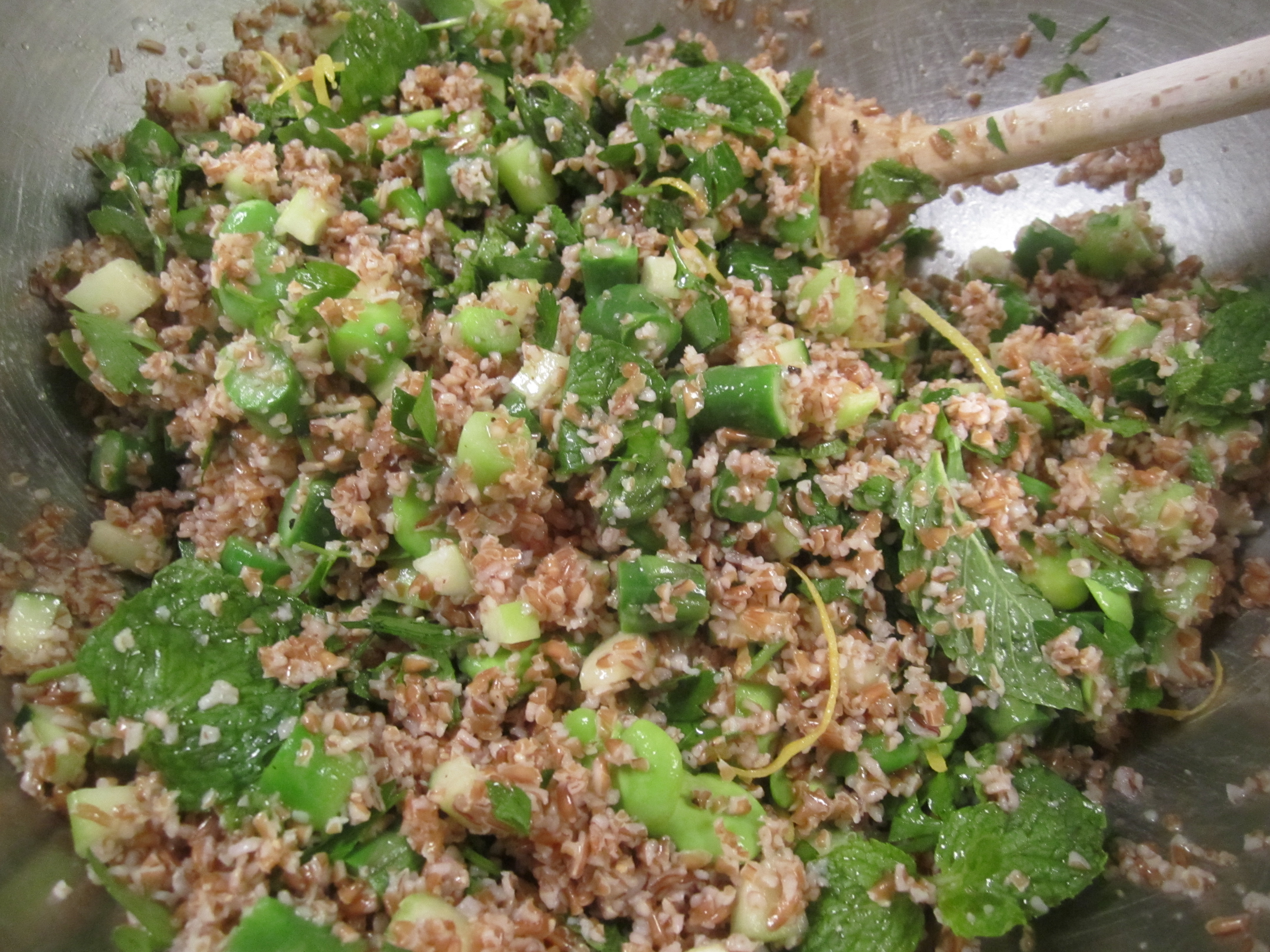
This is a spring variation of my Italian-Ate Tabbouleh, featuring the asparagus and fava beans that are starting to arrive in my local markets.  Bulgur is such a versatile and easy grain to prepare–simply soak in boiling water for 20 minutes or so, then dress.  It lends itself to earthy flavors as well as bright, acidic ones.

The dish is punctuated with lemon juice and zest, fresh mint and parsley.  Cucumbers also add a bit of crunch and brightness.  The asparagus and fave are par-cooked, then added to the mix.

The salad may be made in advance (not too far, since mint will blacken, the longer it sits).  It’s also a great main course for lunch, sprinkled generously with feta or ricotta salata.  

Italian-Ate Bulgur Wheat Salad with Spring Vegetables

serves 6, with leftovers

2 c coarse bulgur

2 c boiling water

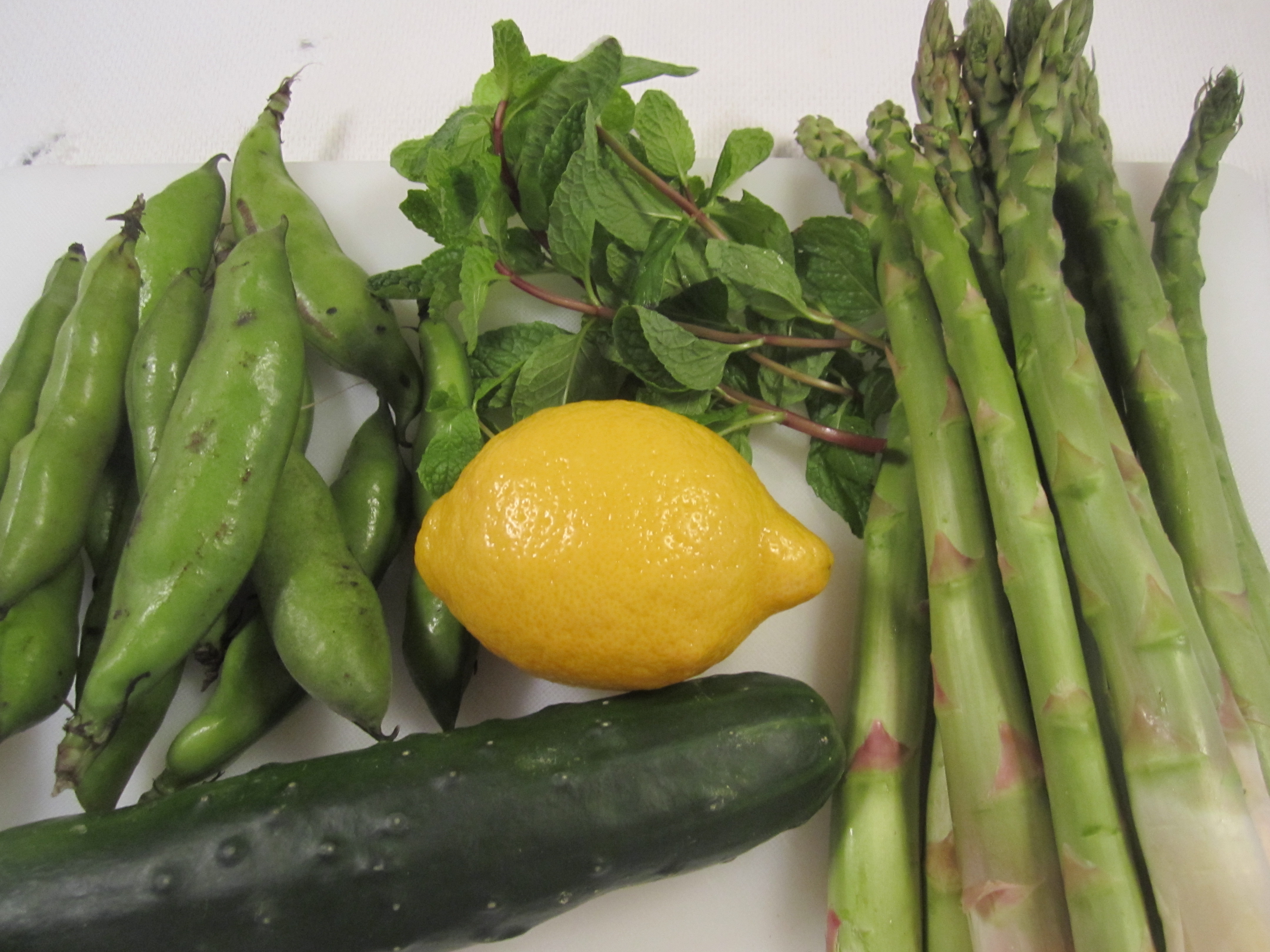
1 1/2 lbs asparagus (fat ones are better than skinny ones)

2 cups fava beans (the yield from approximately 2 lbs whole pods)

1 cucumber, peeled (leaving some strips of peel on)

1 c fresh chopped mint

1 c fresh chopped parsley

1/2 c extra-virgin olive oil

juice + zest of one lemon

salt and pepper to taste

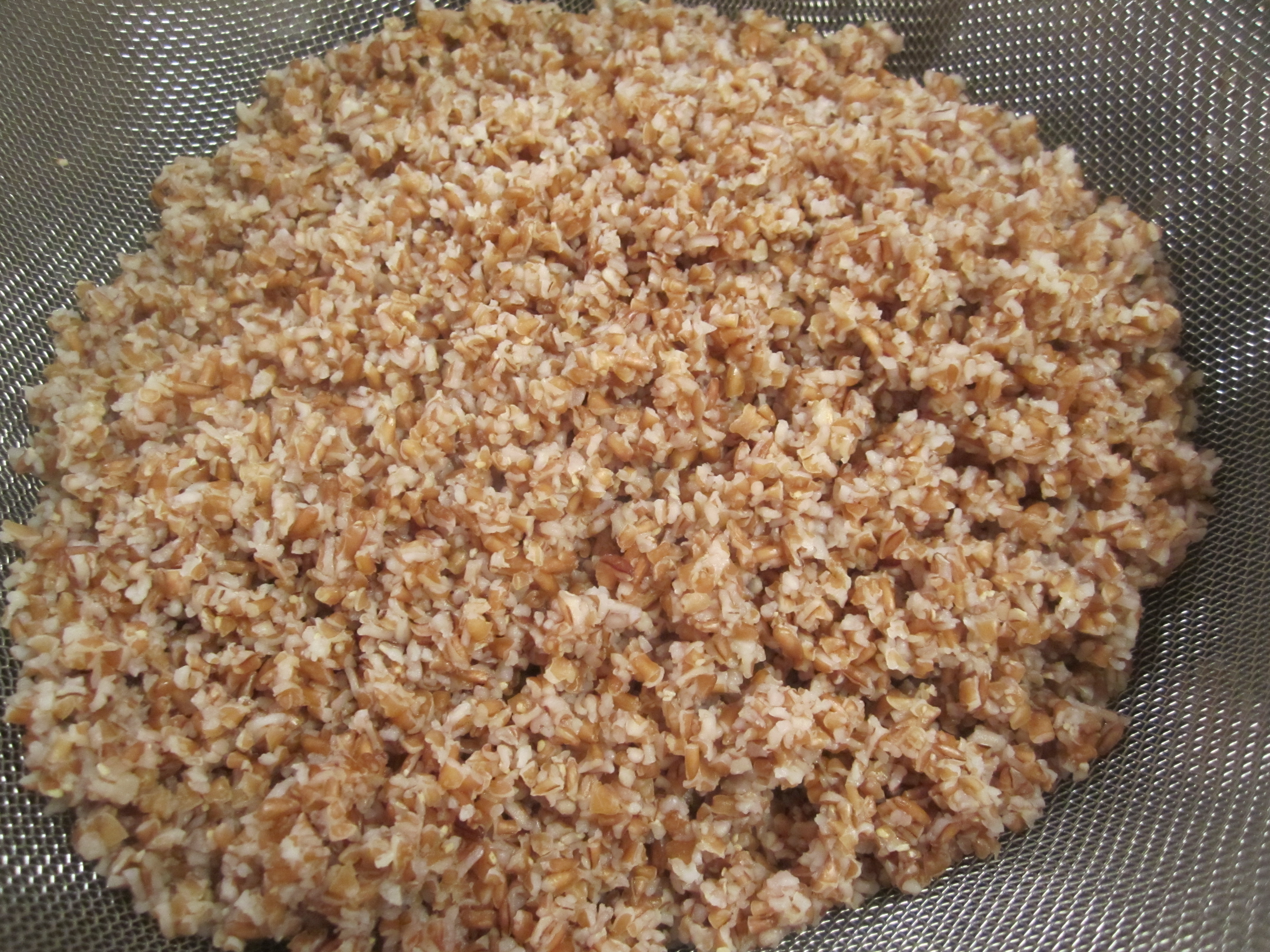
Place bulgur in a bowl and cover with boiling water.  Cover with lid and allow to steep for about 20 minutes.  Drain.

Peel the lower third of each asparagus stalk and immerse in cold water for a few minutes to allow any soil to drop to the bottom of the bowl.  Drop asparagus into boiling salted water for about 1 1/2 minutes (blanch in small batches so as not to reduce water temperature too drastically).

Refresh in cold water immediately.  Cut crosswise into 1/2″ pieces

Peel cucumber and slice in half lengthwise.  With a small round measuring spoon, scoop out seeds.

Cut cucumber into 1/2″ wide strips, then crosswise into 1/2″ dice.

Shuck and peel fave (see Fava Beans with Leeks, Arugula and Mint).  Blanch beans for a minute, then set aside.

In a large mixing bowl, combine all ingredients.

Season with salt and pepper and taste.  Keep stirring and adding salt and pepper until you’ve reached the desired degree of seasoning–I added almost a tablespoon of salt to mine (gradually, by the half-teaspoon).

Serve at room temperature or from the fridge.  Keeps for days, but the mint will blacken as time goes by.

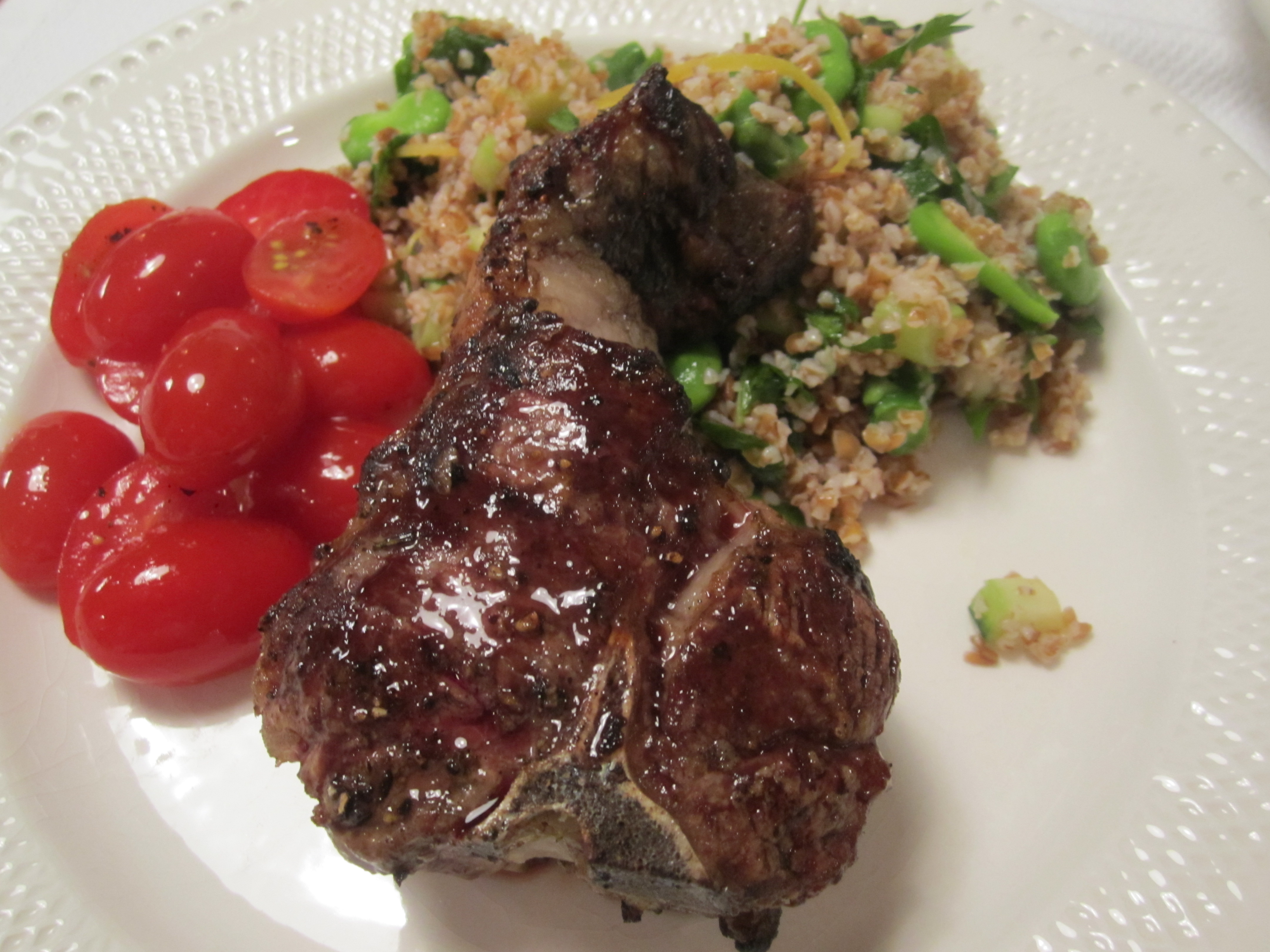
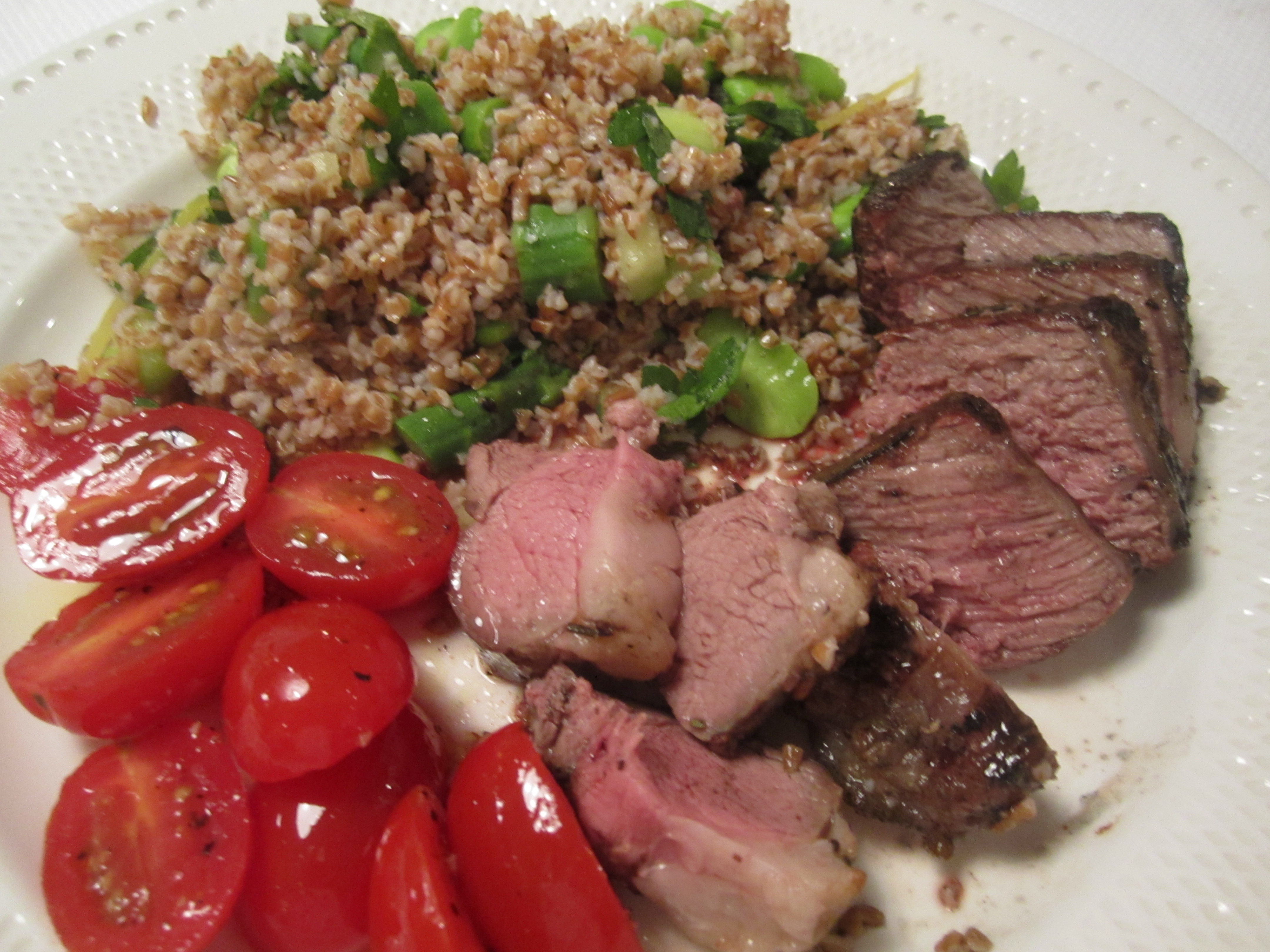
The ideal main course to accompany this dish would be grilled lamb chops. (See my next post, Perfect Grilled Lamb Chops, below).

Posted in Salads | Leave a comment

Perfect Grilled Lamb Chops

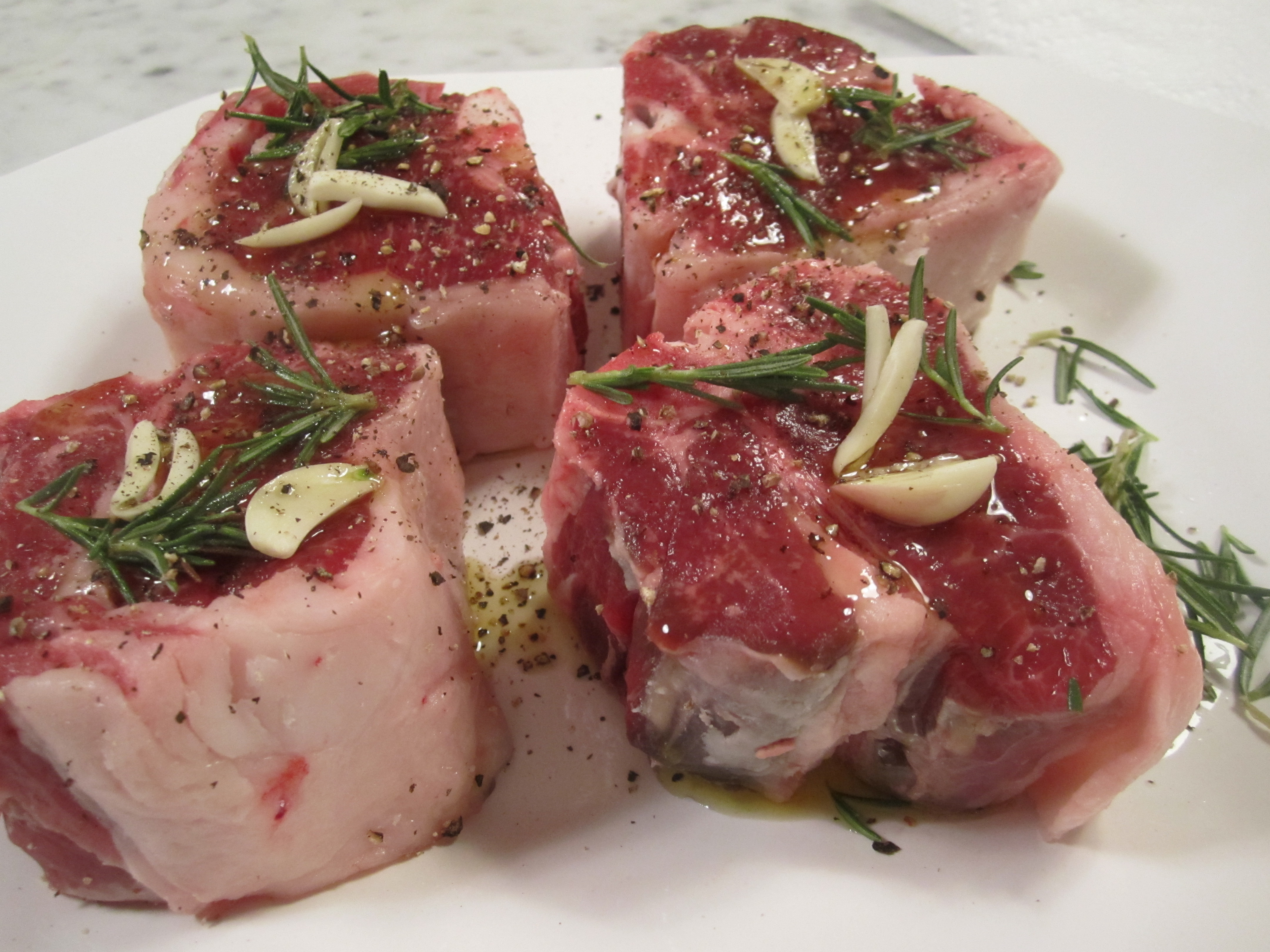
Today, I’ve found some beautiful double-thick loin lamb chops to accompany my Spring Bulgur salad.  I prefer loin chops to rib chops because I like the combination of strip and tenderloin (like a T-bone steak), and I feel that loin chops are meatier than rib chops.

In my opinion, extra-thick chops require a two-step cooking process.      Whether they’re lamb, pork or veal, the best way to get steakhouse quality results is to first sear on an open flame, then finish in the oven.

I like to rub my lamb chops with rosemary, garlic and oil a few hours prior to cooking.  At the last moment before placing on the grill, apply a heavy layer of salt and pepper.

Preheat grill to high.  At the same time, preheat oven to 375 degrees.  In the hot oven, preheat an ovenproof skillet large enough to hold the chops.

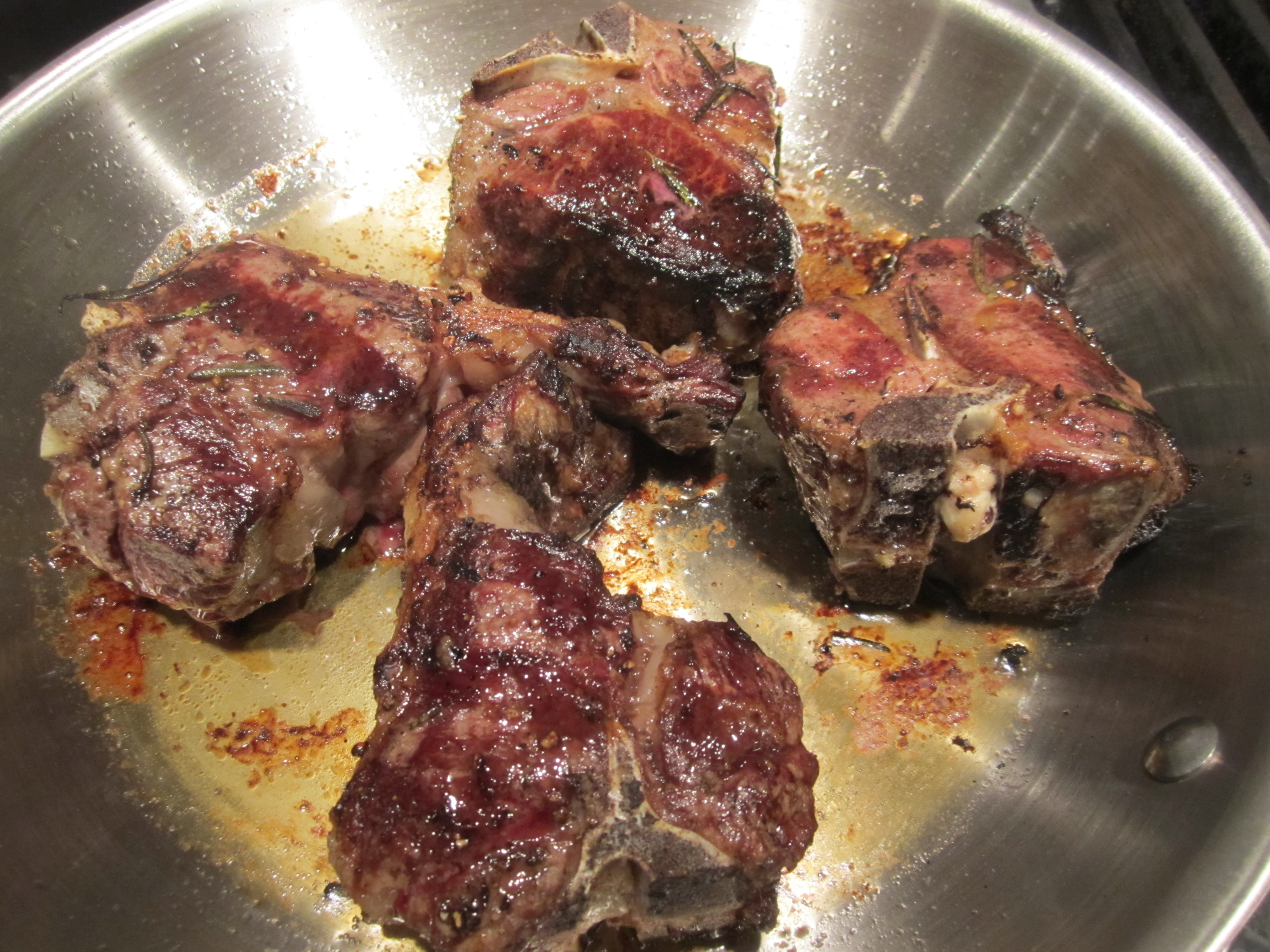
Place chops on grill and allow to sear for 5 minutes per side (these chops were approximately 2 1/2″ thick).

Remove chops from grill, brush off garlic and burnt rosemary and place chops in preheated skillet.  Roast in oven for approximately 15 minutes.

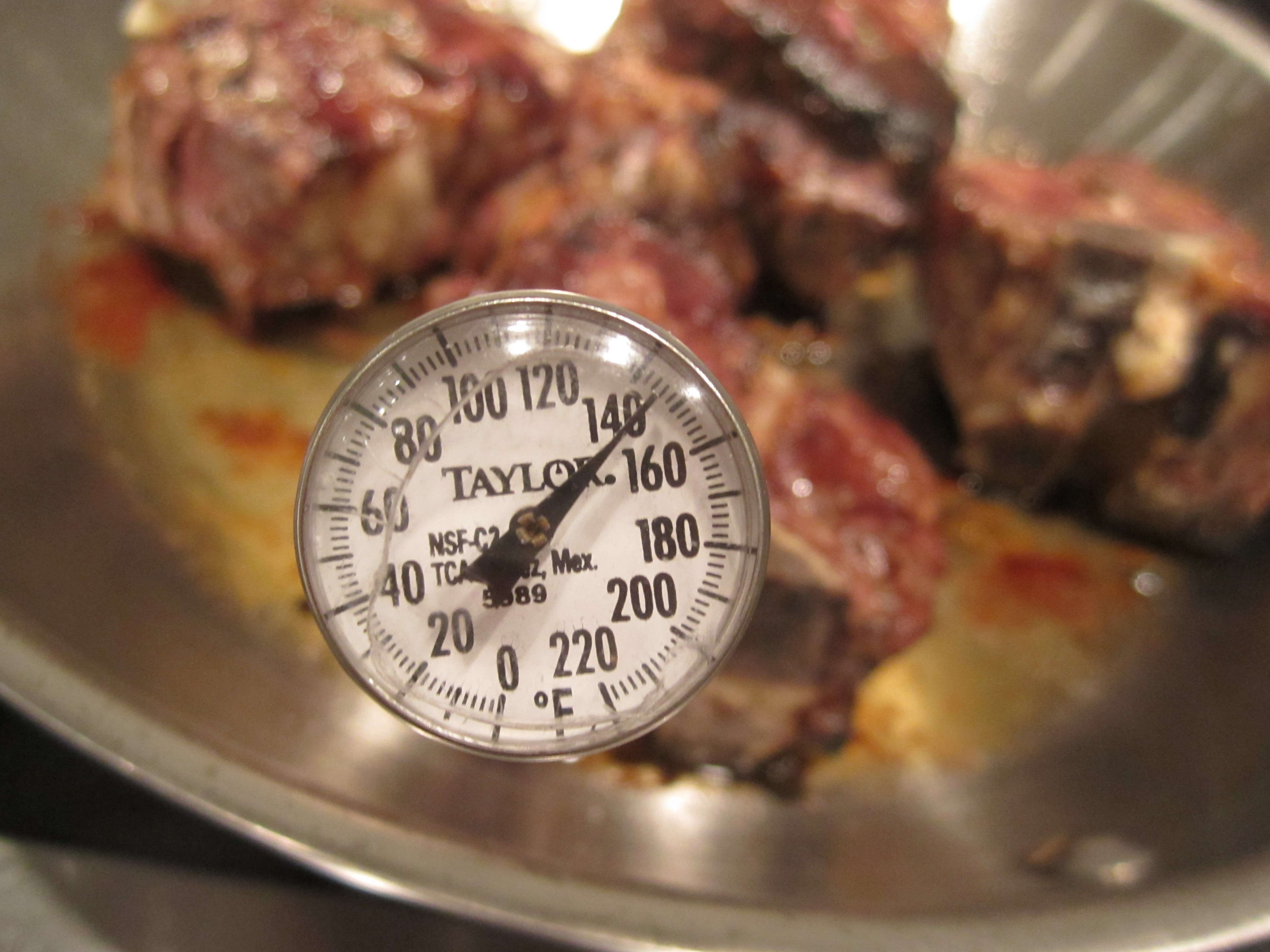
I like to cook my chops to an internal temperature of about 145 degrees for medium-rare meat.

When the meat has rested about 5 minutes, I remove it from the bone in 2 pieces–the loin and tenderloin.  Slice and serve.

Posted in Meat | 1 Comment

Pasta with Fava Beans, Shrimp and Pancetta

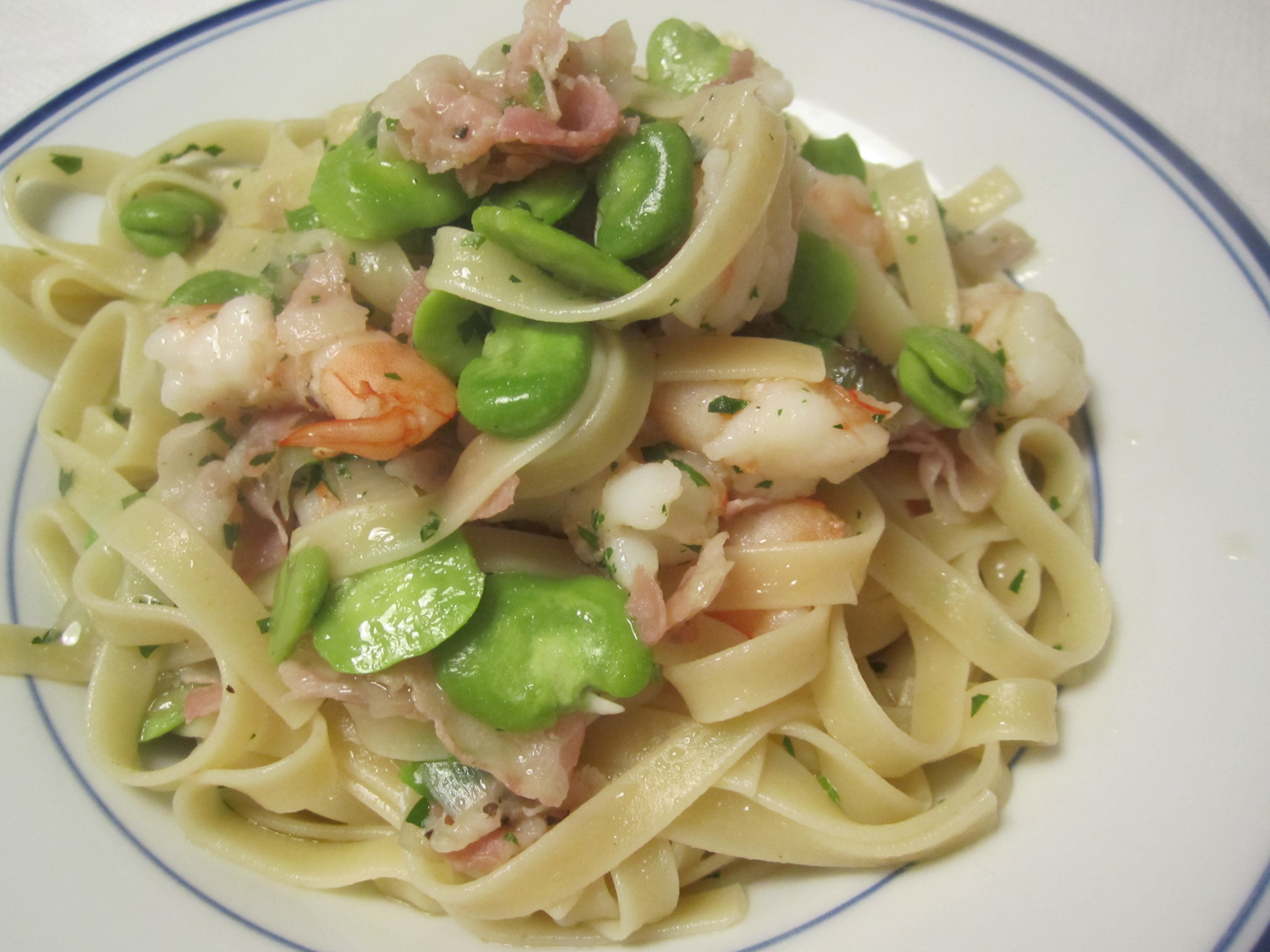
Every once in a while, I like to mix shellfish with pork–a combination more common in Spanish cooking than Italian (e.g. paella).  In fact, these two flavors complement each other beautifully and are both enhanced by the earthy richness of fava beans.

Although fava beans are a labor to prepare, they remind me of Spring and the rebirth of all the local produce in our area.  Therefore, I consider their preparation a welcome ritual and something of a celebration–I make them every opportunity I can find the time to.

Like other legumes, fave have a natural affinity for earthy, smokey flavors, like bacon, pancetta and onions.  Sharp cheeses like pecorino, pair well with them as well.

This is a good one-dish weeknight meal–it contains protein, vegetables and pasta all on one plate.  The only thing necessary might be a salad.

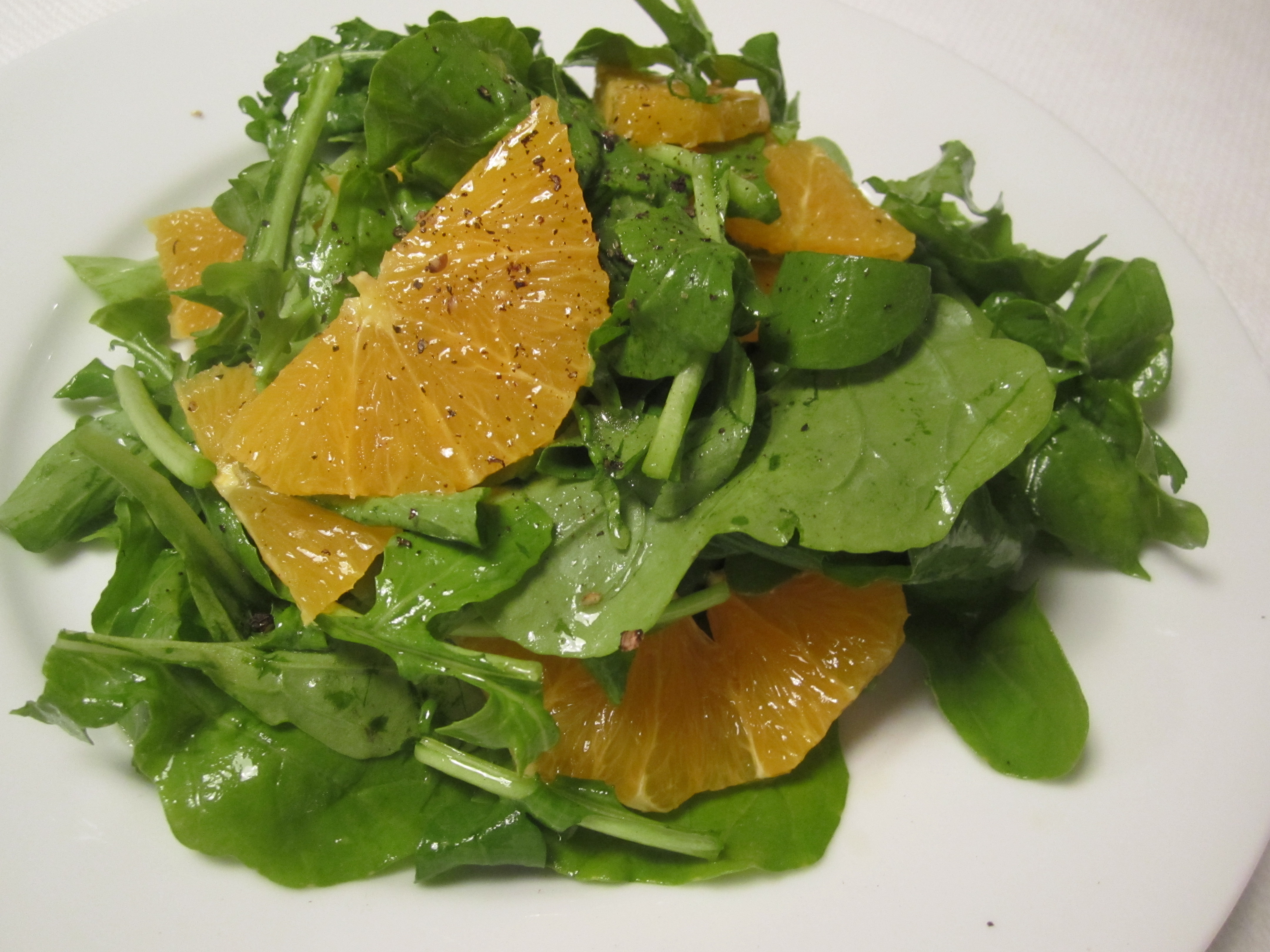
In addition to our pasta tonight, I’ve made a colorful salad of arugula and oranges, dressed with red wine vinegar, agave and olive oil–the perfect sharp flavors to cleanse the palette and balance the richness of the pasta.

Pasta with Fava Beans, Shrimp and Pancetta

serves 2

1/2 lb fettucine or linguine

2 lbs fava beans, shucked and peeled, to yield about 1/2 lb of beans (for shucking and peeling technique, see Fava Beans with Leeks, Arugula and Mint)

1/2 lb shrimp, peeled, de-veined and cut into bite-size chunks

2 oz. pancetta, thinly sliced, then diced crosswise into 1/4″ strips

1 small shallot, finely diced

1/2 c white wine

1/4 – 1/2 c chicken broth

4 tbls olive oil + 1 teaspoon for drizzling

2 tbls fresh chopped parsley

salt and pepper to taste

grated pecorino romano for sprinkling

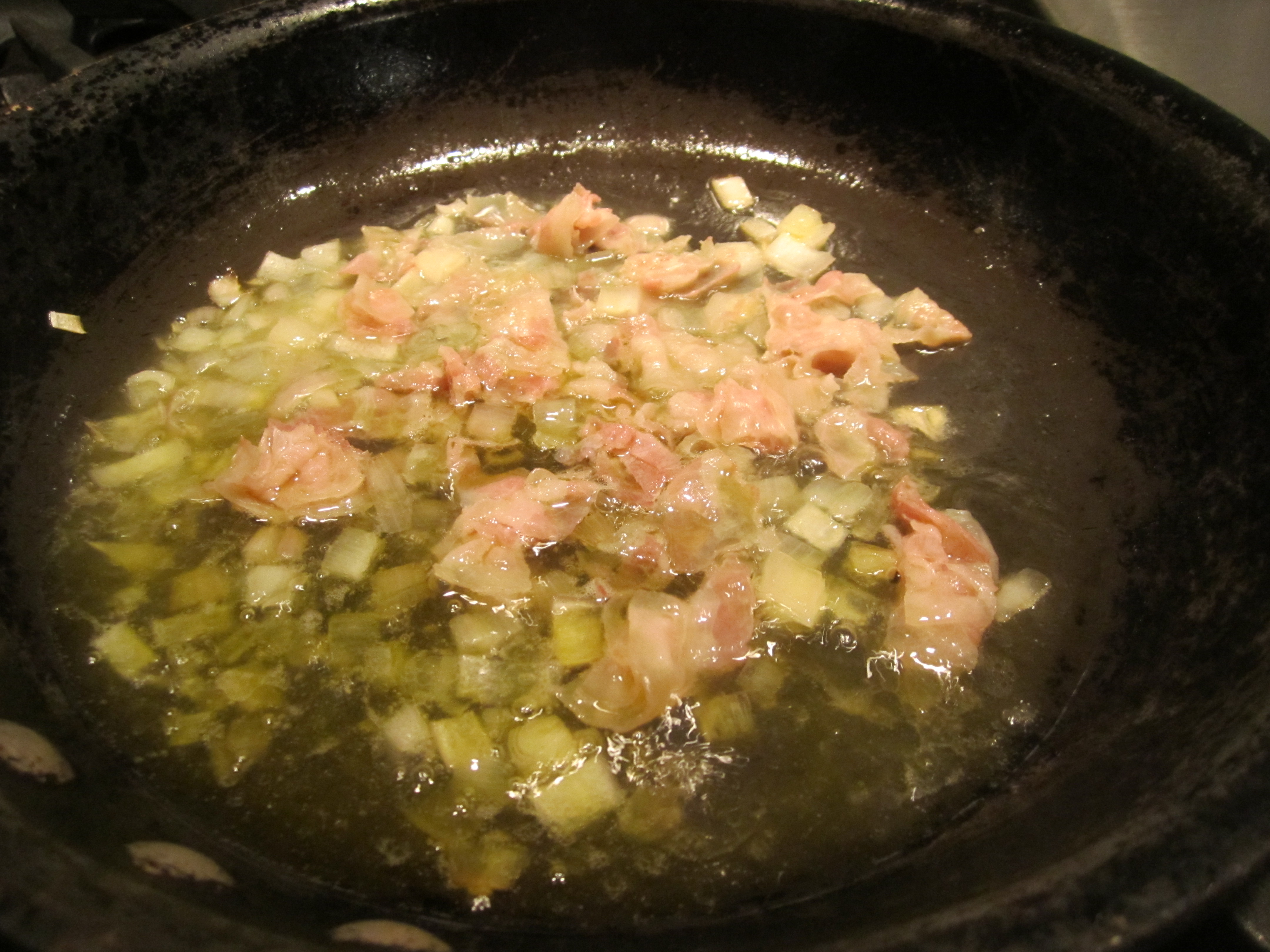
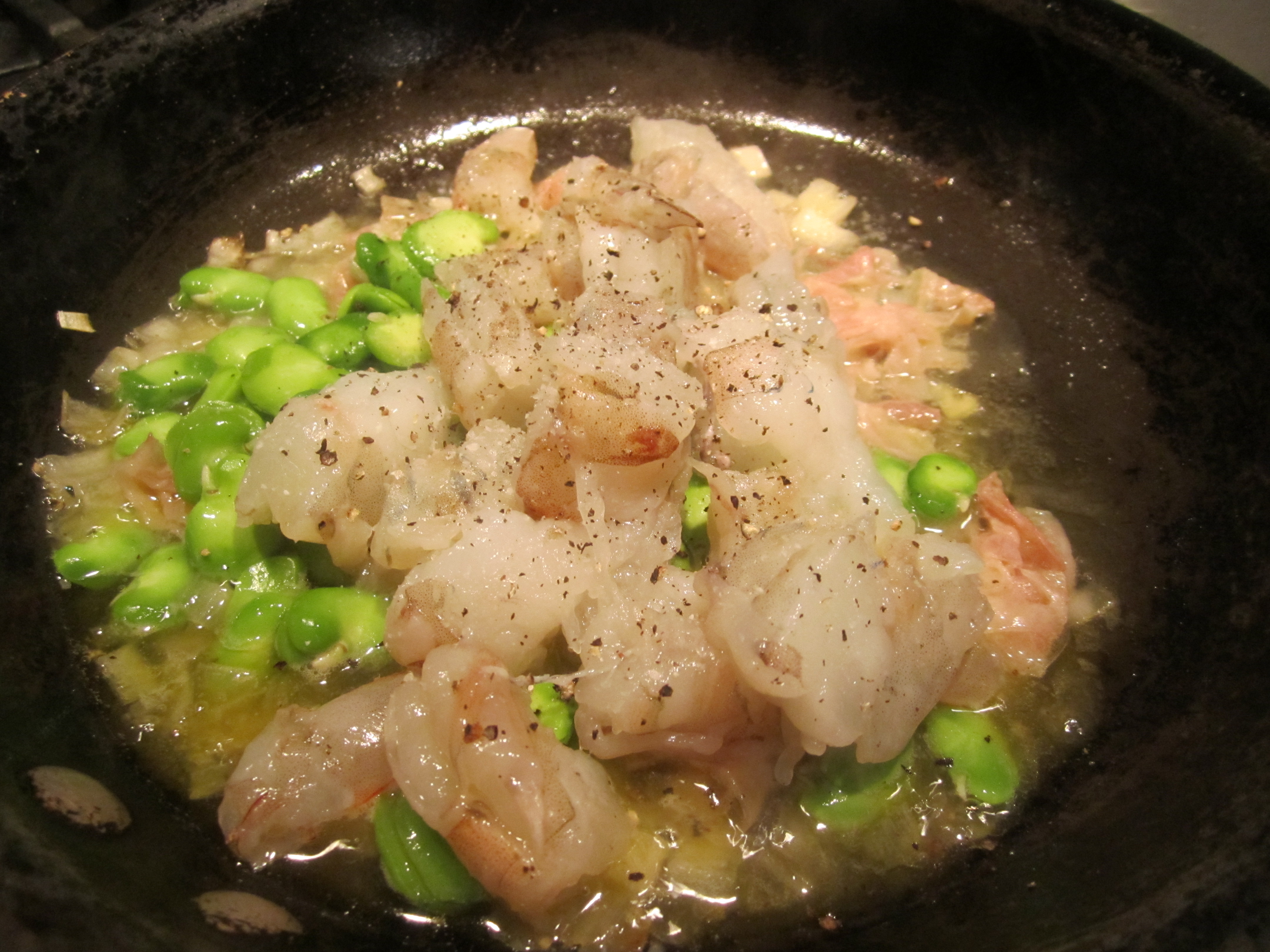
While pasta boils, in a large skillet on low heat, combine shallots, pancetta and oil and bring to a sizzle, as pancetta renders and shallots become golden.

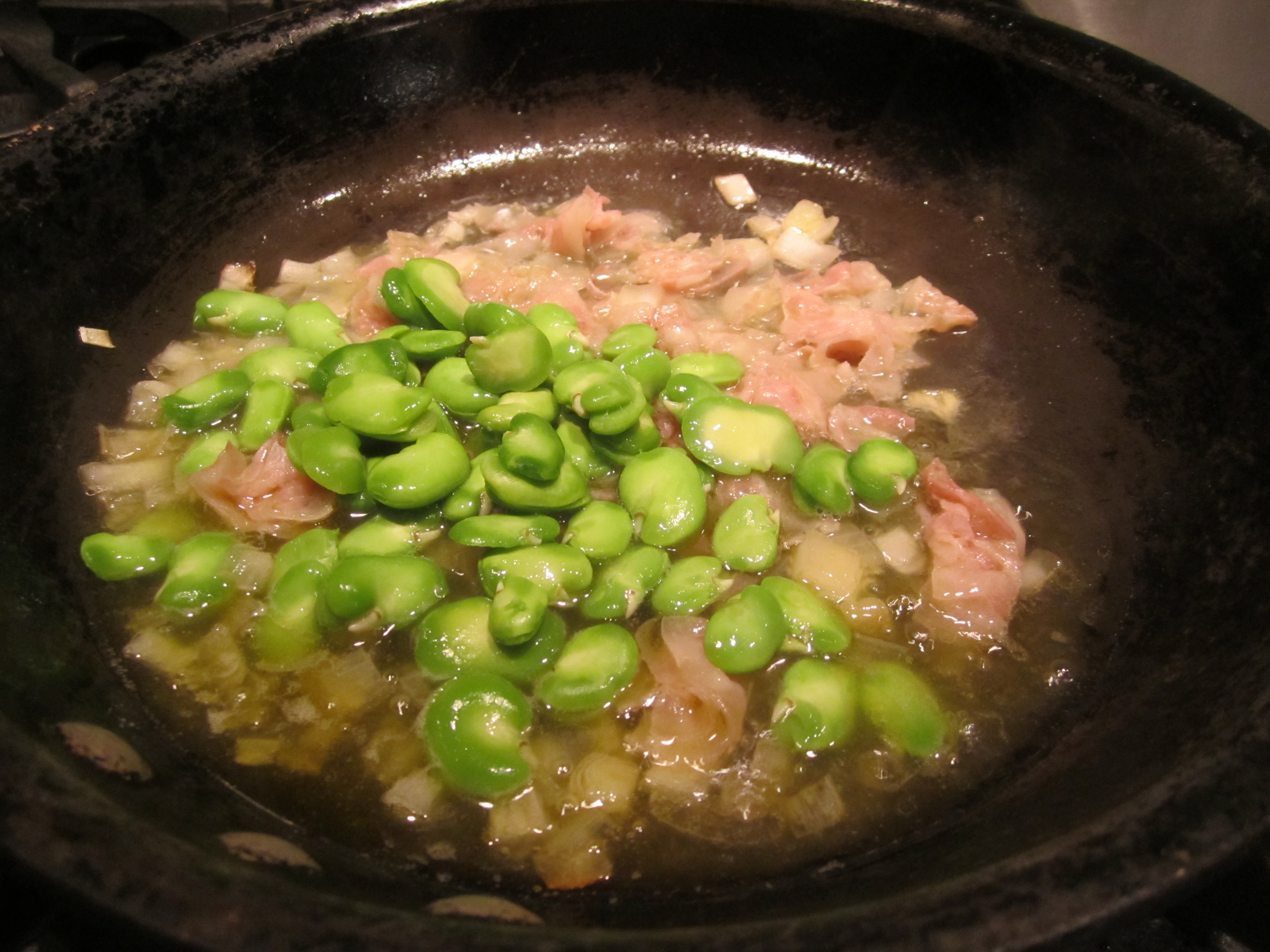
Add fava beans and white wine and reduce for another minute.

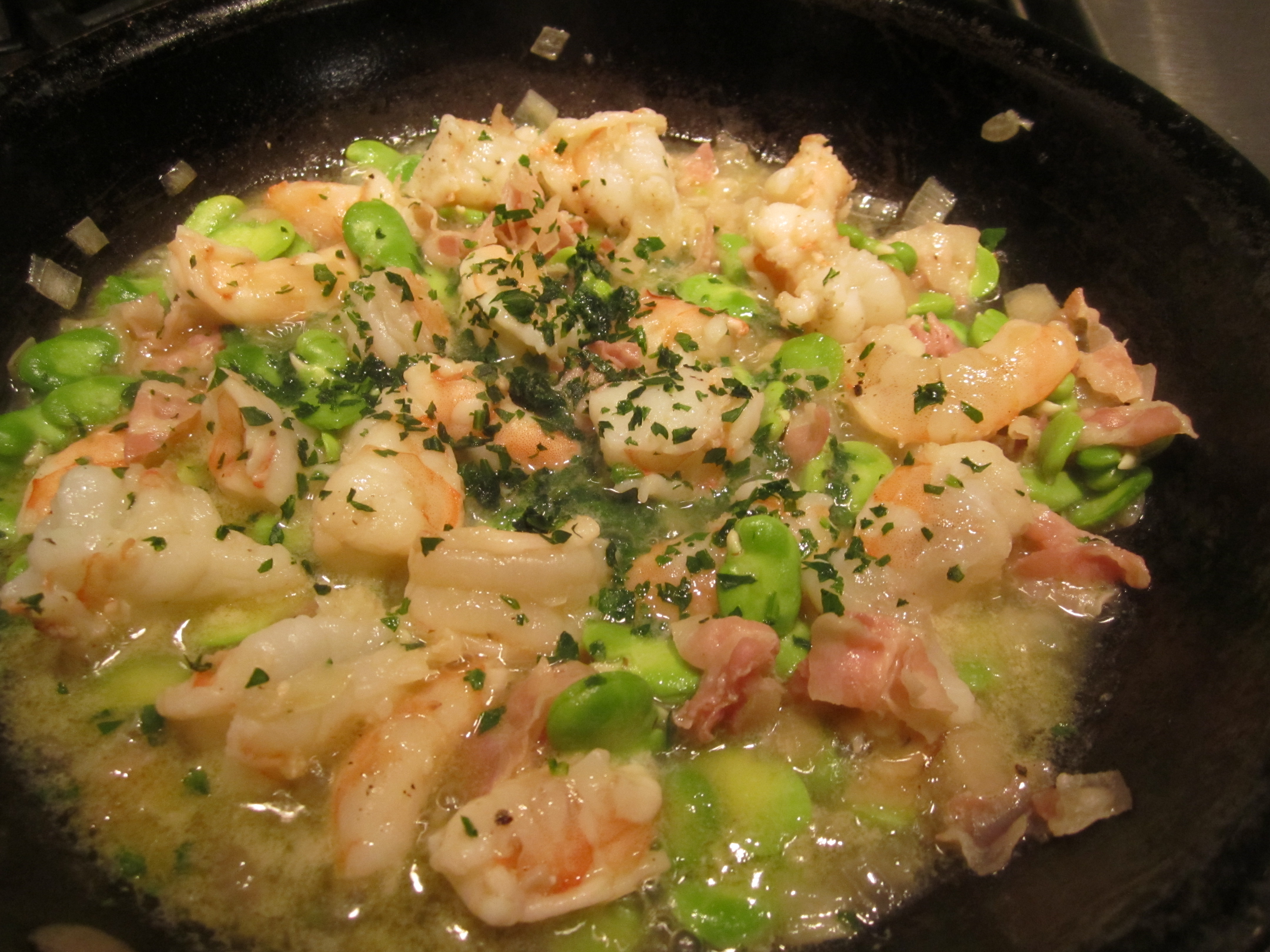
Add half the broth.  Turn heat to the lowest simmer and add shrimp. Season with salt and pepper.

Allow shrimp to rest on top of the mixture until pasta is a minute shy of done.  At that point, add parsley and toss shrimp to combine with sauce.

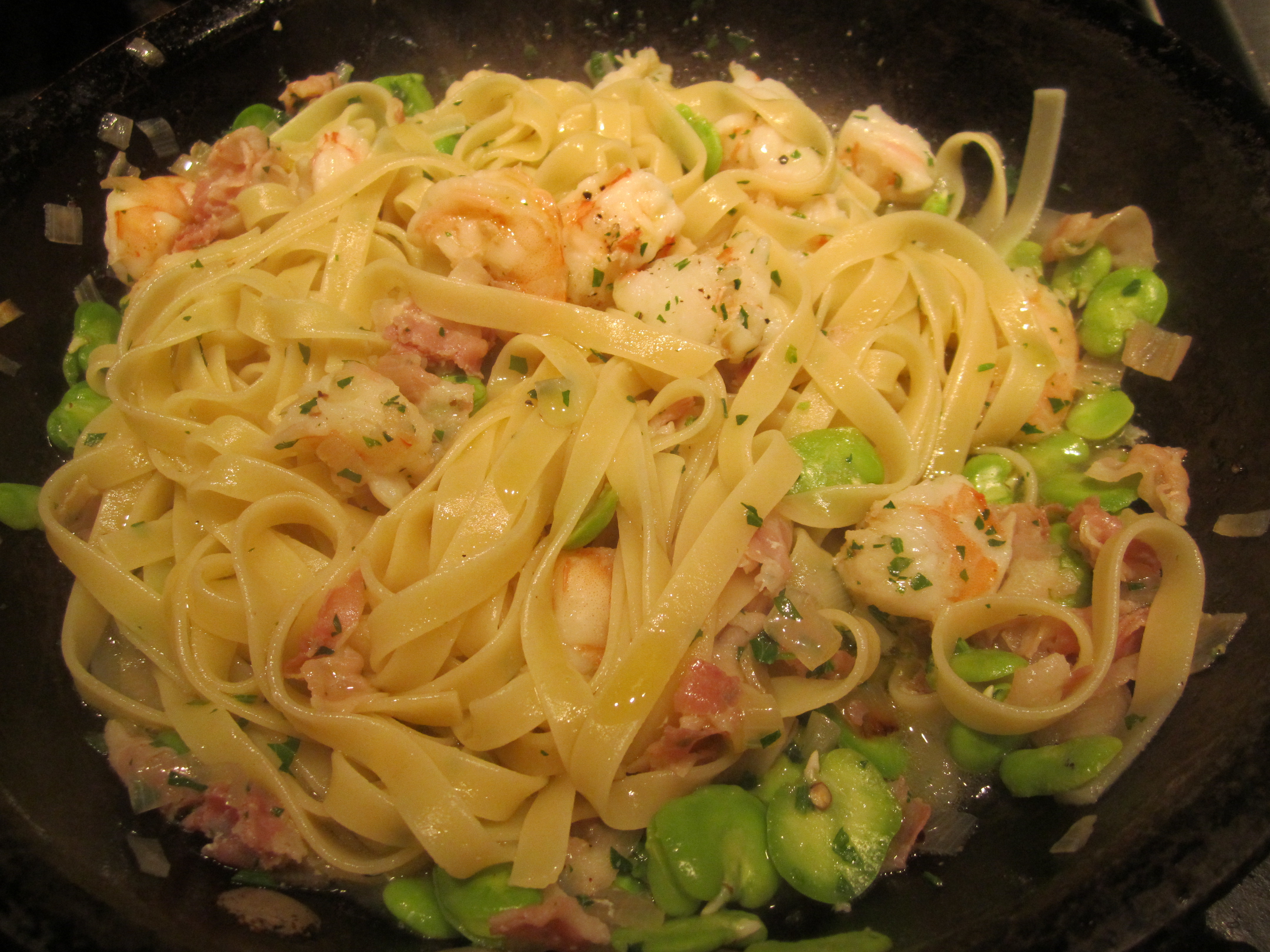
When pasta is done, drain and add to skillet, with a little more broth, if necessary to loosen the sauce.  Sprinkle on more black pepper and a drizzle of extra-virgin olive oil.

Serve with plenty of grated pecorino romano at the table.

Posted in Pasta | 1 Comment

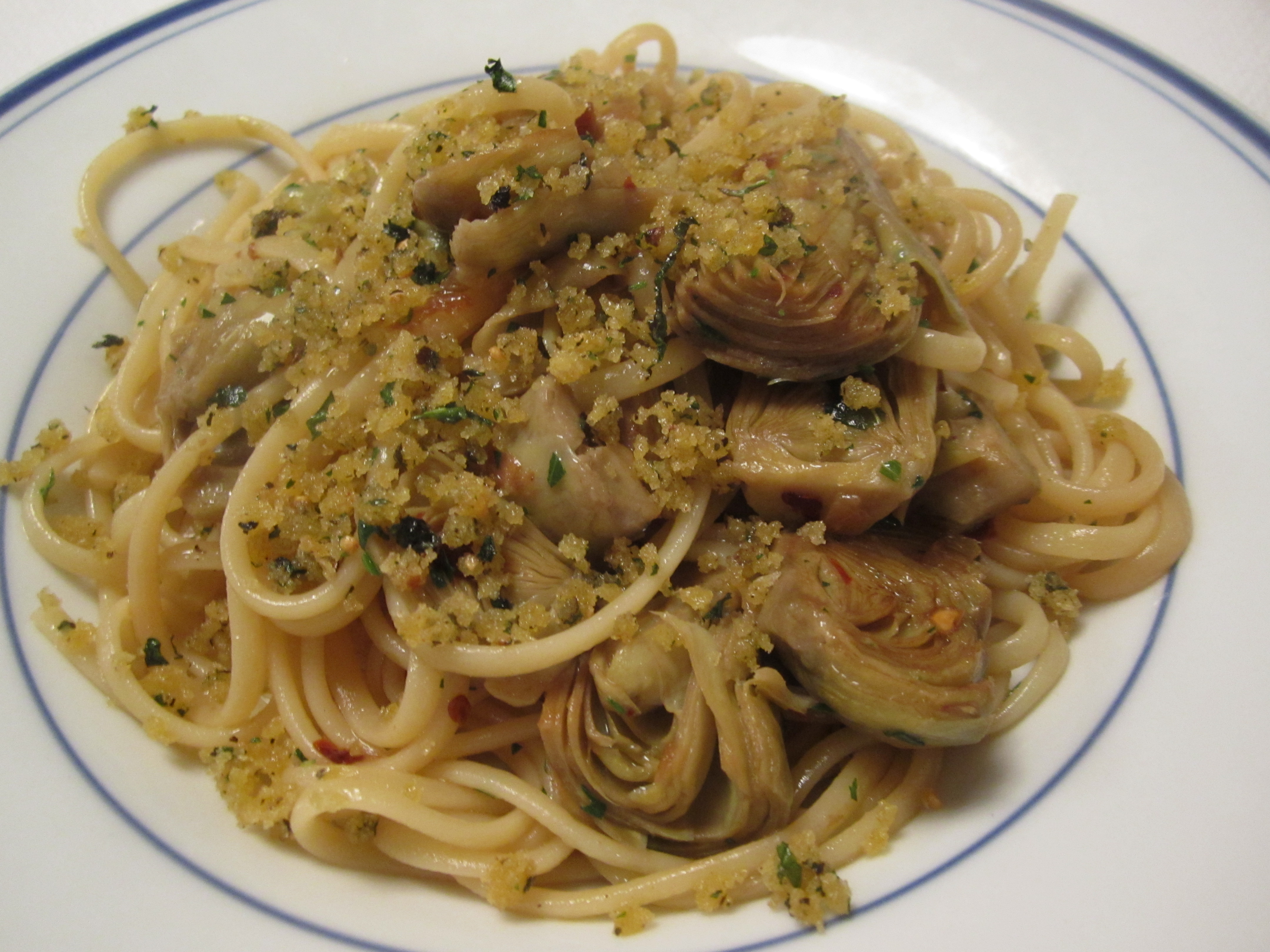
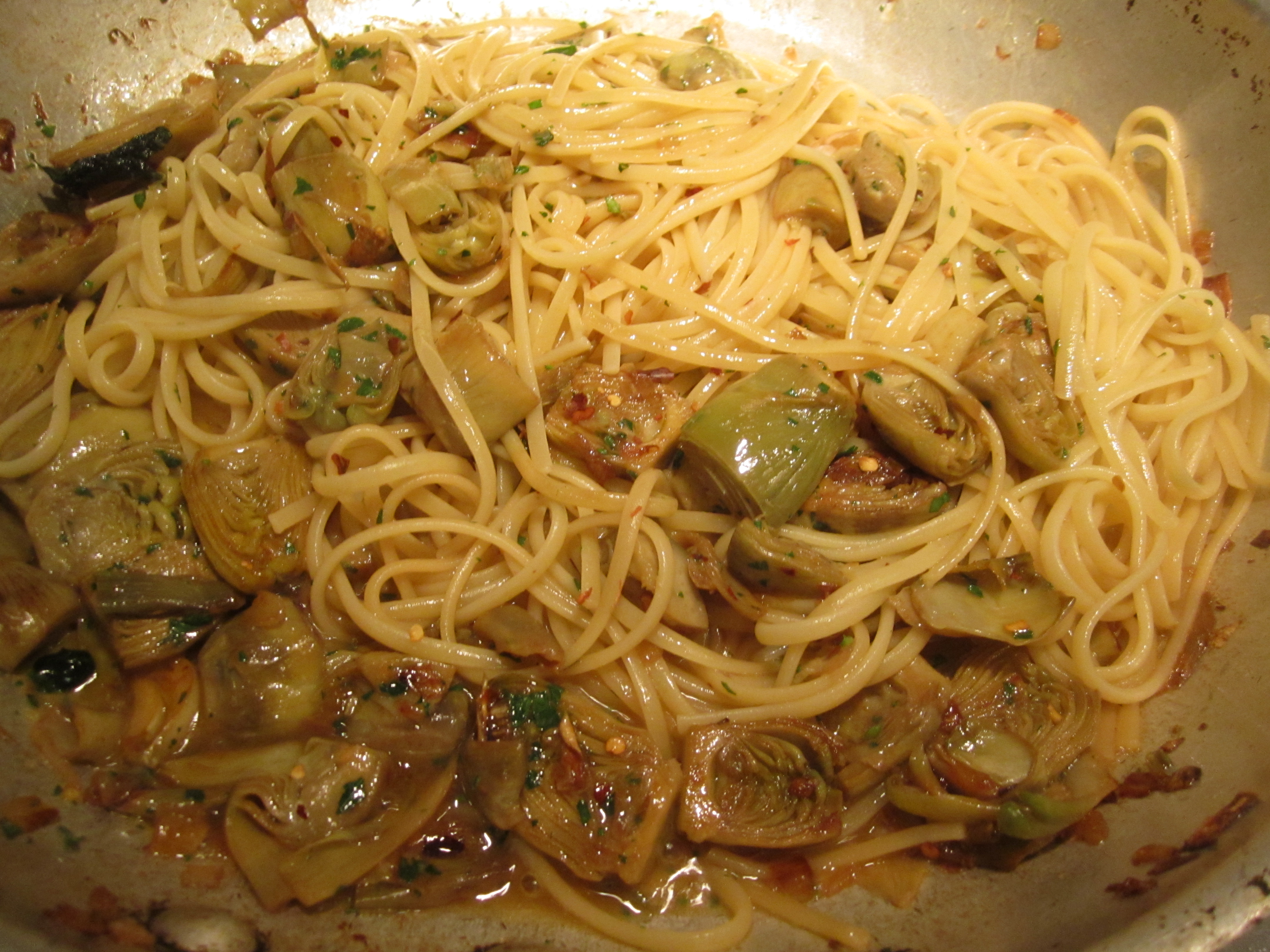
Pasta with Baby Artichokes, Mint Breadcrumbs and Chili Flakes

It’s springtime on Long Island and, although I’ve only been back in New York for a week, my winter getaway in Florida seems like a distant memory.  I’m enjoying the Spring weather and the early profusion of flowering bulbs and trees.  It’s still a bit early for local asparagus or artichokes, but my produce market has an abundance of both of them (from California), and I couldn’t resist the baby artichokes.

Artichokes can be truly challenging to find and prepare (properly).  I’m not a fan of serving artichokes whole on a plate, because I feel they’re a  lot of show and no substance.  I don’t really enjoy picking off leaf after leaf and sucking on the tiny bottom portion, then discarding the rest of the leaf.

Similarly, stuffed artichokes look beautiful on the plate, but what you end up with is a pile of tough, inedible leaves and some leaden bread crumbs and cheese, that might as well have been eaten without ever having touched an artichoke.

This dish is a brilliant combination of pasta and stuffed artichokes.  Pasta with artichokes is a great combination, provided you clean and cook artichokes properly.

The big question is whether to use large globe artichokes or baby ones.  The globe artichokes at my market were very black around the edges, with loose-feeling leaves, noticeably dried out around the edges.  When you hold a globe artichoke, it should feel heavy and tight.  If you squeeze it,  it should feel solid and compact.  If it feels hollow, it’s probably old and dessicated.

Today, the baby artichokes looked better than the large ones.  Baby artichokes are only marginally less work to prepare than large ones, and, contrary to what most recipes say about baby artichokes, they produce almost as much waste as large ones.  Most recipes say that virtually the entire baby artichoke is edible–no choke and not much to peel.  If you follow these instructions, I promise, you’ll still have piles of inedible leaves on your plate.  Furthermore, depending on how large your “baby” artichokes are, you might find some chokes in them as well.

The most important thing to realize about artichokes–whether they’re the baby variety or the large globe variety–is that they are generally about 80 percent waste.  You MUST, as Marcella Hazan once said, clean them “without mercy.”

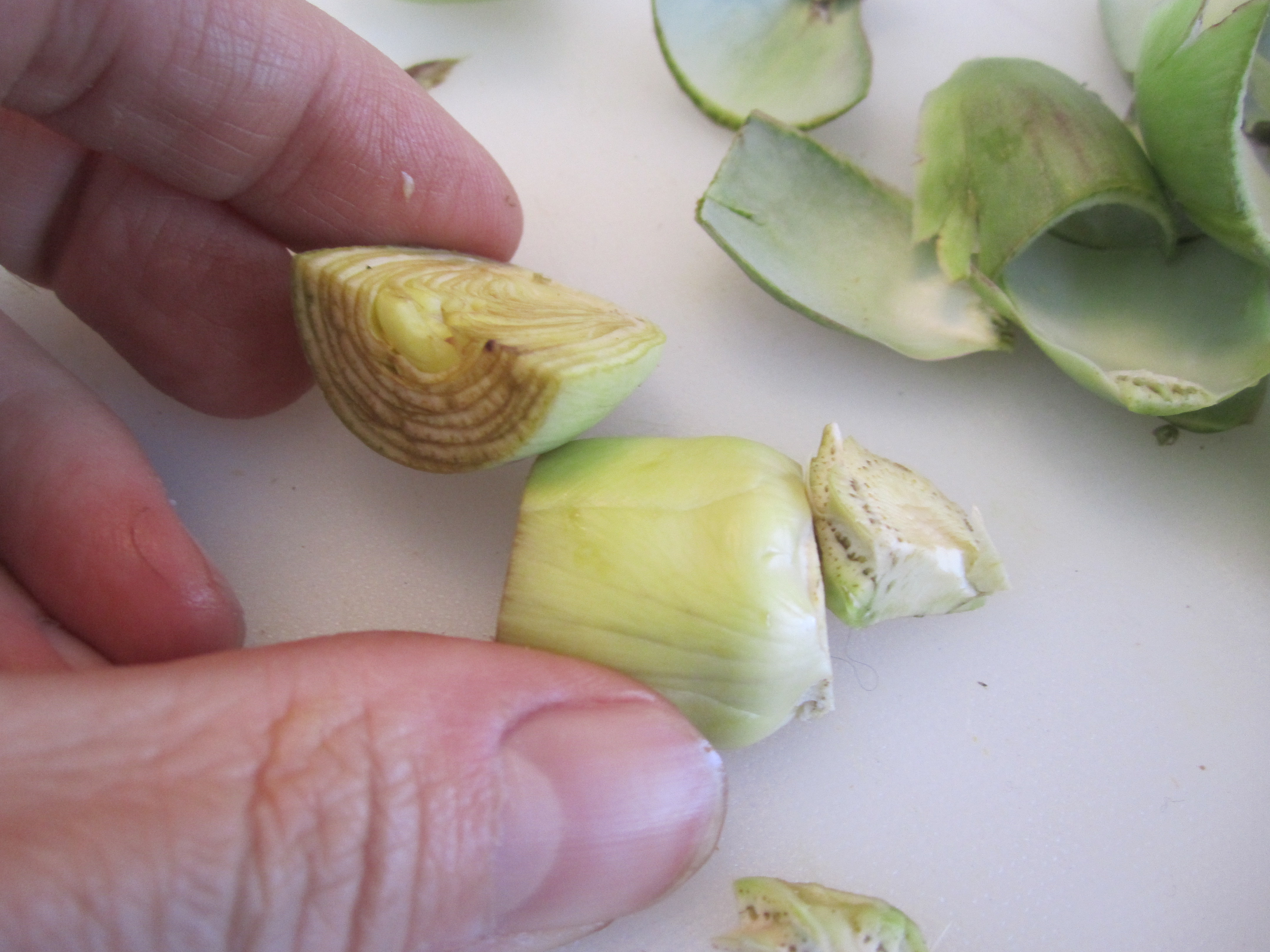
As you clean each one, it must immediately be cut in half and dropped into acidulated water, face-down (otherwise the cut halves will sit above the surface of the water and blacken) until you’re ready to cook them all.  The reason to cut them in half is to check for chokes–if there’s a fuzzy choke in any of them, it must be cut out with a paring knife.

Next, I boil the artichokes prior to sauteing.  This gives you the added benefit of being able to clean and prepare the artichokes entirely in advance (even a day or two), without worry of them blackening.  Once the artichokes are cleaned and boiled, you’ll have the makings of a quick and impressive dish which can be prepared in the time it takes for the pasta to boil.

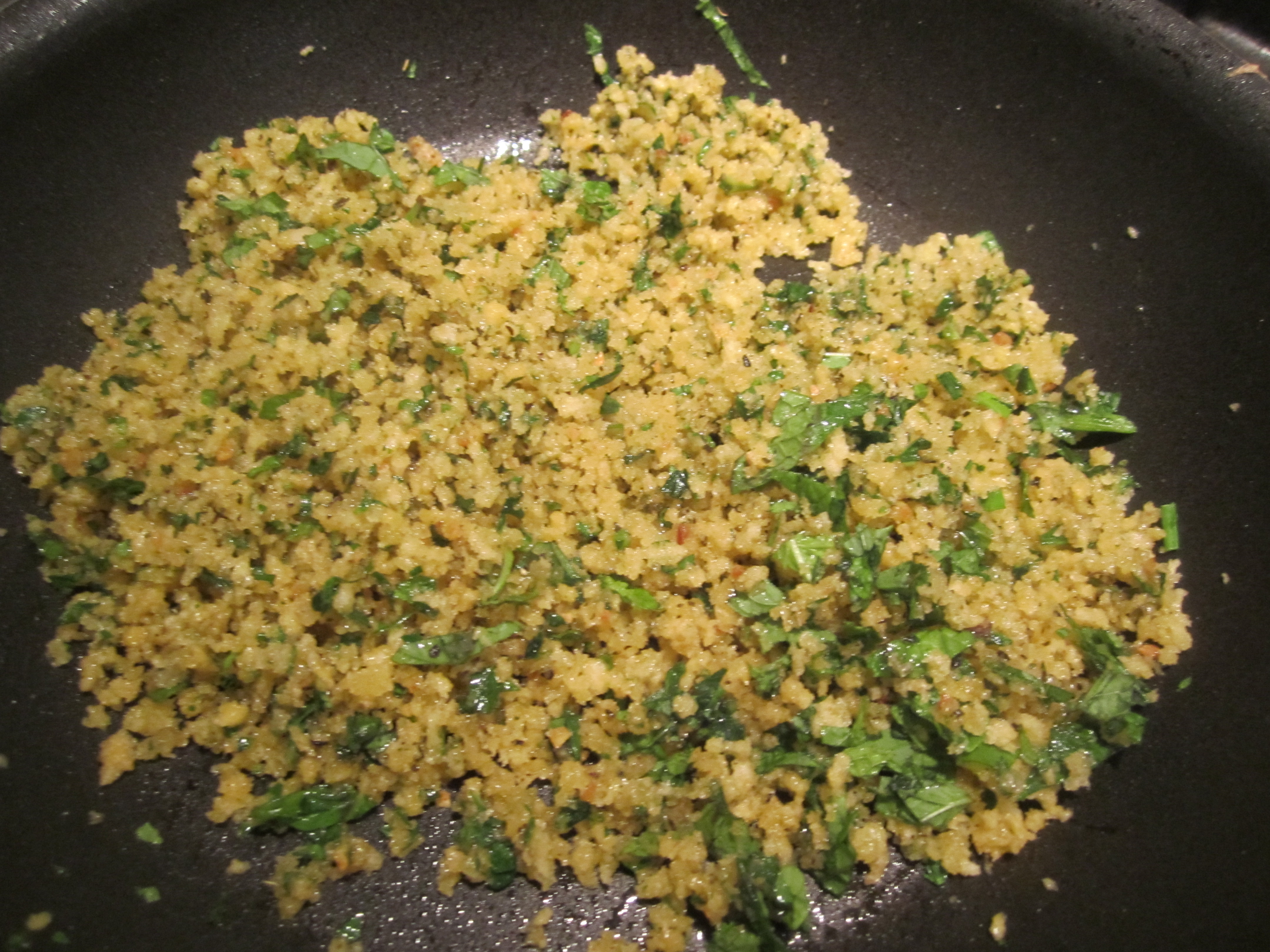
Because this dish is reminiscent of a stuffed artichoke, seasoned breadcrumbs are necessary for its topping.  I love to use mint, parsley and pecorino to dress artichokes, so I’ve infused my crumbs (in this case, Progresso Seasoned Panko crumbs) with lots of chopped mint and parsley as I toasted them in a skillet.  The pecorino simply gets sprinkled on the finished dish.

Tonight, as a main course for our meal, I made a frittata of broccoli di rapa and a salad of local (probably hothouse-grown) baby oak leaf lettuce, dressed with lemon and olive oil.

Pasta with Baby Artichokes, Mint Breadcrumbs and Chili Flakes

serves 4

1 lb dried spaghetti or linguini

4 lbs baby artichokes

4 cloves garlic, split

1 large shallot

6 tbls olive oil

1 tsp chili flakes

3/4 c white wine

12 mint leaves

1/4 c chopped fresh parsley

salt and pepper to taste (be generous with the pepper)

1 c mint breadcrumbs (see below)

grated pecorino for sprinkling

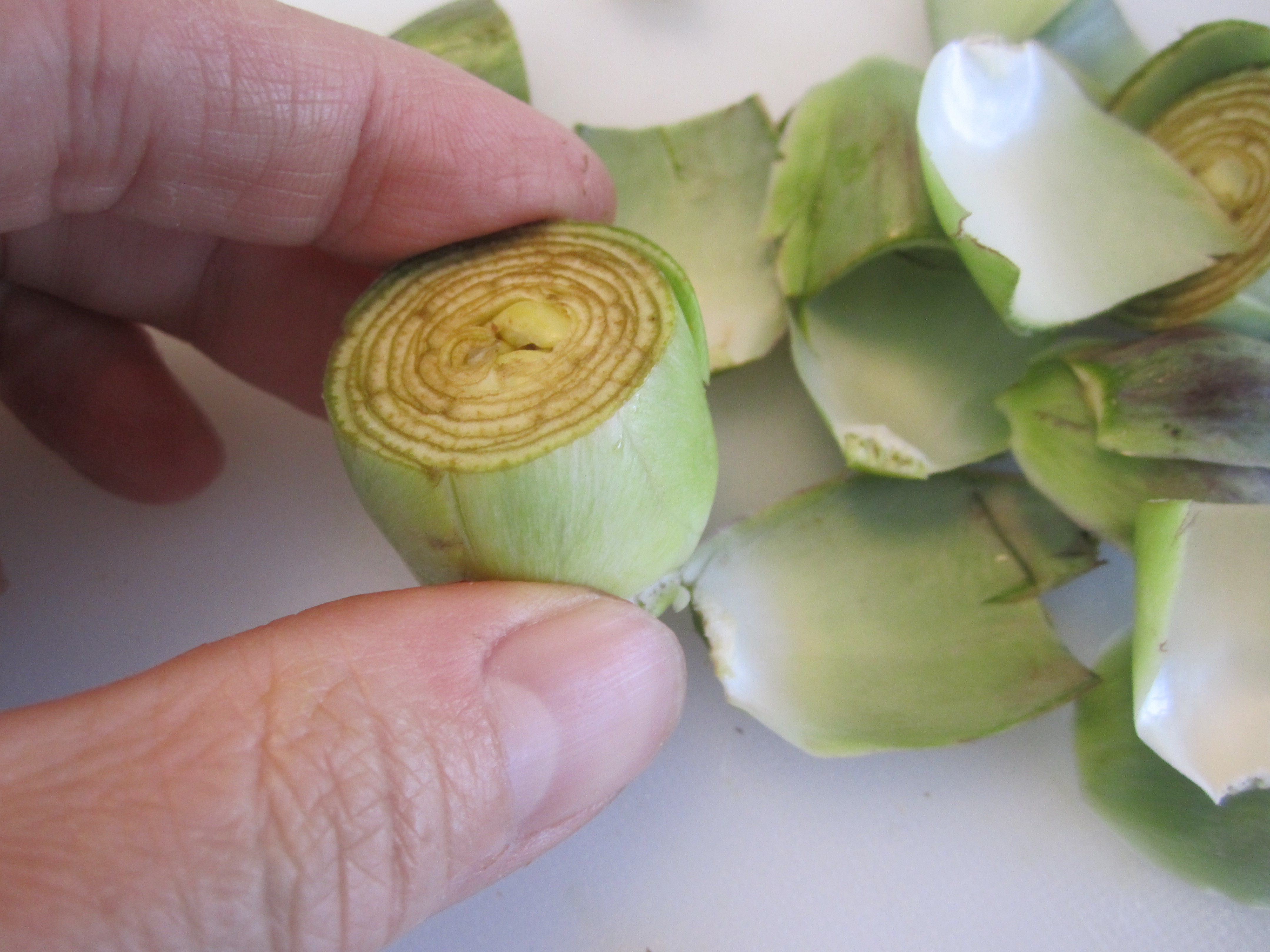
To clean the artichokes, slice off the top 1/2″ crosswise and the stem and discard.  Peel off enough of the outer leaves until the remaining leaves are very pale green (almost white) and tender to the touch.

Slice in half lengthwise to make sure there’s no choke in the center.

Place each half cut-side down, in a large bowl of water containing the juice of a lemon.

Drop the cleaned artichokes into boiling salted water and blanch until tender–about 10 minutes.  Drain and set aside (or refrigerate for up to two days).

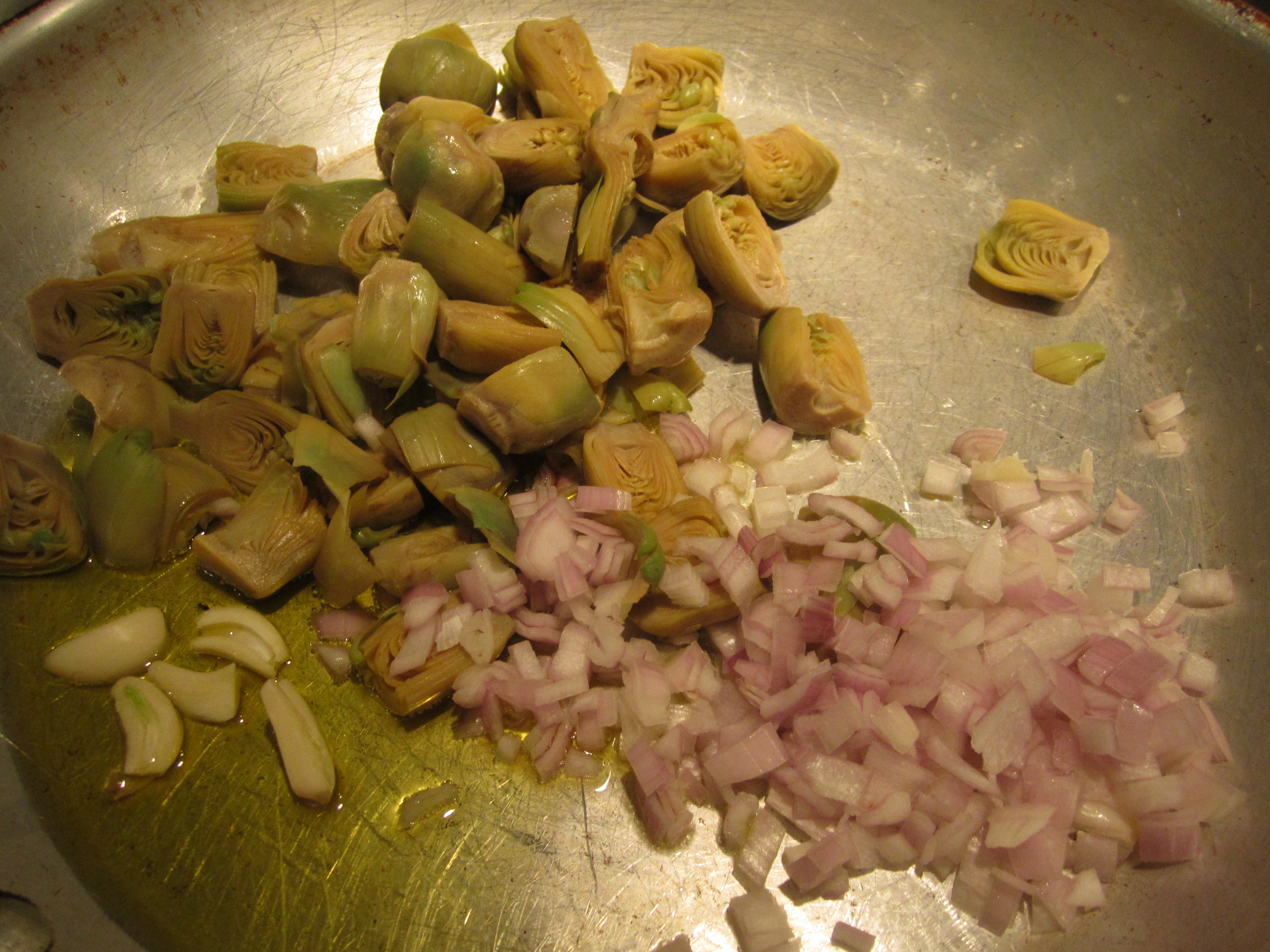
While the pasta boils, in a large skillet, place the shallots, garlic and artichokes on high heat with all but 2 tablespoons of olive oil.

Saute until all begins to turn golden (about 3 minutes, depending on the strength of your burner).  Add in the wine and reduce for another 2 or 3 minutes.  Add 2 more tablespoons of oil and chili flakes and reduce heat to low, stirring and shaking until pasta is cooked.  Just before pasta is cooked, add in mint leaves and parsley.

Add pasta to the skillet, along with about a half-cup of the pasta cooking water.

Serve topped with plenty of crumbs and grated pecorino.

Mint Breadcrumbs

1 c Progresso seasoned Panko crumbs

1/4 c chopped mint leaves

2 tbls chopped parsley

1/2 tsp black pepper

2 tbls olive oil

Place all ingredients in a small, nonstick skillet and toast on medium heat, stirring and turning often, for about 5 minutes (do not scorch!).

Remove from hot skillet and set aside.

Posted in Pasta | Leave a comment

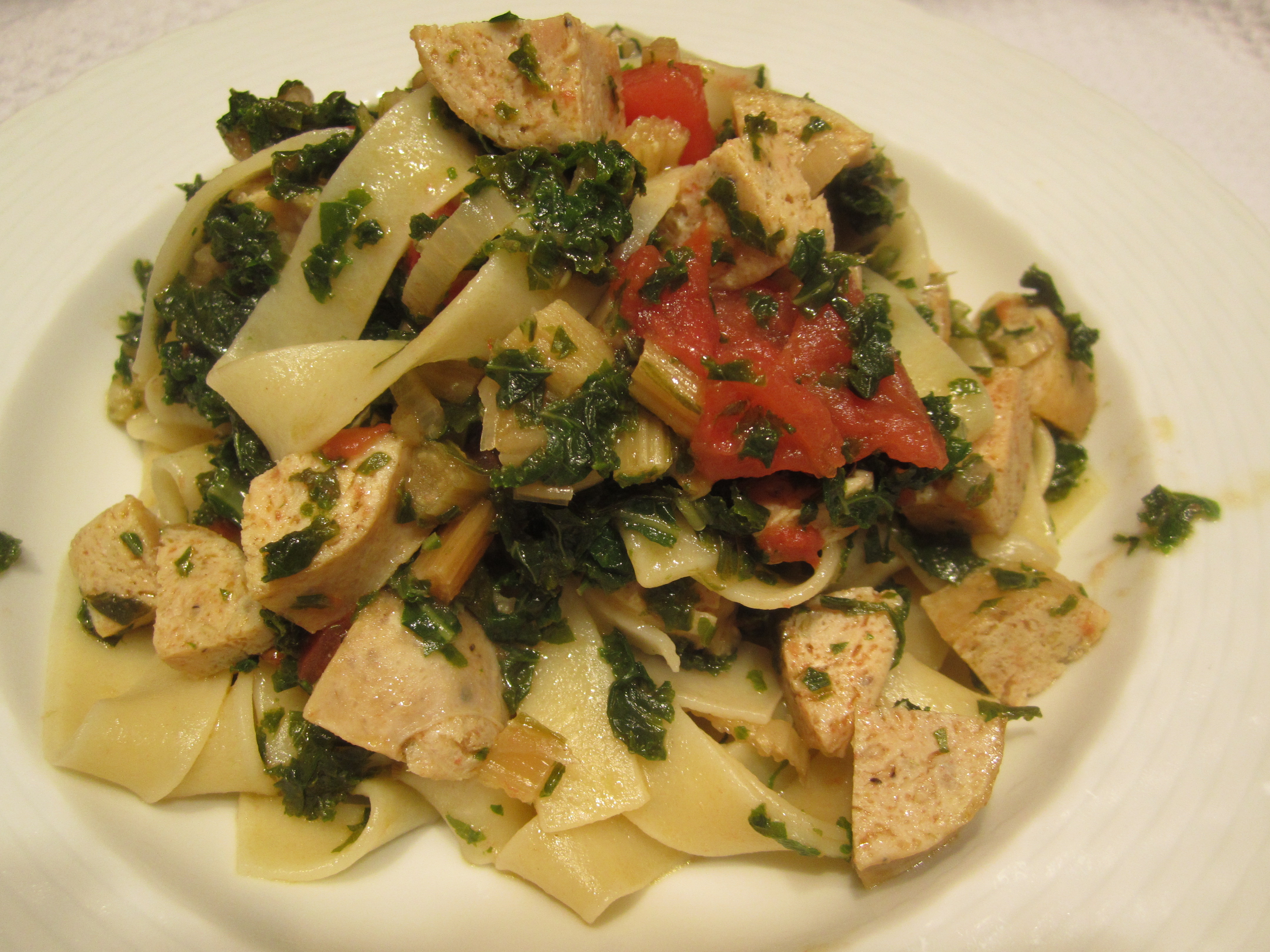
Dinner for One–Pasta with Kale, Sausage and Tomatoes

Still in the process of cleaning out my freezer for my seasonal departure from Florida.  As you may have seen in my prior post, I made a beautiful pasta based on chicken sausage and leftover swiss chard stems.

Tonight, along with one remaining piece of chicken sausage, I discovered one last bag of cooked kale in the freezer, with which I’ve made a variation on last night’s dish.

This time, I’ve added a touch of butter and nutmeg–great together and great with dark green vegetables.  The rest of this dish reads pretty much the same as last night’s post–chopped peeled tomatoes and a touch of chicken broth.  This time, I used grated parmigiano for sprinkling at the table, since it’s a better condiment with a butter-based pasta.

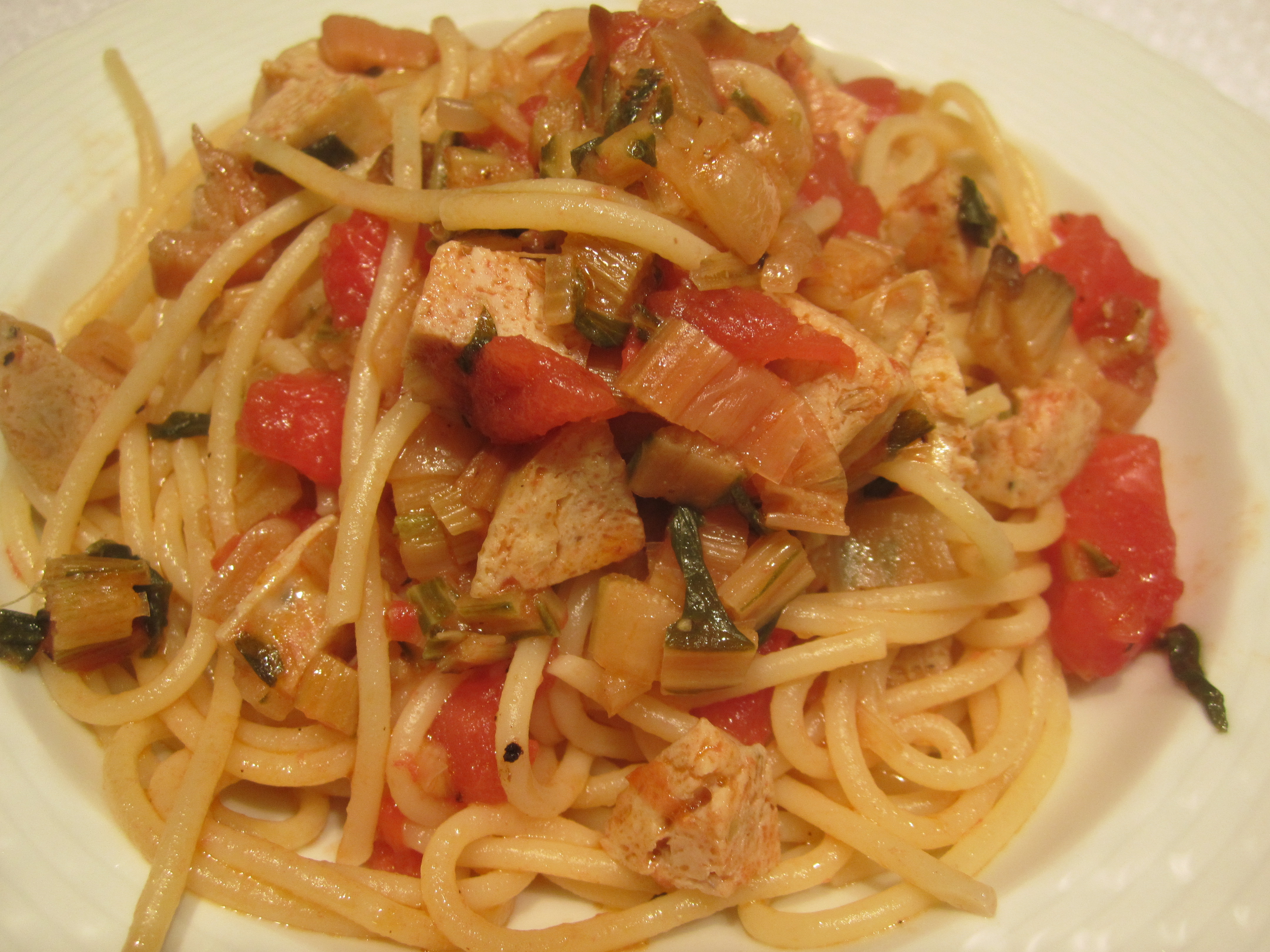
This was a great one-dish meal–vegetables, carbohydrates and protein all in one.  At the risk of sounding like a broken record, this dish was absolutely good enough to serve guests (or I wouldn’t have posted it), although I made it for one very appreciative diner–me.

Pasta with Kale, Sausage and Tomatoes

serves 1

1/4 lb fettucine or pappardelle (egg or semolina)

1 piece chicken sausage, boiled for 10 minutes, sliced into quarters lengthwise, then 1/2″ slices crosswise.

1 c blanched kale leaves (tightly packed), chopped coarsely in the food processor

1/2 a ripe tomato, peeled, seeded and chopped into 1/2″ chunks

1 tbl butter

1 tbl olive oil

1/2 c chicken broth

salt and pepper to taste

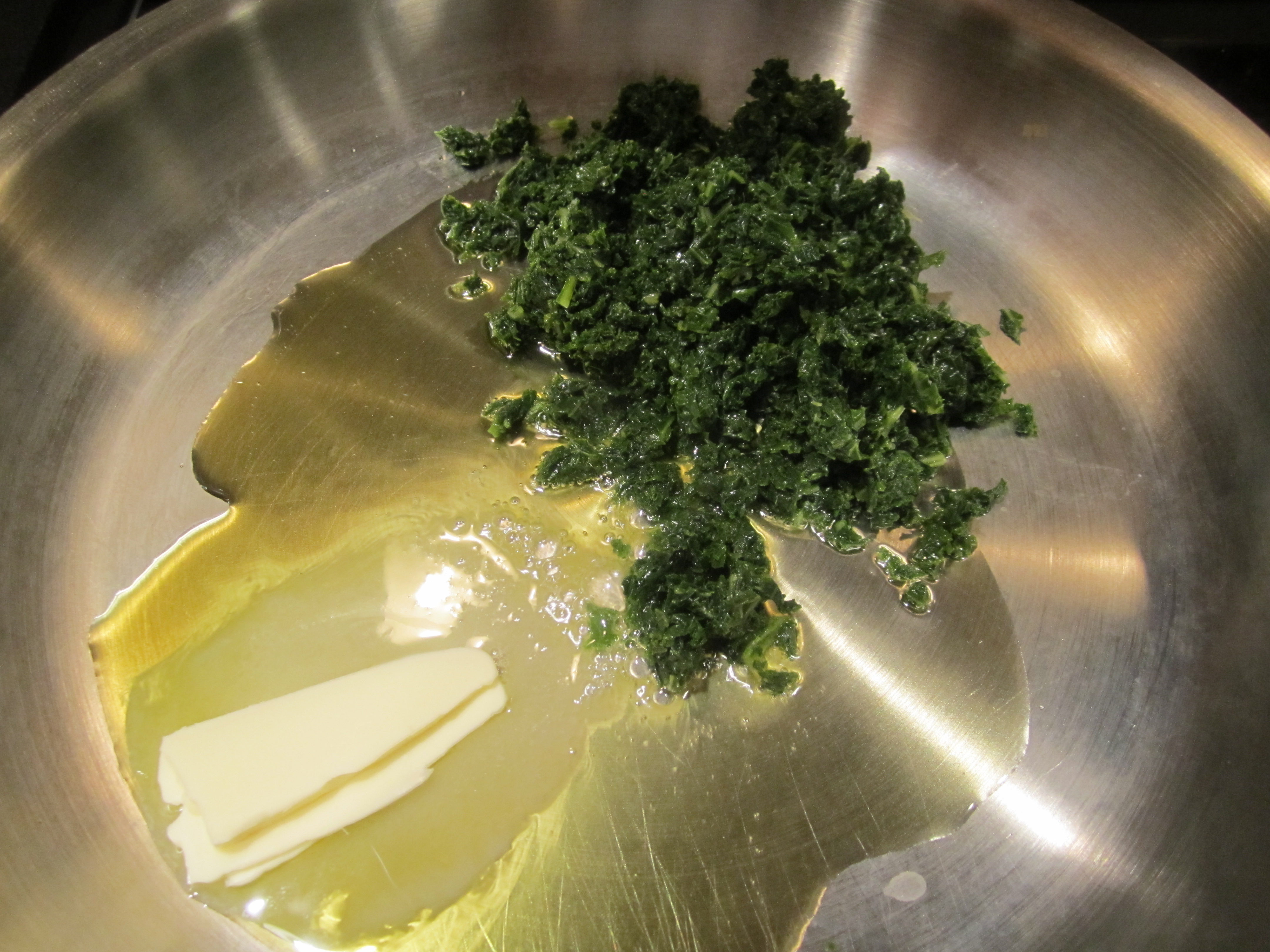
While pasta boils, in a skillet on medium heat, place kale, nutmeg, butter and oil and allow to come to heat and saute for about 3 minutes.

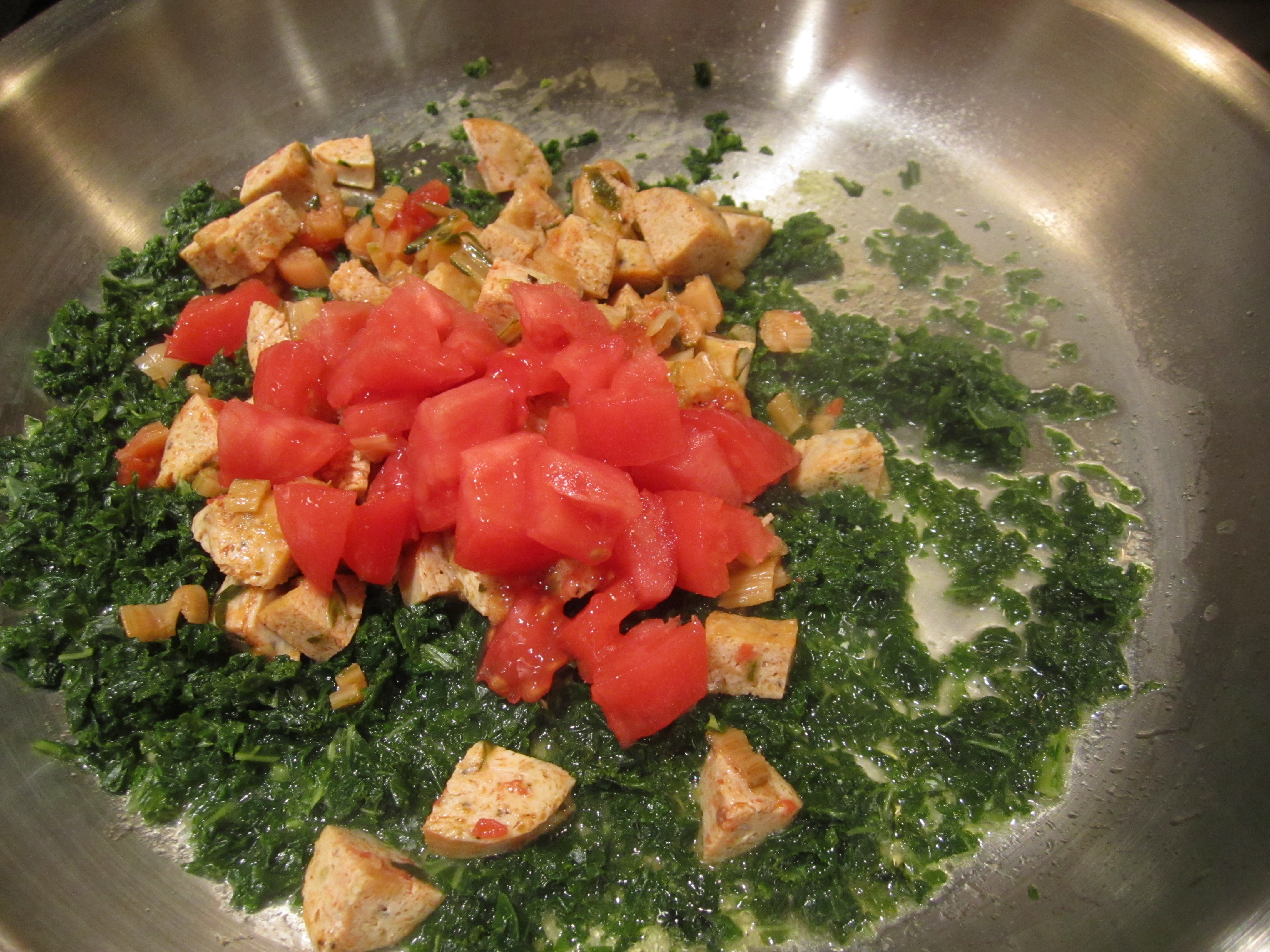
 Add chicken sausage, chopped tomato and broth.

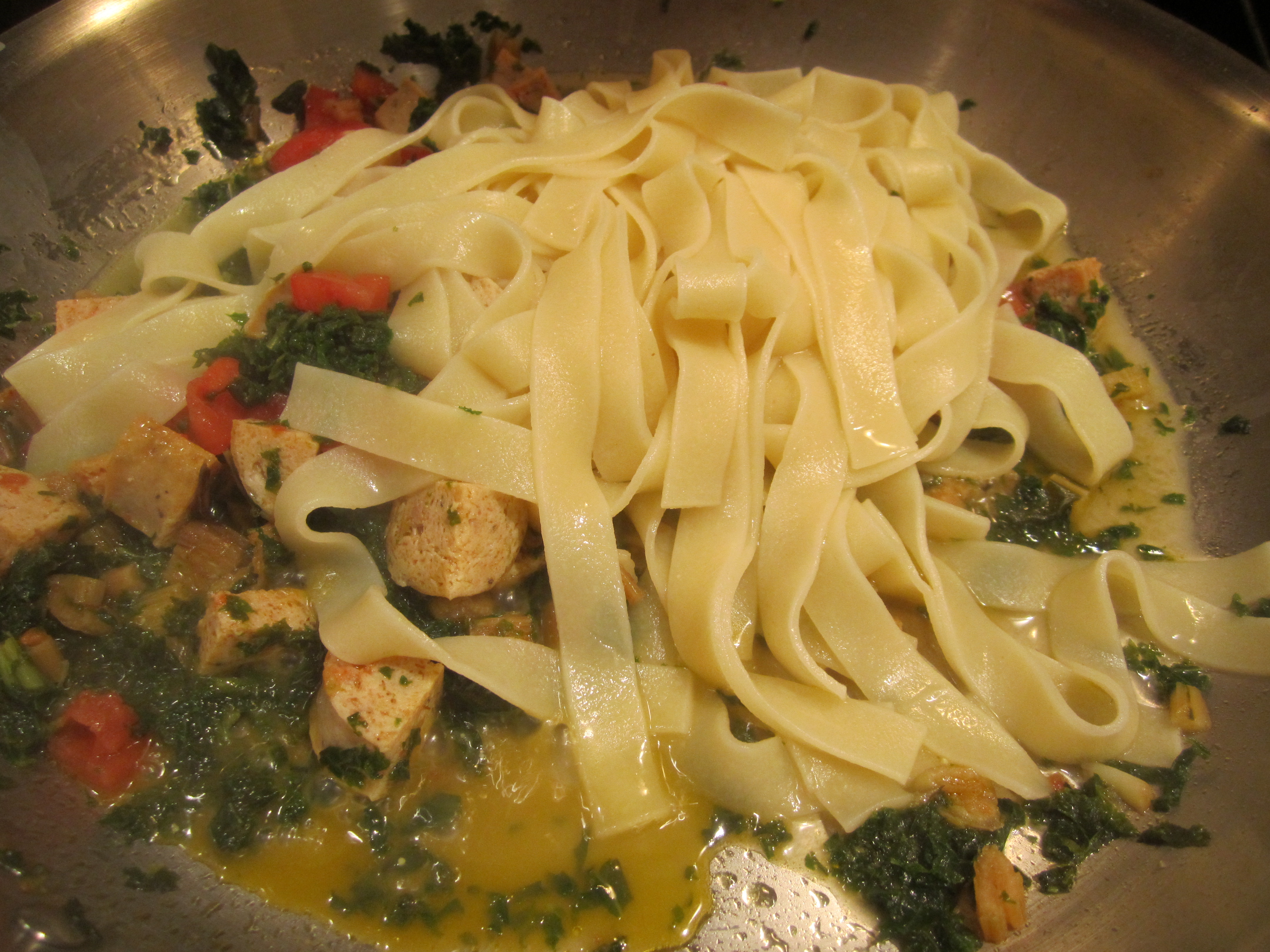
Simmer until pasta is done.  Add in cooked pasta, along with a couple of tablespoons of pasta cooking liquid.

Stir and toss to combine for about 30 seconds.  Serve with plenty of grated parmigiano.

Posted in Dinner for One, Pasta | Leave a comment

Pasta with Swiss Chard Stems and Sausage

I’ve been cleaning out my Florida freezer in preparation for my departure for the season–can’t believe three months have passed so quickly!

I had a bag of beautifully cleaned and chopped swiss chard stems from the farmers’ market one week during the winter.  I must have used the leaves in something and forgotten about the stems.

These stems are actually much more delicate than the leaves, and have none of that iron-y aftertaste that the leaves sometimes do.  Normally, I would make a frittata with these, but tonight I’m in the mood for pasta.

I also had some cooked chicken sausage in the freezer.  When I buy it, I immediately boil it and freeze it, then occasionally slice up a link and add it to some pasta or stew.  Add to that a ripe Florida tomato and some shallots, and I had a dish that I would definitely serve to guests.

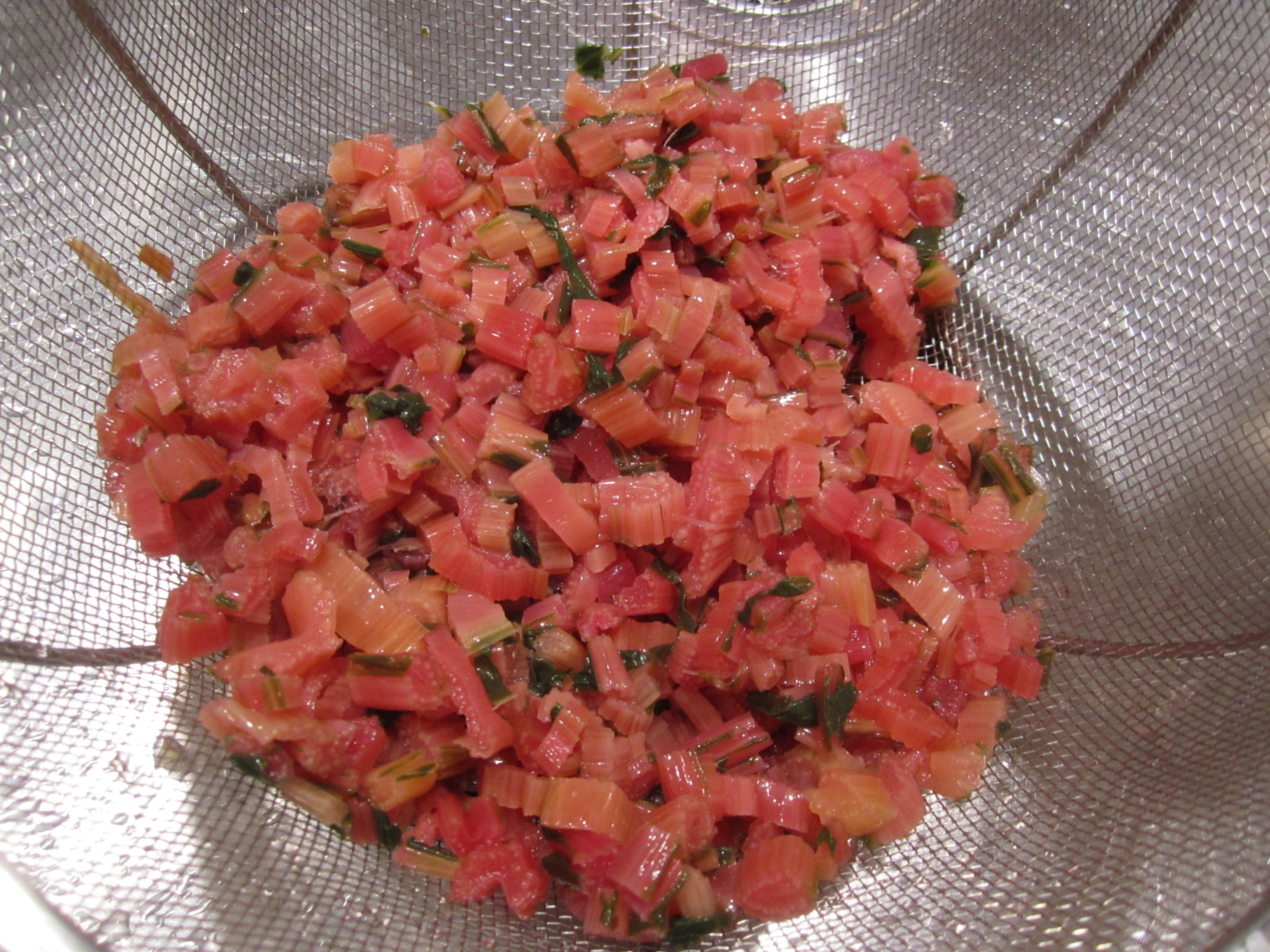
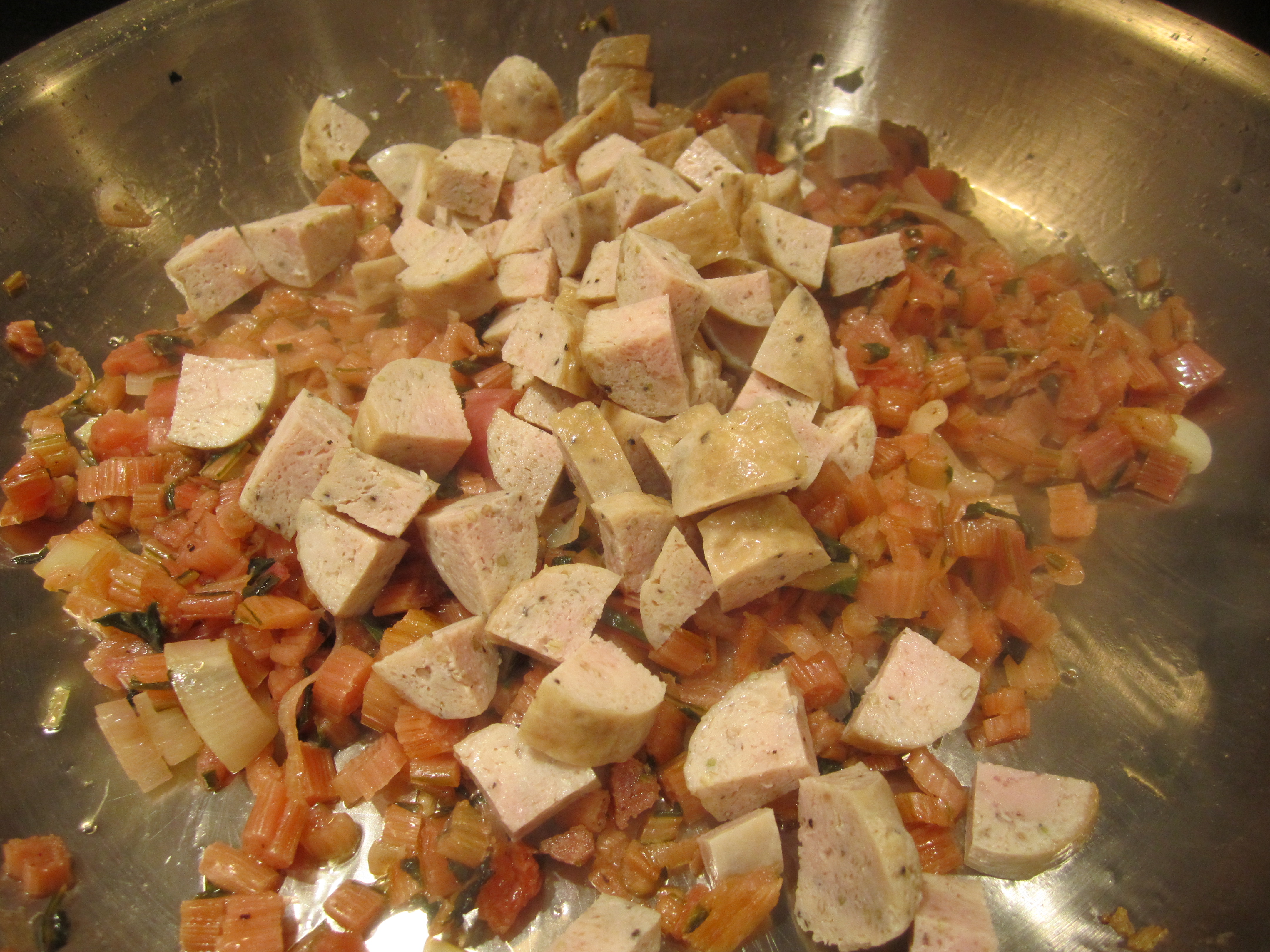
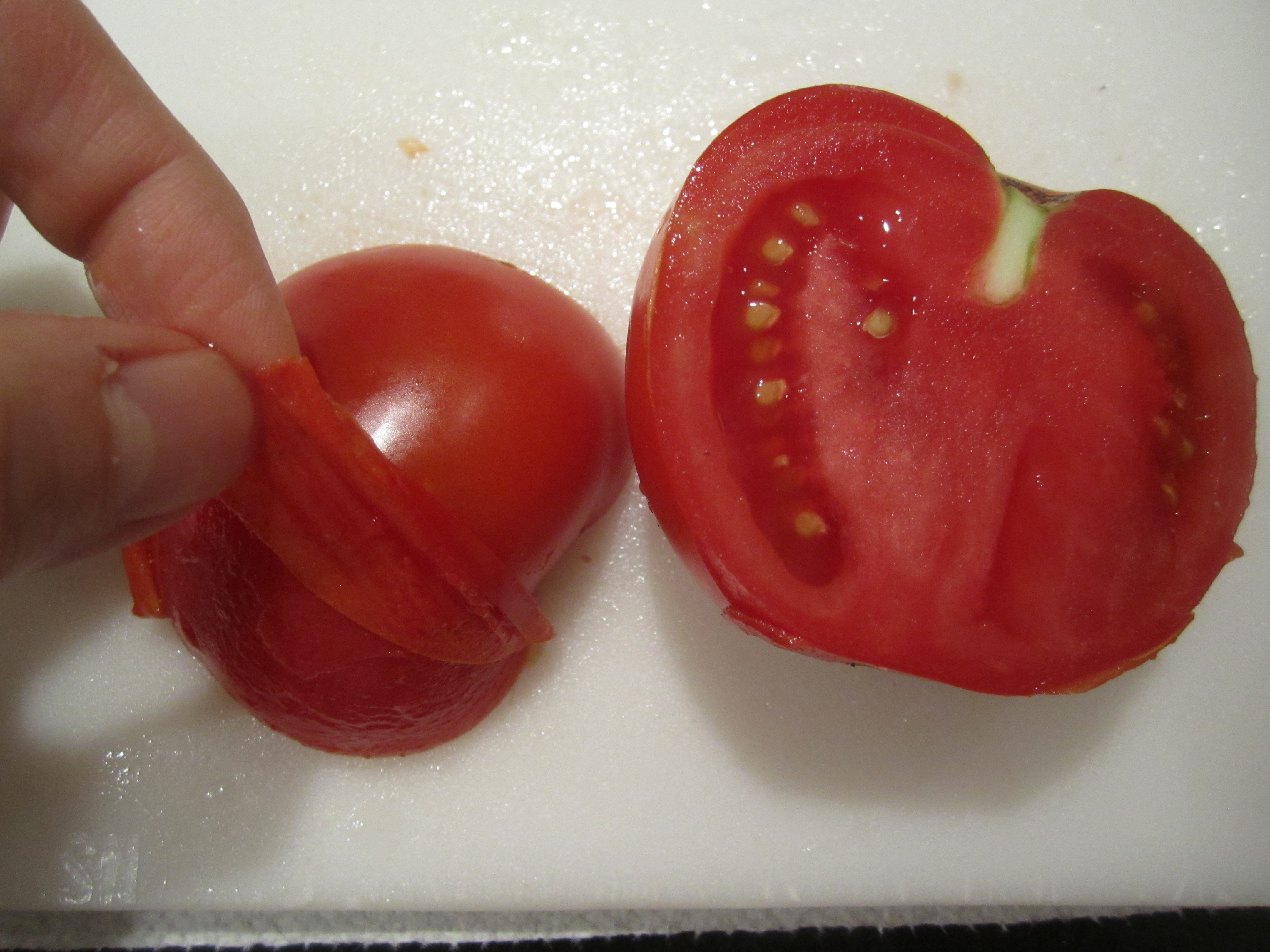
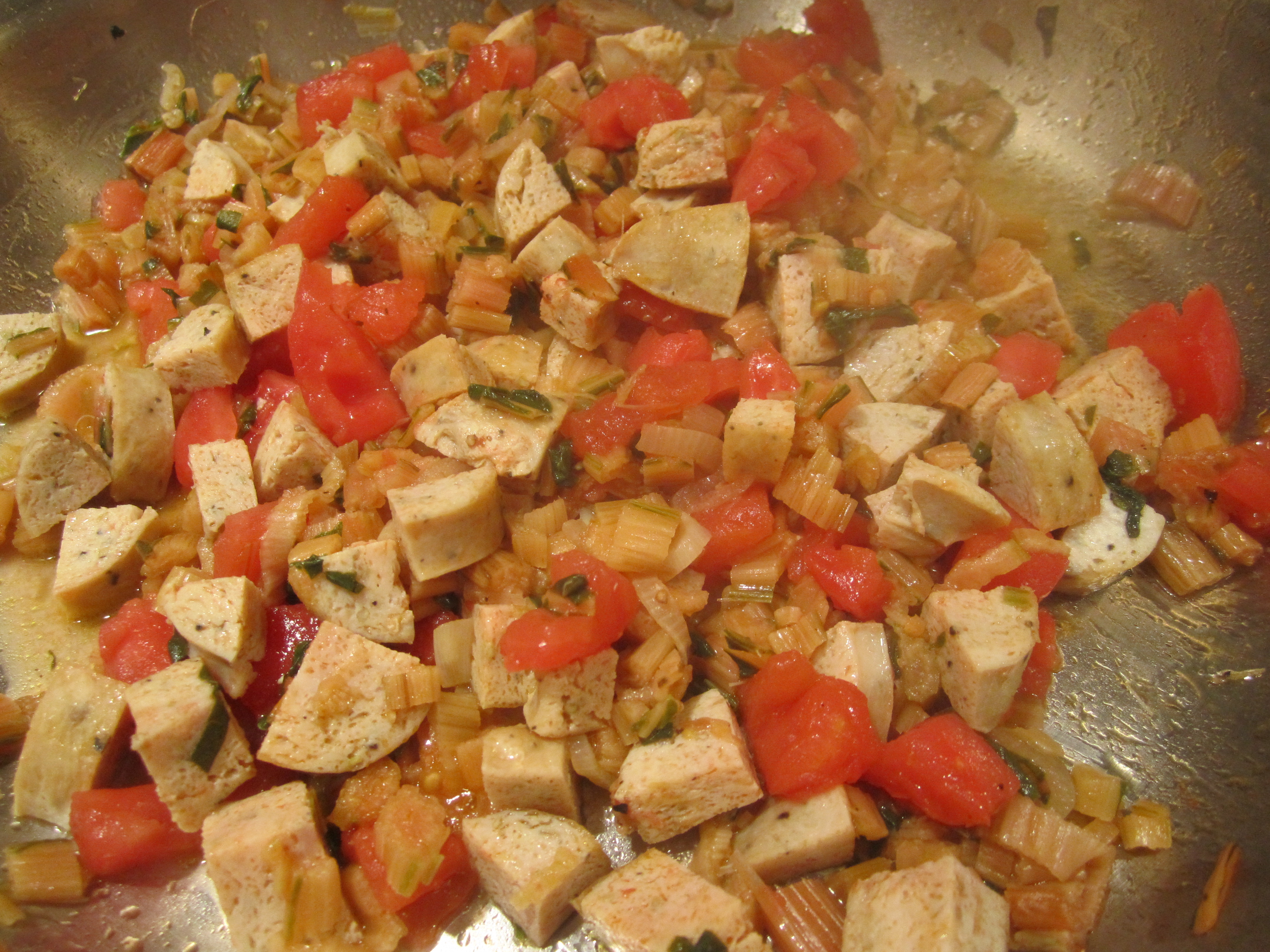
The swiss chard stems (already par-boiled before I froze them) get drained and sauteed with the shallot for a good while, until they begin to caramelize–about 10 minutes.  They take on a wonderfully nutty flavor at this point.  The pre-cooked chicken sausage pieces then get added to heat them (no need to sear them in oil–they’re dry enough already).  The tomato gets dipped in boiling water, then peeled and diced.  All is brought together with a bit of chicken stock and some raw extra-virgin olive oil drizzled on top.

I’m not exaggerating when I tell you that this dish makes an absolute superstar out of the stems–after you try this, you’ll never discard them again.

Pasta with Swiss Chard Stems and Sausage

serves 4

1 lb. spaghetti

stems from 2 lbs. swiss chard, chopped into 1/2″ pieces, blanched for 5 minutes

2 medium shallots

2 ripe tomatoes

1/2 c chicken broth

4 tbls olive oil

salt and pepper to taste

grated pecorino romano for sprinkling

Allow swiss chard stems to drain in a strainer, then squeeze lightly to remove extra water.  In a broad skillet, saute the shallots in 3 tablespoons of oil for about 2 minutes.  Add swiss chard stems and saute on medium heat for about 10 minutes, or until slightly caramelized.

Add in the pieces of diced chicken sausage as well as the broth, and reduce heat.

Dip tomato in boiling water for about 20 seconds.  Remove and peel.

Dice into 1/2″ cubes and add to skillet.

Simmer mixture in skillet on low heat until pasta is cooked.

Add pasta, along with 1/2 cup cooking liquid.  Toss and saute for a minute to incorporate.  Turn off heat and drizzle with remaining tablespoon olive oil.  Add salt and black pepper and serve with plenty of grated pecorino romano.
Posted in Pasta | Leave a comment

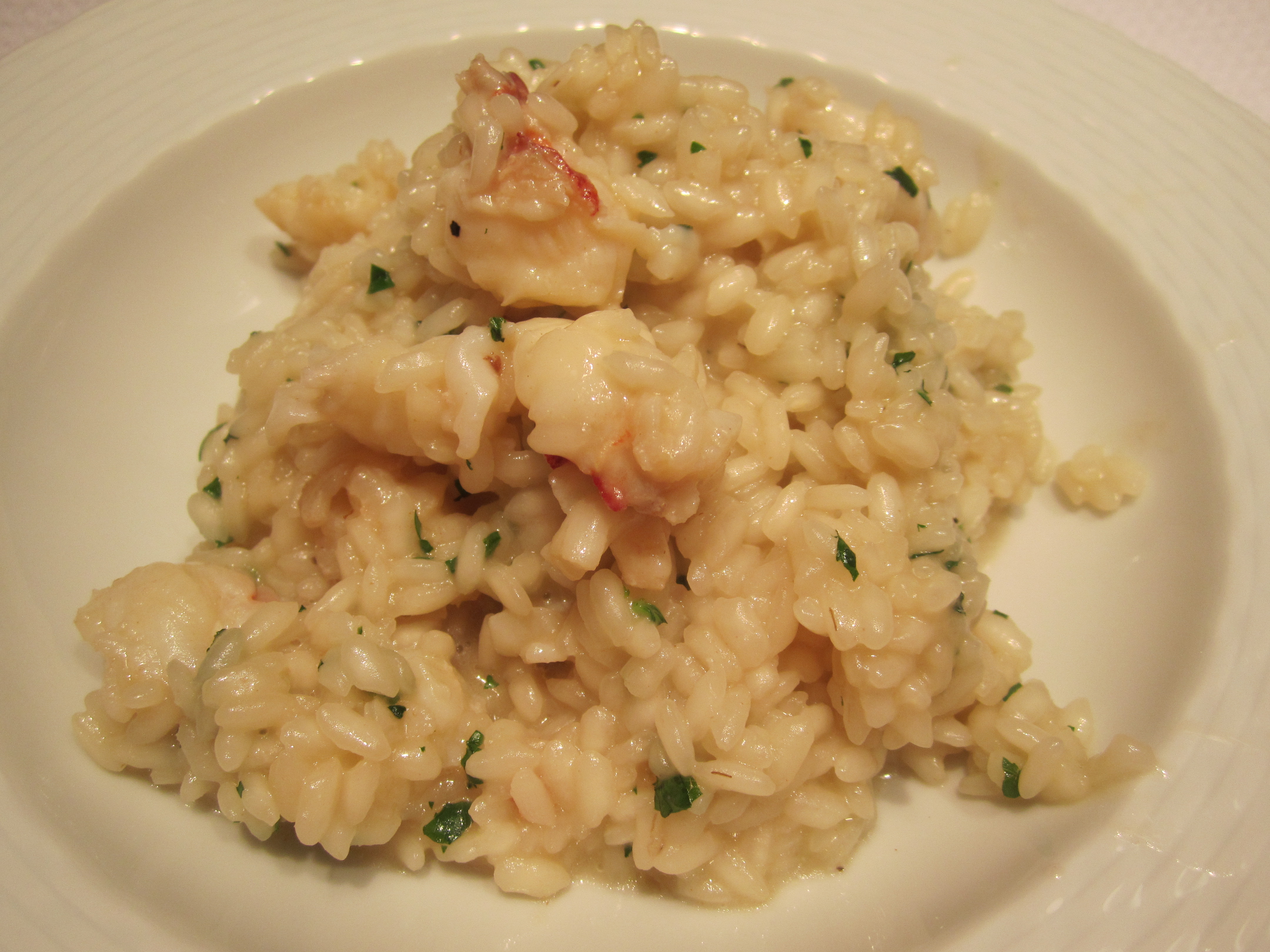
Lobster Risotto

This isn’t radically different from my other risotti, but I thought I’d share it with you for a couple of reasons.
Although I’m in south Florida, fresh, local seafood has been a bit elusive for me.  The best seafood vendor is at my farmers’ market on Saturdays.  There is another local seafood vendor, but the two times I walked in, I didn’t like the fishy odor and I didn’t like the looks of most of the merchandise (dried out around the edges or slimy-looking).  Therefore,  if I want to make seafood any day of the week other than Saturday, I’ve found that the next best source in town is my local Publix Supermarket  (please–continue reading!).

At home on Long Island, I would have thought it a sacrilege to buy frozen seafood imported from some other part of the world, since we have great locally caught fish and scallops twelve months a year.  Here in South Florida, however, I’ve been pleasantly surprised with the results of some imported, previously frozen seafood.

First of all, most people in the food community are well aware that most of the shrimp we buy, even in fine seafood markets, has been previously frozen–which is a good thing.  The shrimp is frozen right on the boat, fresh out of the sea.  It stays frozen until you buy and thaw it (or your fish market thaws it prior to selling it).  This assures you that whenever you buy shrimp, it has been frozen at the height of freshness, and if your fish monger thaws them (and sells out of them) daily, you’re always eating great, fresh shrimp.

Apparently, the same goes for lobster tails.  As much as I’ve always eschewed buying seafood at a supermarket, I’ve gotten to know the fish mongers at Publix, and they are meticulous about same-day thawing and selling of all previously frozen seafood.  They assured me that the seafood is expertly transported from boat to freezer truck and has never seen any temperature above freezing since it was caught.

I was skeptical.  The tails are labeled by country of origin (Canada, in this case) and the label has the date of thaw on it (today).  Still skeptical, I asked to look at them up close and smell them.  The fish men smiled and proudly offered me a tail on a piece of butcher paper to examine in my own hands.  Deep green, not slimy in the least, and sweet-smelling.  Not exactly the Long Island or Maine lobster I’m used to buying, but not bad.  These would make a great, easy but impressive risotto, and the shells would make a great stock.

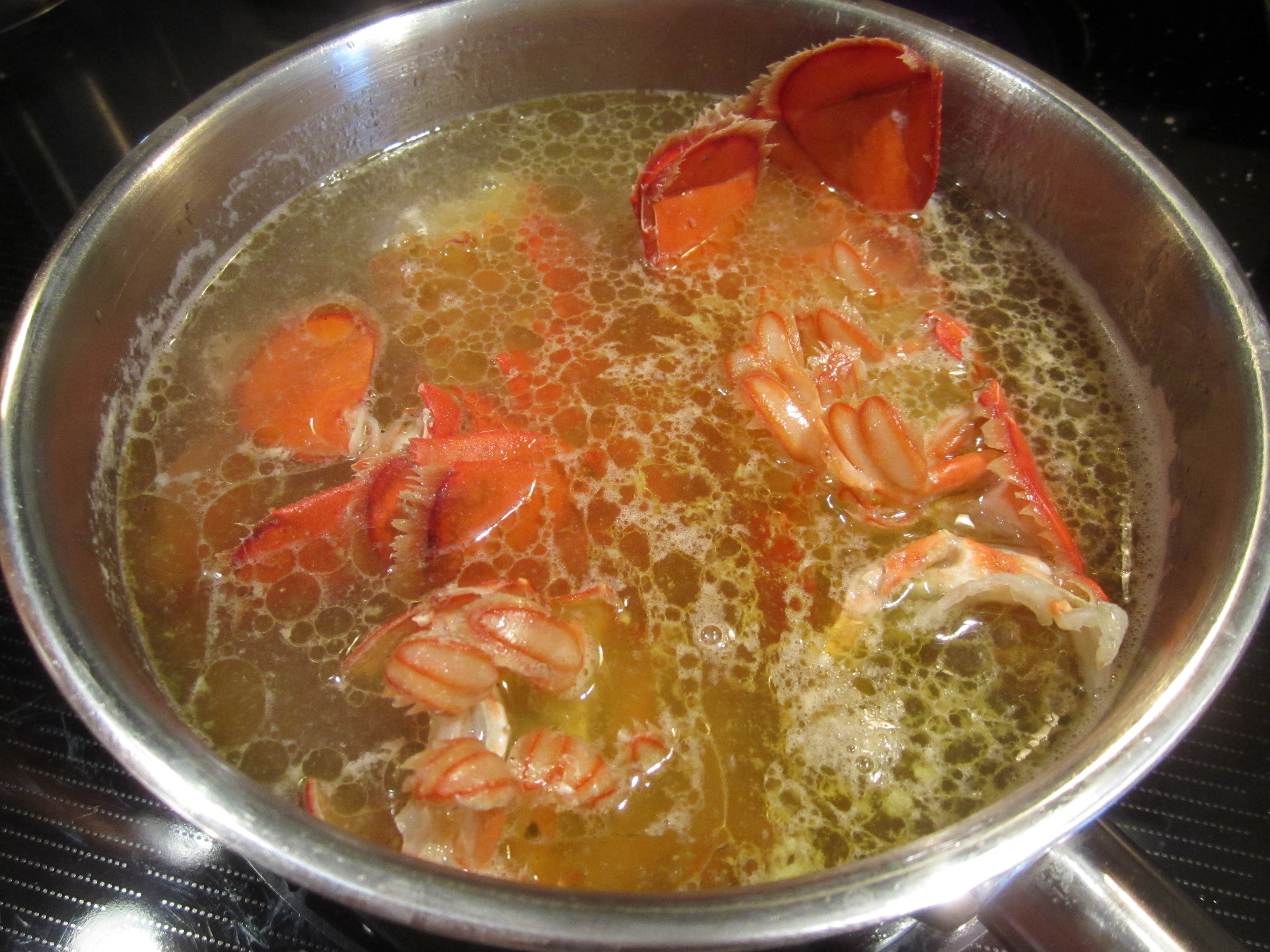
I made the stock for this risotto with the frozen drippings from a huge batch of Roast Chicken Breasts with Rosemary and Lemon, simmered with the shells of my lobster tails.  This combination made a truly memorable stock, that I could have eaten in a bowl by itself.  The chicken drippings were so concentrated, they maintained their rich, deep flavor, even diluted with water.  The lobster shells further perfumed the broth with subtle, briny flavor.

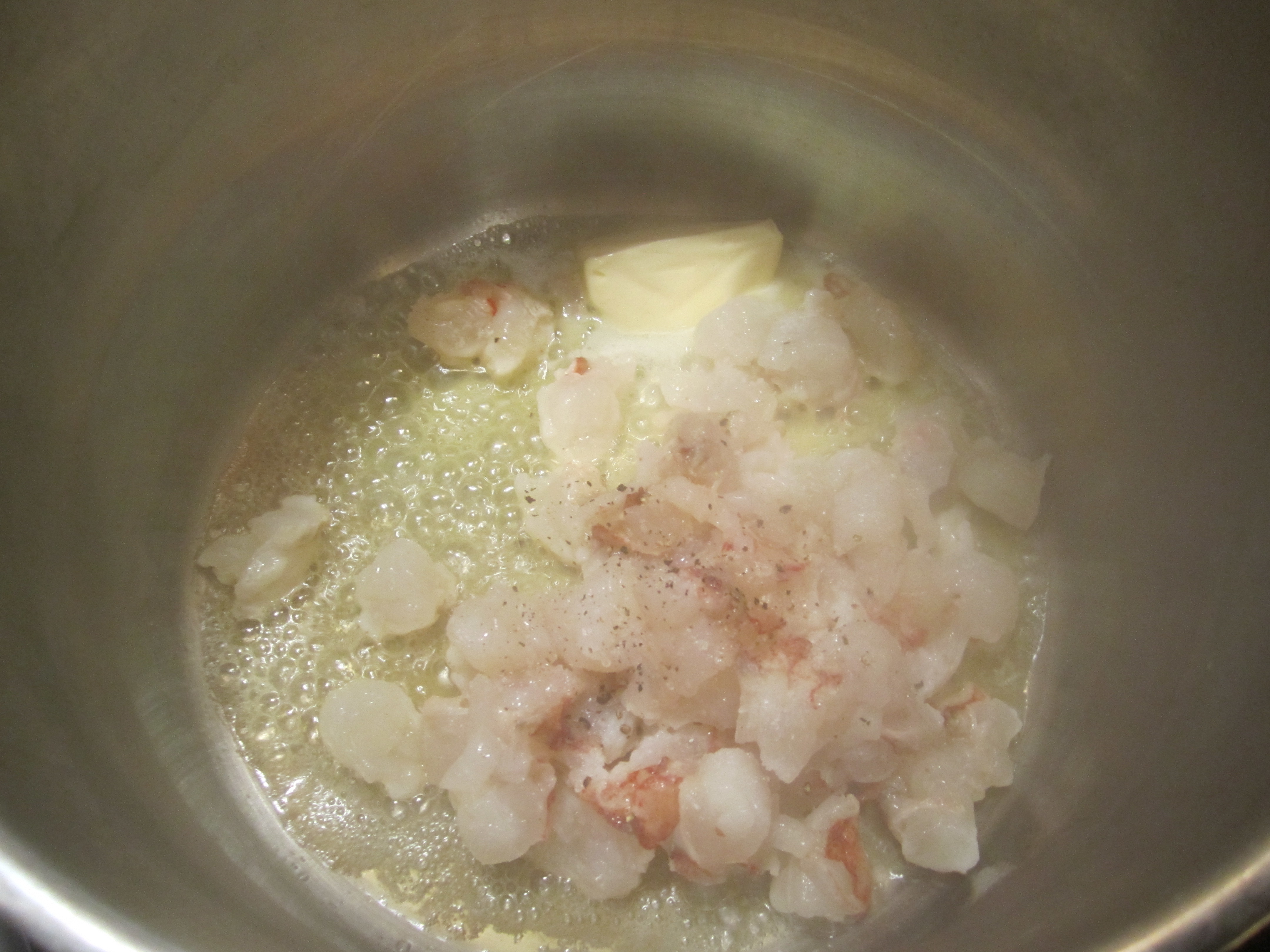
The lobster tails were removed from their shells, coarsely diced, then sauteed in butter.  The meat was then set aside and added back to the risotto at the last moment.  It was good enough to serve guests as a main course, and great right from the fridge the next day.

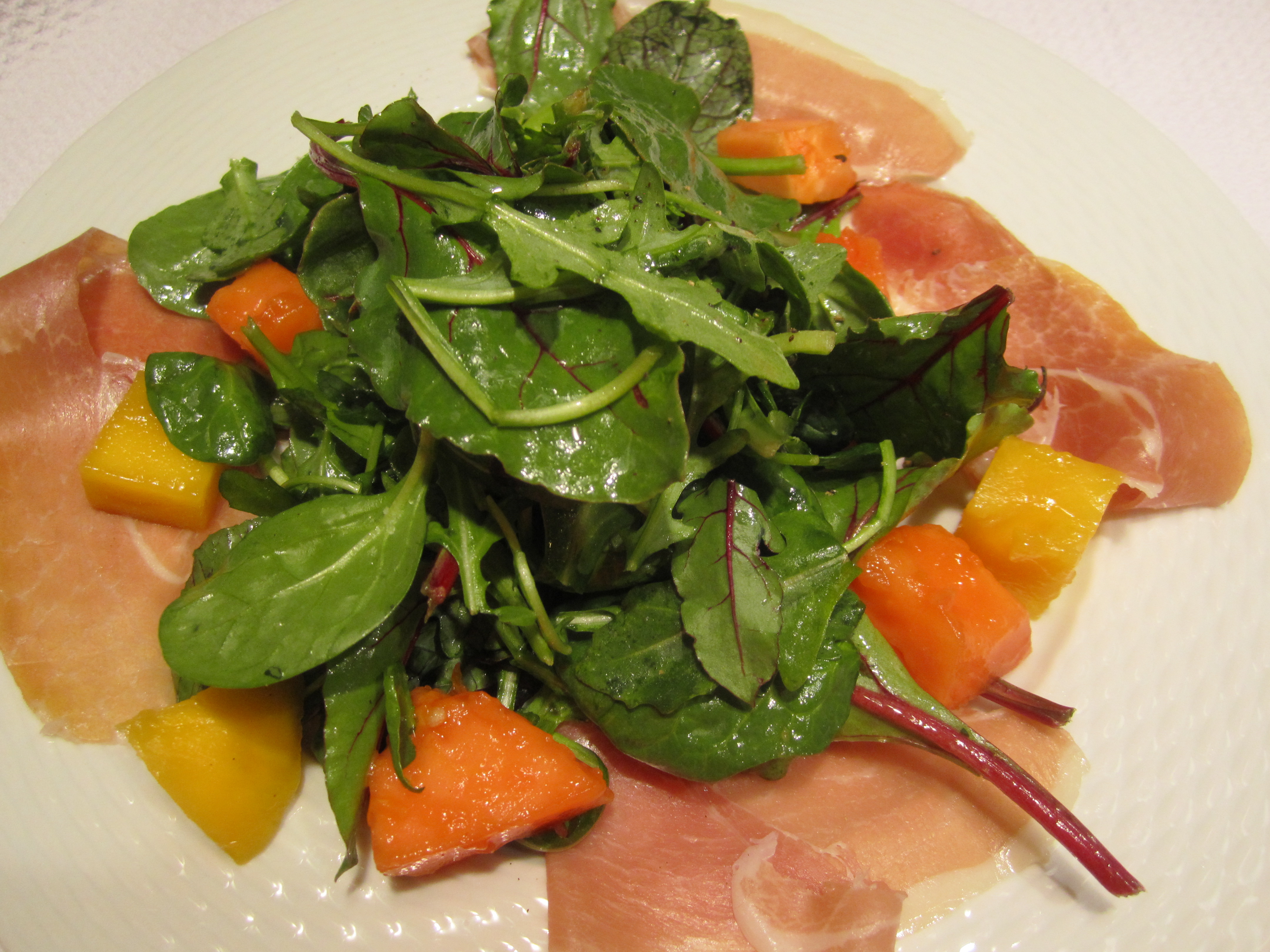
As an antipasto, we had my Florida take on prosciutto e melone–thinly sliced prosciutto, baby greens dressed with lemon and olive oil, and chunks of ripe mango and papaya–sweet, salty, tropical–and beautiful.

Lobster Risotto

serves 6

6 lobster tails with shells

2 medium shallots

6 tbls butter

1 1/2 lbs arborio rice

10 – 12 c chicken broth (or appoximately 3 cups strained chicken drippings with water and some salt added to make 10 – 12 cups)

1 c white wine

2 tbls parsley

salt and pepper to taste

Remove lobster from shells and dice into 1″ chunks.  Place lobster shells in pot of broth and bring to a simmer.

Gently boil for about 45 minutes.

In heavy-bottomed pot, melt 4 tablespoons butter and add lobster meat, along with a sprinkle of salt and pepper.

Saute on high heat for about 3 or 4 minutes, until just cooked through (cook just until translucency is gone–do not overcook).  Taste for salt and pepper.  Sprinkle with a tablespoon of parsley and set aside.

In the same pot, on medium-high heat, add remaining butter and shallots and saute for a minute.  Add rice and saute for about 4 or 5 minutes, until it begins to crackle and turns slightly translucent.  Add the wine and reduce for a minute.

Set your kitchen timer to 15 minutes.

Begin adding simmering broth to the rice and stirring until the broth has been incorporated–rice should be perking agressively the entire time.  Keep adding broth until the timer goes off.  You should still have broth left–if you run out, just heat up some water and add a bit of salt to it, if necessary.

At 15 minutes,  sprinkle with remaining parsley, toss in lobster meat, remove from heat and cover for exactly 5 minutes.  You’ll have perfectly cooked al dente risotto that must be served immediately, or it will loose its bite.  If the risotto is too tight (I like it soupy), add more broth or water and stir.

Serve with plenty of grated parmigiano (despite the Italian prohibition on seafood and cheese!)

Posted in Risotti | Leave a comment